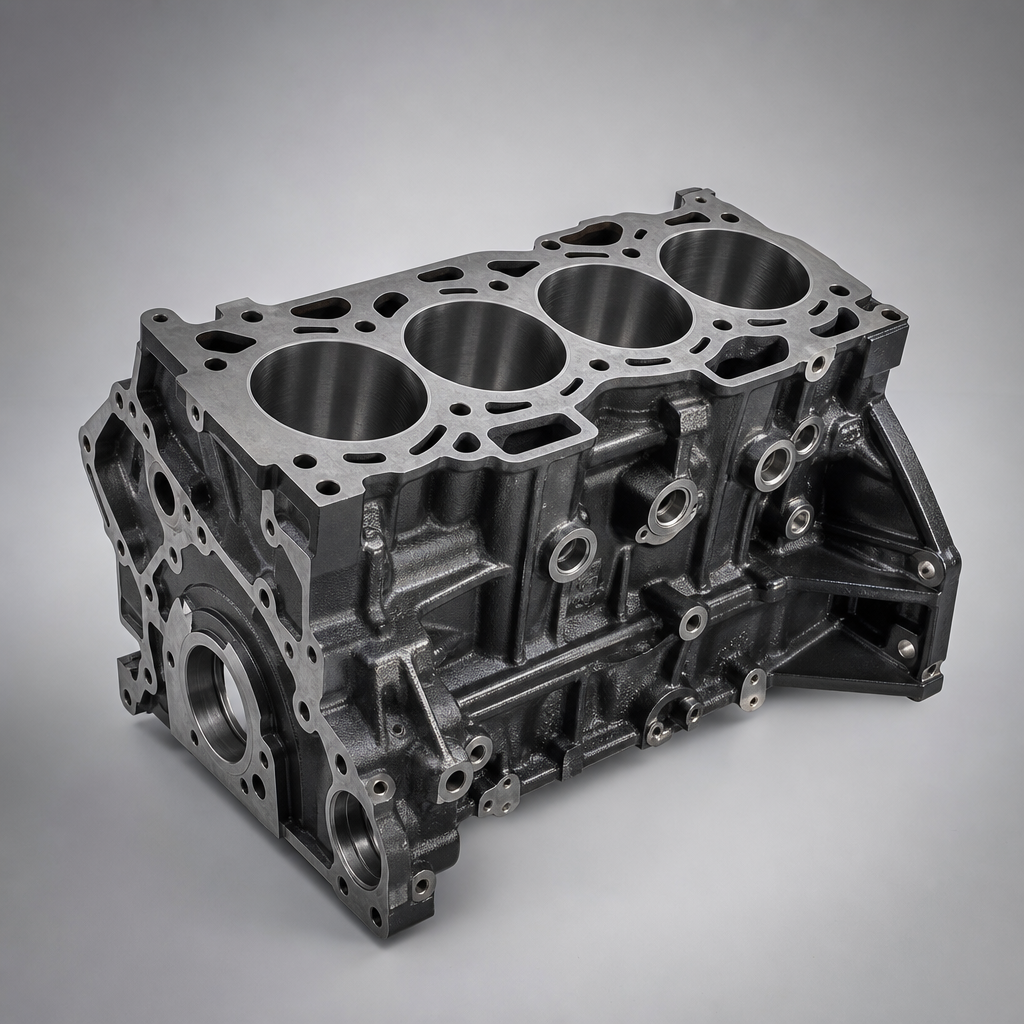
Cylinder Head Porsche Manufacturer China: B2B Sourcing
Sourcing a Porsche-fitment cylinder head from China is not mainly a price exercise. It is a decision about failure risk. If casting quality drifts, if valve seat geometry moves, or if pressure integrity is inconsistent, the cost shows up later as rebuild delays, returns, and warranty claims.
That is why buyers evaluating a cylinder head Porsche manufacturer China option usually start with hard questions, not catalog claims. Can the factory hold repeatable tolerances over multiple batches? Is machining done in-house on critical features? Are leak tests run on every finished head? Can the supplier trace one shipment back to alloy batch, machining lot, and inspection record?
The useful numbers are specific. Deck flatness is often controlled around 0.03-0.05 mm. Valve guide bore tolerance may sit within 0.01-0.02 mm, depending on design. Gasket-face roughness commonly falls near Ra 1.6-3.2 um. A credible supplier should also define its pressure-test method in actual terms: pressure level, hold time, medium, and pass/fail rule.
This article approaches the topic from several angles: how to screen suppliers early, where sourcing programmes usually fail, which specs deserve extra scrutiny, and how procurement teams should compare risk across quotes. Driventus is an independent aftermarket manufacturer; brand names are referenced for fitment only.
Start With The Decision Filter, Not The Quote
The first pass should answer one question: is this supplier even a viable candidate for a high-consequence engine component? If the answer is unclear, detailed price negotiation is premature.
A disciplined screen usually follows this order: casting source, machining control, inspection discipline, then commercial terms. Cheap pricing has little value when porosity, seat runout, or transit damage turns stock into claims.
Use this early filter:
Business system: certification to IATF 16949:2016 and ISO 9001:2015
Material control: aluminium alloy grade verification, melt traceability, and batch records; buyers commonly request chemical composition reports for alloys such as A356 or equivalent casting grades where applicable
Casting source: whether raw heads come from a stable long-term foundry partner or from opportunistic spot buying
Machining scope: CNC capability for deck face, cam bores, valve seats, guide bores, threaded holes, and other critical features
Inspection tools: CMM, pressure-test benches, hardness testing, surface roughness measurement, and air gauges where applicable
Process control: control plans, in-process checks, final inspection records, and lot traceability
Export readiness: pallet specification, corrosion protection, carton durability, and shipping label control
One point buyers often miss: ask whether the manufacturer is producing from its own validated drawings, from customer drawings, or from a reverse-engineered sample. That single distinction affects timing, dimensional responsibility, and claims handling later. Drawing-based programmes usually move faster. Reverse-engineered programmes tend to need extra measurement, fixture validation, and application review before approval is meaningful.
At RFQ stage, require the supplier to name the 10-15 critical characteristics it controls on every batch. For cylinder heads, that usually includes deck flatness, total head height, valve seat concentricity, valve guide bore size, cam bore alignment, spark plug or injector thread quality, and pressure integrity. A capable factory should attach actual control targets, not generic statements, such as flatness within 0.05 mm, seat runout within 0.03-0.05 mm, and guide bore size held to drawing tolerance with gauge records.
For procurement teams covering several engine component categories, it is useful to review the supplier's broader manufacturing base through our catalog and the related engine components range. That helps determine whether cylinder heads can be sourced alongside gaskets, valves, cam followers, or other engine parts under one programme.
Benchmark The Programme Before You Negotiate It
Cylinder head sourcing does not behave like sourcing a small turned part. Foundry scheduling, casting inventory, machining time, cleaning, and leak testing all influence MOQ and lead time.
Sourcing factor
Typical B2B expectation
Why it matters
MOQ per reference
50-200 pcs
Balances casting efficiency with warehouse flexibility
Trial or pilot order
10-30 pcs where agreed
Useful for dimensional validation, market testing, and packaging checks before full release
Sample lead time
30-45 days
Covers casting readiness, machining, inspection, and validation
Mass production lead time
45-75 days
Depends on raw casting availability, machining capacity, and queue time
Replenishment with semi-finished stock
25-40 days
Possible when raw castings or rough-machined bodies are already held
Dimensional inspection submission
100% key dimensions on first samples
Supports buyer approval and drawing comparison
Pressure test
100% final test
Confirms coolant and oil passage integrity
Traceability
Heat/batch + production lot
Supports root-cause containment
Packaging
Individual protection + export pallet
Reduces transit damage on machined faces
</tr></thead><tbody> </tbody></table>These are not fixed rules. They are working benchmarks. Low-volume performance references often come with higher MOQ than buyers first expect because the economics sit upstream in melt volume, tooling use, and casting yield.
Separate the quote into three cost layers:
Casting and machining unit price: the base ex-works or FOB part price
Tooling or fixture amortisation: pattern, machining fixture, leak-test fixture, or seat/guide installation tooling if new development is required
One-time validation cost: first-article inspection, sectioning, third-party lab test, or custom packaging trial when requested
In practice, lower unit pricing usually appears only when annual demand is enough to spread setup and foundry cost across at least 200-500 pcs per year per reference. Below 100 pcs annually, suppliers often protect margin through a higher MOQ, a setup surcharge, or a replenishment cycle tied to grouped casting runs.
Two commercial questions matter more than they seem. First: does the factory hold semi-finished stock? Second: what happens during peak shipping periods? Semi-finished inventory can cut lead time sharply. Port and container pressure can add delay even when production is complete.
A useful negotiation model compares three order patterns: initial SOP order, steady replenishment, and urgent top-up. The same supplier may offer one price at 50 pcs, a better break at 100 pcs, and a shorter lead time only if the buyer agrees to buffer stock or blanket scheduling. That trade-off is usually more valuable than pushing for a nominal unit discount with no production commitment behind it.
Read The Spec Sheet Like A Failure-Mode Map
A cylinder head should be reviewed by what can go wrong in service, not by how many inspection points appear on a checklist. The important question is whether the supplier controls the dimensions and process steps that affect sealing, combustion stability, oil control, and mechanical durability.
Critical checkpoints
Deck flatness: controlled to drawing specification after final machining; many programmes target 0.03-0.05 mm maximum across the full gasket face
Valve seat concentricity: critical for sealing, heat transfer, and combustion stability; a practical review point is whether the supplier can hold seat runout within 0.03-0.05 mm
Valve guide bore size: affects oil control, stem wear, and service life; tolerance is often controlled within 0.01-0.02 mm depending on design and installed guide material
Camshaft bore alignment: essential on OHC designs to prevent abnormal friction or binding; buyers should ask for alignment method and gauge frequency
Surface roughness at gasket faces: should match head gasket sealing requirements; common acceptance windows are around Ra 1.6-3.2 um unless the drawing calls for a tighter finish
Thread accuracy: spark plug, manifold, and fastener threads must pass gauge control; ask whether the supplier uses 100% go/no-go checks on critical threads
Pressure testing: checks for leakage through coolant jackets, oil passages, or casting defects; typical factory settings are around 3-5 bar with a 30-120 second hold time, depending on fixture and design
Installed component retention: valve seats and guides should meet interference-fit requirements after machining and cleaning; buyers should ask for actual interference range in mm and installation temperature process
Porosity control deserves special attention. A supplier may produce an acceptable first sample yet still carry unstable casting quality across later lots. Ask how porosity risk is contained: incoming casting inspection, defined machining stock allowance, pressure testing after final machining, and non-destructive inspection where needed. For higher-risk references, pilot-batch X-ray or penetrant inspection can establish a baseline before serial production settles into normal controls.
Process detail matters. A mature route typically looks like this: incoming casting ID check, rough machining, seat and guide bore machining, cleaning, seat/guide installation, finish machining, thread processing, deburring, washing, pressure testing, dimensional audit, rust-preventive packing, and final lot label issue. If the supplier cannot explain the route clearly, the process is usually not mature enough yet.
Some programmes also justify hardness checks, chemical composition reports, or metallographic review to confirm alloy stability and heat-treatment consistency. Those controls matter more in high-thermal-load applications, long service-interval markets, or channels with low warranty tolerance.
Buyers serving regulated markets should also verify chemical compliance and supporting records. Material and process inputs should align with REACH (EC) No 1907/2006 where applicable. If the cylinder head is used in an engine rebuild for emissions-regulated vehicles, downstream assembly performance may also affect compliance expectations tied to vehicle-level rules such as ECE R-83 in legacy EU contexts.
For an overview of process discipline, audit documents, and inspection flow, see our quality system.
Audit The Factory By Following One Part End To End
A useful factory audit is physical. It should move with the part, not stay in a conference room.
The objective is simple: verify that the records shown during the audit match what happens on the shop floor. Buyers need to see castings move through machining, cleaning, inspection, and packing, and they need to see how nonconforming product is handled when something fails.
Useful audit questions include:
1. What percentage of production is made with in-house machining versus outsourced operations? 2. Which dimensions are classified as special or critical characteristics? 3. Are valve seats and guides installed in-house, and how is interference fit controlled and recorded? 4. Is every finished head pressure tested, or only sampled by batch? 5. How are rejected castings segregated, identified, and recorded? 6. Can the factory provide first-article reports, control plans, and material certificates per lot? 7. What is the complaint response time for dimensional, leakage, or packaging claims? 8. Which gauges and fixtures are dedicated to this product family, and how often are they calibrated?
Evidence to request
First sample inspection report
Pressure test record format showing test pressure, hold time, and pass/fail criteria
Packing specification with pallet count and net/gross weight
Process flow chart and control plan
Certification copies for IATF 16949:2016 and ISO 9001:2015
Recent calibration records for CMM, gauges, and pressure equipment
Nonconformance record examples and corrective action format
Batch traceability example linking casting heat number, machining lot, inspection record, and shipment label
Walk one live part through the full trace chain. Start with the casting mark or barcode. Then check the routing card, machine process sheet, in-process inspection result, leak-test record, final packing label, and carton or pallet ID. If traceability breaks at any point, containment during a claim becomes slower and more expensive.
During the audit, watch for floor-level warning signs: mixed lots, weak status labelling, manual rework with no defined rule, poor chip control after machining, or packing zones too close to dirty operations. Those details often predict future drift better than a polished presentation.
Also ask for actual reaction timing. A capable supplier should define something like 24-48 hours for initial complaint acknowledgment, 72 hours for containment feedback, and 7-10 working days for a formal 8D or corrective action report, depending on claim complexity. That matters because cylinder head claims can disrupt full engine rebuild schedules.
If your programme requires private labelling, exclusive machining features, or bespoke packaging, address those during audit rather than after nomination. Projects with customer-specific drawings or branding controls typically need a more formal launch path through custom manufacturing.
Compare Suppliers On Risk Per Shipment, Not Just FOB Price
Two suppliers can quote similar parts and still represent very different levels of downstream cost. For cylinder heads, the decision should be based on landed risk, not only on FOB price.
A practical scorecard should cover:
Unit price and tooling amortisation
First-pass yield and rejection history
Sample approval speed
Documentation completeness
Packaging performance in export transit
Capacity for repeat orders
Responsiveness on engineering changes
Complaint containment and corrective action quality
Traceability depth from casting batch to finished shipment
Logistics reliability during peak export periods
One recurring sourcing problem is this: a supplier can machine a strong first sample, then struggle to hold repeatability across later lots. Ask for evidence from at least three consecutive batches where possible. Batch data says more than one approved sample because it shows whether the process is actually stable.
Compare the hidden cost drivers as carefully as the visible ones. Scrap allowance, replacement policy, reinspection burden, and claim-response speed often matter more than a small unit-price gap. A supplier that is slightly more expensive on paper may still be the lower-cost option once containment effort and field-failure risk are included.
A common weighting model looks roughly like this: 30% quality capability, 20% process transparency, 15% price, 10% lead time, 10% packaging/logistics, 10% responsiveness, and 5% compliance/documentation. Teams can adjust the split, but quality and repeatability should still outweigh minor commercial differences on a high-consequence component.
For landed-cost modelling, include at least these variables: unit FOB price, tooling amortised over forecast volume, inspection cost at destination, freight per piece, duty where applicable, expected defect rate, replacement freight, and claim-handling labour. A supplier that is 3-5% higher on price may still be cheaper overall if it cuts defect rate from 2.0% to 0.5% and shortens replenishment by 10-15 days.
It is also worth checking whether the supplier can support related parts for a broader engine repair programme. Bundling cylinder heads, gaskets, water pumps, or other hard parts with one vendor can reduce admin cost, but only if controls are consistent across the product range.
When A China Programme Works Well And When It Usually Struggles
A China-based manufacturer is usually a strong fit when the buyer needs cost control, repeatable machining, and scalable export supply at the same time. The model becomes harder when annual demand is very low, engineering data is incomplete, or approval rules are vague at RFQ stage.
The stronger aftermarket and independent distribution programmes usually have four things in place early:
Approved samples with documented key dimensions
Stable MOQ aligned with realistic warehouse turns
Clear agreement on packaging and labelling
Written process for claims, replacement, and root-cause reporting
There are also cases where China sourcing works best as part of a dual-source structure. Buyers with strict service-level requirements may hold local buffer stock while using an approved Chinese manufacturer for planned replenishment and cost control.
In commercial terms, the fit is strongest when annual demand supports either a regular production rhythm or planned buffer stock. As a rule of thumb, references moving 200 pcs+ per year are usually easier to source on stable terms than sporadic programmes buying 20-50 pcs at long intervals. Very low-volume demand can still be supplied, but buyers should expect either higher unit pricing, a larger MOQ, or longer lead times tied to grouped production windows.
For buyers searching for a cylinder head Porsche manufacturer China can be a viable sourcing base if the supplier demonstrates disciplined machining, pressure testing, traceability, and audit transparency. Those points matter more than catalogue breadth alone.
The practical nomination rule is straightforward: approve the source only when the process shows repeatable numbers across batches, not just one good sample.
Driventus supports B2B sourcing enquiries for engine and powertrain components with documented process controls, export packaging, and programme-based supply planning. Driventus is an independent aftermarket manufacturer; brand names are referenced for fitment only.
Frequently asked questions
For many references, MOQ starts around 50 to 200 pieces per part number. The exact level depends on casting economics, machining setup time, tooling use, and whether semi-finished inventory is held for repeat orders. If annual demand is below about 100 pieces, suppliers may ask for a higher MOQ, a setup charge, or a blanket-order commitment to make the programme commercially workable.
Yes. For cylinder heads, 100% pressure testing is a sensible baseline because it helps detect casting leakage or machining-related integrity issues before shipment, lowering warranty exposure and return risk. Buyers should also define the test method in advance, including pressure range, hold time, medium, and pass/fail criteria, because 'pressure tested' without numbers is too vague for a high-risk component.
Request certification copies, first sample inspection reports, material certificates, process flow charts, control plans, calibration records, pressure test records, and packing specifications. Together, these documents support technical approval, supplier audit review, and incoming quality planning. For cylinder heads specifically, it is also useful to request a traceability example, key-dimension report with actual measured values, and complaint-response timing so the buyer can assess both process discipline and after-sales containment capability.
If you are qualifying a supply partner for cylinder heads or related engine components, send your target references, annual volume, target MOQ, required tolerances, and documentation requirements to our team. Use this form to [request a quote](/contact.html).