A camshaft Mercedes-Benz OE equivalent part has to match the original application in geometry, material behavior, surface condition and timing function—not just catalogue fitment. For importers, distributors and repair-chain buyers, the larger commercial risk is rarely the unit price; it is warranty exposure from lobe wear, incorrect phasing, oil-feed mismatch, unstable hardness or packaging damage in transit. This guide gives procurement teams a practical qualification framework for independent aftermarket camshaft suppliers, covering dimensional matching, material controls, validation evidence, traceability, documentation and RFQ data. Driventus manufactures engine and powertrain components in Taizhou, Zhejiang, under IATF 16949:2016 and ISO 9001:2015 certified systems, with exports to more than 60 countries. Driventus is an independent aftermarket manufacturer; brand names are referenced for fitment only.
What OE-equivalence means for camshaft procurement
For a replacement camshaft, OE-equivalence means the part is engineered to deliver the same mechanical function in the specified engine application. It does not mean approval, endorsement or supply status from the vehicle manufacturer. Buyers should define equivalence through measurable criteria: lobe profile, journal diameter, thrust face geometry, timing feature location, oil passage position, metallurgy, hardness, surface finish and assembly interface.
Mercedes-Benz applications use different camshaft layouts across petrol and diesel engines, including DOHC cylinder heads, variable valve timing interfaces, hollow constructions, assembled designs and cast camshafts depending on engine family. A sourcing file should therefore begin with the engine code, model year range, intake or exhaust position, valve timing system type, bank location where applicable and any OE cross-reference format already used by the buyer, such as an OE 11251… reference when supplied by the customer.
For buyers building a wider engine-parts programme, our catalog shows product scope, while engine components covers adjacent categories such as pistons, valves, gaskets and timing components. For drawings, reference samples or controlled development, Driventus can support custom manufacturing under agreed specifications.
Critical dimensions and material requirements
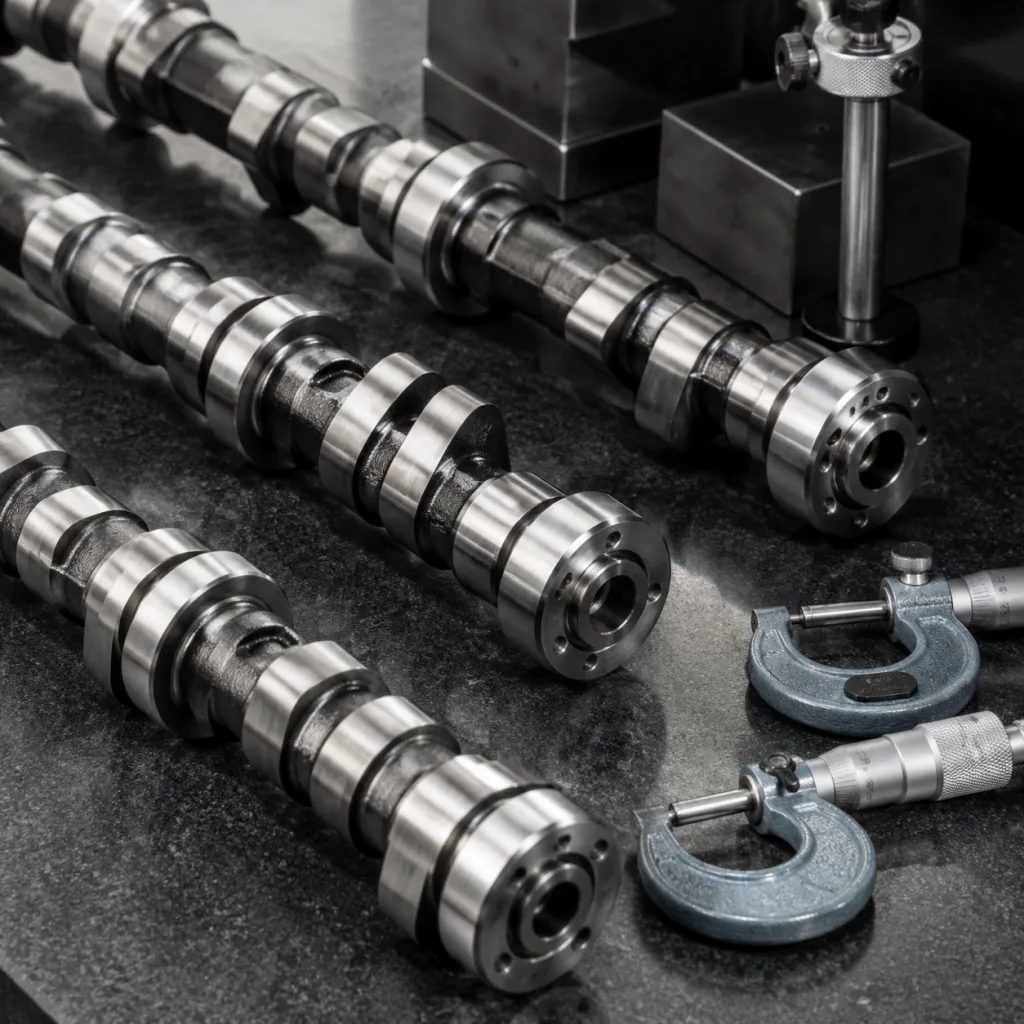
A camshaft Mercedes-Benz OE equivalent programme should rely on drawing-based inspection and functional measurement rather than visual comparison alone. Small deviations in lobe centreline angle, base circle diameter, journal size or timing feature position can shift valve events, affect emissions performance, increase noise and vibration, or create installation complaints.
Typical specification points for buyer review:
Material route: chilled cast iron, forged steel, assembled hollow steel or another route consistent with the original construction and duty cycle.
Journal diameter tolerance: application-specific control confirmed by CMM, air-gauge or other calibrated inspection methods.
Lobe lift and base circle: matched to valve train design, hydraulic lifter preload, follower contact pattern and ECU calibration assumptions.
Surface hardness: defined by material and heat-treatment route, with chilled layer, case depth or induction-hardened zone verification where applicable.
Surface roughness: controlled on journals and lobes to support oil-film stability, break-in behavior and follower life.
Runout and straightness: checked to prevent bearing overload, timing deviation and abnormal rotation resistance.
Oil-feed alignment: verified against the cylinder head and bearing cap configuration to avoid lubrication failure.
Procurement check
Why it matters
Typical evidence requested
Lobe profile scan
Confirms lift curve and valve event timing
Profile report or CMM data
Journal diameter
Controls oil clearance and bearing load
Dimensional inspection report
Hardness mapping
Reduces premature lobe or follower wear
Rockwell or Vickers test records
Runout inspection
Supports stable rotation at engine speed
Runout gauge record
Timing feature position
Ensures correct cam phaser or sprocket alignment
Fixture or CMM report
Surface finish
Supports lubrication and break-in
Roughness measurement data
Oil-passage location
Protects journal and lobe lubrication
Drawing comparison or fixture check
</tr></thead><tbody> </tbody></table>
Validation testing before release
Procurement teams should ask how the camshaft was validated for the target application. A sample that physically fits the cylinder head is not enough. The release process should connect incoming material verification, machining capability, heat-treatment control, cleaning, final inspection and fitment confirmation into one documented workflow.
At Driventus, camshaft development can include 3D scanning of reference samples, CAD comparison, metallurgical analysis, hardness testing, dynamic runout checks and trial assembly against mating components where available. Production lots are managed through inspection plans aligned with IATF 16949:2016 and ISO 9001:2015 requirements for process control, traceability, nonconforming output and corrective action.
Vehicle emissions regulations such as ECE R-83 apply at the vehicle-system level, not to a camshaft as a stand-alone certified item. The relevance for sourcing is that valve timing can influence combustion, exhaust performance and diagnostic behavior. A responsible supplier should avoid claiming vehicle-level certification from component checks alone and instead provide dimensional, material and process evidence showing that the replacement part preserves the intended timing and mechanical interface.
For regulated markets, material declarations may also be part of the release package. REACH (EC) No 1907/2006 is commonly requested by EU importers for substances of concern. Corrosion protection, cleanliness and packaging should be specified with the same care as the camshaft itself, especially for sea freight, long warehouse cycles and mixed-temperature storage.
Quality documents buyers should request
A camshaft Mercedes-Benz OE equivalent sourcing file should contain enough evidence for supplier approval, incoming inspection and warranty review. The exact package depends on order volume, part criticality, destination market and whether the buyer is purchasing an existing aftermarket reference or launching a controlled development project.
Recommended document set:
Certificate scope for IATF 16949:2016 and ISO 9001:2015, where applicable to the manufacturing site and product category.
Control plan covering material receipt, heat treatment, machining, cleaning, inspection, corrosion protection and packaging.
Initial sample inspection report with key dimensions, measurement method, tolerance and pass/fail result.
Material certificate or chemical composition verification for the selected production route.
Hardness and microstructure records for lobes, journals and hardened zones.
Process capability data for critical dimensions when annual volume and risk level justify it.
Traceability format linking batch number, production date, inspection record and packaging label.
Corrective action procedure for field returns, distributor claims and repeat-defect prevention.
Driventus maintains a documented quality system for engine component production. Buyers can use this as part of supplier onboarding, but site certification should be paired with part-specific drawings, approved samples, inspection records and agreed acceptance criteria. That combination gives purchasing, engineering and warranty teams a common basis for release decisions.
Packaging, labelling and market fitment control
Camshafts are vulnerable to corrosion, impact marks, journal scoring and bending if packaging is not designed for export handling. For distributors supplying the EU, UK, US, Canada, Australia, Brazil or other long-distance markets, the packaging specification should be treated as a product requirement rather than a logistics afterthought.
A practical export packaging standard should include rust preventive oil or VCI protection, sealed inner wrapping, rigid supports at journals, separation between parts, carton drop resistance and defined pallet stacking limits. Labels should carry the buyer part number, application reference, batch code, quantity, country of origin where required and barcode format if specified by the buyer. Private-label programmes should also define artwork approval, label placement, carton strength and mixed-SKU packing rules before production release.
Fitment control is equally important. Mercedes-Benz engine applications can vary by market, emissions package, production date, cylinder bank and camshaft position. Intake and exhaust camshafts may look similar but use different timing features, sensor triggers or phaser interfaces. Procurement teams should confirm:
Engine code and displacement.
Intake or exhaust position.
Left or right bank, where applicable.
Variable valve timing interface type.
Sensor trigger or reluctor configuration.
Production date range and destination-market fitment notes.
OE cross-reference format used in the buyer system, for example an OE 11251… reference if already provided by the customer.
Driventus is an independent aftermarket manufacturer; brand names are referenced for fitment only.
RFQ data for accurate quotation
Clear RFQ data reduces sample cycles, prevents mismatched sourcing decisions and helps the supplier separate catalogue confirmation from engineered development work. When buyers request a camshaft Mercedes-Benz OE equivalent quotation, the supplier should receive enough information to verify interchangeability before pricing, tooling review or sample planning.
Include the following in the RFQ package:
Target application: model range, engine code, displacement, fuel type and production years.
Position: intake, exhaust, left bank or right bank as applicable.
Buyer reference number and any OE cross-reference already used internally.
Annual volume, first order quantity, forecast by quarter and destination market.
Required documentation: inspection report, material record, PPAP-style package or buyer-specific forms.
Packaging requirement: neutral, buyer brand, bulk or repair-chain format.
Compliance requirement: REACH (EC) No 1907/2006 declaration or other market documentation.
Sample requirement: reference sample, drawing, 3D scan file, mating component or trial order quantity.
Acceptance criteria: key dimensions, surface finish, hardness range, label format and warranty handling expectations.
For catalogue programmes, the process normally starts with cross-reference confirmation and sample inspection. For engineered projects, Driventus can review drawings, build inspection fixtures and quote tooling or development costs through custom manufacturing. Buyers can request a quote with their target part list, forecast, packaging preference and inspection requirements.
Frequently asked questions
No. OE-equivalent means the aftermarket part is designed to match the specified fitment and function. It does not imply vehicle manufacturer approval, endorsement or supply relationship. Driventus is an independent aftermarket manufacturer; brand names are referenced for fitment only.
Provide the engine code, model year range, intake or exhaust position, bank position if applicable, buyer part number, any OE cross-reference already used, annual volume, destination market and documentation requirements. A reference sample, drawing or 3D scan improves quotation accuracy.
Yes. Driventus can support neutral or buyer-specified packaging subject to artwork, label data, carton specification and order volume. Corrosion protection, batch traceability, barcode format and export packing requirements should be agreed before production release.
For camshaft sourcing, send your application list, annual forecast, destination market and inspection requirements to Driventus for review. Start a technical RFQ at /contact.html