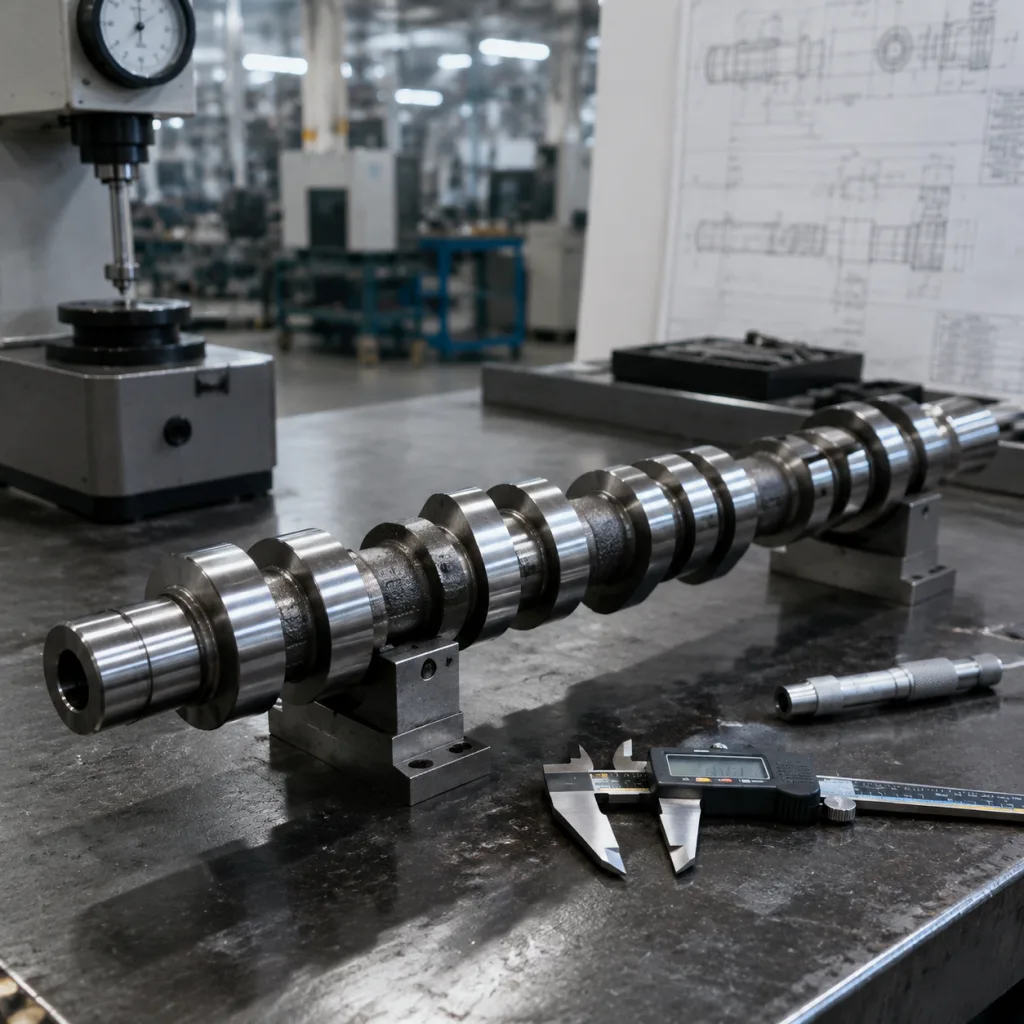
A Mazda camshaft replacement should be treated as a dimensional and functional match exercise, not a visual one. For procurement teams, the key questions are whether the profile, journal sizes, lobe lift, base circle, timing phasing, and surface finish match the target engine application, and whether the supplier can prove it with inspection data. For aftermarket distribution, OEM cross-reference accuracy matters. For repair chains, fitment consistency matters. For OEM and Tier-1 supply, material control, heat treatment, and runout limits matter. Driventus is an independent aftermarket manufacturer; brand names are referenced for fitment only. We support buyers with OE-equivalent camshafts, validation data, and export-ready supply for engine applications used across Mazda passenger car and light commercial platforms.
Match the engine first, not the model
A camshaft only succeeds when it matches the engine’s valve timing geometry and installation envelope. Before ordering, confirm the engine code, cylinder head variant, and whether the original part is intake, exhaust, or a paired set.
Confirm these items before approval:
Overall length and bearing journal spacing
Journal diameter, thrust face location, and oil feed features
Lobe lift, duration, and lobe separation if available
Cam phasing reference points and keyway or trigger features
Surface finish, hardness, and heat-treatment method
Packaged weight and corrosion protection for export
For Mazda applications, buyers often cross-check OE part references against engine codes rather than model names alone. That reduces mis-shipments on similar-looking engines with different valve events. If your team needs a structured source list, start with our catalog and filter by engine family rather than vehicle badge. Typical buyer tolerances for replacement approval are ±0.02 mm on journal diameter, ±0.05 mm on critical journal spacing, and ≤0.03 mm TIR on measured runout unless your drawing calls for tighter control.
What a true OE match has to prove
Replacement parts succeed when the engine builder, repair shop, and distributor all see the same fitment outcome. A camshaft replacement should therefore meet OE-equivalent dimensions, not just fit by appearance.
Verification item
Typical buyer check
Why it matters
Journal diameter
Micrometer against sample
Controls bearing clearance
Lobe lift
Comparator or CMM
Affects valve opening
Runout
Dial indicator
Reduces vibration and wear
Surface hardness
Test report
Supports wear life
Timing reference
Fixture or drawing match
Prevents phasing errors
</tr></thead><tbody> </tbody></table>Where OE data is available, buyers should request inspection reports by batch. For replacement programs, a consistent measured profile is more useful than a generic fitment claim. Driventus can support dimensional confirmation and traceable inspection records through our quality system. For sourcing decisions, we recommend a first-sample acceptance window of 100% inspection on key dimensions, with lot release based on CPK ≥ 1.33 for the controlled features your drawing identifies as critical.
Spec deep-dive: material and wear controls
Camshafts operate under repeated sliding contact and high local load. Material and heat treatment are not secondary details; they determine valve-train durability.
Typical procurement checks:
Cast iron or alloy steel grade confirmation
Induction hardening or nitriding specification
Case depth or hardened layer report where applicable
Surface roughness requirement on lobe and journal areas
Cleanliness after machining and deburring
For export programmes, consistent metallurgy helps reduce warranty variation across mixed service conditions. Driventus manufactures engine components under IATF 16949:2016 and ISO 9001:2015 controls, with production records suitable for distributor and repair-network sourcing. If your requirement includes a special profile, packaging format, or private-label programme, see custom manufacturing. Typical buyer specs include lobe surface roughness Ra ≤ 0.8 μm, journal Ra ≤ 0.4 μm, and hardness targets commonly in the 50–60 HRC range for hardened steel parts or per drawing for cast profiles. If you need a wear-life basis, ask for case depth, hardness traverse, and microstructure evidence on the first article.
Validation: from first article to pilot lot
For procurement teams, validation is the difference between a promising sample and a stable supply line. A Mazda camshaft replacement should be validated in stages: dimensional, functional, and endurance.
Common validation items:
First article inspection against drawing or sample
Assembly check with matching lifters, followers, and bearings
Engine bench or vehicle confirmation of timing and oil pressure
Noise, wear pattern, and surface condition review after test running
Packaging and transit verification for export lanes
Where relevant to your market, request test references that align with published methods such as SAE J2527 for durability-related exposure work, and internal validation aligned to your target service conditions. For emissions-sensitive systems, buyers should also confirm compatibility with applicable regulations and documentation expectations in their market, including REACH (EC) No 1907/2006 where chemical compliance disclosure is required. Driventus does not claim vehicle manufacturer approval or endorsement. A practical qualification flow is 10-piece pilot sampling, then 30–50 pieces for fitment confirmation, then a controlled production lot with agreed AQL and serial or batch traceability.
Avoid the common sourcing failures
Replacement sourcing fails most often when the buyer relies on a model name instead of a verified part definition. The safer process is simple.
1. Confirm engine code, cam position, and OE reference. 2. Request a drawing, sample, or measurement sheet. 3. Check material, hardness, and runout limits. 4. Review packaging, labelling, and barcode needs. 5. Approve only after fitment and function validation.
For catalog buyers, the most efficient route is to build a cross-reference list by engine family and then align it with carton-level traceability. Driventus supports B2B orders for distributors, OEM and Tier-1 programmes, and multi-location repair chains. If you are evaluating a new source, you can request a quote with your OE reference, target annual volume, and required inspection level. MOQ is typically 100–300 pieces per part number for standard export production, with mixed SKU programs possible if the annual call-off justifies setup. Standard lead time is often 30–45 days after sample approval; urgent replenishment can be shorter for repeat orders, but pricing, carton quantity, and inspection scope should be confirmed at RFQ stage.
Frequently asked questions
Confirm the engine code, intake or exhaust position, journal sizes, lobe profile, and OE reference. A visual match is not enough; dimensional and timing checks matter. Ask for journal diameter, runout, lobe lift, and hardness data before approval.
We supply independent aftermarket camshafts for fitment to selected Mazda engine families. Driventus is an independent aftermarket manufacturer; brand names are referenced for fitment only. Buyers should verify engine code and reference number before ordering.
Yes. We support drawing-based and sample-based programmes, including packaging and traceability requirements. Share your target spec through our contact form for review, including annual volume, target MOQ, required lead time, and any inspection or labeling requirements.
If you need an OE-match review, inspection data, or a sourcing quotation, send your part reference and annual volume through /contact.html.