Camshaft Kia wholesale sourcing requires more than comparing unit prices. For importers, aftermarket distributors and repair-chain buyers, the commercial risk often sits in dimensional variation, inconsistent heat treatment, weak traceability or packaging damage that appears after the shipment reaches multiple markets. A reliable programme should confirm the engine application, material route, inspection plan, documentation package and launch quantity before production starts.
Driventus manufactures engine and powertrain components in Taizhou, Zhejiang for B2B customers in Europe, the UK, North America, Australia and Brazil. For Kia-fitment camshafts, we support aftermarket programmes, private-label ranges and multi-location inventory plans with controlled sourcing, export-ready packaging and practical quality documentation. Buyers can use our catalog to review engine component coverage, then confirm drawings, samples, MOQ, packaging and inspection requirements before ordering. Driventus is an independent aftermarket manufacturer; vehicle brand names are referenced for fitment only.
Procurement Priorities for Kia-Fitment Camshafts
A camshaft controls valve timing, lift and duration, so small deviations in lobe profile, journal diameter, straightness or surface hardness can affect idle stability, oil-film performance, valve-train noise and long-term wear. For wholesale buyers, the main concern is not only a single defective part. The larger risk is inconsistent batches that create different return patterns across regions, customers and installation environments.
Key procurement checks include:
Engine application, engine code and model-year range confirmed before quotation
Cross-reference format reviewed where applicable, using buyer-supplied references only
Material grade, casting or forging route and surface-treatment expectations stated in the offer
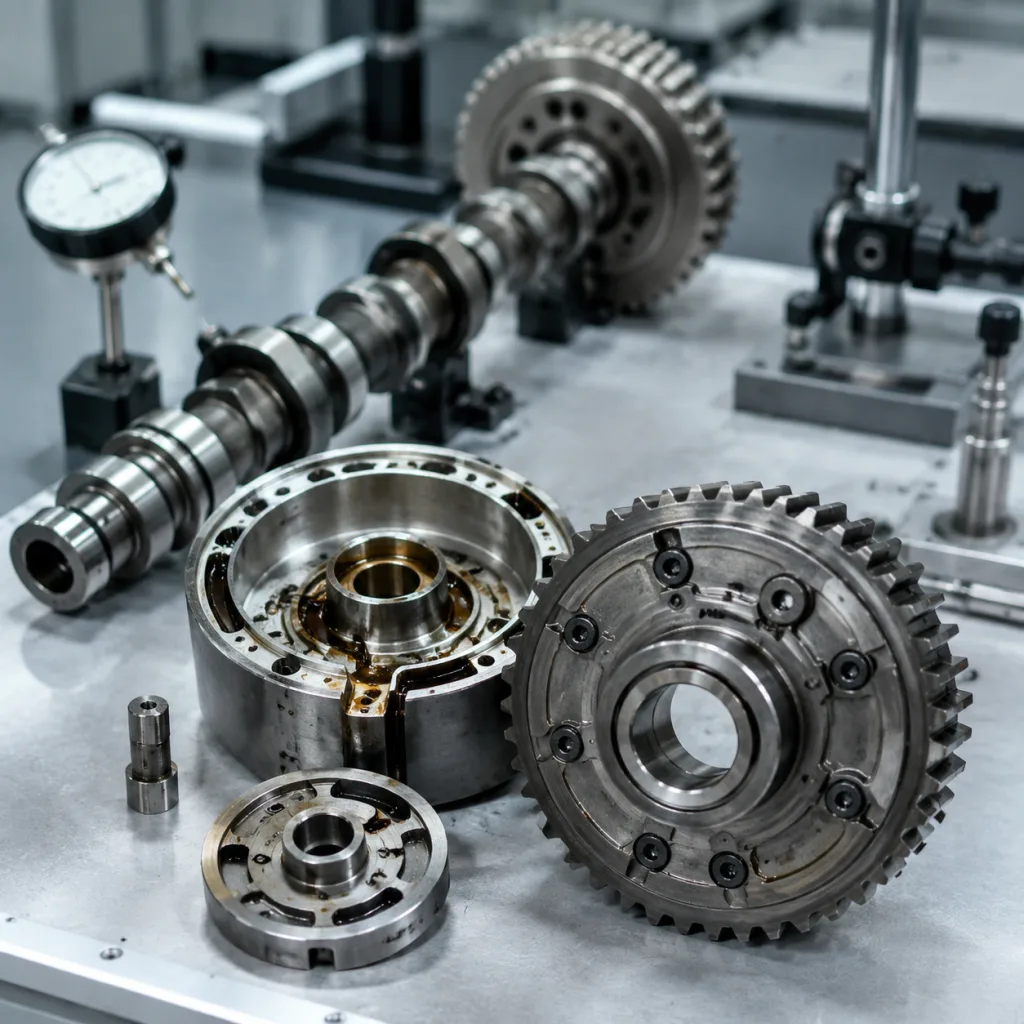
Cam lobe hardness, journal finish, runout and profile controls included in the inspection plan
Rust prevention and packaging method suitable for sea freight, courier samples and warehouse handling
Batch traceability linked to inspection records, heat-treatment data and repeat-order control
For distributors building Kia aftermarket coverage, camshafts should be sourced with related timing, sealing and valve-train components where the programme allows. This improves application consistency, simplifies catalogue management and reduces mixed-source claim disputes. Buyers can review related categories under engine components before finalising the sourcing list.
Manufacturing Route, Materials and Inspection Controls
Driventus supplies camshafts for aftermarket and custom programmes through controlled machining, heat treatment and final inspection. The production route depends on engine family, annual volume, drawing requirements, material selection and target price band. Cast camshafts may be appropriate for many standard replacement lines, while forged or billet options may be specified for higher-load applications, customer-defined designs or special material requirements.
Control point
Typical buyer requirement
Procurement relevance
Material
Chilled cast iron, alloy steel or buyer-specified grade
Determines wear resistance, heat treatment and machining route
Journal diameter
Drawing-controlled tolerance
Affects oil clearance, rotation and bearing life
Cam lobe profile
Profile inspection against master data
Affects valve timing, lift and engine performance
Straightness/runout
Defined by drawing and application
Reduces installation, vibration and rotation issues
Surface hardness
Heat-treatment record and hardness test
Supports lobe and journal wear resistance
Surface finish
Ra/Rz controlled where specified
Supports lubrication film stability and wear control
Traceability
Batch, lot and inspection record
Enables claims analysis, corrective action and repeat orders
</tr></thead><tbody> </tbody></table>Inspection can include dimensional checks, hardness testing, visual review, runout measurement, lobe profile verification and packaging inspection. When a customer supplies a drawing, sample or PPAP-style requirement, Driventus can align the control plan and reporting format with the sourcing programme. The company operates under IATF 16949:2016 and ISO 9001:2015, with process controls documented through its quality system.
MOQ, Lead Time and Export Packaging
Wholesale camshaft programmes should be planned around realistic launch quantities and repeat-order demand. A small trial order can help validate fitment, packaging and market response, but frequent low-volume purchases often increase freight cost, handling work and packaging variation. For stable SKUs, consolidated orders usually improve production scheduling, carton consistency, pallet planning and container utilisation.
Typical sourcing discussion points include:
Trial order quantity for sample validation or first market launch
Standard MOQ by part number, mixed-SKU order value or shipment plan
Lead time for existing tooling compared with new development
Label format, carton strength, palletisation and barcode requirements
Neutral, Driventus or customer private-label packaging
Export documents for customs clearance, distributor intake and warehouse control
Lead time depends on whether drawings, tooling and machining fixtures are already available. Existing applications may move faster after sample approval, while new camshaft development requires drawing review, feasibility confirmation, tooling or fixture preparation, sample production, inspection and validation. For importers serving several branches or countries, a 6- to 12-month forecast helps the supplier plan batches, reserve capacity and reduce urgent air freight.
Factory Audit and Compliance Documentation
Professional buyers usually need more than a price list before approving a camshaft supplier. Procurement and quality teams may request a factory profile, process flow, control plan, inspection equipment list, certificate copies, sample reports and packaging specifications. Driventus supports B2B sourcing reviews with documentation relevant to engine and powertrain component manufacturing.
For EU and UK import programmes, buyers may also request material declarations and restricted-substance controls. REACH (EC) No 1907/2006 is commonly referenced for chemical compliance in European supply chains, especially where coatings, oils, packaging materials or surface treatments are involved. For North American customers, documentation often focuses on quality management, traceability, warranty handling, packaging durability and consistency between approved samples and mass production.
A practical audit checklist for Kia-fitment camshaft sourcing should cover:
IATF 16949:2016 and ISO 9001:2015 certificate validity
Incoming material verification and upstream supplier control
Heat-treatment monitoring, hardness checks and record retention
Calibration status for measuring equipment and gauges
In-process inspection frequency and reaction plan
Final inspection sampling method and report format
Nonconforming product segregation and corrective action process
Export packaging, rust prevention and storage controls
Driventus does not claim vehicle manufacturer approval or endorsement. The supply focus is independent aftermarket fitment, custom development and customer-defined quality agreements.
Custom Programmes and Private-Label Supply
Some distributors buy listed camshafts from existing coverage, while others need private-label packaging, market-specific application coverage or development from drawings and samples. Driventus supports custom manufacturing for customers that require controlled specifications, agreed inspection plans and repeatable batch supply.
Custom work may include sample reverse engineering, drawing confirmation, material changes, surface-treatment requirements, marking control, corrosion protection and packaging design. For higher-volume programmes, buyers can request first article inspection data and production records before moving to repeat orders. Where application risk is high, sample testing and installation feedback should be completed before releasing a large shipment.
The commercial structure should be agreed early. This includes tooling ownership, exclusivity conditions if any, forecast commitments, retained reference samples and claim-handling rules. Clear agreement at the start prevents disputes later, especially when a distributor is launching a new camshaft line across several warehouses, sales teams or territories.
For private-label supply, carton structure and corrosion protection deserve close attention. Camshafts are long machined parts with exposed journals and lobes, so packaging must prevent contact damage during inland transport, sea freight, customs handling and warehouse movement. Labels should support scan-in, batch control and cross-reference management without using restricted brand logos or implying vehicle manufacturer authorisation.
How to Request a Wholesale Quotation
A complete RFQ shortens quotation time and reduces assumptions. For camshaft Kia wholesale programmes, buyers should send the target application list, annual demand estimate, preferred Incoterms, destination country, packaging requirements and any available sample, drawing or cross-reference information. If an OE-style reference is used, keep it in a generic fitment format and avoid language that implies brand authorisation.
Recommended RFQ details:
Vehicle application, engine code and model-year range, if available
Intake camshaft, exhaust camshaft or complete camshaft set requirement
Annual forecast, first order quantity and expected reorder pattern
Required certification, inspection reports and traceability documents
Target market: EU, UK, US, Canada, Australia, Brazil or other region
Packaging choice: neutral, Driventus or customer private label
Shipping preference: courier samples, LCL, FCL or buyer-appointed forwarder
Required response format for price, MOQ, lead time and sample timing
Buyers can start with our catalog, then request a quote with the RFQ details. Driventus will confirm feasibility, available coverage, sample requirements, documentation options and the next steps for approval.
Frequently asked questions
Yes. Driventus can support neutral packaging, Driventus packaging or customer private-label packaging for approved wholesale programmes. Label content, carton strength, corrosion protection, barcode format and batch traceability should be agreed before production.
Typical documents include quality management certificates, inspection reports, packing lists, commercial invoices and agreed batch traceability records. Additional reports, such as first article inspection data or customer-specific check sheets, can be discussed during RFQ review depending on order volume and application risk.
No. Driventus is an independent aftermarket manufacturer; brand names are referenced for fitment only. The company supplies aftermarket and customer-defined programmes without claiming vehicle manufacturer approval, authorisation or endorsement.
For Kia-fitment camshaft sourcing, send your application list, MOQ target and documentation requirements for review. Driventus will confirm feasible supply options through /contact.html