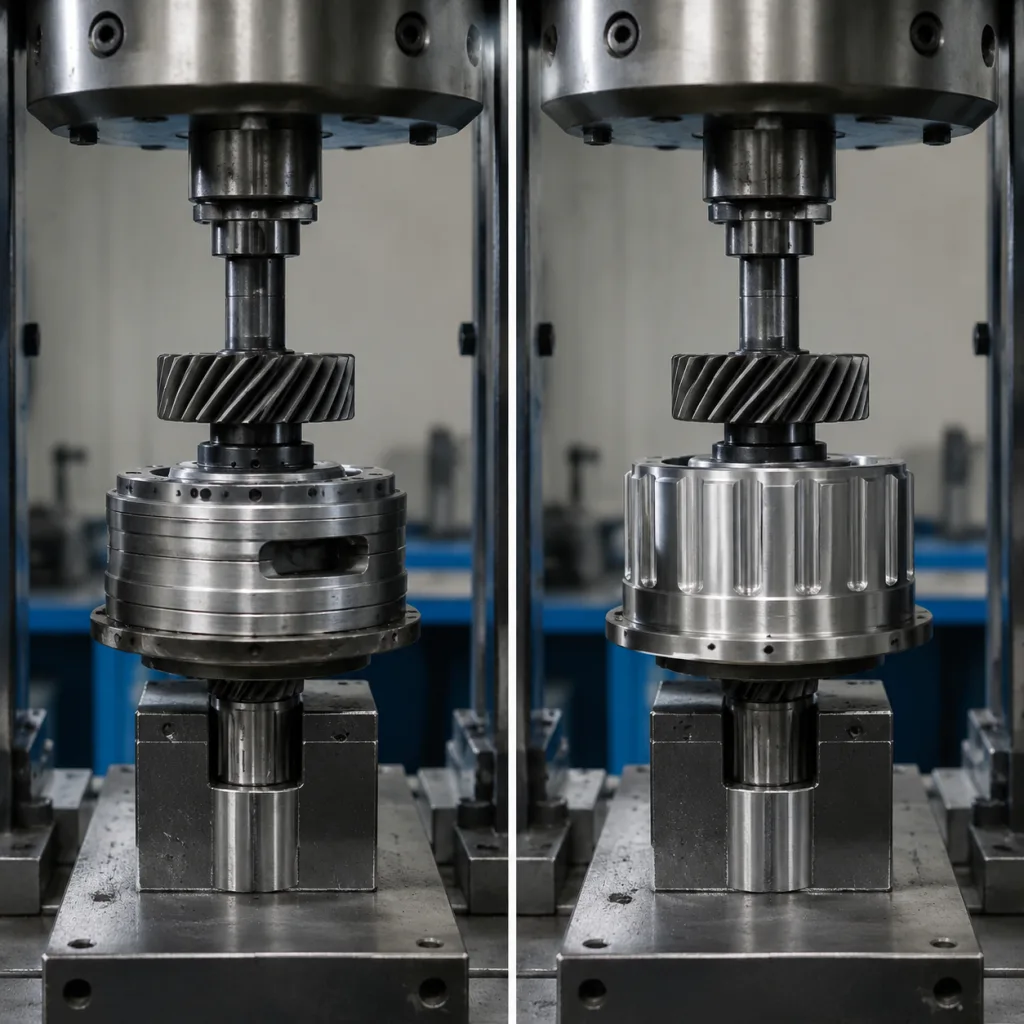
Camshaft Phaser vs KS Alternative: Sourcing Comparison
For procurement teams, a camshaft phaser review is not just a fitment check. It is a decision about calibration match, oil-control response, traceability, and whether the part can survive validation in the target engine family. The KS alternative search usually starts when buyers need a replacement source that matches OE function without depending on one brand channel. That makes the question practical: does the part deliver the same phasing range, locking behavior, surface finish, solenoid interface, and test evidence behind the number? Driventus is an independent aftermarket manufacturer; brand names are referenced for fitment only. This article compares a camshaft phaser vs KS alternative from a sourcing angle, with emphasis on the data buyers should request before volume release.
What matters first: fitment or function?
Quick comparison table
Item
Camshaft phaser
KS alternative
Fitment basis
OE engine code and timing strategy
Cross-reference by OE number or validated sample
Phasing control
Must match ECU calibration
Must match OE movement range
Lock position
Critical at start-up
Critical at start-up
Oil sensitivity
High
High
Buyer risk
Calibration mismatch
Part-to-part variability if not validated
Sourcing check
Dimensional and functional validation
Dimensional and functional validation
Typical phasing window
20°–70° crank angle, depending on engine family
Must replicate the OE window within ±1°–2° crank angle
Axial/runout tolerance
Usually controlled to 0.02 mm–0.05 mm at critical faces
Should be held to the same drawing limit as OE sample
Lock-pin engagement
Full lock expected at zero-pressure start
Full lock expected at zero-pressure start
Internal leakage check
Measured at specified oil pressure and temperature
Must match OE leakage limit or validated benchmark
Service response target
Sweep and return should be repeatable over 10,000+ cycles in validation
Same target, with no sticking or delayed return
Purchase trigger
Vehicle application, engine code, revision
OE number, sample approval, and technical file review
</tr></thead><tbody> </tbody></table>Start with the function, not the brand. A part can look right and still fail the engine’s control strategy. In a camshaft phaser vs KS alternative review, the first job is to confirm that the movement range, lock behavior, and oil response are aligned with the target engine family. If those three do not match, the comparison stops there.
Where cross-reference data misleads buyers
Procurement note
A cross-reference is a starting point, not proof of compatibility.
Buyers get into trouble when catalogue data compresses several revisions into one line item. The label may point to the right family, but the actual part can still differ in casting, machining, vane count, or lock-pin design. For timing components, that is enough to create a field issue.
Treat OE-equivalence as a controlled claim. Confirm that the part number, engine family, and timing strategy match the target application, then ask for sample validation, dimensional data, and any known supersessions. If the catalogue record is thin, request the original OE reference, alternate references, and the build revision used for the offered part.
A practical approval file should include a fitment matrix, a dimensioned drawing, and the exact inspection method used for the sample. Freeze the approved sample against a named OE number and revision. If the supplier later changes casting, machining, or surface treatment, require fresh PPAP-style evidence or an equivalent submission before volume release.
How the two parts behave under load
Common validation tests
Dimensional inspection against master sample
Functional phasing sweep under controlled oil pressure
Thermal cycling from cold start to operating temperature
Leakage and lock-position retention checks
Packaging and traceability audit
These tests matter because service life depends on more than nominal dimensions. Small differences in vane geometry, locking-pin behavior, or internal clearances can change response time and wear patterns over thousands of cycles. Buyers should ask whether the supplier tests cold-start engagement and hot-oil response separately, because a room-temperature check can miss both failure modes.
Useful numeric checkpoints keep the approval process honest. Ask for phasing repeatability within the supplier’s stated limit, typically no worse than ±1°–2° crank angle on the validated engine family, and request leakage data at the test pressure used in validation, often around 3 bar to 5 bar depending on the platform. If the phaser uses a locking pin, confirm release and re-lock behavior across a full thermal cycle, and require evidence that the pin still seats positively after soak testing. Compare surface roughness on sliding interfaces as well; a finish target such as Ra 0.8 µm to Ra 1.6 µm can materially affect oil-film behavior and wear. Those are the details that separate a usable substitute from a risky one.
Spec check: the numbers that decide approval
Procurement checklist
Phasing range by engine family
Lock-pin release pressure
Leakage limit at test temperature
Surface roughness on sliding faces
Axial and runout limits
Start-up lock retention
Repeatability over cycle life
The decision often comes down to a few hard numbers. Buyers should not accept “same as OE” without the underlying spec sheet. Ask for the exact phasing window, the acceptable deviation from the master sample, the test oil temperature, and the lock-pinion release pressure. If the supplier cannot state the test conditions, the result is hard to trust.
The same logic applies to tolerances. A small change in bore size, vane thickness, tooth profile, or bolt pattern can shift the whole assembly out of its calibration envelope. Use the drawing limit, not a generic industry norm. For a camshaft phaser vs KS alternative comparison, the winning part is the one that matches the OE control strategy and can prove it on paper, then in testing.
How Driventus handles technical and compliance requests
Standards and compliance
Driventus operations follow published requirements and material control practices aligned with `REACH (EC) No 1907/2006` where applicable to supplied products and packaging declarations. For surface durability and contamination resistance, buyers may also ask for project-specific test methods such as `SAE J2527` or applicable OEM validation schedules.
That matters because buyers need evidence before release, not after a complaint. Typical documents include material declarations, inspection records, batch traceability, and sample approval status. Where a programme needs private-label packaging or a controlled release plan, production, marking, and carton labelling can be aligned to the customer specification without changing the verified part itself.
For volume programmes, define the acceptance gates up front. A workable sequence is first article sample approval, then pilot lot review, then pre-shipment inspection, then controlled release to production. If the application is sensitive, ask for lot-level traceability to the machining shift or heat/lot number, plus a retained sample from each batch. That makes field returns traceable instead of anecdotal.
A buyer’s risk checklist before release
Commercial comparison
A local distributor may offer shorter delivery. A qualified manufacturer may offer stronger process control and programme stability. Procurement should weigh both, then verify the evidence behind the part.
Before order release, compare the commercial offer with the technical file. Confirm lead time, minimum order quantity, revision control, replacement policy, and whether the supplied lot is traceable to a test record. If the KS alternative is being considered as a multi-source option, freeze the approved sample and require re-validation for any tooling or material change. That prevents price-driven substitutions that look efficient on paper but create risk in the field.
A sensible sourcing model is tiered pricing by annual volume, because timing-component economics usually change sharply between trial, service, and production runs. Check MOQ for sample lots, MOQ for production lots, and the lead-time split between stocked items and made-to-order parts. Ask whether the quote includes packaging, label printing, and inspection documentation, because those items often move landed cost more than the unit price. If a supplier cannot state the price-validity period, revision-freeze date, and expedite policy, the quote is not ready for comparison.
Frequently asked questions
No. Interchangeability depends on phasing range, lock position, oil control, dimensional match, and the validated test window. A visual match is not enough for timing-system parts, and buyers should confirm the tolerance stack, leak limit, and start-up lock behavior before release.
Request OE cross-reference data, dimensional drawings, inspection records, batch traceability, and functional test results. For volume orders, ask for sample approval records, declared tolerances, the stated lead time, MOQ, and the revision level tied to the approved sample.
Yes. We support custom manufacturing, sample validation, and programme-specific packaging for B2B customers. Submit your requirements through the contact page, including target annual volume, packaging spec, required labels, and any required inspection reports so we can quote the right commercial and technical setup.
If you are comparing a camshaft phaser or a KS alternative for your next order, send the OE number and target volume through /contact.html and we will review the fitment details with you.