Camshaft Iveco Supplier: Sourcing Guide for B2B Buyers
If you are sourcing a camshaft Iveco supplier for aftermarket distribution, OEM supply, or repair-chain support, the decision is less about finding a low quote and more about avoiding hidden variation. Dimensional drift, uneven heat treatment, poor surface finish, and weak traceability are the failures that turn a cheap part into a costly return. Driventus is an independent aftermarket manufacturer, and brand names are referenced for fitment only. We support buyers who need documented process control under IATF 16949:2016 and ISO 9001:2015, along with export-ready packaging and cross-reference support for OE numbers where available. This guide breaks the sourcing decision into the checks that actually matter: fitment, process control, supply stability, documentation, and custom-program fit.
Start With Fitment, Not Price
Before comparing offers, lock down the exact engine family, OE number if available, and whether the part is for direct replacement, remanufacturing, or private-label distribution. Those use cases change the required marking, packaging, sampling depth, and warranty terms. For a camshaft Iveco supplier quote to be useful, the supplier needs the critical dimensions up front: overall length, journal diameter, lobe height, base-circle diameter, cam lift, and the timing features tied to the engine variant. Ask for the tolerance bands on those dimensions before sampling, not after. If the supplier cannot state the measurement method, gauge type, or acceptance criteria, that is a warning sign. A part can be cheap and still fail the first production run if the fitment data is incomplete.
Compare Suppliers By Failure Mode
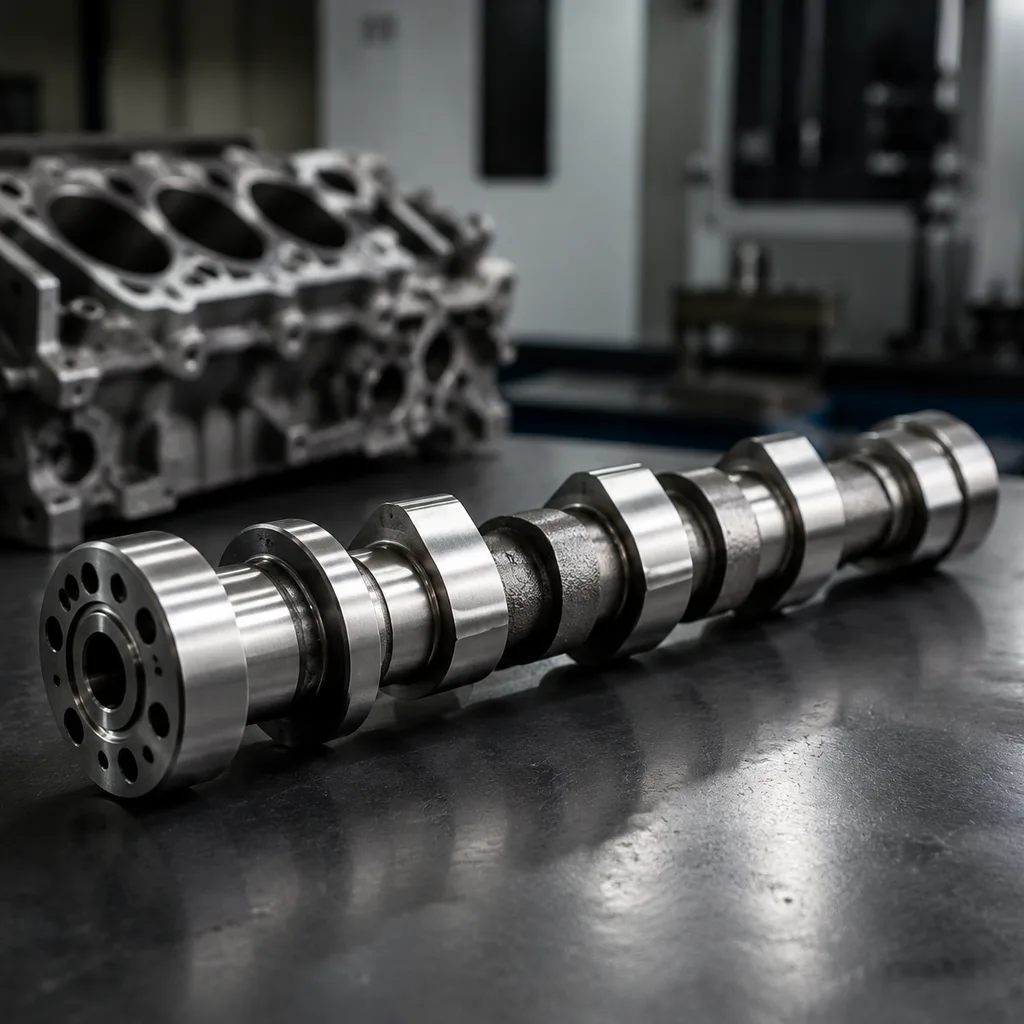
The fastest way to compare suppliers is to ask what they control tightly and what they inspect at the end. A strong camshaft Iveco supplier should document material grade, heat-treatment method, machining consistency, and final inspection. Ask for the steel or casting grade, the hardening process used, and a hardness map for lobe and journal surfaces. Surface hardness, core hardness, and hardened-layer depth matter more than broad quality claims. So do concentricity, cam lift variation, surface roughness, and dynamic balance where applicable. If a supplier says the part is OEM-equivalent, ask how the batch is checked against a reference sample, what percentage of parts are inspected, and whether the measurement report is linked to the lot number. That tells you whether you are buying a controlled production source or just a visually acceptable component.
Read The Quote Like A Procurement Sheet
Lead time should be evaluated with MOQ and replenishment behavior, not on its own. A low unit price can hide inventory pressure if the minimum order is high or repeat supply is unstable. Every quote should show sample lead time, first production lead time, and repeat-order lead time. It should also show MOQ by part number, carton quantity, and pallet quantity so your team can calculate landed cost and storage impact. Ask when the lead time clock starts: PO date, deposit date, or drawing approval date. That detail often changes the real delivery date by weeks. If the supplier can hold a 30- to 45-day repeat lead time but requires a high opening MOQ, that may suit distributors with predictable demand. If demand is volatile, a lower MOQ with a slightly higher unit price can be the safer total-cost option. Compare documentation, packaging, and inspection costs as part of the quote, not as afterthoughts.
What The Quality File Should Contain
At minimum, request dimensional drawings, hardness data, material certificates, and batch traceability records. For European programmes, confirm whether the supplier can provide declarations linked to REACH (EC) No 1907/2006 where applicable to the materials used in production and packaging. When qualifying a new source, ask how samples are identified, which checks are included in pre-shipment release, and whether the controls match serial production rather than a one-off prototype run. A complete pack should include the inspection plan, gauge list, sample size, measurement report, and photos of the part markings and packaging labels. For camshafts, insist on the numbers that matter in service: lobe lift consistency, journal diameter tolerance, runout measurement method, and axial endplay if it applies to the assembly. If the supplier offers PPAP-style documentation, confirm whether it includes material certs, process flow, PFMEA, control plan, and initial sample approval. If not, ask for the closest equivalent package and review it against your internal standard.
When Custom Manufacturing Makes Sense
Custom manufacturing is the better route when the required fitment, packaging, or paperwork differs from a standard catalogue offer. That can mean private-label branding, special carton marking, revised surface treatment, or programme-specific documentation. It also applies when you need a specific lobe profile, a revised base circle, or a matched set for a rebuild programme that must preserve factory timing behavior. Before approving custom work, define the measurable targets in writing: drawing revision, tolerance band, test sample count, acceptable hardness range, packaging count per inner box, and the commercial rules for tool ownership or retooling charges. Ask how change control works if the raw material source changes, because even a small input change can affect wear and noise performance. A good programme ends with signed sample approval, a locked specification, and a replenishment plan that states how quickly repeat orders can ship after final approval.
Q&A For Buyers Under Deadline
What should I ask first? Ask for OE cross-reference, dimensional drawing, hardness data, material certificate, MOQ, and lead time. Also confirm batch traceability, measurement tolerances, lobe lift, journal diameter, and whether production samples come from the same line as mass orders.
How do I compare suppliers on more than price? Compare process control, inspection depth, documentation, packaging, MOQ, and delivery stability. A lower unit price is not a win if the supplier cannot hold tolerances, provides weak traceability, or misses replenishment dates.
Can Driventus support custom camshaft programmes? Yes. We support custom manufacturing, private-label packaging, and production documentation for B2B buyers. Use the contact form to discuss fitment data, target volume, tolerance requirements, and required paperwork.
Frequently asked questions
Ask for OE cross-reference, dimensional drawing, hardness data, material certificate, MOQ, and lead time. Also confirm batch traceability, measurement tolerances, lobe lift, journal diameter, and whether production samples come from the same line as mass orders.
Compare process control, inspection depth, documentation, packaging, MOQ, and delivery stability. A lower unit price is less useful if the supplier cannot hold tolerances, provides weak traceability, or misses replenishment dates.
Yes. We support custom manufacturing, private-label packaging, and production documentation for B2B buyers. Use the contact form to discuss fitment data, target volume, tolerance requirements, and required paperwork.
If you need a camshaft Iveco supply partner with documented quality control and export-ready support, please [request a quote](/contact.html).
Request a Quote