Camshaft for Honda Pilot Replacement: OE Fitment Guide
A camshaft for Honda Pilot replacement needs more than the correct engine family name. Buyers should verify the exact engine code, valve train layout, journal diameter, lobe lift, base circle, and sensor trigger profile before placing an order. For the Honda Pilot, fitment can vary by model year and market, so a VIN-based cross-check is the safest route for procurement teams and service networks. Driventus is an independent aftermarket manufacturer; brand names are referenced for fitment only. The goal is an OE-equivalent part that installs without machining, maintains valve timing stability, and passes inspection against the same dimensional and material controls used in repeat production. This is especially important for distributors and repair chains that need low return rates, predictable stock rotation, and a consistent replacement standard across branches.
What buyers should verify before ordering
A camshaft replacement is rarely a universal part. For the Honda Pilot, the purchase decision should start with the engine variant and the original cam profile. The same vehicle line has used different timing arrangements and sensor configurations across production years, so a visual match is not enough.
Use this checklist before confirming a purchase:
Engine code and model year range
Intake and exhaust cam position, if the set is split
Journal diameter and bearing width
Lobe lift, duration, and base circle
Cam sensor target wheel design
Chain sprocket or VTC interface, where applicable
Surface hardness and finish specification
Oil passage drilling and clean-out quality
For procurement teams, the practical rule is simple: verify fitment by VIN and engine code, then validate against a dimensional drawing and sample measurement. That approach reduces the risk of returns caused by misidentified OE equivalents.
OE-equivalent replacement criteria
An acceptable replacement should match the original camshaft in geometry, metallurgy, and functional timing behaviour. The part does not need to be branded by the vehicle maker, but it must replicate the operating envelope closely enough that the valve train, ECU calibration, and lubrication system remain within design limits.
Parameter
What to confirm
Why it matters
Journal diameter
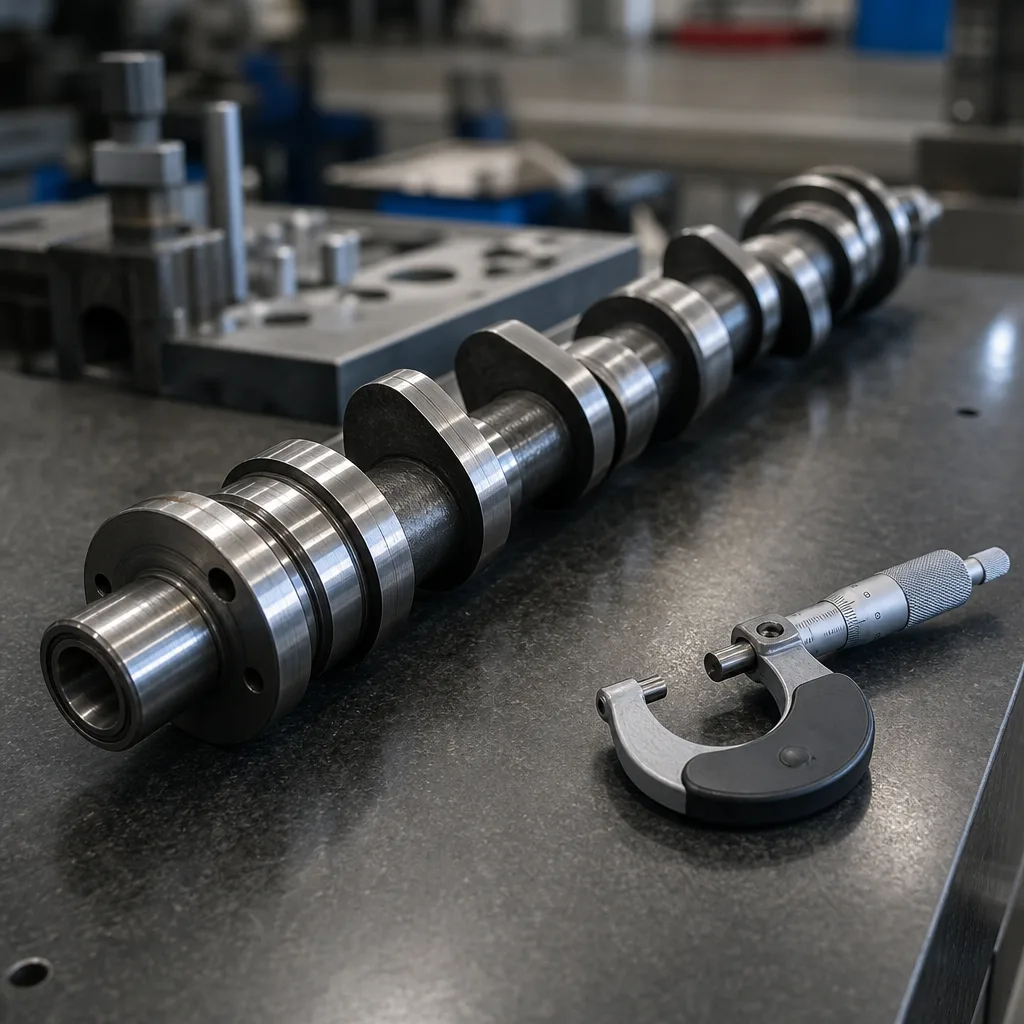
Micrometer check against OE drawing
Prevents bearing clearance issues
Lobe lift
Compare to the validated profile
Preserves airflow and valve timing
Base circle
Measure against master sample
Affects lifter preload and lash
Runout
Verify against production tolerance
Reduces vibration and wear
Surface hardness
Confirm heat-treatment record
Improves wear resistance
Sensor trigger phasing
Match original signal pattern
Avoids misfire and timing faults
</tr></thead><tbody> </tbody></table>For larger buyers, request a dimensional report from first article inspection and a traceable lot record. That is the minimum practical evidence for a replacement part intended for repeat supply.
Testing that matters in real service
Validation should cover both form and function. A camshaft can measure correctly and still fail early if the heat treatment, surface finish, or grinding process is inconsistent.
Relevant checks include:
Hardness verification on the lobe surface and journal areas
Profile grinding inspection for lobe symmetry
Total indicated runout measurement
Magnetic particle or equivalent crack inspection on forged or cast bodies
Oil gallery cleanliness inspection after machining
Packaging checks to prevent transit corrosion and edge damage
For export buyers, material and chemical compliance also matter. Ask for documentation aligned with IATF 16949:2016 and ISO 9001:2015, plus REACH (EC) No 1907/2006 declarations where the destination market requires them. If a coating or corrosion-protection treatment is used, request the applicable corrosion test method and acceptance criteria rather than a generic claim.
H3 - Practical procurement rule Do not compare only price. Compare the inspection evidence, the sampling plan, and the return rate target. The cheaper part often becomes the expensive part after rework, warranty handling, and labour time.
How Driventus supports replacement supply
Driventus supplies camshafts as part of a broader engine-component range, which helps buyers consolidate sourcing for related assemblies. If you are reviewing options across cylinder head and valvetrain parts, see our catalog and the broader engine components range.
Our replacement supply model focuses on repeatability:
Controlled dimensional inspection on critical features
Material traceability by batch
Production records tied to lot identification
Export packaging designed for shelf life and warehouse handling
Sample approval before mass shipment
For customers that need a private label or a non-standard configuration, custom manufacturing is available when the application requires a specific lobe profile, surface treatment, or packaging format. That is useful for distributors serving multiple markets with slightly different fitment demands.
Buying risks to avoid
The most common failure modes are avoidable. They usually come from incomplete fitment data, weak incoming inspection, or a supplier that cannot prove consistency across production lots.
Watch for these risk signals:
No VIN or engine-code verification
No dimensional drawing or control plan
No stated runout or hardness target
Mixed packaging that allows part-to-part damage
Claims of universal fitment without supporting data
Missing batch traceability or incomplete test records
A replacement camshaft should install cleanly, maintain stable timing, and survive normal service intervals. If a supplier cannot explain how the part was validated, the short-term savings are not reliable. For buyers managing branch inventory or regional distribution, consistent quality control is more valuable than a marginal unit-cost reduction.
Procurement summary for service networks
For repair chains and distributors, the right replacement decision is operational, not theoretical. You need a part that can be ordered by fitment data, received with stable packaging, and installed without extra machining or calibration surprises.
Before approval, confirm:
OE-equivalent geometry
Verified hardness and runout
Clean machining and oil passage finish
Lot traceability and inspection records
Market-specific compliance documentation
Reliable stock availability and lead-time visibility
If your team is standardising suppliers, compare the replacement sample against your current benchmark part and keep the same acceptance criteria across all branches. That creates a cleaner warranty position and fewer installation disputes. You can request a quote once the engine variant, quantity, and destination market are confirmed.
Frequently asked questions
Use the VIN, engine code, and model year together. Then check journal diameter, lobe profile, sensor trigger pattern, and whether the application uses intake, exhaust, or a matched set.
Ask for a dimensional drawing, hardness data, runout limits, material traceability, and first article inspection records. For export markets, request REACH and quality-system documentation where applicable.
Yes, if it matches OE-equivalent geometry and passes validation testing. The key is repeatability across lots, not brand origin. Fitment should always be confirmed before purchase.
If you are sourcing a verified replacement for a specific engine code or market, send the fitment data and target quantity through our team at [request a quote](/contact.html).