camshaft · 2026-06-18

Camshaft GMC Supplier: B2B Sourcing Guide

A camshaft GMC supplier is not selected by fitment match alone. The real decision is whether the supplier can repeat lobe geometry, hardness, runout control, packaging, and records across batches without creating warranty noise downstream. Driventus manufactures engine and powertrain components in Taizhou, Zhejiang, and exports to distributors, OEM/Tier-1 programmes, and repair-chain supply networks in more than 60 countries. For GMC-fitment camshafts, we support catalogue supply and project-based development under IATF 16949:2016 and ISO 9001:2015 quality systems.

Good RFQs separate what is known from what still needs engineering confirmation: engine code, OE or aftermarket cross-reference, sample or drawing status, annual volume, packaging route, destination port, and inspection expectations. That separation keeps MOQ, tooling, price, and lead time from being bundled into one vague number. Driventus is an independent aftermarket manufacturer; vehicle brand names are used for fitment reference only.

Start With the Decision Gate, Not the Part Number

The first sourcing mistake is treating the camshaft as a simple catalogue lookup. It is not. A camshaft controls valve timing, lift, opening duration, and overlap; small errors in lobe profile, journal diameter, runout, or surface hardness can show up as noise, accelerated wear, emissions complaints, low oil-pressure reports, or repeat warranty returns.

Before asking for price, define the decision gate. Is the requirement replacement aftermarket distribution, a repair-chain supply programme, or an OE/Tier-1 style project? Each route changes the evidence needed. A distributor may need coverage, landed cost, stable cartons, and batch inspection records. A repair chain may care more about complaint rate and repeat packaging. An OE/Tier-1 programme will usually require drawing control, APQP discipline, capability evidence, and formal change management.

A useful RFQ package should confirm engine family and code, displacement, model-year range, fuel type, valve-train layout, sensor trigger features, gear or sprocket interface, and the intended sales route. If the part is cross-referenced from an existing aftermarket number, include the reference and interchange notes. If an OE-style number appears in the buyer’s own system, it can be listed for identification, but it should not imply vehicle manufacturer endorsement.

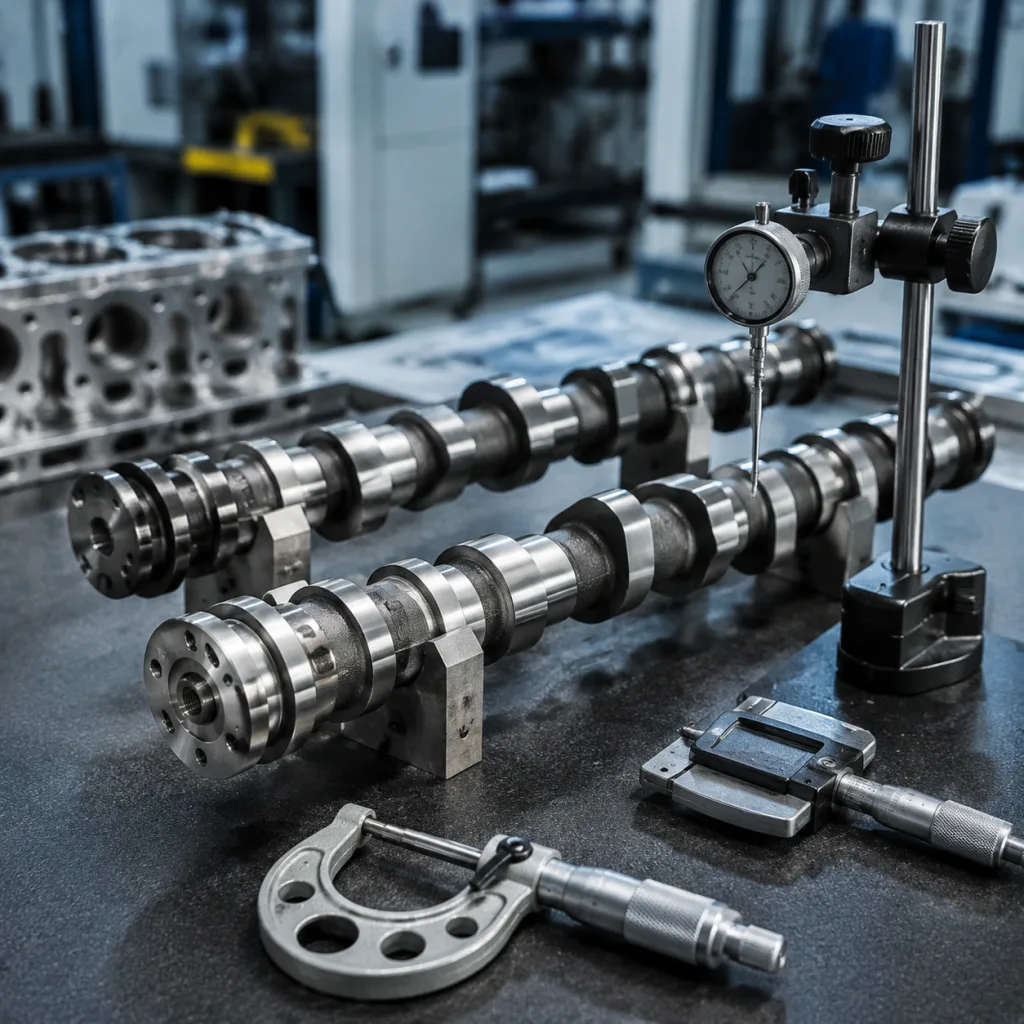
The measurement baseline matters as much as the reference number. Typical checks include overall length, journal diameters, thrust face width, dowel or keyway position, cam sensor feature, lobe lift, base-circle diameter, lobe centerline, oil-hole position, gear interface, and end runout. Catalogue items are normally checked against an approved internal master sample or application drawing. Reverse-engineered parts need at least one unworn sample; two or three samples are safer when used parts may have wear or previous machining.

Practical incoming-inspection targets may include journal diameter tolerance in the 0.010–0.020 mm range where the drawing supports it, lobe lift around ±0.03 mm, runout around 0.03–0.05 mm on datum journals, and surface roughness such as Ra 0.2–0.4 µm on journals and lobes. These are planning references, not universal rules. Final values must follow the drawing, validated sample, and engine application.

For related engine components and programme planning, buyers can review our catalog and the engine-component range at /products/engine-components.html. For non-catalogue geometry, custom manufacturing can be assessed with drawings, samples, or reverse-engineering data.

Where Camshaft Programmes Usually Fail

Most failed camshaft sourcing projects do not fail because the supplier cannot make one acceptable sample. They fail when the production process cannot repeat the sample. The common weak points are material variation, uncontrolled heat treatment, unstable grinding, poor straightening discipline, dirty oil holes, weak rust protection, and packaging that lets a good part arrive damaged.

A qualified camshaft GMC supplier should show control over the full route: casting or forging, blank inspection, rough machining, heat treatment, straightening, semi-finish grinding, lobe grinding, journal finish grinding, deburring, cleaning, corrosion protection, inspection, and packing. The correct route depends on engine duty cycle, volume, cost target, and design type: chilled cast iron, alloy cast iron, forged steel, steel billet, or assembled tube construction.

Key failure modes to discuss before order release include:

  • Lobe wear: often linked to inadequate hardness, poor surface finish, lubrication-hole contamination, or material mismatch
  • Noisy operation: commonly driven by profile variation, runout, journal error, or valve-train mismatch
  • Timing or sensor faults: caused by angular-indexing error, dowel position error, or incorrect trigger feature geometry
  • Early bearing distress: linked to journal diameter, roughness, straightness, oil-hole burrs, or cleanliness problems
  • Batch-to-batch drift: caused by weak grinder setup control, poor wheel dressing discipline, or unclear master-sample approval
  • Freight damage: caused by insufficient lobe separation, poor end protection, carton collapse, or corrosion during sea freight

Controlled characteristics should be written into the control plan, not left to operator judgment. Typical examples include material grade, lobe and journal hardness, chilled or case depth where specified, lobe lift, lobe angle, centerline, journal diameter, thrust face width, camshaft runout, surface roughness, cleanliness, and batch traceability. Cast-iron lobe surfaces often target about HRC 50–60 depending on grade and process, but the approved drawing or sample should define the final requirement.

Process discipline should also cover grinder wheel dressing frequency, coolant concentration, magnetic-particle or crack inspection where specified, gauge calibration interval, first-piece approval, patrol inspection, and final AQL or 100% checks for critical dimensions. For assembled camshafts, add tube straightness, lobe positioning, joining method, joining force where relevant, and angular indexing.

For new or high-risk parts, buyers can request a pre-shipment dimensional report covering 5–10 pieces from the pilot batch before carton release. Relevant management standards include IATF 16949:2016 and ISO 9001:2015. For regulated markets, material and substance declarations may reference REACH (EC) No 1907/2006 where applicable to the supplied product and destination.

Choose the Supply Route Before Negotiating MOQ

MOQ makes sense only after the supply route is clear. A catalogue replenishment order, a private-label range, a sample-based replacement project, and a drawing-controlled programme have different cost drivers. If they are compared only by unit price, the cheapest option may become the most expensive after tooling, validation, packaging, inspection, and freight are added.

</tr></thead><tbody> </tbody></table>When comparing quotes, separate part cost from tooling, sample cost, profile fixtures, packaging, inspection documents, PPAP work, and freight. A catalogue camshaft may quote as an EXW or FOB unit price with no tooling. A new casting or forging route may need a one-time tooling charge, sample charge, fixture cost, or documentation charge. Low MOQ usually raises the unit price because setup time, grinding changeover, inspection, carton printing, and export paperwork are spread across fewer pieces.

Lead time should be quoted as a range. Raw material availability, heat-treatment capacity, inspection-fixture readiness, artwork approval, drawing sign-off, and port schedule all affect the date. Buyers should define when the clock starts: purchase order, deposit receipt, drawing approval, artwork approval, or sample approval.

Recurring programmes are easier to stabilise with a 3–6 month rolling forecast and agreed safety stock. A practical planning range is 4–8 weeks of demand for fast-moving catalogue items, with longer coverage for low-volume or development parts using dedicated tooling. For urgent distributor orders, mixed-container planning with gaskets, water pumps, pistons, crankshafts, or turbochargers can reduce freight cost per SKU and improve container utilisation.

Incoterms also change the real price. Compare FOB Ningbo/Shanghai, CIF destination port, and air-freight options for samples or emergency replenishment. A low unit price can disappear quickly in inefficient partial-shipment logistics.

Choose the Supply Route Before Negotiating MOQ

Audit Evidence: What to Ask For and Why

A factory audit should answer one question: can this supplier prove that the next batch will match the approved batch? Certificate copies help, but they are not the whole answer. Procurement teams should request evidence that matches programme risk.

Driventus maintains a documented quality system aligned with IATF 16949:2016 and ISO 9001:2015. Audit discussions can cover document control, supplier management, heat-treatment control, calibration, nonconforming-product handling, corrective action, and traceability. If PPAP is required, the submission level and evidence scope should be agreed before quotation because they affect engineering time, sampling cost, and timing.

For catalogue aftermarket supply, a practical release file may include certificate copies, material confirmation, final inspection report, hardness readings, runout data, surface-finish readings where applicable, packing photos, and a shipment traceability list. For higher-risk projects, buyers can request process flow, PFMEA, control plan, dimensional layout, MSA for key gauges, initial process capability, sample approval records, and change-control rules.

Use this audit checklist as a working filter:

  • Certificate scope: valid IATF 16949:2016 and ISO 9001:2015 certificates covering the manufacturing location and product scope
  • Material control: incoming certificate review, heat or lot traceability, and segregation of nonconforming blanks
  • Heat-treatment control: furnace charts, hardness logs, chilled-zone checks, quench or cooling controls where applicable
  • Grinding control: wheel dressing records, coolant maintenance, grinder setup approval, and calibration status
  • Measurement method: lobe profile, journal diameter, lobe lift, angular position, thrust face, and runout inspection process
  • Inspection reaction plan: first-piece, in-process, and final inspection frequency, plus containment rules for out-of-tolerance results
  • Packaging validation: drop protection, VCI or anti-rust oil method, humidity control, and carton compression suitability
  • Corrective action: nonconformance containment, 8D process, customer-complaint timing, and repeat-issue prevention
  • Export file: invoice, packing list, origin documents, inspection files, and destination-market document controls

Capability targets such as Cpk ≥1.33 are common for stable special characteristics when the measurement system and sample size support statistical review. The exact requirement should be agreed during APQP, not added after sampling.

Record retention should also be defined. A common aftermarket expectation is at least three years for batch inspection records; OE/Tier-1 programmes may require longer retention under customer-specific requirements. Any change to material grade, process route, heat-treatment source, lobe profile, packaging, or manufacturing site should require written approval before shipment.

For emissions-related engine parts, avoid unsupported claims. Standards such as ECE R-83 define emissions requirements at the vehicle level. A replacement camshaft supplier should provide dimensional, material, inspection, and process evidence rather than claim vehicle certification unless the programme has formal validation.

Scenario: The Part Is Right, but the Shipment Fails

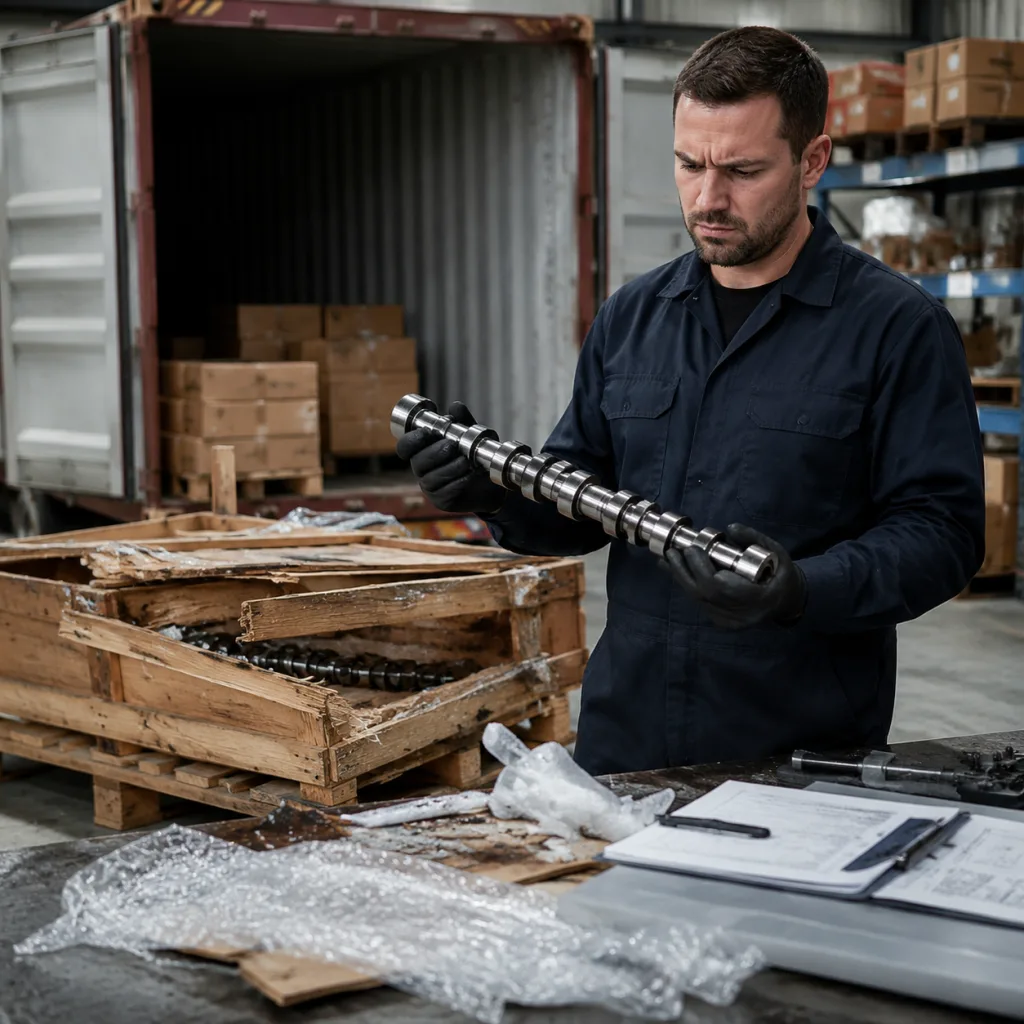
A camshaft can pass inspection and still fail commercially if packaging, labelling, or import data are weak. Long machined parts are vulnerable. Lobes and journals can be marked by impact, ends can break through cartons, corrosion can appear after sea freight, and poor labels can slow warehouse receiving or trigger customer claims.

For importers serving the EU, UK, US, Canada, Australia, Brazil, and other aftermarket regions, packaging is part of the product. It affects scanning, claim rate, distributor labour, brand perception, and customs readiness. Common B2B requirements include neutral boxes, private-label cartons, pallet labels, barcode labels, country-of-origin marking, desiccant, VCI protection, and part-number cross-reference labels. Labelling should not imply endorsement by any vehicle manufacturer; brand names should be used only for fitment identification where permitted by the buyer’s market rules.

A practical camshaft packing method uses anti-rust oil or VCI bagging, individual sleeve or foam support at journals, end protection, lobe separation, inner carton restraint, and outer master-carton or pallet protection. For longer or heavier parts, buyers should specify maximum carton weight, pallet height, corner protection, strapping, and whether wooden pallets must comply with ISPM 15. Courier and LCL shipments usually need stronger cartons and more internal blocking than full-container sea freight.

Lock label data before production. Typical fields include buyer part number, Driventus or supplier part number where agreed, quantity, batch or lot number, production date, country of origin, barcode type such as EAN-13, UPC, Code 128, or QR code, and allowed fitment cross-reference. For private-label work, carton artwork should be approved as a PDF proof and, where needed, as a physical or photo sample before mass packing.

A broker-ready shipment file usually includes commercial invoice, packing list, certificate of origin where required, bill of lading or airway bill, inspection report, and agreed product photos. For restricted substances, buyers may request declarations connected to REACH (EC) No 1907/2006. Packaging materials may also need to meet destination-specific wood packaging, recycling, or extended-producer-responsibility requirements.

For US-bound shipments, importers may also need clear HTS classification, country-of-origin marking, and packing data that matches the broker’s format. Buyers should confirm final import classification with their customs broker. Driventus is an independent aftermarket manufacturer; brand names are referenced for fitment only.

Scenario: The Part Is Right, but the Shipment Fails

Shortlist Q&A for a Camshaft GMC Supplier

Q: Should the shortlist start with price or capability?

Start with capability. Price matters, but only after fitment, process route, inspection depth, certifications, export experience, communication speed, and repeat-order support are understood. A low unit price has limited value if batch variation creates returns or if labels, cartons, and documents change every shipment.

Q: What is the fastest way to compare suppliers?

Use the same RFQ pack for all candidates. Confirm application data, engine code, model-year range, fuel type, valve-train layout, and sensor or timing feature. Send the OE or aftermarket cross-reference, drawing, sample photos, and a clear note on whether the requirement is catalogue supply or new development.

Q: What should the quotation show?

Ask for MOQ, price basis, Incoterms, tooling cost if any, sample cost, inspection-document cost, packaging cost, lead-time range, and assumptions. If one supplier includes carton artwork, inspection reports, and FOB freight handling while another does not, the unit prices are not comparable.

Q: How should samples be approved?

Approve samples through dimensional checks first. Add hardness review, profile comparison, bench validation, or engine validation where the application requires it. Confirm packaging, labelling, palletisation, barcode rules, destination-market documents, and allowed fitment wording before the pilot order, not after production.

Q: What weighting works for a sourcing scorecard?

A practical scorecard can weight quality and process capability at 35–40%, landed cost at 20–25%, delivery and lead-time reliability at 15–20%, documentation and audit support at 10–15%, and communication or engineering response at 10%. Adjust the weighting by business model. Distributors may prioritise SKU breadth and landed cost. Repair chains often prioritise warranty control and packaging consistency. OEM or Tier-1 buyers should place more weight on APQP, drawing control, change management, and audit readiness.

Q: Where does Driventus fit?

Driventus can support standard catalogue supply or engineered camshaft programmes depending on volume, documentation requirements, packaging route, and validation plan. A pilot order is recommended before full annual-volume release so incoming defects, claim rate, delivery performance, and document consistency can be reviewed under real operating conditions.

Frequently asked questions

Provide engine code, displacement, model-year range, target market, annual volume, packaging requirement, and any existing OE or aftermarket cross-reference data. For development work, send a drawing or physical sample and define key inspection requirements such as lobe lift, journal diameter, runout, hardness, surface finish, and validation expectations before quotation.

Yes. Private-label cartons, neutral packaging, barcode labels, pallet labels, corrosion protection, and packing photos can be arranged. Artwork, label format, barcode type, carton strength, country-of-origin wording, and destination-market marking rules should be confirmed before mass production.

No. Driventus is an independent aftermarket manufacturer; brand names are referenced for fitment only. We provide dimensional, material, inspection, traceability, and quality-system evidence without claiming endorsement by any vehicle manufacturer.

For camshaft sourcing, catalogue review, audit documentation, or sample-based development, send your application list, cross-reference data, target MOQ, annual volume forecast, packaging route, destination port, and required inspection documents. You can [request a quote](/contact.html).

Request a Quote
Supply route Best fit MOQ logic Typical lead time after order confirmation Buyer documents needed
Catalogue aftermarketDistributor stock replenishmentOften 50–200 pcs per part number, or carton/pallet multiples for small SKUs15–35 days if blanks or finished stock are available; 35–60 days if production is scheduledApplication list, forecast, label format
Private-label catalogueWholesaler or repair-chain brandUsually 100–300 pcs per SKU, or one packaging print batch if cartons are customised30–55 days including artwork, barcode, carton proof, and packing approvalArtwork, barcode rules, market compliance needs
Sample-based developmentHard-to-source replacement rangeTrial batch often 20–50 pcs after sample approval; mass MOQ depends on tooling and blank route60–120 days for reverse engineering, trial machining, inspection, and approvalPhysical sample, annual volume, test criteria
Drawing-based projectOEM/Tier-1 or structured aftermarket programmeAgreed project volume tied to forecast, tooling amortisation, and PPAP scope90–180 days depending on APQP, tooling, validation, and submission levelDrawing, material spec, tolerance table, audit requirements