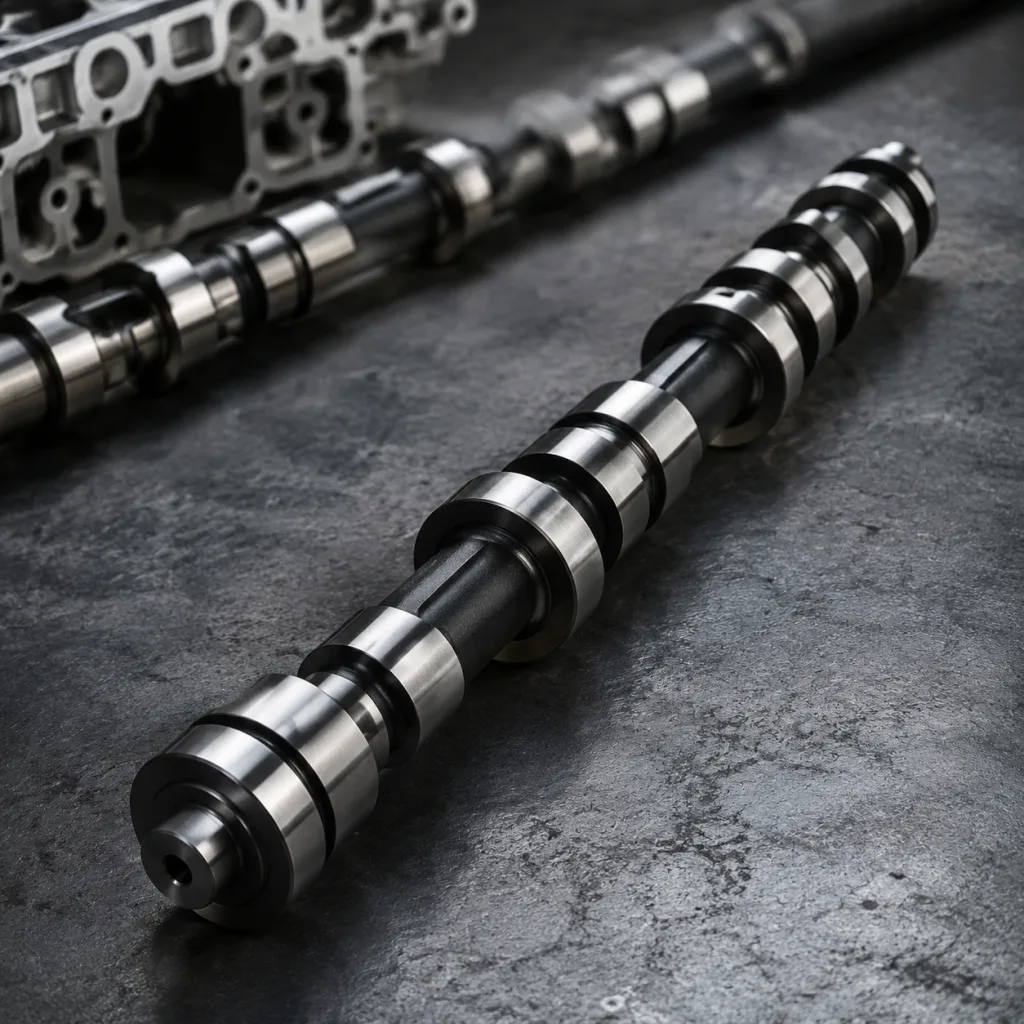
Sourcing a camshaft for GMC Acadia aftermarket replacement is not a “match the vehicle name” exercise. The part has to repeat the original valvetrain geometry, oil-feed layout, sensor trigger pattern and timing interface closely enough to protect installers, distributors and private-label programs from noise, fault codes and warranty returns. One small miss can be expensive: a 0.05 mm journal error, an incorrect reluctor angle or an undocumented hardness band may pass a visual check but fail in the field.
Driventus manufactures engine and powertrain components in Taizhou, Zhejiang, with process controls aligned to IATF 16949:2016 and ISO 9001:2015. This article gives procurement teams a practical way to evaluate Acadia V6 replacement camshafts: how to define fitment, where failures start, which specifications deserve tighter control, what documentation to request and how MOQ, price and lead time should be linked to engineering risk. Driventus is an independent aftermarket manufacturer; brand names are referenced for fitment only.
Decision Gate: Confirm the Exact Acadia Variant Before Price Talk
The first sourcing decision is not material or unit price. It is whether the supplier is quoting the same camshaft the buyer needs.
GMC Acadia applications can differ by model year, engine code, intake or exhaust position, bank orientation and camshaft position sensor arrangement. Two shafts may look close on a screen and still be wrong if the reluctor profile, oil groove location, thrust feature, phaser interface or timing sprocket mounting changed during a production revision.
Do not source by vehicle name alone. Build the RFQ around the variant:
Engine displacement and engine code where available, such as buyer-supplied 3.6L V6 application data
Model-year range, market region and VIN breakpoint if the catalog has split-year coverage
Intake or exhaust position, because lobe order and sensor logic are not interchangeable
Left-bank or right-bank orientation, confirmed by engine layout rather than catalog wording alone
Timing sprocket interface, including dowel pin, bolt pattern, flange thickness and phaser contact face
Sensor trigger or reluctor configuration, including tooth count, tooth width and angular reference position
OE cross-reference format, supersession history and excluded references
Existing aftermarket numbers to match, avoid or cross-check during catalog mapping
A useful RFQ package includes clear photos of both shaft ends, the reluctor, oil-feed holes, thrust faces and all stamped or etched marks. If the buyer can supply a sample, Driventus normally treats it as the physical baseline for reverse checking before quotation.
For unknown variants, use this sequence: sample measurement first, tooling feasibility second, price confirmation third. Quoting from an incomplete fitment line may look faster, but it usually increases catalog-correction risk later.
Although the keyword camshaft for gmc acadia aftermarket replacement describes a fitment-driven part, catalog control is the first quality gate. Driventus maps applications against customer-supplied references, sample parts and engineering drawings before production release. Related engine parts can be reviewed in our catalog and the engine component range at /products/engine-components.html.
Failure Modes: The Small Geometry Errors That Create Big Claims
A replacement camshaft must reproduce the functional geometry of the original part. The dangerous deviations are often small. Lobe lift, base-circle diameter, journal alignment and phase relationship all affect valve timing, idle quality, emissions behaviour and diagnostic monitoring.
For V6 replacement programs, separate critical-to-quality characteristics from normal process characteristics before the supplier starts sampling.
Feature
Procurement check
Typical control target to define
Typical risk if incorrect
Overall length
Match drawing or approved sample
±0.10 mm, or buyer drawing tolerance
Thrust misalignment or cover interference
Journal diameter
Control to application tolerance
Often within ±0.01–0.02 mm depending on bearing design
Low oil pressure, seizure or excess noise
Journal roundness
Measure at multiple clock positions
Typically ≤0.01 mm where specified
Oil-film instability and accelerated wear
Total indicated runout
Check between centres after final machining
Common target ≤0.03–0.05 mm
Noise, uneven journal load or assembly difficulty
Lobe lift
Verify by profile measurement
Commonly ±0.03 mm from master profile
Misfire, reduced volumetric efficiency
Base-circle diameter
Compare across all lobes
Application-specific, usually held tightly to sample
Valve lash or hydraulic lifter preload error
Lobe centre angle
Check against master profile
Often controlled within ±0.5° crank/cam equivalent as specified
Timing deviation and fault codes
Reluctor profile
Match to sensor strategy
Tooth count, width and angular reference locked to sample
Crank/cam correlation errors
Oil holes and grooves
Inspect position and diameter
Hole diameter and groove width per drawing or sample
Starved journals or delayed phaser response
Sprocket interface
Check keyway, pin, bolt or flange
Datum position and face runout controlled
Incorrect cam phasing or assembly failure
</tr></thead><tbody> </tbody></table>A strong approval rule is simple: do not release mass production until the first-article report, profile chart, hardness result and packaging sample are approved together. Separate approvals create gaps. One team approves dimensions, another approves packaging, and nobody confirms the full launch condition.
Driventus recommends retaining a golden sample for each camshaft variant. Production batches can then be checked against the same baseline using CMM inspection, runout measurement, cam profile tracing and surface profile comparison.
Where drawings are unavailable, reverse engineering should be controlled through approved samples and buyer sign-off before tooling release. Define the datum system in writing: journals as primary datums, thrust face as axial datum and timing interface as angular datum, for example. Otherwise, one supplier may measure from the sprocket end while another measures from the reluctor end. Both reports can appear compliant while the engine sees a different part.
Spec Deep-Dive: Material, Hardness and Surface Finish Are One System
Camshaft durability is not decided by material name alone. Material route, heat treatment, hardened depth, grinding quality and surface cleanliness work as one system. A cheap substitution may pass a visual receiving check and still fail through lobe pitting, journal wear or torsional fatigue after installation.
Common manufacturing routes include chilled cast iron, ductile iron and forged or machined steel, depending on the camshaft design. The correct route is application-specific. If the original design uses a cast profile, changing to a different casting grade or heat-treatment path should be treated as an engineering change, not a purchasing shortcut.
Ask suppliers for evidence tied to the finished part, not generic capability claims:
Material grade and chemical composition range, supported by mill certificate or foundry heat record
Heat-treatment method and target hardness range, such as lobe hardness commonly controlled around 50–60 HRC or equivalent depending on material route
Case depth or hardened layer requirement where applicable, defined as an effective depth rather than only surface hardness
Journal and lobe surface roughness targets, commonly Ra 0.2–0.8 μm depending on the functional face and drawing requirement
Straightness or runout tolerance after machining, checked after heat treatment and final grinding
Magnetic particle, eddy-current or visual crack inspection plan where used, including sampling frequency
Residual burr control at oil holes, keyways and reluctor edges to prevent contamination and sensor damage
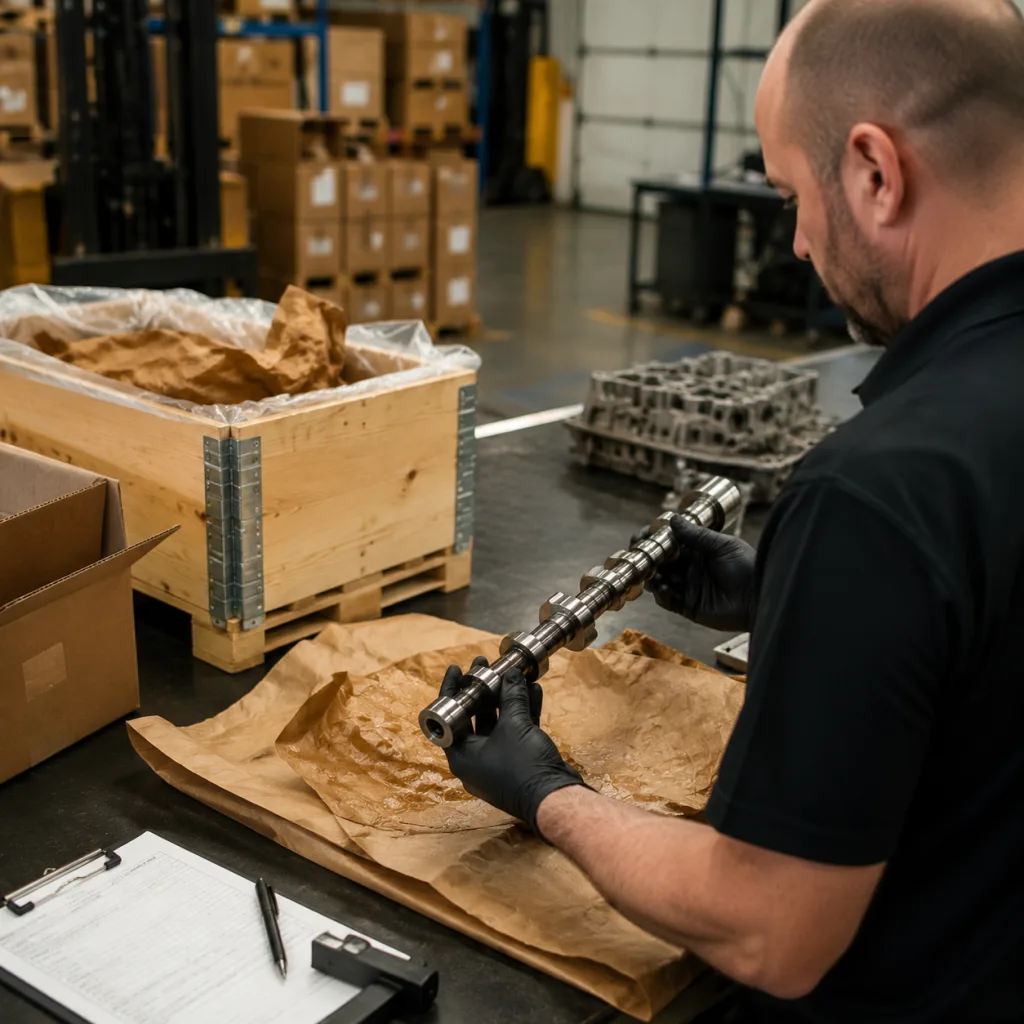
Rust-prevention method and export packaging specification, including oil, VCI bag, desiccant or sealed inner carton as required
Surface condition deserves extra attention. Many warranty returns begin as boundary-lubrication failures. A rough lobe surface can accelerate follower wear. An incorrectly finished journal can damage the cylinder head bearing surface. Burrs near oil holes can introduce debris exactly where the engine cannot tolerate it.
Driventus controls machining, washing, anti-rust treatment and packing as linked process steps under its documented quality system.
For a buyer-ready control plan, inspection frequency should change by feature. Material chemistry is normally checked by heat lot. Hardness is checked by batch and location. Profile and runout are checked at first article plus periodic sampling. Visual condition and rust protection should be covered by 100% final inspection. For private-label or high-volume programs, buyers can also request retained samples from each production lot for 12–24 months to support later field analysis.
Validation Path: Choose the Test Level by Warranty Exposure
Not every camshaft program needs the same validation package. The right level depends on sales volume, warranty exposure, private-label risk and destination-market requirements.
A low-volume service part may need first-article approval and batch inspection. A national repair-chain program may justify PPAP-style submission, capability data and retained sample rules. The mistake is to ask for the cheapest quote first and define the validation burden later.
Typical validation controls include:
Incoming material inspection with chemistry and mechanical property review by heat or melt lot
First-article dimensional report for journals, lobes, thrust faces, oil holes and timing interface
Cam profile measurement for lift curve and angular position, with master profile overlay where available
Hardness testing on lobes and journals, with test location identified on the report
Runout testing after final machining, preferably between centres using a defined datum method
Surface roughness measurement on functional surfaces, with Ra value and measurement direction recorded
Dynamic or fixture-based timing interface verification, including reluctor orientation and sprocket datum
Salt-spray or humidity checks for packaging and corrosion protection when specified by the buyer or destination market
Trial assembly on fixture or sample cylinder-head interface where the program value justifies it
Lot traceability check from raw material batch through machining, heat treatment, inspection and carton label
For higher-risk launches, use staged approval. Start with 3–5 prototype samples for dimensional review. Move to 10–30 pilot pieces for packaging and receiving checks. Then place a controlled first order after approval.
If capability evidence is required, agree the numbers before sampling. Critical dimensions such as journal diameter, lobe lift and runout can be reported with Cp/Cpk targets agreed in advance, commonly 1.33 or higher for stable production characteristics where the measurement system supports it.
For emissions-related engine components, the camshaft affects combustion stability and diagnostic monitoring. Vehicle-level compliance standards such as ECE R83 may apply to the completed vehicle or engine calibration, but an aftermarket camshaft supplier should not claim vehicle manufacturer approval or emissions certification unless it is formally documented by the relevant authority.
Driventus can support distributors and repair-chain programs with PPAP-style documentation where contractually agreed, inspection reports, batch traceability and packaging labels aligned to customer ERP requirements. Define the document set before pricing. Full PPAP-style reporting, special gauges, retained samples and extra testing can change tooling cost, unit price and lead time.
Importer Scenario: What Must Be Traceable After the Shipment Arrives
Imagine a distributor receives a mixed shipment for several engine-component lines. The cartons look fine. Six months later, a repair chain reports camshaft noise on a small number of units. The question is immediate: which production lot, which material heat, which inspection report and which customers are affected?
That is why documentation has to connect the sold part number to the physical production lot. A commercial invoice is not enough.
A practical sourcing file should include:
Part number and application list, including model-year boundaries and excluded variants
Buyer-approved cross-reference table with OE, aftermarket and private-label numbers separated
Drawing revision or sample approval record, with approval date and responsible contact
Material specification and heat-treatment record, linked to batch or lot number
Cam profile or lift curve record for approved first article and any engineering change
Batch or lot traceability code shown on part label, inner box and master carton where required
Packaging specification and carton label format, including barcode type such as Code 128, EAN-13 or buyer ERP format
Country of origin declaration where required
REACH (EC) No 1907/2006 status for applicable substances in EU supply chains
Quality certification references, including IATF 16949:2016 and ISO 9001:2015 where relevant
Warranty claim template defining photos, mileage, installation date, oil condition notes and fault codes required for review
Importers in the EU, UK, US, Canada, Australia and Brazil may have different customs and compliance expectations, but the receiving logic is similar: the file should make inspection, inventory control and claim review faster.
Predefine the sampling plan before goods arrive. A common commercial approach is 100% supplier-side visual and packaging inspection, plus buyer-side dimensional sampling from each lot. Critical features such as journal diameter, lobe lift and timing interface should have tighter acceptance rules than carton scuffs or label position.
Driventus exports to more than 60 countries and structures documentation for B2B receiving and aftersales teams. For private-label projects, custom manufacturing can include buyer-specific numbering, neutral packaging, barcode formats and agreed inspection plans. Driventus is an independent aftermarket manufacturer; brand names are referenced for fitment only.
Step-by-Step RFQ: Lock Engineering, Commercials and Launch Timing
A purchase order should come after the technical and commercial assumptions are locked. Otherwise, a low unit price can turn into warranty claims, stock corrections and catalog clean-up work.
Use the checklist as a controlled sequence, not an afterthought.
Step
Buyer action
Supplier evidence to request
1
Confirm exact application range
Fitment table, OE cross-reference and sample comparison record
2
Verify intake/exhaust and bank position
Drawing, photo control sheet or inspection fixture data
3
Approve functional dimensions
First-article inspection report with tolerance column
4
Confirm material and hardness
Material certificate, heat-treatment record and hardness readings
5
Review surface finish
Roughness values, lobe photos and visual inspection records
6
Validate packaging
Anti-rust method, inner protection, carton drop protection and label sample
7
Lock traceability
Batch code format, carton code position and record retention policy
8
Agree warranty handling
Defect photo requirements, return analysis process and response timeline
9
Confirm commercial basis
MOQ, price validity, Incoterm, currency and tooling or sample cost
10
Confirm launch schedule
Sample lead time, mass-production lead time and shipping plan
</tr></thead><tbody> </tbody></table>MOQ and price belong inside the engineering discussion. For a standard camshaft with existing tooling and confirmed references, MOQ is usually driven by machining setup, heat-treatment batch size and packaging print quantity. For a new or uncertain variant, expect sample or tooling charges, a higher first-order MOQ and more time for reverse engineering.
Unit price is normally affected by material route, machining cycle time, heat-treatment method, inspection level, packaging type, annual forecast and Incoterm, whether FOB, CIF, DAP or another agreed basis.
As a planning guide, sample development for an existing design may take about 2–4 weeks after data confirmation. New reverse-engineered variants can require 6–10 weeks depending on sample availability, tooling, fixtures and validation depth. Repeat production is often planned around a 30–60 day manufacturing window after deposit and packaging approval, with ocean freight, customs and inland delivery added separately.
Seasonal demand changes the risk profile. Buyers should place releases early enough to avoid combining rushed production with rushed inspection.
A controlled RFQ should state annual forecast, release quantity, target packaging, destination port, required documents, acceptable Incoterm, target price logic and whether samples are needed before mass production. Buyers can request a quote with application data, drawings or sample photos so the engineering team can confirm feasibility before pricing.
Frequently asked questions
No. Fitment can vary by engine code, model year, intake or exhaust position, bank orientation and sensor trigger design. Buyers should source by confirmed application data, VIN split where available and approved cross-reference records, not vehicle name alone.
Request first-article dimensions, cam profile data, hardness results, surface roughness readings, runout checks, material records and batch traceability. High-volume programs should also define sample retention, AQL rules, critical-feature tolerances and warranty analysis requirements.
No. Driventus is an independent aftermarket manufacturer; brand names are referenced for fitment only. No vehicle manufacturer approval, endorsement or emissions certification is claimed unless separately documented by an authorised party.
For a controlled quotation, send your application list, target volume, expected MOQ, destination port, preferred Incoterm and required documentation package. Contact Driventus to discuss sampling and supply options at /contact.html