Camshaft Genesis Wholesale: Sourcing Guide for Buyers
Procurement teams sourcing `camshaft genesis wholesale` parts need a decision process, not a generic catalog pitch. The buy depends on engine code, lobe geometry, journal finish, heat treatment, packaging, and batch traceability. For distributors, repair networks, and Tier-1 supply chains, the main risks are dimensional mismatch, unstable lead times, and weak documentation. Driventus is an independent aftermarket manufacturer; brand names are referenced for fitment only. We supply camshafts from a vertically integrated plant in Taizhou, Zhejiang, with export experience in more than 60 countries and production controls aligned to `IATF 16949:2016` and `ISO 9001:2015`. This article shows how to verify fitment, compare suppliers, and prevent avoidable receiving issues before a wholesale order ships.
Start with fitment, not the model name
When sourcing camshaft Genesis wholesale stock, the vehicle badge is the wrong starting point. The same model line can use different cam profiles, sensor trigger positions, and bearing journal dimensions across production years.
Minimum checks before you request pricing
- Engine code and displacement
- Number of lobes, journals, and bearing locations
- Overall length, nose form, and drive-end geometry
- Surface finish on journals and lobes
- Heat-treatment method and hardness band
- Packing method for corrosion protection
- Batch traceability and inspection record
If your sheet only lists the model name, the quote is not ready. Ask for dimensional confirmation against the OE reference, such as OE `06A107065` when that cross-reference is already used in your internal catalog. Also confirm whether you are buying a finished camshaft, a blank, or a machined semi-finished component.
Where wholesale orders fail in practice
Most camshaft sourcing problems are not pricing problems. They come from assumptions that looked harmless on paper.
Common failure modes include:
- A correct vehicle listing but the wrong engine variant
- A part that matches visually but misses journal tolerance
- Incomplete hardness or runout data
- Packaging that allows corrosion or transit damage
- A sample that passes, while batch consistency drifts later
- Lead times that ignore sample approval and first-article checks
The cheapest offer can become the most expensive one once a warehouse rejects the shipment or a repair network reports fitment variance. That is why procurement teams should treat the specification file as part of the order, not as supporting paperwork.
What a camshaft spec sheet must show
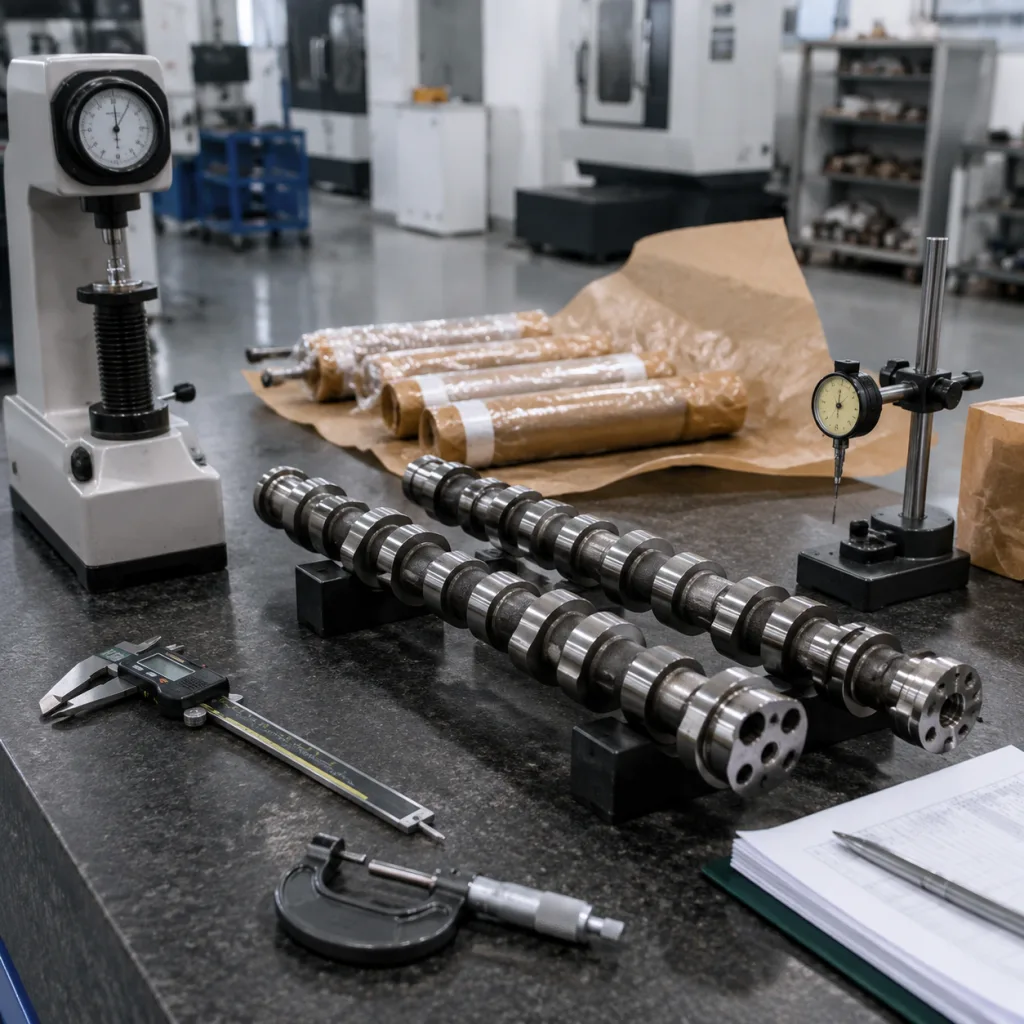
A camshaft quote should include the measurable features that affect fitment and valve timing. If these are missing, the return risk rises immediately.
| Specification item | Why it matters | What to request |
|---|---|---|
| Overall length | Affects block and head fit | Millimetre value from drawing or sample |
| Journal diameter | Controls bearing clearance | Nominal size and tolerance band |
| Lobe lift and profile | Affects airflow and valve event timing | Profile data or equivalent OE match |
| Nose and drive-end geometry | Needed for timing components | Clear end-view drawing |
| Surface hardness | Affects wear life | Hardness range and test method |
| Runout | Impacts vibration and valvetrain stability | Measured runout limit |
| Surface roughness | Influences wear and oil film | Ra or equivalent surface value |