Camshaft Ford Supplier: Sourcing and Quality Checks
A camshaft Ford supplier should be judged on evidence, not catalogue breadth alone. For Ford-fit camshafts in passenger car, light commercial, fleet repair, and aftermarket distribution channels, the buying risk usually sits in four places: application accuracy, lobe and journal control, hardening consistency, and repeatable supply after sample approval. Price still matters, but a low quote can lose value quickly if the shaft does not match the engine code, arrives with mixed revisions, corrodes in storage, or lacks batch records when a claim appears.
Driventus is an independent aftermarket manufacturer; brand names are referenced only for fitment identification. Our B2B model supports catalogue stock, private-label programmes, and custom manufacturing for OE cross-reference parts where the application data is already established, including references such as OE 06A107065 where applicable. Sourcing reviews can be aligned with recognised systems such as IATF 16949:2016 and ISO 9001:2015, plus buyer-defined AQL plans, validation gates, packaging rules, and inspection records.
Start With the Fitment Decision, Not the Quote
Before comparing prices, decide exactly which engine variant the part must serve. A one-character engine-code difference can change the intake/exhaust side, lobe phasing, journal width, sensor trigger pattern, thrust face, or timing drive interface. Treat each part number and revision as a separate sourcing line until interchangeability is proven.
Minimum data set for a clean RFQ:
Engine family, displacement, fuel type, and model-year range
OE or aftermarket reference number, including supersession chain
Intake or exhaust side identification and quantity per engine
Base circle, lobe lift, lobe separation, and installed height targets
Journal diameter, journal width, overall length, and thrust face detail
Timing interface, dowel or pin position, sensor wheel, and end-thread specification
Packaging, labelling, barcode, and market-specific marking requirements
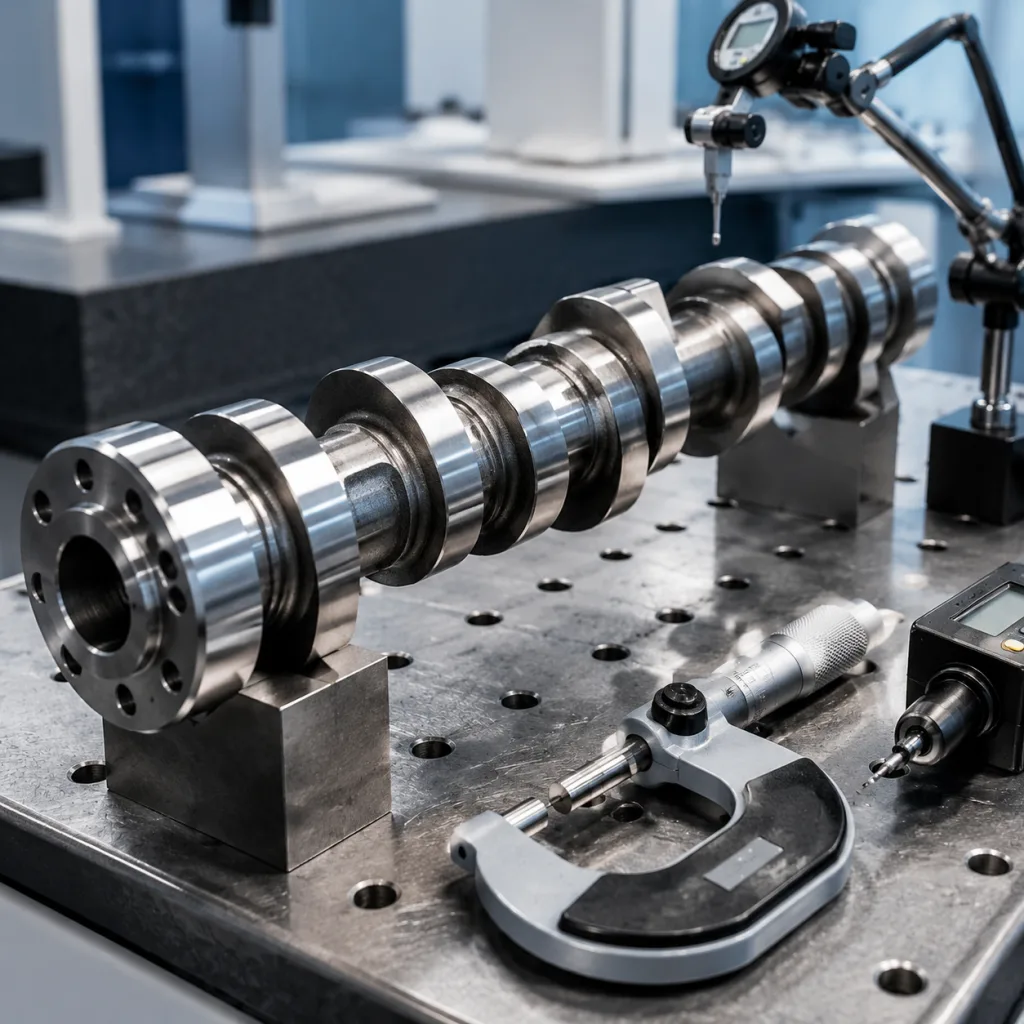
Set the inspection language early. Buyers commonly define journal diameter tolerance around ±0.010 mm, lobe lift tolerance around ±0.030 mm, total indicated runout around 0.030-0.050 mm, and surface roughness targets such as Ra 0.2-0.4 µm on bearing journals and Ra 0.4-0.8 µm on lobe contact areas, subject to the approved drawing and engine family. If the drawing uses inch units, lock the conversion and rounding rule before the first measurement report.
Also define the supply form: bare shaft, matched follower set, bearing-supported kit, or service package. If the programme covers several engine revisions, write down the revision code, cross-reference logic, and substitution rules before sample approval. That single step reduces mixed-fit shipments, warehouse relabelling, and avoidable claims during inbound inspection.
Where Supplier Promises Usually Fail
The weak point is rarely the first sample. It is whether the camshaft Ford supplier can hold the same route through pilot and repeat orders. At Driventus, commercial terms are built around forecast demand, order minimums, release schedules, inspection level, and packaging format. For active catalogue references, MOQ may be carton- or pallet-based. For slow-moving or custom references, MOQ is normally driven by casting or forging lot size, heat-treatment batch size, machining setup time, and printed packaging runs.
Sourcing topic
Practical target to confirm
Risk if ignored
MOQ
Stock item: often 50-100 pcs; custom item: often 300-1,000 pcs by PN
Excess stock or weak price leverage
Sample lead time
Typically 20-35 days after data confirmation
Late fitment approval
Pilot order
Typically 45-60 days after sample approval
Unproven packaging and logistics flow
Mass production
Typically 60-90 days, depending on route and quantity
Missed launch or replenishment window
Price logic
Lower tiers often at 100 / 300 / 500 / 1,000 pcs
Poor landed-cost planning
Traceability
Heat number, batch code, inspection record, packing list
Slow claim containment
Certification
IATF 16949:2016 and ISO 9001:2015 evidence
Limited process audit trail
Packaging
VCI bag or oil paper, end protection, export carton, pallet
Corrosion and transit damage
</tr></thead><tbody> </tbody></table>Do not compare only EXW unit price. Ask for quote basis, fixture or tooling charge, sample cost, inspection scope, incoterms, pallet configuration, gross weight, and price validity. A part that looks 3-5% cheaper can cost more once MOQ, freight density, rework, and delayed replenishment are included.
Buyers in the EU, UK, US, Canada, Australia, and Brazil often rank supply continuity beside price. For growing programmes, our custom manufacturing route can support private-label or drawing-based requirements while keeping the approved fitment basis under control. The most useful forecast is split into annual demand, first release, reorder quantity, and safety-stock target.
Spec Deep-Dive: Material, Hardness, and Wear
Camshaft life depends on the base material, hardening route, lobe geometry, lubrication environment, and final surface finish. Ask for the material specification in writing, then connect it to the duty cycle and warranty expectation. Chilled cast iron, ductile iron, alloy cast iron, forged steel, and billet or alloy steel do not behave the same in cost, machinability, hardening response, or wear resistance.
Control points worth locking:
Material grade and standard, such as chilled cast iron, ductile iron, or alloy steel according to the approved drawing
Induction hardening, chill-cast wear surface, nitriding, or another agreed hardening route
Surface hardness target, commonly reviewed in the 50-62 HRC range depending on material and process
Effective hardened depth, often around 1.0-3.0 mm for induction-hardened lobes where specified
Journal roundness, lobe profile accuracy, taper, and runout control
Surface roughness on bearing journals, lobe nose, flank, and base-circle areas
Phosphate, oiling, VCI, or sealed anti-rust packaging for 6-12 months of normal warehouse storage
For fleet and aftermarket programmes, broad durability statements are not enough. Useful evidence includes bench checks, dimensional comparison, hardness mapping, and vehicle or engine testing matched to the use case. High-mileage fleets, extended idle time, stop-start operation, cold starts, and long oil-change intervals all increase the value of profile-stability evidence after thermal cycling and lubrication checks.
Define rejection criteria before testing starts: no abnormal pitting, no spalling, no journal scoring, no measurable lobe collapse outside the agreed tolerance, and no timing-interface deformation after installation torque checks. A compact report with pre-test and post-test lobe lift readings, wear photos, hardness results, and oil assumptions is more useful than a generic durability certificate.
Build the Audit Trail Before Shipment
Quality assurance should be fixed before the first commercial shipment leaves the factory. Procurement teams often request PPAP-style support, dimensional reports, material or hardness evidence, and incoming inspection criteria even for aftermarket supply. Define what is checked at first article, what is checked per batch, and what is checked by sampling during final inspection.
Our quality system covers controlled inspection, traceability, and corrective-action handling under IATF 16949:2016 and ISO 9001:2015. For buyers, this creates a clearer audit trail, faster batch review, and fewer specification disputes.
Useful inspection records:
First-article dimensional report with drawing balloons or agreed key characteristics
Runout and concentricity checks at journals and timing end
Lobe lift, base circle, journal diameter, overall length, and thrust-face readings
Hardness results by batch, with location stated for lobe and journal areas
Surface roughness report where required by drawing or critical-characteristic list
Visual finish and edge-condition record covering burrs, nicks, rust, and casting defects
Packing, labelling, barcode, carton quantity, and pallet quantity confirmation
Sampling should match risk and order size. A practical approach is 100% visual inspection, 100% critical-interface checks during setup approval, and AQL-based final inspection for batch release. Higher-risk launch orders may use tightened inspection for the first 1-3 shipments. State whether you require AQL 1.0, 1.5, 2.5, or a custom plan, and classify features as critical, major, or minor.
If your team audits suppliers, request the process flow, control plan, inspection method, gage calibration status, nonconforming-material procedure, and change-control process. These documents separate a stable production programme from a short-term trading offer. They also make claims easier to investigate by batch, heat number, inspection date, operator record, and shipment lot.
Choose the Route: Aftermarket, Fleet, or Tier Supply
A Ford camshaft programme may support wholesalers, repair chains, fleet maintenance networks, or Tier-1 channels. The buying logic changes by route. Aftermarket distributors usually prioritise coverage, realistic MOQs, clear catalogue mapping, and resale-ready packaging. Fleet buyers focus on repeat availability and failure containment. OEM and Tier-1 buyers normally require tighter tolerance control, formal revision approval, PPAP-style documentation, and deeper validation records.
For market cross-referenced parts, the offer sheet should document OE number matching, including references such as OE 06A107065 where applicable. It should also state the engine code, application notes, intake/exhaust side, superseded numbers, excluded variants, and whether the part is interchangeable with earlier or later revisions. If the catalogue data is uncertain, approve by physical sample and measurement comparison before commercial release.
Driventus does not claim vehicle manufacturer approval or endorsement. We are an independent aftermarket manufacturer; brand names are referenced for fitment identification only. This matters for compliance, packaging, advertising, and marketplace listings. Buyers using private-label packaging should provide approved wording, warning labels, barcode format, carton artwork, and trademark restrictions before production.
If your line card already includes related engine parts, review our catalog and the broader engine components range. Consolidating adjacent programmes such as gaskets, water pumps, crankshafts, timing components, and turbo-related components can simplify documentation, carton planning, and shipment coordination. For mixed-container orders, align carton quantities and pallet heights early so camshafts are not loaded under heavier engine parts.
RFQ Sequence That Speeds Approval
A strong enquiry answers feasibility questions before the supplier has to ask them. Send the engine code, OE reference, annual demand, target market, packaging format, required document set, and validation requirement before requesting final pricing. For a direct replacement, include a drawing or sample. For catalogue expansion, include the competitor reference, vehicle application list, and expected first-year sales volume.
RFQ content that prevents delays:
Part number or OE cross-reference, including superseded numbers
Engine family, displacement, fuel type, model years, and market region
Intake/exhaust side, quantity per engine, and excluded variants
Estimated annual volume, first order quantity, reorder quantity, and release pattern
Required certifications, PPAP level, inspection reports, or material records
Sample quantity, sample deadline, and delivery address
Target incoterms, destination port or warehouse, and lead-time window
Packaging format, label language, barcode type, carton quantity, and pallet limits
Target price level or landed-cost ceiling, if your sourcing policy allows disclosure
The quotation should then show unit price by tier, MOQ, sample cost, tooling or fixture cost if applicable, sample lead time, production lead time, payment terms, incoterms, packing dimensions, and document package. Many buyers request pricing at 100, 300, 500, and 1,000 pcs to see whether a cost break justifies a larger release.
If annual demand is uncertain, start with a pilot order and agree a replenishment rule tied to sell-through. That is safer than forcing an unrealistic first shipment. If you need a new drawing, a revision-controlled sample, or a private-label supply plan, our request a quote form routes the enquiry to the sourcing team for feasibility, MOQ, timing, price logic, documents, and sample approval steps.
Frequently asked questions
Yes, when the application data is clear. Provide the engine code, OE reference, intake or exhaust side, revision notes, target market, and expected volume so we can confirm fitment and manufacturing feasibility before quoting.
Common documents include first-article dimensional reports, lobe and journal measurements, runout checks, hardness results, batch traceability, packing confirmation, and quality-system evidence aligned with IATF 16949:2016 and ISO 9001:2015.
Yes. We support drawing-based and programme-based supply through our custom manufacturing route, subject to specification review, MOQ, tooling or fixture needs, validation requirements, packaging approval, and lead-time agreement.
If you need pricing, samples, or a programme review, send your part data, target quantity, document requirements, and forecast through /contact.html and we will respond with sourcing options.