Camshaft for Mitsubishi L200 OE Equivalent: Buyer Guide
A camshaft for Mitsubishi L200 OE equivalent has to match more than the external casting. For procurement teams, the correct part depends on journal diameters, lobe lift, duration, lobe separation, base circle, timing-drive interface, thrust control, and any sensor or pulley features used on the target engine. Small deviations can alter valve timing, reduce oil-film stability, create valvetrain noise, trigger misfire symptoms, or affect emissions control. For replacement supply, the requirement is dimensional and functional equivalence to the original part, backed by traceable inspection, controlled material and heat treatment, and clear fitment evidence. Driventus supplies engine components for B2B buyers who need stable fitment across aftermarket distribution, repair networks, engine rebuild programs, and regional parts channels. Driventus is an independent aftermarket manufacturer; brand names are referenced for fitment only. This guide explains how to evaluate OE-equivalent camshafts for Mitsubishi L200 applications, what to verify before ordering, and which documentation matters for cross-border sourcing in the EU, UK, US, Canada, Australia, and Brazil.
What OE-equivalent means for Mitsubishi L200 camshafts
OE-equivalent does not mean "close enough." It means the camshaft must fit the intended Mitsubishi L200 engine variant and reproduce the original functional characteristics within agreed tolerance. A camshaft that installs physically but changes valve timing, bearing clearance, thrust control, or sensor indexing is not an acceptable OE-equivalent replacement.
For Mitsubishi L200 sourcing, buyers should confirm the engine code, model year, market region, valve-train layout, and whether the application uses a single camshaft or dual camshaft configuration. L200 applications have been sold across many markets, and engine revisions, emissions packages, and production dates can affect the correct camshaft specification. Catalogue fitment should therefore be checked against the engine code and OE reference rather than the vehicle model name alone.
A correct replacement should match:
Overall length and bearing journal layout
Journal diameter, roundness, and oil-clearance target
Lobe lift, duration, ramp shape, and lobe phasing
Base circle, nose radius, and contact pattern
Thrust face location and end-float control features
Drive end geometry, keyway, dowel, slot, or sprocket interface
Sensor trigger, reluctor, or timing reference features where fitted
Oil holes, lubrication grooves, and chamfers
Surface hardness, case depth, and finish specification
If the part is being purchased against an OE reference, ask for the OE part number cross-reference and the supporting application data. Do not rely on vehicle model alone. L200 trim levels, engine revisions, diesel emissions configurations, and regional catalogues can differ across markets and production dates. For B2B ordering, the supplier should be able to state exactly which engine family, year range, and OE reference the camshaft is intended to replace.
Key inspection points before purchase
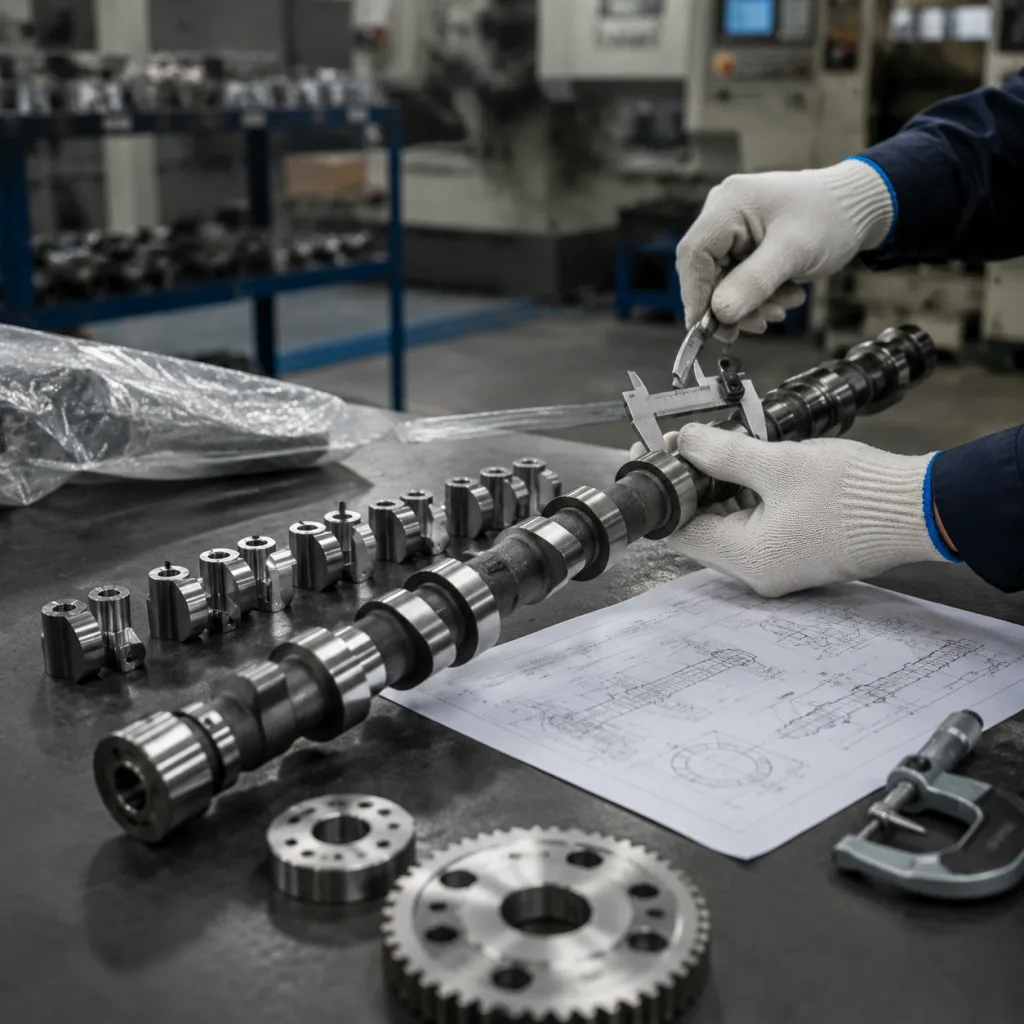
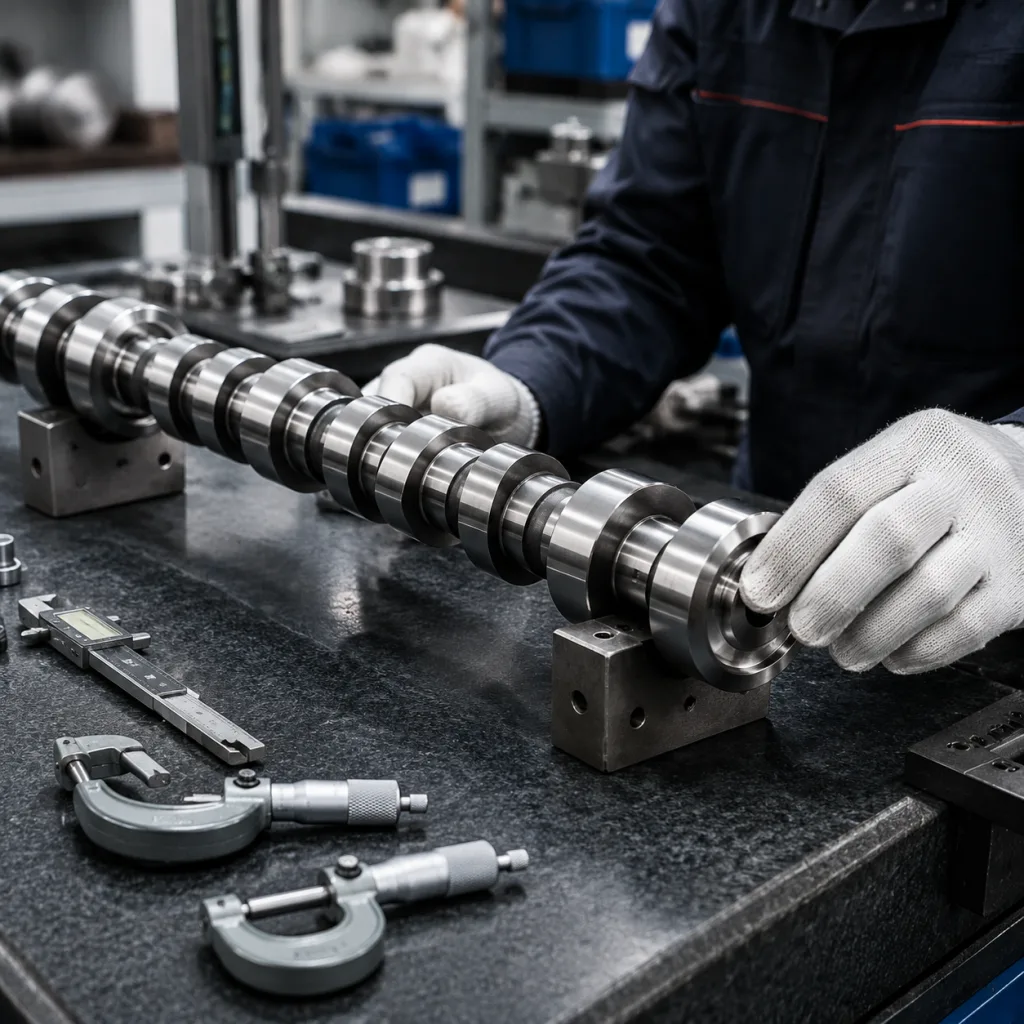
A procurement review should verify the measurable features that affect installation, oil control, valve timing, and engine performance. Visual inspection is useful for obvious damage or incorrect machining, but it cannot confirm whether the camshaft will run correctly in service. Buyers should request dimensional evidence before approving samples or placing repeat orders.
Check point
Why it matters
Typical buyer evidence
Journal diameter
Controls bearing clearance and oil film stability
Dimensional report, micrometer readings
Journal roundness
Prevents uneven loading and oil-pressure loss
Roundness report or CMM data
Lobe lift and profile
Determines airflow, valve opening, and timing behavior
Profile drawing, master sample comparison, or CMM report
Base circle
Affects valve lash, lifter preload, and geometry
Dimensional inspection report
Lobe phasing
Keeps intake and exhaust timing aligned with engine calibration
Cam profile measurement or timing-angle report
Surface hardness
Affects wear resistance on lobes and journals
Heat-treatment record, hardness test
Runout
Prevents vibration, uneven contact, and premature wear
Straightness or runout report
Drive end interface
Ensures correct timing gear, pulley, or sprocket fit
Spline, keyway, slot, or dowel dimensions; sample photos
Sensor features
Required on some emissions-calibrated engines
Cross-section drawing, application note, trigger-position data
Oil holes and chamfers
Supports lubrication and prevents assembly damage
Drawing callouts, inspection photos
</tr></thead><tbody> </tbody></table>For OE-equivalent sourcing, the drawing should state inspection standards, tolerance bands, and acceptance criteria. Published standards often referenced in supply agreements include IATF 16949:2016 and ISO 9001:2015, with additional material, packaging, or emissions-related requirements where applicable. If the supplier works from reverse engineering rather than an original drawing, buyers should ask how the reference sample was selected, how many samples were measured, and how production variation is controlled.
Materials, heat treatment, and wear control
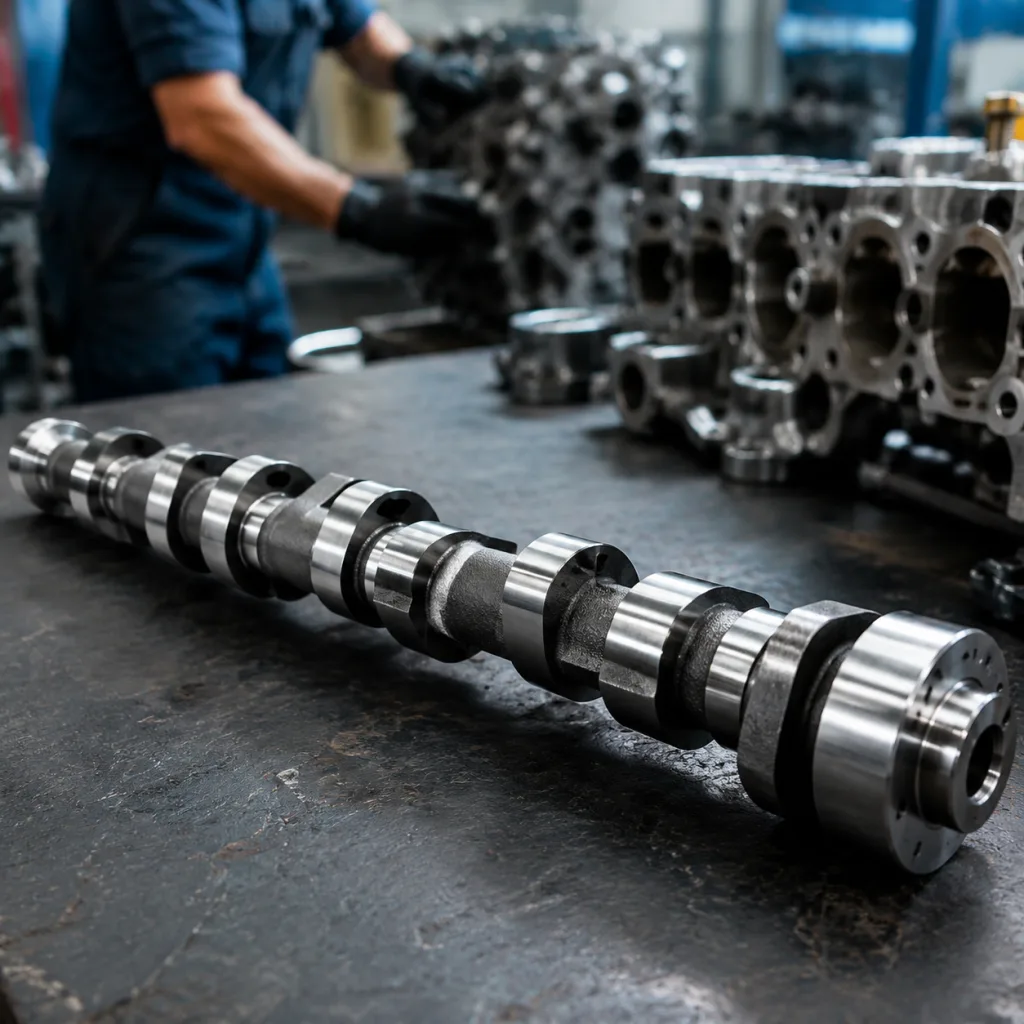
Camshaft durability depends on the material route and the hardness profile at the lobe surface, bearing journals, and thrust faces. Common manufacturing routes include chilled cast iron, forged steel, and induction-hardened steel, selected according to engine duty cycle, production volume, and cost target. The correct route should be matched to the original design intent, not chosen only to reduce unit cost.
For buyers, the practical questions are:
Is the camshaft manufactured from a specified alloy, steel grade, or casting grade?
Is the heat treatment controlled by batch record and process parameter?
Is lobe surface hardness measured on production lots?
Is the case depth or hardened layer verified where required?
Is journal finish controlled to support oil-film formation?
Is the finish suitable for break-in, lifter contact, and oil compatibility?
Are machining burrs, blocked oil holes, and sharp chamfers checked before packing?
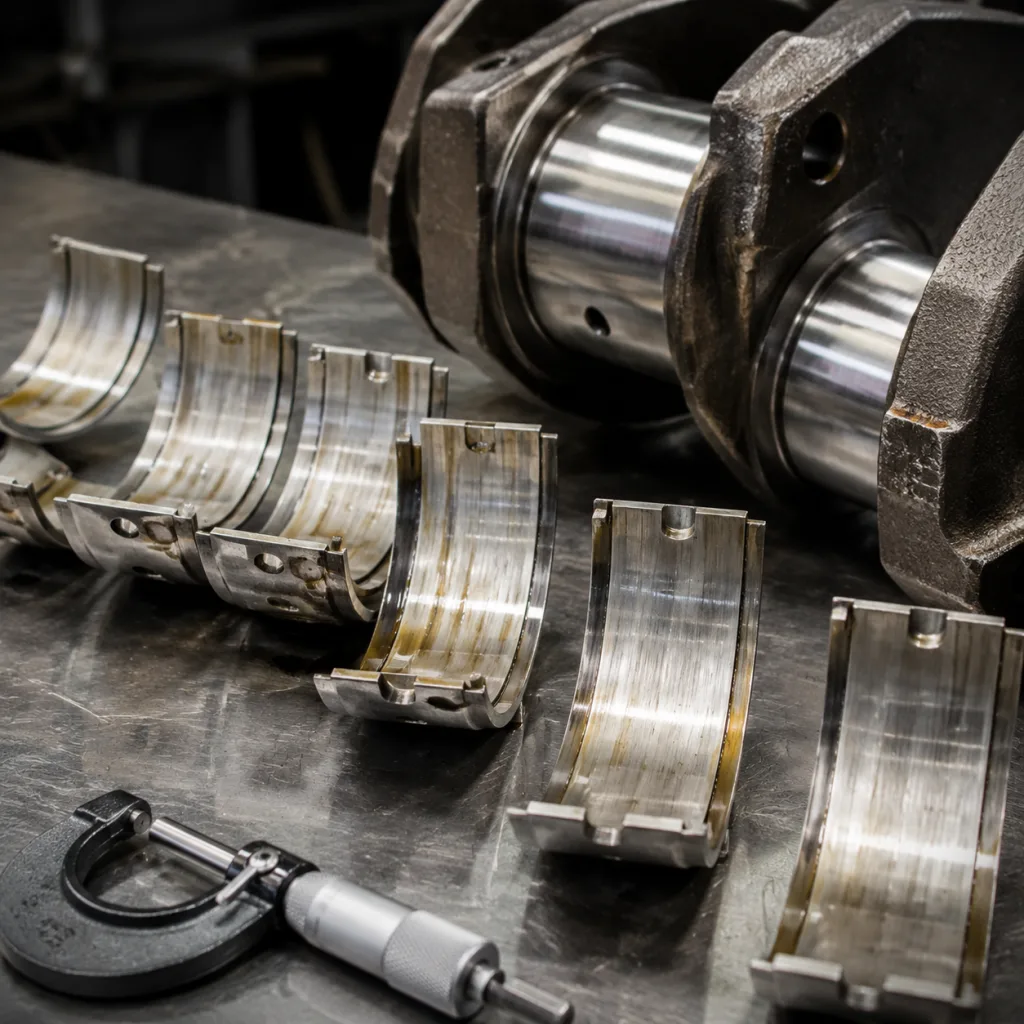
A supplier should be able to explain the wear mechanism it is controlling. For example, a hardened lobe surface reduces scuffing and pitting, while controlled journal finish reduces boundary wear during cold start. Thrust faces also need consistent finish because excessive end-float or rough contact can create noise and timing instability. In fleet, mining, utility, and high-mileage service, these details matter because the L200 is often used under heavy load, variable maintenance conditions, and extended operating cycles.
If the application runs in severe duty or high-mileage repair programs, ask for evidence from endurance testing, process audits, oil cleanliness control, and returned-part analysis. Where markets require regulatory compliance, confirm material declarations against REACH (EC) No 1907/2006 and any customer-specific restricted-substance requirements. For cross-border programs, it is also useful to confirm whether the same material specification is used for every production lot or whether substitutions are permitted only after buyer approval.
Validation testing buyers should request
Replacement parts should be validated against the intended engine family, not only checked visually. For a camshaft for Mitsubishi L200 OE equivalent, test evidence should cover fitment, durability, dimensional stability, and repeatability from lot to lot. This is especially important when one purchasing program serves multiple repair locations or aftermarket distributors.
Suggested validation package:
1. Dimensional inspection on first article and production samples 2. Full cam profile measurement for lift, duration, ramps, and lobe phasing 3. Hardness testing on lobe, journal, and thrust surfaces 4. Runout, concentricity, and straightness measurement 5. Metallographic or process verification when material changes are proposed 6. Trial assembly with matching gears, seals, lifters, caps, or related components 7. Engine bench or endurance data for the target application where available 8. Salt-spray or corrosion-protection review for long export storage 9. Packaging drop, abrasion, and oil-paper or VCI protection checks 10. Final inspection and lot traceability records before shipment
If the camshaft is used in a repair program, ask whether the supplier can support PPAP-style documentation, inspection records, control plans, and lot traceability. For emission-sensitive engines, the timing profile must remain stable enough to support calibration intent. A profile that shifts valve events by a small angle may still fit the engine but can affect idle quality, exhaust temperature, turbo response, or diagnostic behavior.
Buyers should also confirm compatibility with related components such as lifters, rocker arms, timing gears, chains, sprockets, seals, cam caps, and thrust washers. When the replacement program includes bundled kits, the camshaft should be validated as part of the complete assembly environment rather than as an isolated component.
How Driventus supports procurement teams
Driventus manufactures engine and powertrain components for B2B buyers who need stable repeat supply, application clarity, and export-ready documentation. Our catalogue covers camshafts and related engine parts across multiple engine families, and our catalog can be used to review the available range.
For buyers evaluating a new source, the most useful checks are:
IATF 16949:2016 and ISO 9001:2015 certification status
Confirmed application data by engine code, model year, and OE reference
Lot traceability and inspection records
Sample approval process for dimension-critical parts
Material and heat-treatment documentation
Packing specification for export, warehouse handling, and long storage
Label format, barcode requirements, and private-label options
Lead-time stability for repeat orders
Support for distributor, repair network, and rebuild program volumes
Driventus can support sourcing teams that need more than a single spot purchase. For aftermarket distributors, that may mean consistent part numbering, carton labeling, and repeatable inbound inspection data. For repair networks, it may mean avoiding fitment ambiguity across regional L200 variants. For rebuild programs, it may mean sample approval, controlled production lots, and technical communication before the first shipment.
If your program needs a non-standard profile, modified finish, controlled packaging, or private-label presentation, custom manufacturing can support application-specific development. To review broader engine parts that may be bundled with a camshaft order, see engine components.
Ordering checklist for replacement programs
Before you place a purchase order, confirm the technical, commercial, and logistics details with the supplier. A clear ordering file reduces mismatch risk when a camshaft for Mitsubishi L200 OE equivalent is supplied to multiple warehouses, distributors, or repair locations.
Confirm these points before approval:
Engine code and model year range
Vehicle market or region, including EU, UK, US, Canada, Australia, or Brazil where relevant
OE reference, if available
Supplier cross-reference and catalogue number
Left-hand or right-hand drive market differences, if any
Valve-train configuration and number of lobes
Single-cam or dual-cam position, where applicable
Drive-end type, keyway, dowel, slot, gear, or sprocket interface
Sensor trigger, reluctor, or timing reference features
Required certificates, inspection reports, and country of origin documents
Material grade, heat-treatment evidence, and hardness report
Packaging, label format, barcode, and carton quantity
Rust prevention method for sea freight or long storage
Acceptance criteria for sample approval
Warranty handling, return analysis process, and corrective-action expectations
This checklist helps prevent returns caused by incorrect timing geometry, unsuitable journal dimensions, missing sensor features, or catalogue overlap between engine variants. It also gives both buyer and supplier a shared record for repeat orders. If the part must be matched to a specific OE number, the supplier should provide a written cross-reference and dimensional confirmation before shipment. For high-volume programs, it is good practice to approve a first sample, retain a reference unit, and define which measurements must be repeated on each production lot.
Frequently asked questions
No. OE-equivalent means the part is designed to match the original fit and function, but it is not an OEM-branded part. Buyers should verify dimensions, timing profile, material specification, surface hardness, and the relevant OE cross-reference before ordering.
Confirm the engine code, model year, regional application, valve-train layout, journal dimensions, lobe profile, base circle, drive-end interface, and any sensor trigger features. Ask for inspection records, hardness data, material documentation, and the relevant OE cross-reference if one is available.
Yes. We support B2B replacement and custom manufacturing programs with traceability, inspection records, sample approval, export packaging options, and private-label requirements. Use the contact link below to discuss engine code, OE reference, target volume, and documentation needs.
If you are sourcing a camshaft for Mitsubishi L200 OE equivalent, send your engine code, target OE reference, required documentation, destination market, and annual volume for review. Request a quote at /contact.html.