Camshaft for Hyundai Santa Fe OE Equivalent: Sourcing Guide
Procurement teams sourcing a camshaft for Hyundai Santa Fe OE equivalent need more than a part that fits one engine family. They need dimensional match, correct journal geometry, controlled surface finish, validated heat treatment, and traceable evidence tied to the exact application. For replacement programs, the practical question is whether the part reproduces OE installation and performance targets across the intended vehicle range. Driventus supplies engine components from Taizhou, Zhejiang, and operates under IATF 16949:2016 and ISO 9001:2015 controls. Driventus is an independent aftermarket manufacturer, and brand names are referenced only for fitment identification. For buyers, the focus should remain on drawing compatibility, inspection data, and packaging consistency. This article explains what to verify before ordering, how OE cross-references are handled, and where to review supporting documentation across our catalog, quality system, and custom manufacturing options.
OE-equivalent vs. OE: what actually changes
For this category, OE-equivalent means the camshaft matches the original installation requirements without claiming manufacturer approval. That distinction matters. The part may be functionally correct and still not be OE-branded, OE-certified, or approved by the vehicle maker.
Use the application data, not the badge, to decide fitment. A Santa Fe listing can hide multiple engines, cam layouts, and timing systems. Before you compare prices, confirm the exact engine code, model year, OE number, and whether the part is intake, exhaust, or a matched pair.
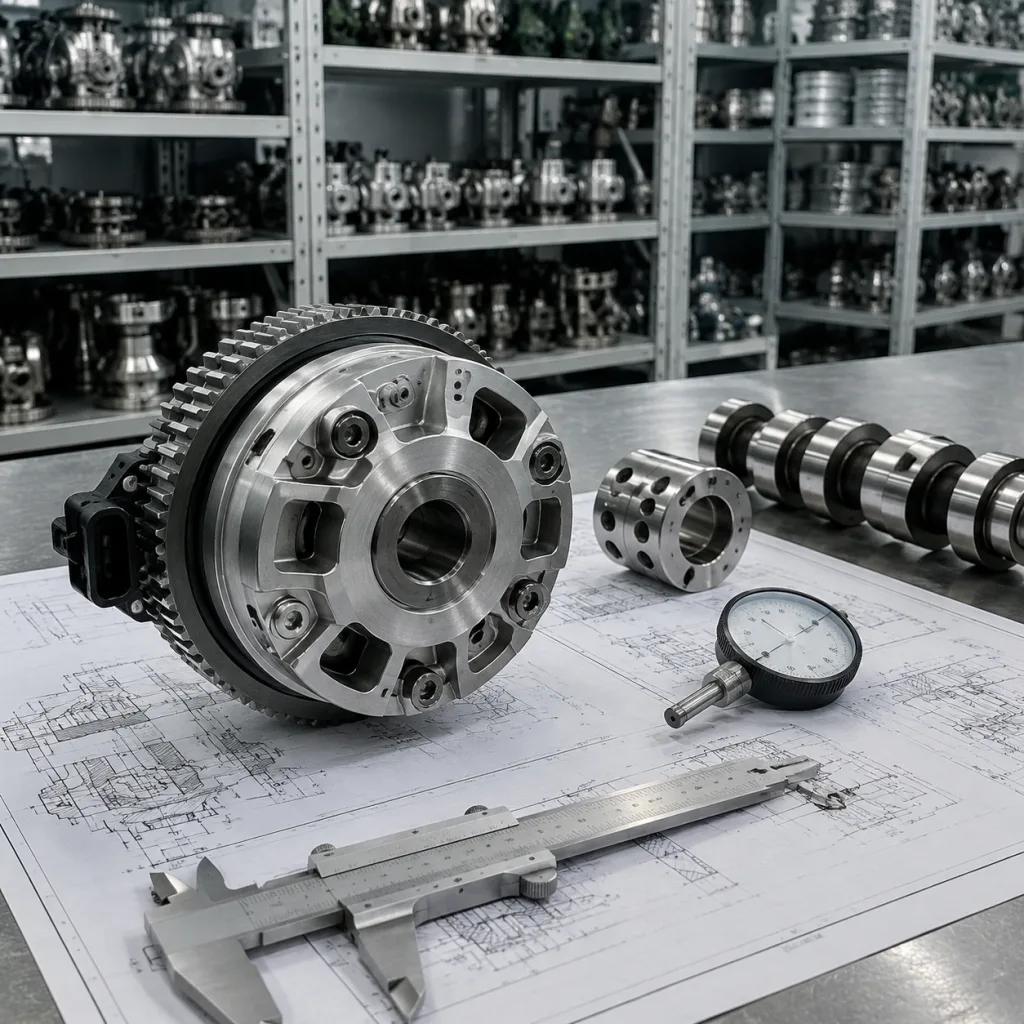
A usable replacement should still hold the core geometry: lobe count, base circle, nose height, journal diameter, thrust face location, and phasing relationship. If the supplier cannot show those dimensions, the part is a guess.
The spec stack buyers should verify first
Procurement teams get the best result when they start with measurable features, not catalog photos.
Item
Typical verification point
Why it matters
Journal diameter
Measured to drawing
Controls bearing clearance
Total indicator runout
Checked on V-blocks or centers
Reduces vibration and wear
Lobe lift
Compared against OE drawing
Preserves valve event timing
Surface hardness
Verified by test report
Supports wear resistance
Nose and heel profile
Profile inspection
Avoids valvetrain noise
Thrust width
Measured at bearing face
Maintains axial control
Cleanliness
Oil-free, protected packing
Prevents corrosion in storage
</tr></thead><tbody> </tbody></table>For a camshaft for Hyundai Santa Fe OE equivalent, request the steel or casting type, heat-treatment route, inspection method, and sample size before you approve a quote. Common control packages include SCM-type alloy steel or chilled-cast iron, magnetic-particle or ultrasonic crack checks, journal roughness around Ra 0.20–0.40 μm, and lobe roughness capped at Ra 0.80 μm unless the drawing says otherwise.
If the program depends on a specific follower or actuator design, that interface becomes part of the spec. Missing that detail is a common sourcing error.
Where replacement parts fail in the real world
Most camshaft issues are not dramatic at first. They start as noise, timing drift, or accelerated wear.
Common failure modes include:
Journal diameter drift that changes bearing clearance
Poor lobe profile control that alters valve timing
Inadequate hardness after heat treatment
Rough surface finish that accelerates follower wear
Wrong thrust width that creates axial movement
Incorrect trigger wheel or sprocket interface on variable timing systems
The hidden risk is not always the camshaft itself. It is the mismatch between the camshaft and the engine variant. A part can look right, ship fast, and still miss the phasing, lift, or drive-end detail that the head assembly needs. That is why buyers should ask for drawing-based evidence instead of relying on the vehicle name alone.
If you are qualifying a new source, start with a small pilot lot and inspect the functional dimensions before you scale.
Validation checks that reduce warranty exposure
Replacement buyers should ask for validation that reflects actual duty cycle, not just a visual match. A practical package includes:
Dimensional inspection against the control drawing
Hardness testing after heat treatment
Surface roughness measurement on journals and lobes
Profile and indexing verification for valve timing geometry
Salt-spray or corrosion-resistance checks when storage protection is part of the requirement
Fit checks in the intended cylinder head and drive system
A tight acceptance plan helps more than broad language. For example, buyers may specify hardness scatter within ±2 HRC across the lobe band, straightness within 0.02 mm per 100 mm, and no pitting, scoring, or spalling after a 24-hour neutral-salt inspection where corrosion protection is required. First-article approval is often most useful when it includes full dimensional reports on 10 pieces, followed by an agreed AQL or lot-based rule for production.
Vehicle-level emissions and durability still need separate validation. A camshaft report is not a full powertrain approval.
How Driventus handles B2B sourcing programs
Driventus is built for repeatable supply, not one-off retail orders. The operating structure is aligned with IATF 16949:2016 and ISO 9001:2015, with process control across machining, heat-treatment coordination, inspection, and packing.
Typical support includes:
OE part-number cross-reference review
Drawing-based manufacturing for replacement programs
Inspection reports for incoming and outgoing batches
Private-label and carton specification alignment
Lot traceability for distributor and warehouse control
If a program needs a revision for a different engine code, custom manufacturing can be handled under controlled specifications. If you want broader sourcing context, see our catalog and the engine-component overview at `/products/engine-components.html`.
For commercial planning, ask for sample pricing, pilot lead time, and mass-production lead time separately. That makes the quote usable instead of just low. A 20–50 piece engineering lot often behaves very differently from a recurring production run.
PO checklist: the last gate before release
Before releasing a purchase order, confirm the following with the supplier:
1. Exact OE reference and engine code 2. Camshaft type: intake, exhaust, or matched pair 3. Sensor trigger wheel, actuator, or sprocket interface 4. Required finish: bare, oiled, phosphated, or packed with VCI 5. Acceptance criteria for runout, hardness, and profile 6. Required documents: inspection report, material certificate, and packing list
If the part goes into a distributor program or multi-location repair network, standardize the receiving check so every batch is screened the same way. That reduces disputes and makes warranty claims easier to isolate.
A solid PO also defines commercial terms that keep scope from drifting: annual usage, call-off frequency, minimum order quantity, price breaks, partial shipment rules, and packaging tolerances. If the camshaft includes a variable timing phaser interface, state whether the phaser is buyer-supplied or supplier-matched. That one line can change both inspection and cost.
Frequently asked questions
No. OE-equivalent means the replacement is built to match the target OE dimensions and function, but it is not an approval or endorsement by the vehicle manufacturer.
Provide the OE number, engine code, model year, and whether the part is intake or exhaust. If available, include the old part dimensions and photos of the drive end. For a faster quote, include the target annual quantity, the requested finish, and whether you need sample pricing, production pricing, or both.
Yes. We support drawing-based changes, private-label packing, and controlled revisions for B2B programs. Start with [request a quote](/contact.html).
If you need an OE-equivalent camshaft supply review, send the OE reference and target application details, and we will confirm the best matching specification. Use /contact.html to request a quote.