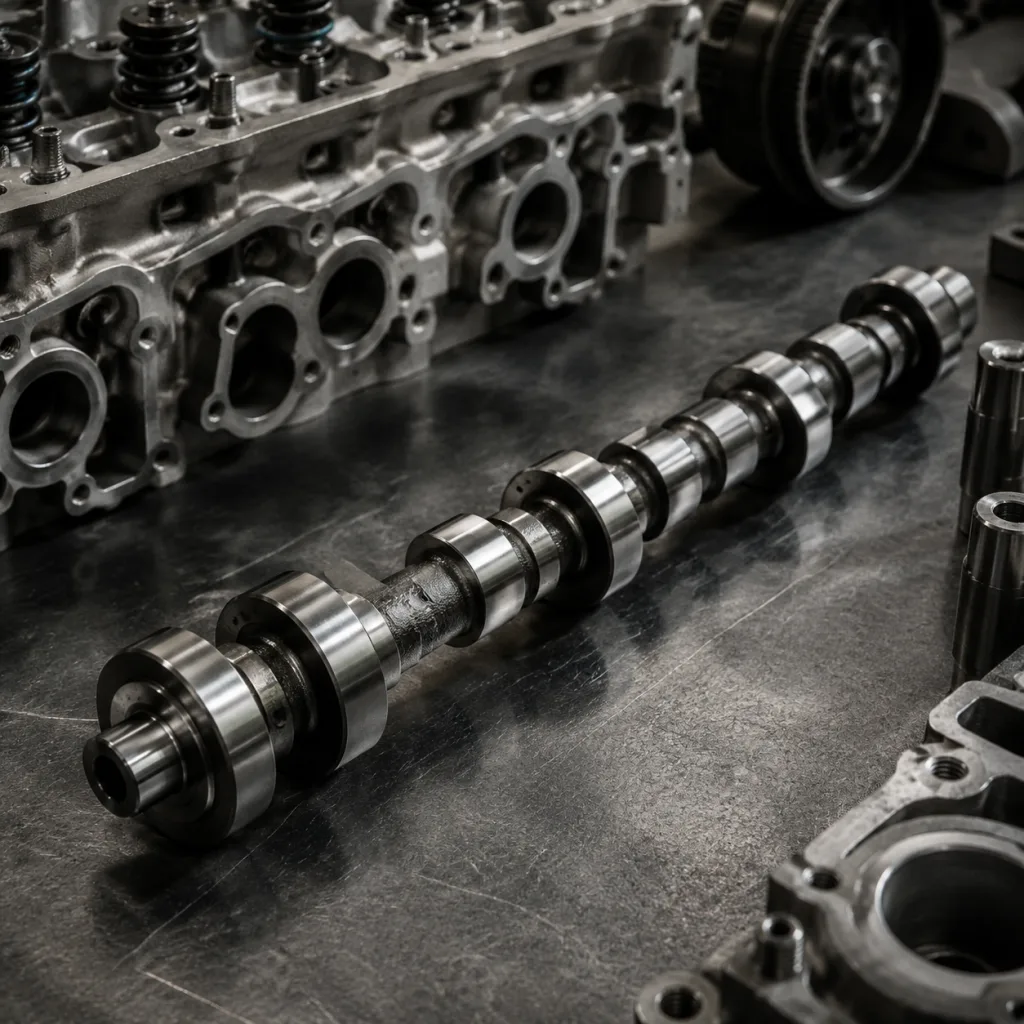
A camshaft for Ford F-150 OE equivalent programs has to do more than fit the cylinder head. For distributors, repair-chain buyers, and engine rebuilders, the part must match OE geometry, hold valve timing within spec, resist lobe wear, and arrive with documentation that supports repeatable procurement. Ford F-150 applications span multiple engine families and model years, so sourcing should begin with engine code, VIN-derived fitment, valve-train layout, and OE part-number cross-reference data rather than vehicle name alone. This article explains how Driventus approaches camshaft equivalence for replacement channels: dimensional matching, metallurgy, surface treatment, timing feature control, inspection records, and packaging discipline. Driventus is an independent aftermarket manufacturer; brand names are referenced for fitment only.
Start With the Fitment Trap: Why “F-150” Is Not Enough
OE equivalence is a technical claim, not a marketing phrase. On a camshaft for Ford F-150 OE equivalent program, the first failure mode is simple: buyers source by vehicle name and miss the engine family, cam position, or timing interface. The part may physically fit the head and still be wrong on lift, phasing, or actuator alignment.
Ford F-150 coverage changes across displacement, cylinder head layout, intake versus exhaust position, and variable valve timing architecture. That means a correct sourcing file needs more than a model-year range. It needs the control points that separate one camshaft variant from another.
Buyers should ask for documented numbers, not vague equivalence language. Practical control targets often include:
Journal diameter tolerance held to the drawing requirement, commonly within ±0.01 to ±0.02 mm on controlled production parts
Lobe lift variation limited to the specified profile window, often within ±0.03 to ±0.05 mm on critical lobes
Camshaft total runout kept to a small controlled band, typically no more than 0.03 to 0.05 mm unless the buyer specifies otherwise
Lobe-to-lobe phase variation measured against the master drawing, usually within ±0.5° to ±1.0° crank angle on replacement programs
Overall length and thrust-face position verified before release to avoid end-play stack-up in assembly
Before placing a PO, procurement teams should demand:
Application matrix by engine family, year range, camshaft position, and valve-train type
OE number cross-reference format where applicable, based on the buyer-provided reference number
Critical-to-quality drawing features and inspection plan
Material grade, heat-treatment process, and hardness range
Timing feature verification method and master sample control
Batch traceability, packaging standard, and change-notification rule
Where Camshafts Fail: The Controls That Actually Matter
A camshaft can pass a visual check and still create field problems. The common failure modes are usually dimensional, not cosmetic. Timing errors, accelerated wear, noisy operation, and inconsistent idle quality often trace back to one missed control feature.
For a replacement program, the inspection scope should cover the features that interact with hydraulic lash adjusters, followers, valve springs, chains, phasers, and sensors. The table below keeps the discussion practical.
Feature
Why it matters
Typical verification method
Typical control target
Journal diameter and roundness
Controls oil film and bearing clearance
Micrometer, roundness gauge
Roundness often held within 0.005 to 0.010 mm
Lobe lift and base circle
Determines valve lift and lash geometry
Cam profile measuring machine
Lift checked to the approved profile; common tolerance ±0.03 to ±0.05 mm
Lobe phasing
Controls valve timing relative to crankshaft
CMM or dedicated timing fixture
Phase commonly controlled within ±0.5° to ±1.0°
Overall length and thrust faces
Prevents end-play and housing interference
Caliper, height gauge, CMM
End-face location verified to drawing, typically within ±0.02 to ±0.05 mm
Dowel, slot, or phaser interface
Maintains timing drive alignment
Go/no-go gauge, CMM
Fit checked against master gauge and approved sample
Runout
Reduces vibration and uneven journal loading
V-block and dial indicator
Total indicated runout commonly limited to 0.03 to 0.05 mm
Surface roughness
Affects oil retention and wear-in behaviour
Roughness tester
Journal and lobe finish usually specified by Ra value, often 0.2 to 0.8 μm depending on surface
</tr></thead><tbody> </tbody></table>A useful sourcing rule is to separate features by risk. Interfaces, traceability marks, and timing-critical geometry often justify 100% inspection. Cosmetic or noncritical items can be sampled. That keeps cost aligned with actual failure exposure.
Driventus uses controlled drawings and sample approval records before serial production. Where the buyer provides original samples or drawings, our engineering team compares datum structure, cam profiles, and assembly interfaces before confirming tooling or process route. That is how we avoid parts that install cleanly but drift out of timing once the engine runs.
Spec Deep-Dive: Material, Heat, and Surface Life
Durability starts with the blank, but it does not end there. For a camshaft for Ford F-150 OE equivalent replacement program, the material family, heat-treatment route, machining stability, and final surface finish all shape service life. The right process depends on lobe loading, follower type, lubrication, and whether the application uses variable valve timing.
Driventus production routes may use cast iron or steel camshaft blanks depending on the application and buyer specification. Each route requires controlled hardness and microstructure. For high-volume replacement programs, the procurement file should define acceptable material grade, hardness range, lobe surface condition, and inspection frequency.
Typical durability-related checks include:
Chemical composition verification by batch, with mill or furnace records retained for traceability
Hardness testing at journals and lobes where applicable, often targeting a defined range such as 54 to 62 HRC for hardened lobe surfaces or the buyer’s specified equivalent
Microstructure examination after heat treatment to confirm no excessive carbide segregation, white layer, or quench crack risk
Surface roughness measurement on lobes and journals, with lubrication-sensitive applications commonly requesting Ra 0.2 to 0.8 μm
Magnetic particle or other crack inspection where specified, especially after grinding or heat treatment
Profile measurement before packing to confirm every critical lobe matches the master data set
Oil-hole and groove inspection for blocked passages, burrs, or incomplete deburring
Documentation should align with the supplier’s quality system. Driventus operates under IATF 16949:2016 and ISO 9001:2015 frameworks for automotive production management, including process control, corrective action, supplier control, and traceability. Those systems do not replace part validation, but they give buyers a repeatable manufacturing base.
A strong purchase specification also states what process variation is acceptable. For example, a program may allow cast-iron blanks with induction-hardened lobes, or alloy-steel blanks with through-hardening, but it should still define final hardness, minimum case depth where relevant, and allowable distortion after heat treatment. Without those values, suppliers quote different routes that are not commercially comparable.
Validation Checklist: What Buyers Should Demand Before Release
Validation should match the sales channel. A distributor wants low return rates and stable fitment coverage. A repair chain wants predictable installation across branches. OEM and Tier-1 buyers usually want deeper production-part approval records, capability studies, and change-control discipline.
For a camshaft for Ford F-150 OE equivalent project, Driventus can align validation with application risk and order volume. A typical plan may include dimensional layout, material certification, hardness mapping, functional assembly checks, and endurance or bench testing where required. For higher-volume programs, capability studies can be applied to critical features such as journal diameter, lobe lift, phaser interface position, and runout.
A buyer-ready validation package often includes:
First-article dimensional report with actual values for every critical feature
Profile trace for each lobe family on the part number being sourced
Material certificate showing chemistry, heat number, and batch linkage
Hardness map with measured points and acceptance band
Functional fit trial on the intended cylinder head or test fixture
Runout and end-play measurement after assembly simulation
Packaging drop or transit check for distributor shipment profiles
Relevant standards and regulatory references depend on the market. IATF 16949:2016 and ISO 9001:2015 support quality-management expectations. REACH (EC) No 1907/2006 may matter for material substance declarations into the European market. Packaging and labelling requirements should also be agreed for destination-specific import and distribution needs.
The real control point is release discipline. Buyers should tie sample approval to a version-controlled drawing revision and a frozen process route. If a supplier changes grinding wheels, heat-treatment recipe, or inspection frequency, the approval should be reopened before shipment. That is a simple way to stop pilot-approved parts from drifting out of spec in repeat production.
Buying Scenario: How to Source Without Guesswork
The purchasing file should read like a decision record, not a generic RFQ. If the application is unclear, price comparisons are meaningless. If the validation scope is thin, the cheapest quote usually becomes the most expensive return cycle later.
A practical sourcing workflow looks like this:
1. Start with engine code, OE number, sample part number, or a verified drawing. 2. Confirm camshaft position, valve-train type, and timing interface. 3. Lock the tolerance focus, material route, hardness band, and surface finish. 4. Review first-article actuals, not only pass/fail summaries. 5. Approve packaging, traceability, and change-notification rules before release. 6. Move to serial supply only after the sample status matches the frozen revision.
Commercial details should be part of that same file. Many camshaft programs carry a tooling or sample-development lead time of 30 to 60 days, then a production lead time of 25 to 45 days depending on material availability and inspection scope. A typical MOQ may sit between 50 and 200 units for packaged replacement parts, while private-label cartons, barcode labels, or customer-specific inserts can push the MOQ to 200 to 500 units. Buyers should request tiered pricing at 100, 300, and 500 unit breaks so landed cost can be compared against service targets.
Pricing should also be structured clearly. Some buyers need EXW for forwarder control; others need FOB or CIF for import planning. If lead time matters, ask for a split quote that separates base part price, packaging surcharge, and expedite premium. That keeps the commercial comparison honest.
Driventus can also support custom manufacturing when the buyer needs a private-label specification, controlled drawing, or regional fitment database. That is often the cleanest path when the program needs a dedicated camshaft range, packaging set, or inspection report format.
How Driventus Keeps Repeat Orders Consistent
Driventus manufactures engine and powertrain components in Taizhou, Zhejiang, and exports to more than 60 countries. For camshaft programs, our role is controlled manufacturing, practical engineering review, and B2B documentation for buyers who need repeatable replacement supply rather than one-off trading.
The process starts with fitment confirmation and sample or drawing review. Engineering then defines critical dimensions, material route, machining sequence, heat treatment, and inspection points. Production batches are managed under IATF 16949:2016 and ISO 9001:2015 quality-management practices, with traceability retained according to agreed customer requirements.
A typical buyer workflow is straightforward:
1. Submit vehicle coverage, engine code, OE cross-reference, or sample part number. 2. Driventus reviews fitment scope and identifies the camshaft position, variant, and control features. 3. We confirm the drawing route, tolerance focus, MOQ, lead time, and sample plan. 4. The buyer approves sample results and packaging format. 5. Serial production begins with batch traceability, inspection records, and shipment documentation.
For distributors, the main benefit is fewer fitment disputes and more stable repeat ordering. For repair-chain procurement teams, consistent packaging and traceability help manage branch-level service issues. For OEM and Tier-1 sourcing teams, Driventus can discuss project documentation, audit requirements, and controlled production planning.
A camshaft for Ford F-150 OE equivalent program should always be judged by data: profile accuracy, journal control, interface location, hardness, surface finish, and inspection records. Driventus is an independent aftermarket manufacturer; brand names are referenced for fitment only.
Frequently asked questions
Yes. Buyers can provide OE, aftermarket, sample, or drawing references for review. Driventus verifies fitment by engine family, camshaft position, timing interface, and critical dimensions before confirming supply. We do not claim approval or endorsement by any vehicle manufacturer.
Documentation can include dimensional inspection reports, material records, hardness results, sample approval records, packing details, and batch traceability. The exact package depends on order volume, application risk, and buyer requirements. For larger programs, buyers can also request version-controlled drawings, control plans, and first-article actuals.
Yes. Driventus can discuss neutral, private-label, or buyer-specified packaging, including corrosion protection, carton format, pallet labels, and barcode requirements. Packaging specifications should be confirmed before production release. Buyers should also define whether they want carton-level labels, master-carton labels, or serialized batch marks.
For fitment review, sample evaluation, or volume pricing, send your application list and documentation requirements. You can [request a quote](/contact.html).