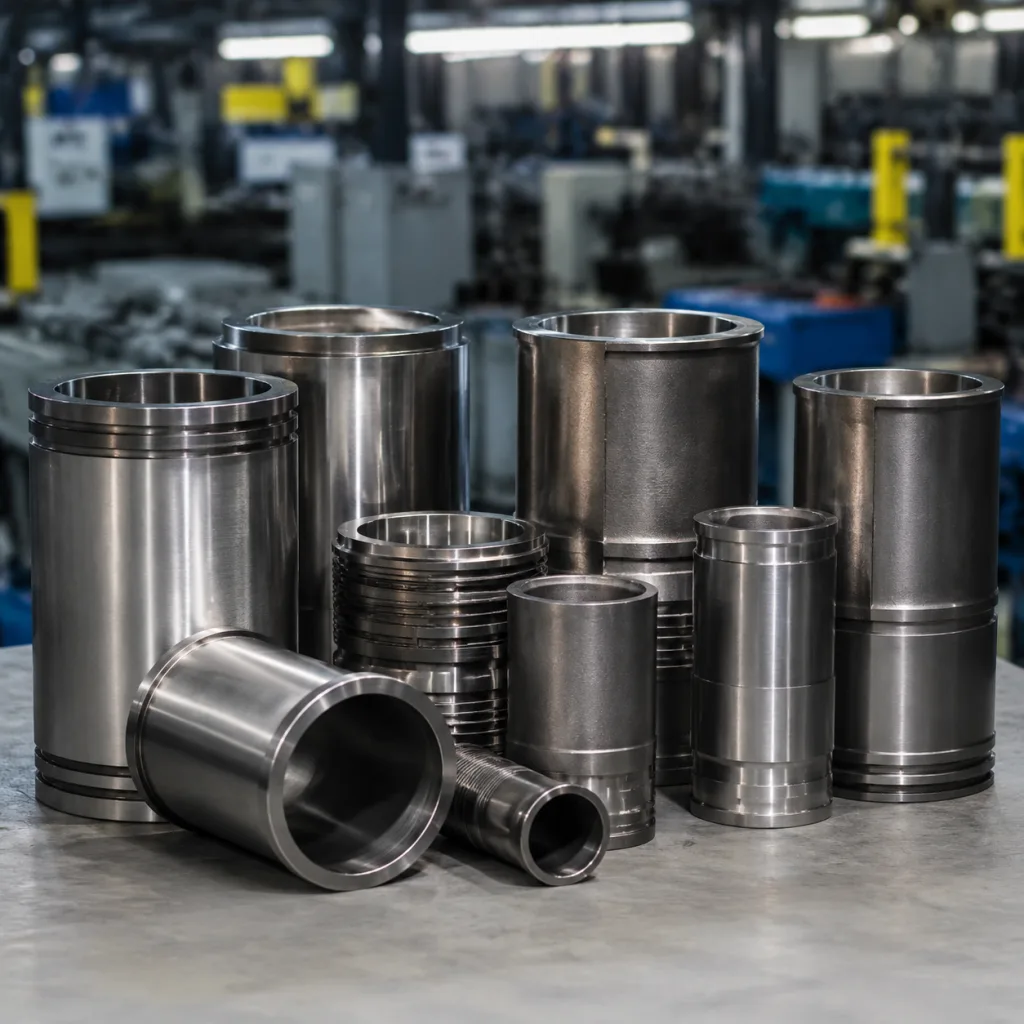
Buying a cylinder liner for Jeep applications is a sourcing exercise, not a brochure exercise. Procurement teams need dimensional match, stable metallurgy, controlled machining, and repeatable lead times. Driventus supplies engine and powertrain components from Taizhou, Zhejiang, with production controlled under IATF 16949:2016 and ISO 9001:2015. For cylinder liner programmes, the priority is fitment verification against the cylinder block, ring pack, cooling strategy, and the OE cross-reference used by the buyer. Driventus is an independent aftermarket manufacturer; brand names are referenced for fitment only. For buyers comparing suppliers in China, the real questions are MOQ, wall thickness tolerance, liner finish, inspection records, and whether the factory can support custom manufacturing for private-label or programme-specific needs. This article explains what to check before you place an order and how to reduce risk in import sourcing.
What procurement teams should verify first
For a cylinder liner Jeep manufacturer China search, start with fitment data and production control, not price alone. Ask for the block family, bore size, liner type, and whether the part is wet or dry. Confirm the OE reference format used by your team, for example OE 06A107065, before you request samples.
Key checks:
Base material specification: alloy cast iron, centrifugally cast sleeve, or ductile iron depending on application
Finished bore diameter and roundness control
Outside diameter and press-fit allowance
Liner height projection above block deck
Surface finish on the bore and skirt
Packaging standard for sea freight and warehouse intake
A supplier should provide dimensional drawings, inspection reports, and traceability by batch. If those documents are not available, the sourcing risk is high even if the unit price is low.
Buyer-side acceptance targets should be written into the RFQ. For many passenger-car style liner programmes, practical controls include bore diameter within ±0.01 to ±0.02 mm of nominal, roundness within 0.01 mm, outer diameter interference typically in the 0.03 to 0.08 mm range depending on block material, and deck projection controlled to within ±0.02 mm. Wall thickness should be mapped at a minimum of four quadrants, with any local thin spot outside the agreed print limit rejected. Ask the supplier to state measurement method, gauge resolution, and whether values are reported at 20°C, because thermal variation can distort OD and bore readings. A serious supplier will also define sample size for first-article checks, commonly 3 to 5 pieces per lot or per cavity, with 100% visual inspection on critical surfaces before packing.
Typical cylinder liner specifications for Jeep programmes
Exact dimensions depend on engine code, but procurement teams usually evaluate the same technical points across programmes. The table below shows the information buyers should request before approval.
Item
What to confirm
Why it matters
Bore size
Nominal diameter and tolerance
Ring sealing and combustion control
Outer diameter
Press-fit or interference fit
Block retention and heat transfer
Liner type
Dry or wet
Cooling path and service method
Material
Centrifugally cast iron or ductile iron
Wear resistance and crack resistance
Hardness
Supplier test range
Machinability and wear life
Surface finish
Honed bore Ra value
Ring seating and oil control
Deck height
Projection spec
Head-gasket sealing
Coating
If used, confirm process
Corrosion control and break-in behaviour
</tr></thead><tbody> </tbody></table>If your programme uses OE 06A107065 or a similar OE 06A… reference, require a dimensional drawing against the same block family and a signed sample approval record. Do not accept verbal fitment claims without measurement data.
For sourcing decisions, ask for actual numeric limits rather than generic statements. Common buyer specs include bore finish Ra 0.2 to 0.8 μm after honing, surface waviness controlled below 0.5 μm where ring compatibility matters, and hardness in the 220 to 300 HB range for many cast-iron sleeve applications, depending on the alloy and heat treatment. If the liner is intended for reconditioning work, confirm oversize availability, often in steps such as +0.25 mm or +0.50 mm on the finished bore after machining. You should also request concentricity between OD and bore, typically held to 0.02 mm or better for stable press-fit and ring life. Where the application uses a flanged liner, the flange thickness and flange flatness should be defined explicitly, because even a 0.03 mm deviation can create gasket load variation and head-seal issues.
How Driventus controls production and quality
Driventus runs manufacturing and inspection under IATF 16949:2016 and ISO 9001:2015. For B2B buyers, that matters because it defines how raw material, machining, gauging, and final release are controlled.
For export supply, we also align documentation with REACH (EC) No 1907/2006 where applicable to material declarations and downstream compliance requests. If your project requires a special bore finish, deck projection, or packaging format, custom manufacturing is available for programme-specific sourcing. This is useful for distributors and tiered supply chains that need a controlled part number map across multiple vehicle applications.
In practical terms, buyers should expect a defined control plan, not just a final inspection sheet. A typical production flow includes raw bar or blank receipt, spectrometer or material verification where required, rough turning, heat treatment if specified, finish machining, honing, 100% air-gauge or bore-gauge checks on critical dimensions, and final visual and packaging inspection. For each lot, request lot number, production date, operator or line code, gauge calibration status, and a retain sample. If your programme is higher risk, specify PPAP-style deliverables: material certificate, dimensional report, process flow, control plan, and initial sample approval. Even if the supplier is not quoting a formal PPAP package, the same evidence should be available before commercial release.
MOQ, lead time, and audit expectations
Most procurement teams want three commercial answers: minimum order quantity, lead time, and audit access. A serious supplier should be able to state these clearly before sample approval.
Typical sourcing questions:
MOQ by SKU and by programme
Sample lead time versus mass production lead time
Tooling ownership for special machining
Palletisation and carton count per export order
Factory audit availability, onsite or remote
Record retention for dimensional and material reports
For multi-location repair chains and wholesalers, the lower-cost option is not always the lowest landed cost. High scrap, mixed batches, and poor labelling increase intake cost. Buyers should compare supplier declarations with actual sample measurements and ask whether the factory can support recurring purchase orders without changing process conditions mid-run.
Commercially, many China suppliers will quote samples in 7 to 15 days if the tooling and machining route already exist, while first production lots commonly run 20 to 35 days after sample approval. Standard MOQ often starts at 100 to 300 pieces per SKU for catalog parts, but custom machining, private-label cartons, or special test requirements can push MOQ to 500 pieces or more. If you need mixed SKU consolidation, negotiate by annual volume instead of single line-item volume; suppliers are often more flexible on lead time when the forecast is firm and repeatable. Ask for ex-works and FOB pricing separately, then calculate landed cost with carton dimensions, gross weight, and estimated defect allowance. For audit planning, a remote document audit can be completed quickly, but an onsite visit should verify machining capability, gauge calibration, and finished-goods storage. For long-term programmes, also ask whether the factory retains dimensional records for at least 12 to 24 months and whether they can provide a corrective-action response within 5 to 10 working days if a deviation is found.
Fitment, validation, and replacement risk
A cylinder liner is a replacement part only if the dimensions, material, and surface finish are validated against the application. For Jeep engines, the main risks are wrong interference fit, incorrect liner height, or a bore finish that does not support ring seating.
Validation steps before purchase order release:
1. Match the OE reference and engine code. 2. Measure block counterbore and liner OD. 3. Confirm protrusion or deck height requirement. 4. Review sample hardness and microstructure data. 5. Check bore finish and any post-hone process. 6. Install a pilot batch and inspect after heat cycling.
If the end customer requests aftermarket replacement only, document that Driventus is an independent aftermarket manufacturer; brand names are referenced for fitment only. This reduces compliance risk and keeps the technical scope clear for importers and distributors.
A buyer should also validate service-life risk with a simple pilot plan. Install 5 to 10 units from the same batch where possible, then recheck after thermal cycling for movement, coolant seepage, or top-deck fretting. Measure bore wear and ovality after teardown if the programme allows destructive testing. If the liner is a dry press-fit design, pay particular attention to block bore cleanliness and installation force; inconsistent press force can indicate OD variation or surface finish issues. If it is a wet liner, confirm seal groove dimensions, O-ring material compatibility, and coolant-side surface roughness, because sealing failures usually come from poor groove control rather than the liner body itself. Any approved deviation should be documented by part number, revision level, and the exact engine family so the buying team can prevent mix-ups later.
How to source from Driventus
Buyers can review our catalog and the broader engine components range before sending an RFQ. Include engine code, OE reference, annual demand, target market, packaging requirement, and any special inspection criteria.
For a fast quotation, send:
Vehicle application and engine family
OE cross-reference, if available
Target quantity and forecast
Required certificate copies
Sample or drawing, if you already have one
Destination port and delivery terms
If you are qualifying a new supplier, request a small pilot lot, then audit the dimensional report against your own gauge set. That is the simplest way to confirm whether the part is stable enough for ongoing procurement.
To move forward, request a quote and include your application details.
To make the RFQ faster and more accurate, include your target tolerance band, required inspection frequency, and commercial assumptions. A complete RFQ should specify whether pricing is needed at 500, 1,000, and 5,000 pieces, because the unit price can change materially once packing and machine setup are spread over the lot. Ask the supplier to quote separate lines for part cost, special marking, cartons, pallets, and any third-party inspection. If your forecast is recurring, request a 6- or 12-month price validity window and a review trigger based on raw material index movement. For lead time, clarify whether the quoted clock starts from drawing approval, deposit receipt, or sample sign-off; this avoids disputes later. Buyers who share one approved sample and a clear measurement sheet usually reduce quotation cycles and get more reliable delivery commitments on the first order.
Frequently asked questions
Yes. Private-label packing and programme-specific cartons can be arranged under custom manufacturing, subject to order volume and specification approval.
Request a dimensional drawing, material declaration, inspection report, sample approval record, and batch traceability details. These support internal quality review.
Yes. Production is controlled under IATF 16949:2016 and ISO 9001:2015, with compliance support where REACH declarations are needed.
If you are comparing suppliers for a Jeep cylinder liner programme, send your OE reference, target quantity, and packaging needs through /contact.html for a direct quotation.