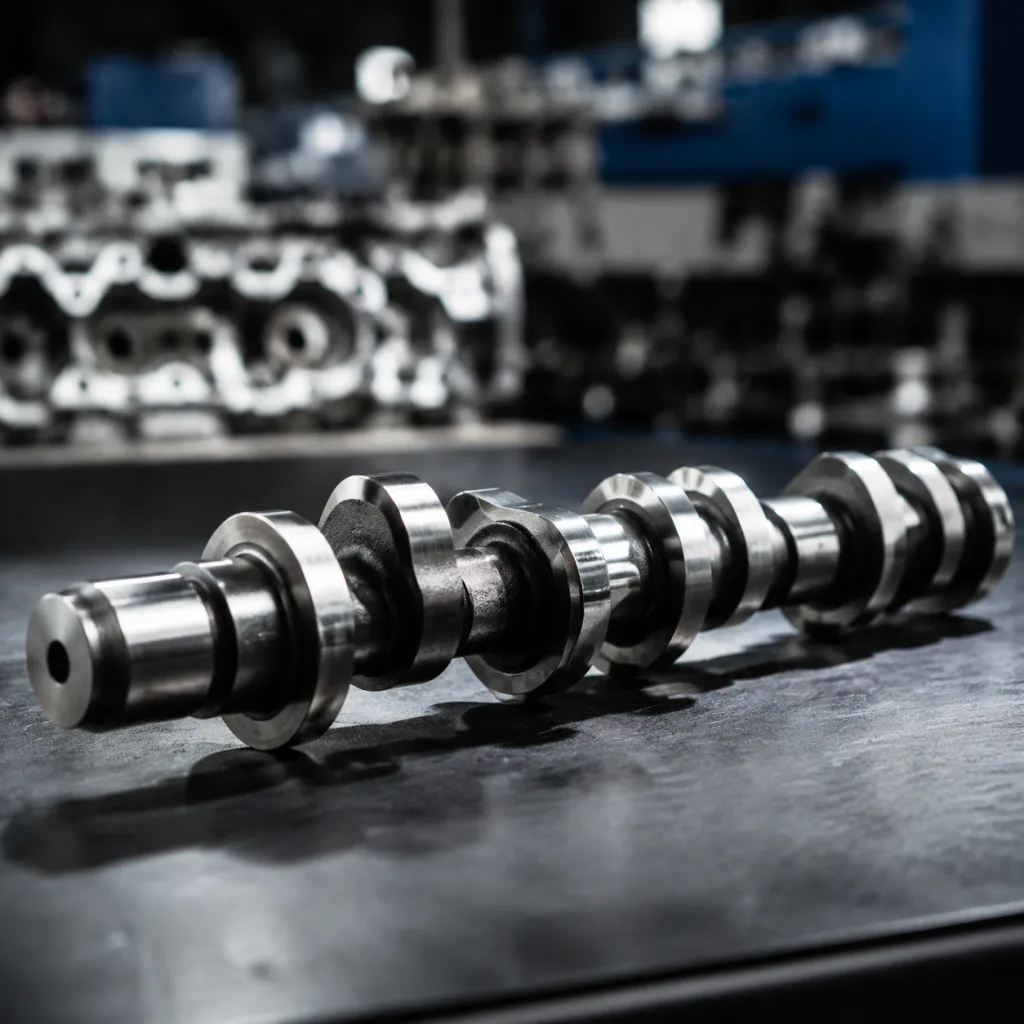
Camshaft for Audi Q7 Replacement: OE-Equivalent Sourcing
Sourcing a camshaft for Audi Q7 replacement is not a catalog exercise. The part has to match the engine variant, cam position, lobe profile, bearing journal layout, trigger geometry, material route, and inspection standard before it is safe to release into stock. One wrong assumption can create installation failures, warranty claims, and slow-moving inventory.
For procurement teams, the useful question is simple: can this supplier prove repeatable fitment and controlled production before the purchase order is placed? Driventus supplies aftermarket camshafts for B2B channels with inspection documentation, batch traceability, and quality controls aligned to IATF 16949:2016 and ISO 9001:2015. Driventus is an independent aftermarket manufacturer; brand names are referenced for fitment only.
For Audi Q7 programmes, buyers should confirm engine code, valve train layout, OE cross-reference, dimensional targets, MOQ, landed cost, and lead time before release. That discipline reduces install risk and supports stable replenishment across EU, UK, US, Canada, Australia, and Brazil.
Decision gate: prove the variant before you price the order
Do not start with “Audi Q7 camshaft” as the buying specification. Start with the engine.
The Q7 platform has used multiple engine families and valve train configurations. A camshaft that looks close in a catalog can still be wrong at the trigger feature, journal size, nose geometry, or intake/exhaust position. That is where returns begin.
Before PO release, procurement teams should verify:
Engine code and displacement
Intake or exhaust application
Number of lobes and trigger windows
Journal diameter, overall length, and nose geometry
Lobe profile, phasing, and lift target
Surface hardening depth and core material
Packaging labels, batch traceability, and serial or lot reference
Target MOQ, sample quantity, and required lead time
Where an OE number is available, cross-reference it in the format `OE 06A107065` or the relevant family number supplied by the customer. Do not assume interchange from vehicle model or model year alone.
A practical buyer workflow is:
1. Collect the failed part number, VIN data, or workshop sample. 2. Confirm engine code and camshaft position. 3. Request a dimensional report against the intended replacement. 4. Approve first article samples. 5. Release a pilot batch before recurring production.
For higher-risk launches, ask the supplier to quote three stages separately: sample set, pilot batch, and steady-state production. This prevents a cheap unit price from hiding tooling, validation, or packaging costs.
Driventus aligns replacement control plans to documented quality systems and shipment inspection records. Buyers can review our quality system before qualification.
Failure modes that expose a poor camshaft match
A camshaft is unforgiving. Small deviations can show up as timing errors, oil film instability, noisy valve train operation, sensor faults, or premature lobe wear. The part may install, but that does not mean it is correct.
For OE-equivalent replacement, check the features that usually cause field problems:
Risk area
What can go wrong
Procurement control
Journal diameter
Low oil pressure, bearing noise, seizure risk
Match OE nominal size within `±0.01 mm` to `±0.02 mm` depending on print
Maintain indexing within `±0.5°` to `±1.0°` crank equivalent where applicable
Runout
Binding, vibration, uneven wear
Limit finished shaft runout to `≤0.03 mm` TIR unless the customer drawing is tighter
Trigger features
Sensor fault, no-start, timing code
Match wheel count, angular index, and sensor offset exactly
Material route
Short service life under load
Use cast or billet specification per application, with heat lot traceability
Surface finish
Accelerated journal or lobe wear
Journals typically `Ra ≤ 0.4–0.8 µm`; lobe surfaces per OE print or approved standard
</tr></thead><tbody> </tbody></table>Validation should not stop at a catalog match. A buyer-friendly acceptance package usually includes first article dimensions, in-process checks, final inspection results, and a packing list tied to lot numbers.
For replacement supply, dimensional consistency matters more than broad fitment claims. Driventus can support this through our catalog and part-matching review before shipment.
Specification deep-dive: material, hardness, finish, and cleanliness
The camshaft specification is more than a shape. Material and process choices decide whether the shaft survives the duty cycle.
Most passenger vehicle camshafts use chilled cast iron, ductile iron, or hardened steel depending on the original design. The replacement should follow the same functional architecture as the OE part unless the buyer has approved a validated alternative.
Qualification checks that matter
Hardness verification on lobes and journals, typically `52–60 HRC` for hardened surfaces where applicable
Visual inspection for porosity, scoring, cracks, and heat-treat distortion
Runout and concentricity measurement on a fixture or V-block setup
Surface roughness checks on bearing and contact areas
Cleanliness control before packing, including oil residue and chip removal
Metallurgical confirmation of case depth or hardening depth when required by the application
For qualification, buyers often request first article approval with 3 pieces, process capability evidence for key dimensions, and a rejection plan for nonconforming lots. A common commercial tolerance strategy is to agree critical dimensions at `CPK ≥ 1.33` for stable production, with tighter customer-specific targets on lobe lift and journal size where the engine family is sensitive.
Driventus uses documented inspection points under IATF 16949:2016 and ISO 9001:2015 controls. Where customers need a non-standard profile, private-label carton, or application-specific packaging, our custom manufacturing service can support programme requirements.
Published standards may also apply at the system level, including REACH (EC) No 1907/2006 for material compliance in relevant markets. The replacement part must still be validated against the exact engine variant, not just the vehicle badge.
Commercial model: sample, pilot, replenishment—not one blind bulk buy
Replacement camshafts are usually stocked for independent repairers, fleet workshops, and regional distributors. The buying risk is not only technical. It is also commercial: wrong MOQ, vague lead time, poor carton control, or unclear warranty terms.
Procurement teams should confirm:
MOQ and pack quantity
Lead time by production batch
Whether lead time is ex-stock, production-only, or transit-inclusive
Country-of-origin marking and carton labelling
Export documentation and traceability records
Warranty terms and claim process
Price breaks at 100, 300, and 500-unit tiers
A staged sourcing model works better than a single bulk order:
Stage
Typical quantity
Purpose
Sample order
1–2 units
Dimensional check and fitment validation
Pilot lot
25–50 units
Workshop confirmation and early demand test
Production release
100+ units per part number
Replenishment stock after application approval
</tr></thead><tbody> </tbody></table>Lead-time language needs precision. A realistic benchmark is 2–5 days for stocked items, 4–8 weeks for production lots, and longer if tooling or special packaging is required.
For large programmes, batch stability matters as much as unit price. If you manage multi-location service stock, consolidate the application list by engine code and OE reference before ordering. That reduces picking errors and helps field teams select the correct part on the first attempt.
When comparing suppliers, use landed-cost logic: part cost, carton configuration, freight, duty, inspection burden, and return exposure should be evaluated together. If you need a part family review for engine components, see engine components.
Workshop scenario: when replacement beats reconditioning
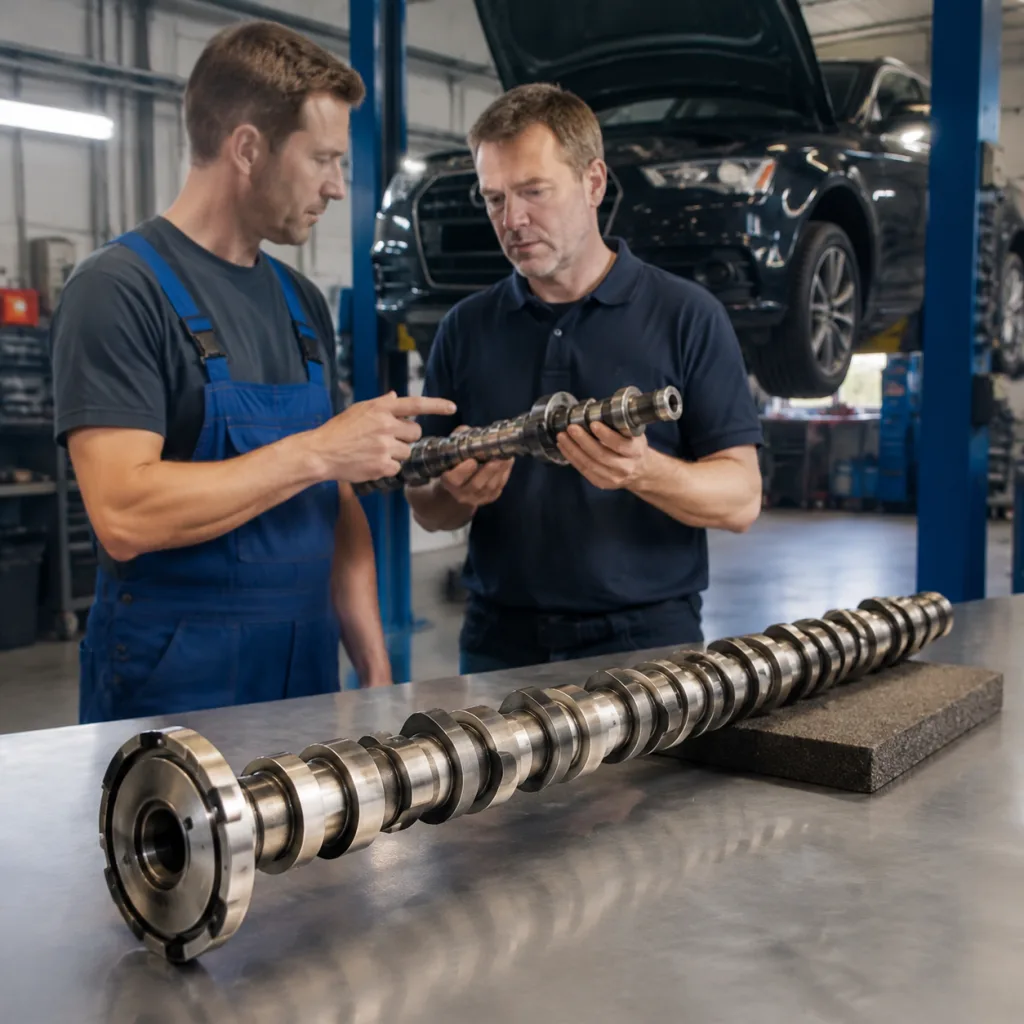
Picture the common case: a Q7 arrives with valve train noise after an oiling issue. The cam cover is removed. One lobe shows visible wear, a journal has scoring, and metallic debris is present in the lubrication path. Reusing the shaft may save money on the invoice, but it pushes risk into the repair.
A camshaft should be replaced when wear, pitting, galling, or lobe damage exceeds reuse limits. Replacement is usually the correct route when:
Lobe wear is visible or measurable
Journals show scoring or heat marks
The shaft is bent or outside runout specification
Previous failure left metal debris in the engine
The OE unit cannot be economically reconditioned
The measured profile no longer falls inside the approved tolerance band
A clean replacement strategy is safer than a mixed-condition assembly. Match the camshaft with related components such as followers, lifters, seals, and timing hardware when the repair procedure requires them. If the root cause was oil starvation or contamination, the workshop should also address lubrication and debris removal before startup.
For distributors, this matters because repeat failures often become commercial disputes. Supplying a correct, traceable camshaft—and recommending the associated repair parts where required—lowers claim exposure and improves installation consistency across workshops.
Q&A for B2B buyers working with Driventus
Who is Driventus set up to support? Aftermarket distributors, wholesalers, OEM and Tier-1 supply chains, and multi-location repair networks that need controlled replacement supply rather than consumer-grade catalog sales.
What should a buyer send first? Send the OE reference, engine code, camshaft position, target market, annual volume estimate, MOQ target, and required lead time. If available, include a sample, drawing, or dimensional data from the original part.
What happens before mass production? The usual sequence is part-number matching, dimensional review, sample approval, MOQ and price-tier confirmation, and production lot release with a target delivery window. This reduces ambiguity on fitment and makes replenishment easier across regions.
Can Driventus support private-label or programme-specific requirements? Yes. Buyers can start with our catalog, review the quality system, or discuss custom manufacturing for special labelling, packaging, or non-standard technical requirements.
What is the safest sourcing path for an Audi Q7 camshaft programme? Validate the OE cross-reference, confirm the engine variant, sign off critical dimensions, approve first samples, and require production lot traceability before release.
Driventus is an independent aftermarket manufacturer; brand names are referenced for fitment only.
Frequently asked questions
Use the engine code, OE cross-reference, camshaft position, and critical dimensions such as journal diameter, overall length, lobe profile, and trigger features. Model year alone is not enough because the Q7 uses multiple engine variants. Ask the supplier for an inspection report with nominal dimensions and tolerance values before approval.
Ask for IATF 16949:2016 and ISO 9001:2015 evidence, inspection records, batch traceability, and the declared test scope for hardness, runout, and dimensional checks. For a controlled release, also request first article samples, a dimensional report, and photos of label and carton marking.
Yes. Our OEM support can cover customer-specific profiles, packaging, and labeling where the technical package is complete and the application is confirmed. Buyers should provide the drawing, target tolerance band, expected annual usage, MOQ target, and desired lead time so the quotation is commercially usable.
If you are sourcing a camshaft for Audi Q7 replacement, send the OE reference, engine code, target market requirements, MOQ target, and lead-time expectation through our contact page: /contact.html