Camshaft Chevrolet Replacement: OE-Match Sourcing Guide
A Chevrolet camshaft replacement should be treated as a dimensional and functional match, not a simple part swap. The sourcing question is less “does it fit?” and more “does it preserve the engine’s timing, load, and durability targets?” Buyers need the correct lobe profile, journal size, base circle, timing phasing, and surface finish to keep valve timing within specification and avoid repeat failures. Driventus supplies camshafts for aftermarket, OEM, and Tier-1 supply chains from Taizhou, Zhejiang, with IATF 16949:2016 and ISO 9001:2015 processes. Driventus is an independent aftermarket manufacturer; brand names are referenced for fitment only. This article focuses on the decision points that matter, the failure modes to watch, and the documents to request before a purchase order is issued.
Decide the spec before you buy
For a camshaft Chevrolet replacement, start by locking the specification, not the catalog listing. A part can share the same application name and still change engine behavior if one critical variable is off.
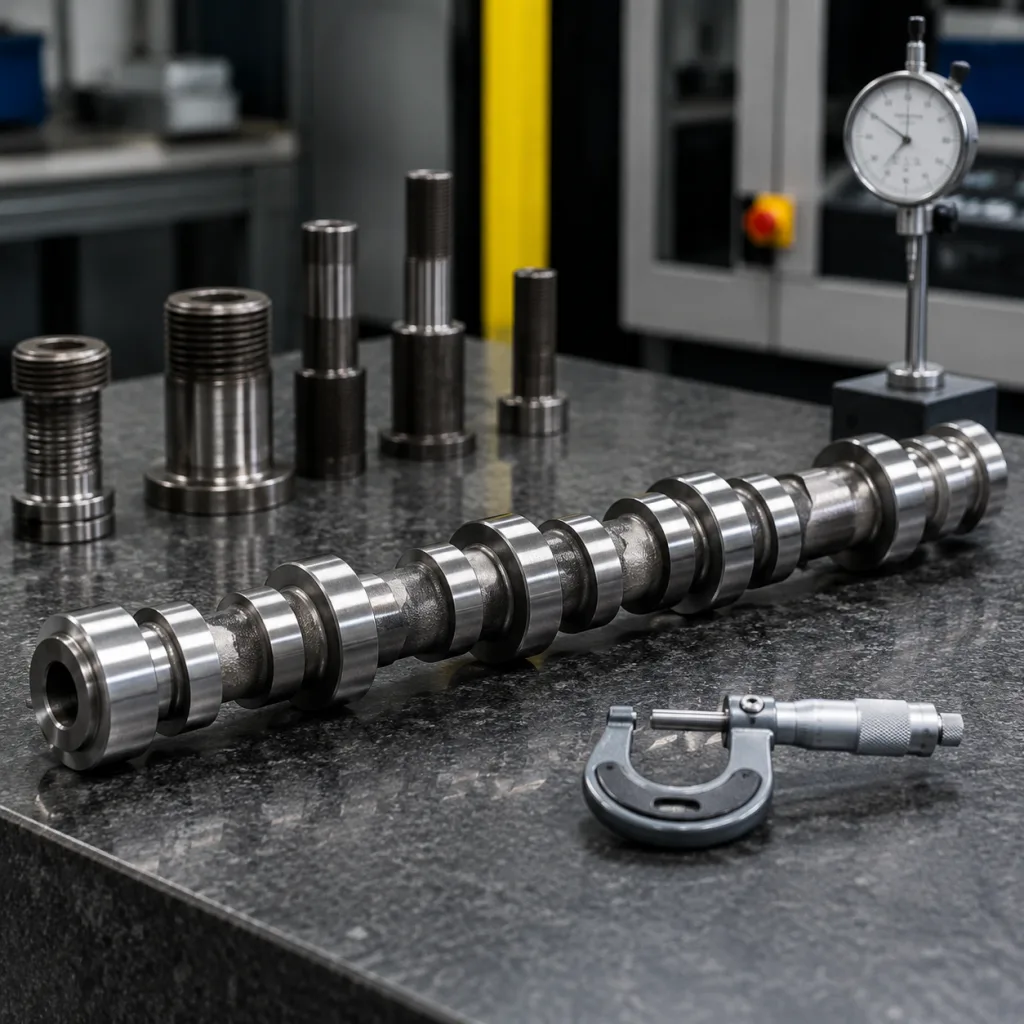
Confirm journal diameter and overall length to the drawing tolerance; many buyer prints hold these dimensions within ±0.01 to ±0.03 mm depending on the engine family
Match lobe lift, duration, and lobe separation at the same checking height, such as 1.0 mm or 0.050 in, so the comparison is meaningful
Verify base circle size and cam timing phasing; a small error can shift valve events enough to affect idle, emissions, or piston clearance
Specify material grade, hardening route, and surface finish instead of accepting a generic material description
Check thrust control features and axial float limits, especially where the engine uses a thrust plate or an integrated control surface
Confirm compatibility with lifters, followers, rocker ratio, and timing set before freezing the profile
If the engine package is not fully defined, the safest path is to work from the OE print, an approved master sample, or a measured reference part. For many Chevrolet programmes, the camshaft cannot be validated in isolation because valve springs, lifter type, piston-to-valve clearance, and ECU calibration all influence the result. Driventus can support OE-style cross-reference reviews when the customer provides the existing number, print, or sample data. Brand names are used for fitment only, and no vehicle manufacturer approval is implied.
Where replacements fail in service
Most replacement issues show up after installation, not during visual inspection. The risk is usually a mismatch that looks minor on paper but changes the valvetrain in practice.
Failure mode
What it does
What to check
Wrong timing phasing
Alters valve events and can hurt drivability or emissions
Request cam centerline data and phase error limits
Incorrect journal diameter
Creates bearing fit problems and oil-clearance issues
Compare actual measured values, not only pass/fail
Base circle mismatch
Changes lash or preload and can push the valvetrain outside its adjustment range
Confirm lifter preload and rocker setup
Weak heat treatment
Reduces wear resistance and shortens service life
Ask for hardness range and heat-treat traceability
Poor surface finish
Increases scuffing risk and follower wear
Specify Ra target and the inspection method
Missing thrust control
Allows axial movement and timing drift
Verify axial clearance limits and thrust-face width
</tr></thead><tbody> </tbody></table>Chevrolet engines across different years may share architecture but not the same cam profile. That is why a “fits many applications” listing is not enough for procurement. A controlled sourcing decision needs acceptance limits for each critical characteristic: journal diameter, runout, lobe phasing, hardness, and surface finish. Once those limits are written into the RFQ, incoming inspection can reject nonconforming lots consistently instead of arguing over catalog fitment.
Compare replacement paths
Buyers usually have three sourcing paths: direct OE-match replacement, catalog aftermarket, or custom profile development. Each has a different tradeoff.
OE-match replacement: best when the goal is to preserve original drivability, emissions behavior, and calibration compatibility
Catalog aftermarket: useful when the application is common and the published profile already meets the target engine family
Custom profile: preferred when the buyer needs a revised lift, different material, alternate finish, or packaging change
The wrong path is usually the cheapest-looking one. A catalog part may reduce unit cost, but if it changes lift, duration, or base circle, the downstream cost can be higher because of rework, returns, or calibration issues. Custom supply is slower, but it gives procurement more control over the final dimensional package. Driventus supports all three paths through engineering review, sample comparison, and production scaling, so buyers can choose the route that matches the programme rather than forcing the programme to fit the part.
Validate with data, not appearance
Replacement parts should be validated by measurement and bench testing, not by appearance alone. For Chevrolet replacement supply, a buyer should request:
First article inspection with critical dimensions recorded; include journal diameters, overall length, runout, lobe lift, and base circle on the same report
Material certificate and heat-treatment summary; keep heat number, batch number, and process date for traceability
Hardness testing on the finished camshaft; specify the test method and measurement location
Runout and concentricity checks; buyers commonly require values in the low hundredths of a millimeter or thousandths of an inch, depending on the engine family
Surface roughness data on journals, lobes, and thrust faces; define the accepted Ra limit in the drawing or control plan
Packaging and corrosion-protection verification for export lanes; define VCI use, carton protection, and any sea-freight requirement
For OEM and Tier-1 programmes, validation often follows internal control plans and relevant industry standards. Driventus works under IATF 16949:2016 and ISO 9001:2015 quality systems, and can align document packs to customer PPAP-style requirements where needed. A practical approval package should include sample approval records, control-plan checkpoints, and revision control for any drawing change before production release. For emissions-sensitive applications, buyers should also consider local compliance expectations such as ECE R-83 where applicable; final vehicle compliance remains the responsibility of the assembler and calibrator.
Use the right material and process route
Most replacement camshafts are produced from cast iron or billet steel, depending on the engine family, production volume, and wear target. The right choice depends on the original design intent and the duty cycle the part will see.
Typical buyer questions
Is the camshaft cast or machined from billet?
What hardness range is achieved after heat treatment, and is it measured on journals, lobes, or both?
Are lobes induction-hardened, chilled, or nitrided?
Is the surface finish controlled for flat-tappet or roller use?
Can the supplier provide anti-corrosion protection for sea freight?
Consistency matters more than marketing language. A camshaft can pass dimensional inspection and still fail early if hardness or finish drifts from lot to lot. Buyers should ask for the process route: raw material receipt, rough machining, heat treatment, finish grinding, superfinishing, final cleaning, and rust-prevention pack-out. That sequence matters because a camshaft can pass a visual check and still fail after 500 to 2,000 km if the lobe finish or hardness window is wrong. Driventus maintains in-process checks and final inspection controls through its quality system, which buyers can review on our quality system page.
Source and scale with less risk
Once the spec is locked, sourcing becomes a commercial exercise as much as a technical one. Buyers usually need three things: a confirmed fitment path, a stable supply plan, and clean documentation.
Use our catalog to review the current engine-component range, including related valvetrain and powertrain parts. If the Chevrolet application needs a special profile, alloy change, or packaging format, our custom manufacturing service can be used to develop a controlled alternative to the submitted sample or drawing.
A practical sourcing model is simple: prototype samples first, then a pilot lot, then repeat production after the dimensional report and durability checks are accepted. MOQ depends on profile complexity, finishing steps, and packaging format, so the RFQ should include target annual volume, expected call-off cadence, and shipment split. Lead time is usually shortest for existing catalog profiles and longer for custom grinds, new tooling, or revised heat treatment. For distributor programmes and multi-location repair chains, the same rule applies: lock the dimensions first, then confirm commercial terms. That reduces returns, prevents mix-ups between similar engine families, and shortens approval cycles.
Checklist before release
Before issuing a purchase order, confirm the following:
OE number or sample reference is confirmed, with the exact engine code and model year range documented
Critical dimensions are measured and recorded, including journal size, overall length, lobe lift, base circle, and runout
Material and heat-treatment requirements are agreed, with hardness range, test method, and lot traceability specified
Packaging, labelling, and traceability rules are specified, including part number, revision level, and country-of-origin marking where required
Inspection plan and acceptance criteria are documented, with clear tolerance limits and rejection rules for sample and production lots
Lead time and shipment terms are aligned with demand, including MOQ, target monthly consumption, and whether air or sea freight will be used
If you need a controlled replacement for a Chevrolet application, ask for a dimensional review, sample comparison, and document pack before commitment. That is the fastest path to a reliable replacement programme, especially when the target is an OE-equivalent part rather than a universal aftermarket item. For volume planning, buyers should also ask for a price-break schedule tied to annual quantity, because a custom camshaft often moves through different unit-cost bands once setup amortization is spread over a larger lot size.
Frequently asked questions
Yes. Share the OE number, sample, or drawing and we can review dimensional match, material, and validation needs. Brand names are used for fitment only.
Ask for dimensional inspection data, hardness results, material certificate, heat-treatment summary, and traceability details. For larger programmes, request PPAP-style support.
Yes. Driventus offers custom manufacturing for controlled changes to profile, material, finish, or packaging when the application needs a non-catalog solution.
If you need a Chevrolet replacement camshaft matched to OE dimensions and validated for supply, send your requirements and we will review them. Use /contact.html to request a quote.