Procurement teams sourcing a camshaft Cadillac OEM supplier need more than a part match. They need dimensional consistency, controlled metallurgy, stable lead times, and documentation that stands up to incoming inspection and traceability checks. For Cadillac applications, the critical variables are lobe profile, journal diameter, surface finish, runout, hardness, and compatibility with the intended valvetrain package. Driventus is an independent aftermarket manufacturer; brand names are referenced for fitment only. Our production is based in Taizhou, Zhejiang, and supported by IATF 16949:2016 and ISO 9001:2015 processes. For buyers in the EU, UK, US, Canada, Australia, and Brazil, the real question is simple: can the supplier hold tolerance, pass validation, and scale supply without quality drift?
How to judge a Cadillac camshaft supplier
Start with the decision that matters most: is the supplier actually controlling the part, or only matching the catalog number? For a Cadillac camshaft program, that answer should come from drawings, material records, and inspection data—not from a sales claim.
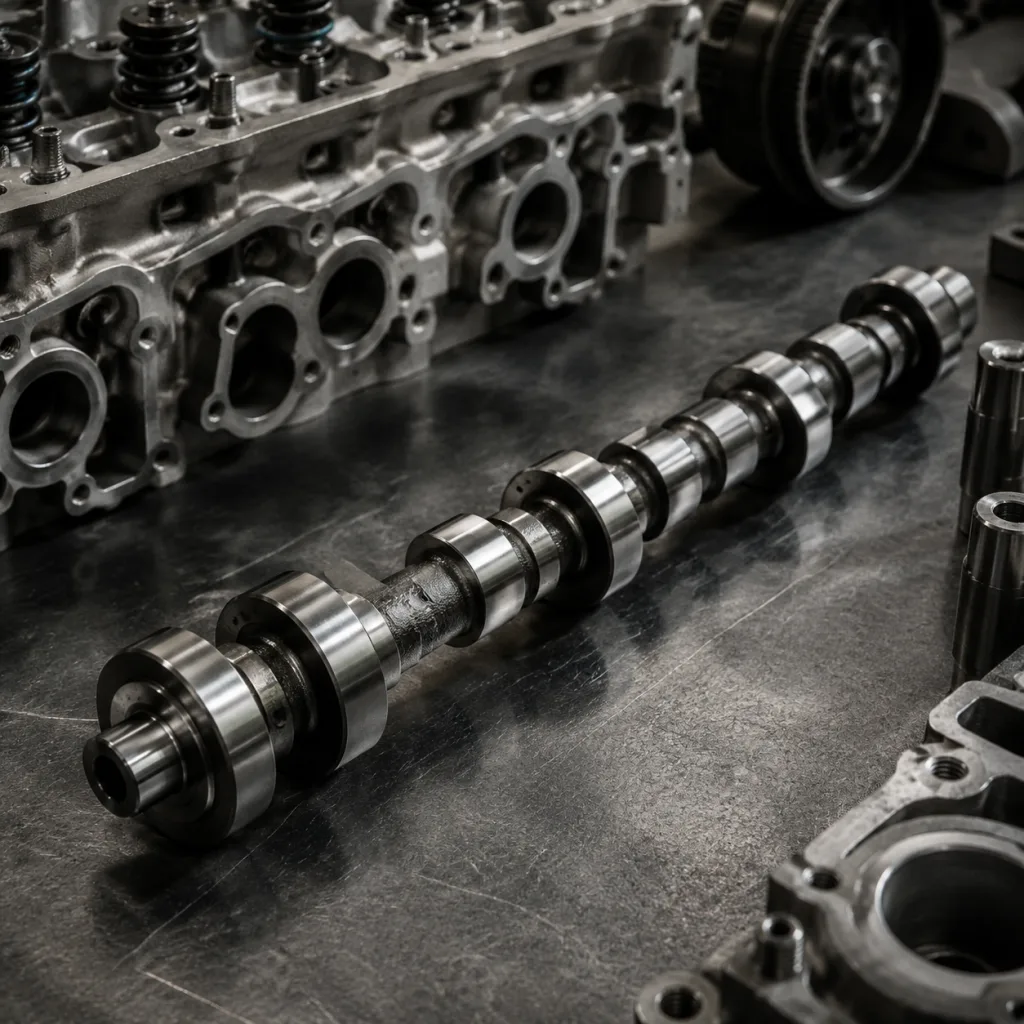
Verify the OE part-number cross-reference, engine code, valve timing requirements, and valvetrain type first. Hydraulic flat tappet, hydraulic roller, and other architectures do not carry the same risk profile. A supplier should be able to show control of these points:
Journal diameter tolerance: typically ±0.01 mm to ±0.03 mm, depending on drawing and bearing class
Lobe lift tolerance: typically ±0.02 mm to ±0.05 mm at the finished grind stage
Total indicated runout: commonly ≤0.02 mm on precision programs, unless the drawing allows more
Surface roughness: Ra 0.2–0.8 μm on journals and specified lobe finish by print
Hardness: batch-verified to the specified case depth or core hardness, often HRC 55–60 on hardened lobes where applicable
Packaging: corrosion-inhibiting wrap, VCI protection, and journal protection sleeves for export
Check item
Typical buyer expectation
Why it matters
Dimensional match
OE-equivalent or print-specific
Fit and timing accuracy
Material control
Documented alloy, casting, or billet specification
Strength and wear resistance
Hardness
Verified by batch and heat lot
Lobe and journal durability
Traceability
Lot-level records with heat number
Recall and inbound control
Documentation
IATF 16949:2016 / ISO 9001:2015
Supplier qualification
Finish quality
Ra and profile recorded on first article
Break-in performance and noise control
</tr></thead><tbody> </tbody></table>Driventus maintains batch traceability and inspection records aligned to buyer PPAP or ISIR requests where required. Before release, request the drawing, revision level, material cert, and first-article inspection report.
Where OEM and aftermarket buyers diverge
OEM and Tier-1 buyers usually care most about process stability, while aftermarket distributors care more about fitment coverage and complaint rates. The technical bar is similar. The commercial priorities are not.
Criterion
OEM / Tier-1 focus
Distributor focus
Engineering support
Drawing review, GD&T review, and DFM feedback
Fitment mapping and supersession control
Validation
DV/PV evidence, capability data, and sample sign-off
Sample consistency and complaint reduction
MOQ
Long-run stability and forecast adherence
Stock flexibility and mixed-SKU ordering
Lead time
Locked production windows and expediting rules
Replenishment speed and shipment cadence
Packaging
Line-side delivery and damage prevention
Shelf-ready packing and carton durability
</tr></thead><tbody> </tbody></table>Ask every camshaft Cadillac OEM supplier for the same basic commercial facts: MOQ, sample lead time, production lead time, and export packing standard. If the program needs a custom grind profile, the supplier should document the revised lobe separation, base circle, and timing events before release. For destination markets that require it, request REACH (EC) No 1907/2006 material declarations as part of the quote package. Typical structures are 50–100 pcs MOQ for catalog parts, 200–500 pcs MOQ for custom variants, 7–15 days for samples, and 30–60 days for production depending on machining load and finish requirements.
Inspection points that catch failures early
Camshaft validation should combine metrology, material testing, and application checks. The goal is to catch drift before it becomes a field failure.
Recommended inspection set
Micrometer checks on journals and critical diameters, typically recorded to 0.001 mm resolution
CMM or dedicated fixture measurement for lobe geometry and lobe indexing
Hardness testing by batch and heat lot, with acceptance tied to the customer drawing or process spec
Magnetic particle inspection or equivalent crack inspection where specified
Cleanliness verification before packing, including residual burr and abrasive control
Runout and straightness measurement on finished shafts, typically with a max reading documented on the inspection report
A common failure mode is hidden variation between samples and production lots. Another is over-trusting dimensional fit while ignoring finish, hardness, or runout. Both create expensive returns. For export programs, a supplier should also be able to support ECE R-83 when the camshaft is part of a broader emissions-related service or compliance package, and SAE J2527 where endurance testing is referenced by the customer specification. Not every application requires both, but the supplier should understand the requested validation method and maintain records accordingly. Buyers should request at least one PPAP-style submission package containing dimensional results, material certificates, hardness records, and sample approval photos before volume release.
Commercial terms that actually reduce risk
Lowest unit price is often a bad proxy for landed cost. In camshaft sourcing, risk usually shows up later as schedule slips, packaging damage, rejection, or undocumented changes.
Ask for a commercial sheet that covers:
MOQ by part number and by machining family
Sample and mass-production lead times
Incoterms and export documentation support
Spare capacity for urgent replenishment
Change-control notice period for process or tooling updates
It also helps to know whether the part is catalog stock or built to order. Catalog availability shortens procurement cycles. Build-to-order works better for low-volume engine variants and custom programs. Pricing should follow the demand curve: prototype pieces cost more per unit, pilot runs usually sit above steady-state volume, and annual blanket orders can lower piece price by reducing setup losses. Use this quick decision frame: under 100 pcs per year, prioritize availability and low tooling exposure; 100–1,000 pcs per year, negotiate staged release pricing; above 1,000 pcs per year, ask for annual tiers, fixed forecast windows, and safety-stock agreements. You can review our catalog at our catalog and our quality system before opening a sourcing discussion.
When custom development is worth it
Custom camshaft development makes sense when the buyer needs a new profile, a superseded OE design, or a regional application with different emissions or drivability targets. If the only goal is to mirror an existing part, custom work usually adds cost without adding value.
Driventus offers custom manufacturing for programs that need revised timing, lift, or material specification, along with packaging and labeling aligned to the buyer’s import process. For related engine parts, see our engine components. If your program is tied to a legacy Cadillac fitment or a cross-reference with an OE 06A-style identifier, ask for a documented sample approval route before committing to volume. A workable sequence is straightforward: drawing review, feasibility check, sample quote, pilot run, dimensional report, fitment validation, and production authorization. Expect revised quotes when the design changes bearing journal size, lobe lift, or heat-treatment requirement, because each change affects scrap risk, cycle time, and inspection cost.
Driventus is an independent aftermarket manufacturer; brand names are referenced for fitment only.
Frequently asked questions
At minimum, ask for dimensional reports, material records, hardness results, traceability by lot, and quality certificates aligned to IATF 16949:2016 or ISO 9001:2015. For controlled sourcing, also request revision-level drawings, first-article results, and a packaging specification.
Yes. Custom manufacturing is available for revised timing, lift, or packaging requirements, subject to drawing review and agreed validation steps. Typical custom projects start with a feasibility check and a sample lot before full production release.
Yes. Driventus supplies aftermarket distributors, OEM/Tier-1 buyers, and repair chains with controlled production and export support. Volume terms, MOQ, and lead time are quoted per part number based on forecast and finish requirements.
If you are sourcing a Cadillac camshaft program, share the drawing, target volume, tolerance targets, and OE cross-reference and we will review fitment and lead time. Start here: /contact.html