Camshaft for Cadillac CTS Replacement: B2B Sourcing Guide
A camshaft for Cadillac CTS replacement programme should be managed as a fitment, dimensional, and validation project—not as a simple catalogue lookup. Cadillac CTS applications span several engine families and model years, with differences in valvetrain layout, cam phaser interface, sensor target design, cylinder-bank position, and timing drive arrangement. For distributors, repair chains, and importers, the risk is more than a returned part; it is fitment uncertainty across mixed fleets, rebuild stock, and regional aftermarket listings. Driventus manufactures engine and powertrain components in Taizhou, Zhejiang, for B2B customers in more than 60 countries. Camshaft buyers typically need OE-equivalent geometry, controlled metallurgy, stable surface hardness, sea-freight-ready packaging, and inspection records that support incoming quality checks. Driventus is an independent aftermarket manufacturer; brand names are referenced for fitment identification only.
Replacement Fitment Starts With Engine Identification
Cadillac CTS replacement demand can involve different engine families, production years, and cylinder-bank layouts. Before issuing a purchase order, buyers should confirm the engine code, model year range, bank position, intake or exhaust location, phaser or sprocket interface, and camshaft position sensor target. A left-bank exhaust camshaft should not be treated as interchangeable with a right-bank intake camshaft, even when the casting or overall length appears similar.
For B2B sourcing, Driventus recommends matching replacement camshafts against physical samples, engineering drawings, or customer-approved cross-reference data. If an OE-style reference is supplied by the customer, it should be recorded in procurement files as a fitment identifier only, for example OE 06A… or OE 11251…. Driventus does not claim approval, sponsorship, or endorsement by any vehicle manufacturer.
Key confirmation points include:
Engine displacement and model year range
Intake versus exhaust camshaft position
Left-hand versus right-hand cylinder bank
Timing sprocket, phaser, or actuator interface
Camshaft position sensor target form
Journal diameter and thrust control design
Lobe count, firing-order relationship, and oil feed layout
Seal diameter, locating features, and end-face design
A replacement camshaft must preserve valve timing, lift, duration, bearing oil clearance, and sensor relationship within the engine’s operating limits. Minor deviations can lead to valvetrain noise, low power, rough idle, diagnostic trouble codes, or accelerated follower and bearing wear. For procurement teams, the key question is whether the supplier controls the features that affect installation accuracy and service life.
Typical control items for a camshaft for Cadillac CTS replacement programme include:
Feature
Procurement check
Why it matters
Journal diameter
Micrometer or CMM verification
Maintains oil film and bearing clearance
Lobe lift
Profile measurement
Controls valve opening and cylinder filling
Lobe phasing
Cam profile and datum check
Prevents timing deviation and fault codes
Thrust face width
Dimensional inspection
Controls axial movement
Sensor target geometry
Visual and gauge inspection
Supports accurate ECU position reading
Oil passage cleanliness
Cleanliness inspection
Reduces actuator or bearing restriction risk
Surface hardness
Batch hardness test
Supports wear resistance at lobes and journals
Runout and straightness
Dial indicator or CMM check
Helps prevent vibration and uneven bearing load
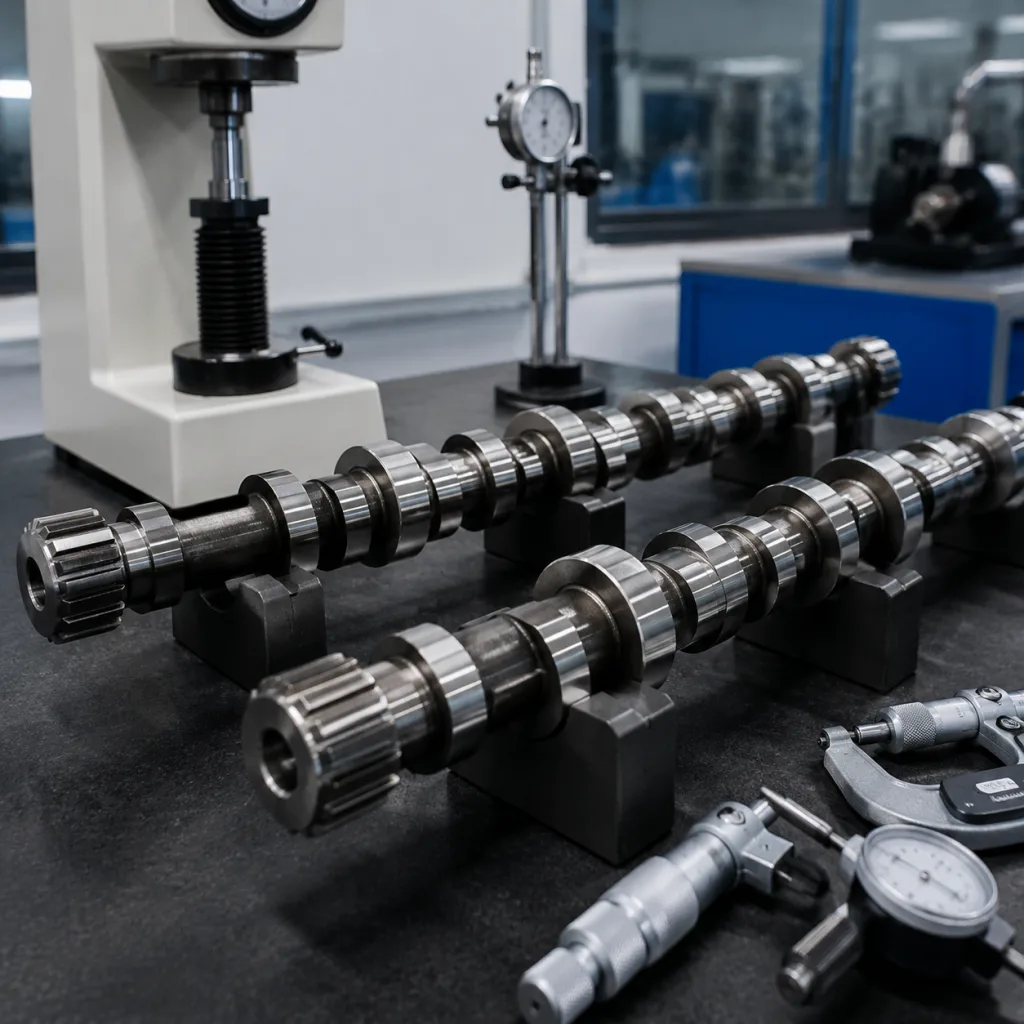
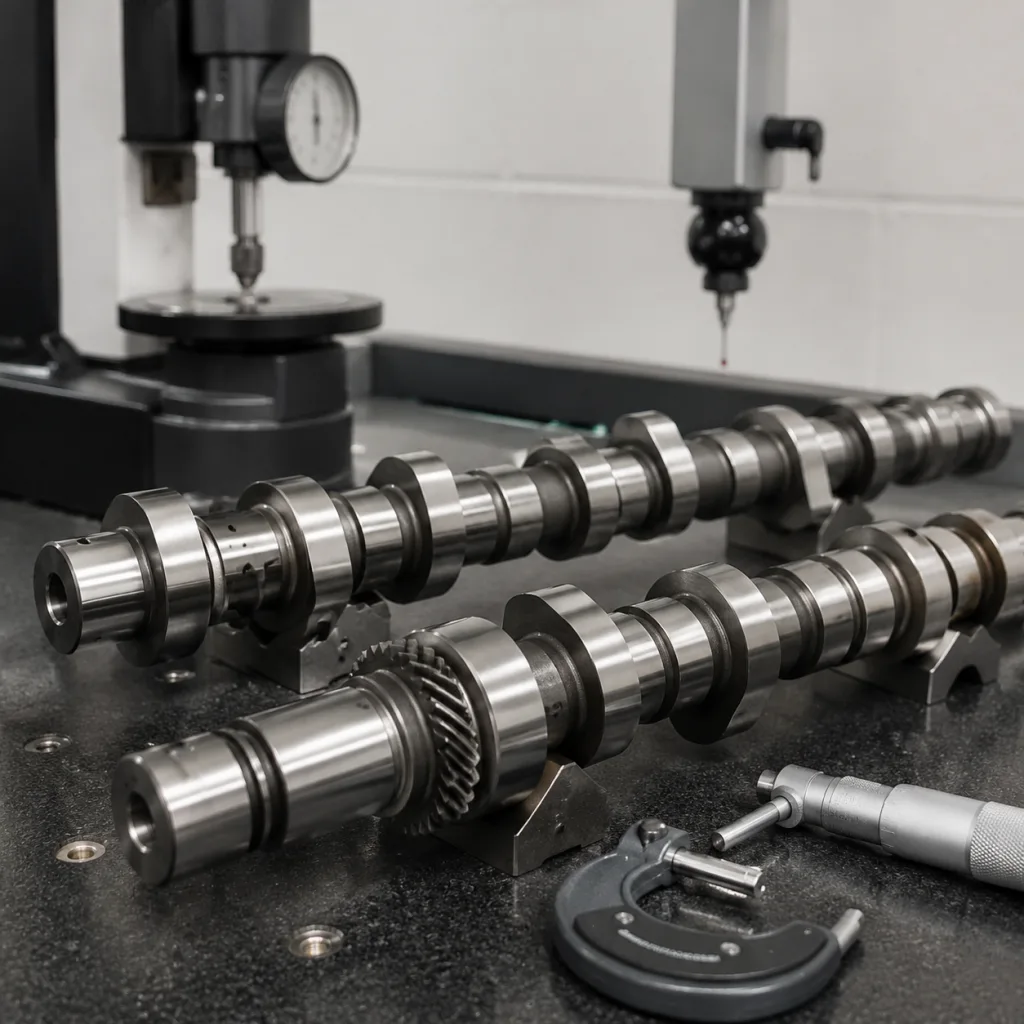
</tr></thead><tbody> </tbody></table>Material selection depends on engine design, production route, and customer specification. Common camshaft constructions include chilled cast iron, forged steel, and assembled camshafts. Driventus aligns material grade, heat treatment, machining datum, and surface finishing with customer drawings or validated reference samples. Where required, production part approval files, dimensional reports, hardness results, and batch traceability can be prepared under the customer’s sourcing procedure.
Validation Testing for OE-Equivalent Replacement
A camshaft is a high-load rotating component that must work with followers, bearings, timing components, seals, and electronic position sensing. Validation should therefore cover geometry, wear behaviour, oil-feed integrity, and functional compatibility with the timing and sensing system. Driventus applies inspection planning within an IATF 16949:2016 and ISO 9001:2015 certified management framework. Certification does not replace part-specific testing, but it supports disciplined control of process changes, nonconforming material, traceability, and corrective action.
For replacement camshafts, validation may include:
First-article dimensional inspection against drawing or approved sample
Cam profile measurement for lift curve consistency
Journal runout and straightness measurement
Surface hardness and case depth checks where applicable
Metallographic review for heat-treated or cast structures
Roughness measurement on journals, lobes, and thrust faces
Oil-hole, groove, and internal-passage cleanliness checks
Salt spray or packaging validation when specified for export conditions
Trial assembly checks with timing components, seals, and sensor references
Documentation expected by importers
Procurement teams commonly request inspection reports, material certificates, packing lists, country-of-origin information, and compliance declarations where applicable. For EU-bound shipments, REACH (EC) No 1907/2006 may be relevant to restricted substances in materials, coatings, cleaning residues, or packaging. Driventus can align documentation with customer import and receiving inspection needs through its quality system.
Common Replacement Risks in Aftermarket Supply
The most expensive camshaft sourcing problems often come from incomplete cross-reference data, not machining defects alone. Cadillac CTS repair demand may include older vehicles, mixed engine variants, rebuilt engines, and workshops that order by vehicle description instead of engine code. A distributor carrying one generic listing can face high returns if bank position, actuator interface, or sensor target details are not separated correctly.
Common risks include:
Incorrect bank or position: Intake and exhaust cams may share similar journals but differ in lobe orientation, timing datum, and sensor features.
Uncontrolled timing datum: A small datum error can cause rough running, poor emissions behaviour, or cam/crank correlation codes.
Poor oil-hole deburring: Burrs can restrict lubrication or release debris during break-in.
Weak packaging: Camshafts are long, slender parts and can be damaged by bending, end impact, or corrosion during sea freight.
Incomplete labelling: Similar-looking camshafts can be mixed in warehouse picking if bank, position, and batch data are not clearly identified.
Driventus uses fitment review, sample comparison, controlled inspection points, and export packing specifications to reduce these risks. For customers with private-label or region-specific references, custom manufacturing can include drawing review, fixture development, packaging design, barcode labelling, and carton-marking requirements.
Sourcing Checklist for Buyers and Repair Chains
For importers and multi-location repair groups, a replacement camshaft line should be evaluated before market launch. The checklist below supports supplier qualification, quotation review, sampling approval, and incoming inspection planning.
Confirm exact CTS engine code, model year range, cylinder bank, and intake or exhaust position.
Require a physical sample, drawing, or customer-approved reference data before tooling approval.
Specify camshaft construction, material grade, heat treatment, hardness range, and surface finish targets.
Request first-article inspection for journals, lobes, thrust faces, runout, oil passages, and sensor targets.
Define packaging requirements for corrosion protection, end protection, carton strength, and drop resistance.
Check supplier certification to IATF 16949:2016 and ISO 9001:2015.
Require traceability by batch, production date, inspection lot, and packing lot.
Confirm labelling, EAN/UPC if needed, warehouse part numbers, and master carton data.
Agree documentation requirements before shipment, including inspection reports and compliance declarations where needed.
For a camshaft for Cadillac CTS replacement order, Driventus can support MOQ discussion, lead-time planning, inspection documentation, and private-label packaging. Buyers can also combine camshafts with pistons, gaskets, crankshafts, water pumps, and turbochargers to consolidate engine-component procurement.
How Driventus Supports Replacement Programmes
Driventus supplies B2B customers that need stable production, documented quality controls, and export coordination. The company is based in Taizhou, Zhejiang, and manufactures engine and powertrain components for aftermarket distributors, OEM/Tier-1 suppliers, and repair chains in Europe, the United Kingdom, North America, Australia, Brazil, and other regions.
For camshaft projects, support can include drawing review, sample reverse engineering, material selection, prototype inspection, batch production, and export packaging. Commercial details such as MOQ, incoterms, lead time, sample schedule, and annual forecast planning are handled during quotation. For established customers, scheduled blanket orders can help reduce stockout risk while keeping inventory under control.
Driventus is an independent aftermarket manufacturer; brand names are referenced for fitment identification only. The objective is OE-equivalent replacement performance based on controlled dimensions, validated materials, suitable packaging, and consistent production records—not vehicle manufacturer endorsement. Buyers preparing a camshaft for Cadillac CTS replacement programme can use request a quote to share engine data, samples, drawings, forecast volume, target packaging, and documentation requirements.
Frequently asked questions
Provide model year, engine code, cylinder bank, intake or exhaust location, sample photos, and any customer-approved cross-reference data. A physical sample or drawing is preferred for dimensional confirmation.
Yes. Private-label cartons, barcode labels, corrosion protection, end protection, and export packing can be reviewed during quotation. Requirements should be confirmed before mass production.
No. Driventus is an independent aftermarket manufacturer; brand names are referenced for fitment identification only. Products are supplied as OE-equivalent replacement components based on customer specifications and validation requirements.
If you are building a camshaft sourcing plan, send engine data, samples, drawings, and annual volume estimates for review. Contact Driventus to discuss fitment, documentation, MOQ, lead time, and packaging requirements at /contact.html