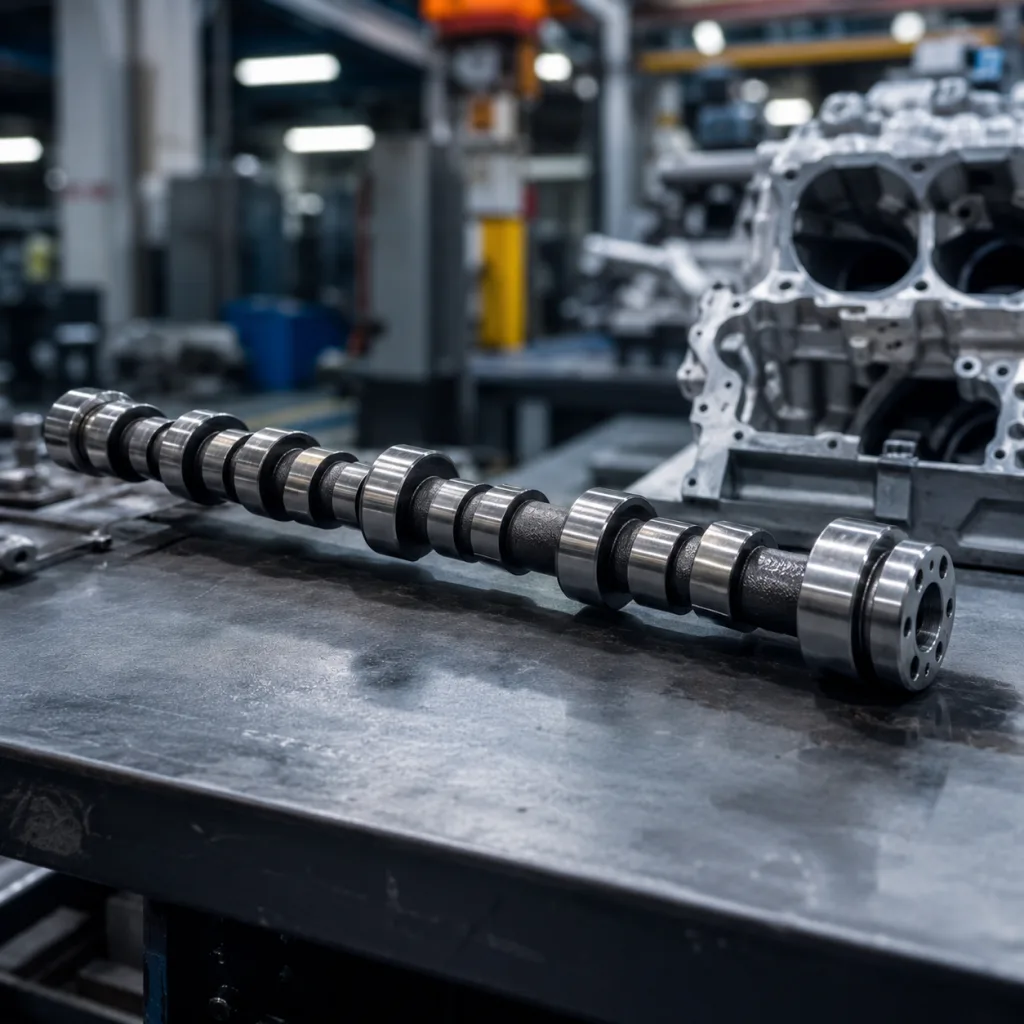
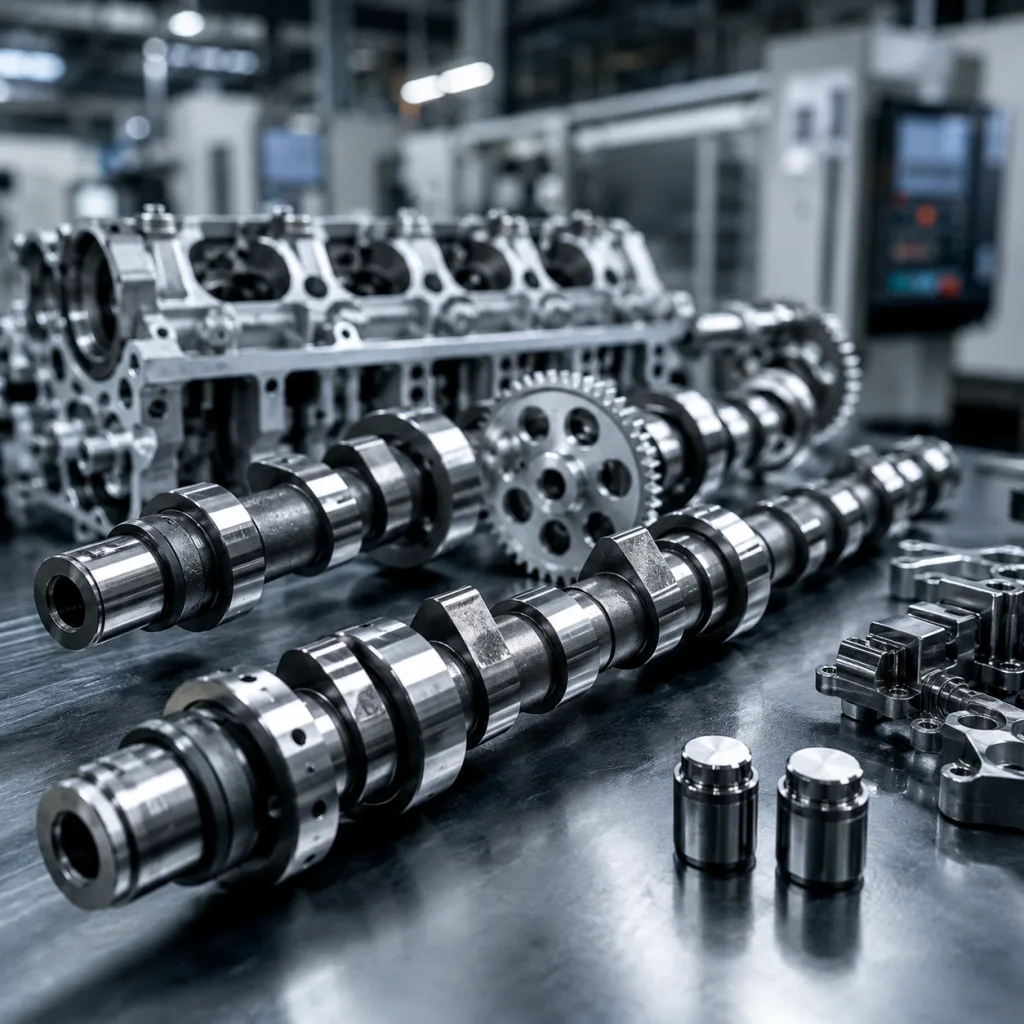
A camshaft for BMW 1 Series replacement sourcing program can fail long before the first carton ships. The usual cause is not price. It is an unclear match between engine code, camshaft position, timing interface, lobe geometry, trigger pattern, heat-treatment route, and packaging method. A catalogue description may say “BMW 1 Series,” but importers need proof that the part matches the exact engine family and market application they plan to sell.
Driventus manufactures engine and powertrain components in Taizhou, Zhejiang, and exports to more than 60 countries. For camshaft projects, we focus on OE-equivalent design intent, verified machining, documented heat-treatment control, and batch-level inspection records. Driventus is an independent aftermarket manufacturer; vehicle brand names are used only to identify fitment.
This sourcing note is written for distributors, repair-chain buyers, and engine rebuild suppliers that need fewer fitment disputes, lower warranty exposure, and steadier repeat supply. It moves from fitment decisions to failure modes, validation, commercial planning, factory audit checks, and shipment documentation.
Start With the Fitment Decision, Not the Catalogue Name
The BMW 1 Series has been built with multiple petrol and diesel engine families. Specifications change by market, production year, emissions level, and valve-train layout. A replacement camshaft should therefore be specified by engine code, camshaft position, timing-system design, and OE reference convention rather than by model name alone.
For procurement teams, the phrase camshaft for bmw 1 series replacement should trigger a controlled fitment decision:
Confirm engine family, displacement, fuel type, production range, and market code from VIN-derived data or the buyer’s application file
Identify intake or exhaust position before quoting; do not merge left/right, inlet/exhaust, or revised timing variants into one SKU
Verify VANOS or other variable valve timing interfaces, including bolt pattern, center bore, dowel location, oil-control passages, and phaser seating face
Match cam sensor trigger pattern, reluctor tooth count, slot width, angular position, and reference feature location against the approved sample or drawing
Check cam gear, sprocket, or phaser mounting geometry, including thread size, depth, chamfer, and datum-to-face distance
Confirm journal diameter, lobe count, thrust-face position, oil-feed groove width, oil-hole diameter, and plug design before sample release
Define corrosion protection and packaging for sea, air, or courier freight, including VCI bag, end caps, sleeve density, and carton drop resistance
A useful fitment file is short but strict. It should show the buyer SKU, application list, intake/exhaust position, drawing revision, approved OE cross-reference convention, and one controlled master sample where possible. For dimensional comparison, buyers often hold journal diameter, thrust-face width, lobe lift, base-circle diameter, overall length, and trigger-feature angle as critical-to-quality items.
Typical buyer drawing tolerances for replacement camshafts may specify journal diameter within ±0.010 mm, lobe lift within ±0.030 mm, overall length within ±0.20 mm, and trigger-feature angular position within ±0.5° when sensor correlation is sensitive. These figures are not a substitute for the approved drawing or master sample.
OE part-number references should be validated against the buyer’s data file, drawing, or physical sample. Generic conventions such as OE 06A… or OE 11251… may help internal sorting, but they should not be treated as confirmed fitment until checked against the exact engine application. Driventus can compare buyer-supplied references with drawings, samples, and application data, while avoiding any claim of approval by a vehicle manufacturer.
Camshaft life is not decided by one number on a certificate. It depends on base material, surface hardness, lobe profile, lubrication conditions, follower design, journal finish, and cleanliness during assembly. For an aftermarket replacement program, the target is not to redesign the engine. The target is to reproduce the functional geometry, wear resistance, and timing behavior of the intended application.
Most failures trace back to one of four areas: the wrong manufacturing route, unstable heat treatment, inaccurate grinding, or weak final inspection. Depending on the design, production may involve induction-hardened forged or cast steel, chilled-cast surface control, or another agreed route. The route then drives grinding allowance, hardness depth, straightening method, and inspection risk. Buyers should ask which process is used for the quoted part number, not just which process the factory can perform.
Control area
Typical buyer target or tolerance
Verification method
Journal diameter
Drawing value, often ±0.005–0.015 mm
Micrometer, air gauge, or CMM inspection
Lobe lift
Drawing value, often ±0.020–0.050 mm
Cam profile measurement equipment
Base circle runout
Commonly ≤0.020–0.050 mm TIR
Dial indicator, V-block, or CMM check
Surface hardness
Typically HRC 55–62 or design-specific
Rockwell or equivalent hardness test
Effective hardened depth
Commonly 1.5–3.0 mm when specified
Metallographic section or hardness traverse
Journal surface roughness
Often Ra 0.2–0.4 µm
Roughness tester on journals
Lobe surface roughness
Often Ra 0.4–0.8 µm
Roughness tester on lobe contact area
Straightness
Commonly ≤0.03–0.06 mm over supported length
V-block runout inspection
Trigger feature position
Drawing angle, often ±0.5°–1.0°
Fixture gauge or CMM confirmation
</tr></thead><tbody> </tbody></table>The quoted ranges are procurement reference values, not universal limits. Lock the final values in the drawing, control plan, or signed sample report. If the original camshaft uses a close-tolerance trigger wheel for cam/crank correlation, angular location may matter more than a minor cosmetic mark. If the camshaft runs directly in an aluminum cylinder head without replaceable bearings, journal size, roundness, cylindricity, and surface finish become high-risk dimensions.
Driventus applies process documentation aligned with IATF 16949:2016 and ISO 9001:2015 principles. These standards support production control, traceability, corrective action, and change management, but they do not replace part-specific validation. Importers should request a control plan for the actual camshaft family, including critical dimensions, hardness range, gauge type, sampling frequency, reaction plan, and approval threshold.
A Practical Approval Sequence Before Mass Orders
A replacement camshaft must stay inside the functional envelope of the original design. That means dimensional conformity, lobe profile accuracy, trigger-feature location, hardness depth, runout, and heat-treatment stability must be proven on production-representative parts. Early development samples are useful, but they are not enough if later mass production uses a different material batch, heat-treatment route, grinding setup, or fixture.
A practical validation pack may include:
Dimensional inspection report for journals, lobes, thrust faces, oil holes, keyways, threads, plugs, end faces, and mounting features
Lobe profile comparison against an approved drawing, master sample, or buyer reference data, including lift curve, opening/closing angle, and peak lift position where available
Hardness readings on lobes and journals where the design requires them, with a defined minimum, maximum, and test location
Metallographic check for case depth, chilled layer, decarburization, or microstructure when specified by drawing or risk assessment
Runout and straightness report after heat treatment and after final grinding, before cleaning and packaging
Trial assembly notes when mating phaser, sprocket, caps, followers, or fixture conditions are available
Batch traceability label format and inspection sampling plan, such as 5 pieces for first-article approval and AQL-based checks for repeat lots
Photos of approved marking, packaging, rust-prevention oil, VCI bag, inner sleeve, carton layout, and pallet stacking method
A low-risk launch usually follows three steps. First, 1–2 pieces confirm drawing interpretation and basic fitment. Second, 5–10 pieces support dimensional, assembly, and packaging approval. Third, a pilot lot of 50–200 pieces checks repeatability before full container or scheduled batch orders. If dyno, road, or engine-bench testing is required, the buyer should define duration, oil grade, break-in method, follower type, pass/fail wear limits, and test-cost ownership before sample release.
Although a camshaft is not normally treated as a standalone emissions-control device, poor replacement quality can affect valve timing, combustion stability, misfire risk, and diagnostic behavior. Buyers supplying EU or UK channels may need to consider the wider vehicle compliance context, including ECE R-83 for vehicle emissions approval. Material declarations should also support REACH (EC) No 1907/2006 obligations where applicable.
Driventus can provide documentation through its quality system, including inspection formats, sample approval records, traceability references, and corrective-action procedures for B2B customers.
Build the Purchase Spec Around Dispute Prevention
A strong purchase specification prevents arguments after shipment. Camshafts are precision engine parts; a small difference in oil-hole position, reluctor geometry, thrust-face width, or lobe phasing can become a warranty claim for distributors and repair networks.
Before placing a purchase order, procurement teams should define the following items in writing:
Application list by engine code, production range, transmission relevance, emissions level, and market where available
Buyer part number, cross-reference policy, supersession rules, and whether old and new versions may be shipped together
Inner-box label fields, barcode format, country-of-origin wording, language requirements, and private-label artwork approval
AQL level or agreed inspection sampling plan, with critical, major, and minor defect definitions
Warranty handling process for technical returns, field claims, credit notes, and root-cause review timing
MOQ and price should reflect process reality. For an existing camshaft with active tooling and shared material, a trial order may be practical at 50–100 pieces per SKU. Regular production is often more efficient at 200–500 pieces per SKU. A new or low-volume camshaft requiring fixture setup, programming, sample approval, or private packaging may need a higher MOQ or a tooling/setup charge. Pricing is normally affected by material route, hardness process, grinding cycle time, scrap risk, inspection level, packaging specification, order quantity, exchange rate, and Incoterms such as EXW, FOB Ningbo/Shanghai, CIF, or DAP.
Lead time should be planned as a sequence, not a promise date. Typical timing is 7–15 days for drawing/sample review, 20–35 days for first samples when tooling is available, 45–75 days for new development or fixture modification, and 30–45 days for repeat production after deposit and artwork approval. Ocean freight, consolidation, customs clearance, and destination warehousing sit outside production lead time. If the importer has a launch date, the PO should show the latest sample approval date, packaging artwork freeze date, production release date, inspection date, and required vessel cutoff.
For a camshaft for BMW 1 Series replacement line, SKU separation deserves extra attention. Some engines use separate intake and exhaust camshafts that look similar in warehouse handling but differ in timing features, trigger patterns, or phaser interfaces. Mixing them can create installation problems or field failures. Colour coding, laser marking, carton-level identifiers, and scan-based picking controls reduce that risk.
If a standard part does not match the buyer’s market requirement, Driventus can discuss custom manufacturing, including machining adjustments, private-label packaging, controlled sample approval, documented revision management, and scheduled shipment planning.
Audit the Process Path, Not the Showroom
A factory audit for camshaft sourcing should go beyond capacity claims, certificates, and product photos. The buyer needs to know whether the supplier controls the steps that create performance risk: material traceability, heat treatment, straightening, grinding, measurement, cleaning, and export packaging.
Key audit points include:
Audit item
What to check
Buyer acceptance evidence
Incoming material control
Grade, certificate review, lot traceability
Heat number linked to batch record and material certificate
Sleeve fit, carton strength, drop resistance, humidity protection
Drop-test or transport test record, pallet photo, carton specification
</tr></thead><tbody> </tbody></table>During an audit, ask to follow one batch from raw material receipt to final carton. The useful evidence is the link between heat number, production order, heat-treatment lot, grinding lot, inspection report, packing label, and shipment document. If those records cannot be connected, warranty investigation becomes slow and often inconclusive.
For repeat B2B programs, buyers should also require change control. No change to material grade, heat-treatment route, lobe grinding program, trigger fixture, marking, or packaging should be made without written approval.
Driventus is based in Taizhou, Zhejiang, and supplies engine and powertrain components to aftermarket distributors, wholesalers, OEM/Tier-1 customers, and multi-location repair chains. Certification to IATF 16949:2016 and ISO 9001:2015 supports audit readiness, while part-family evidence remains essential during supplier qualification.
Driventus is an independent aftermarket manufacturer; vehicle brand names are referenced for fitment identification only.
Q&A: What Must Be in the Shipment File?
What should the shipment file prove? It should connect the shipped batch to the approved specification and give the receiving team clear acceptance criteria. A certificate alone is rarely enough for replacement camshafts.
Recommended shipment documentation includes:
Commercial invoice and packing list with buyer SKU references, carton count, net weight, gross weight, and pallet quantity
Batch or lot number linked to production date, heat-treatment lot, grinding lot, and final inspection record
Inspection report for critical dimensions and functional features, including actual measured values rather than only pass/fail marks for launch lots
Hardness test summary where specified by the control plan, with test locations and accepted range
Material certificate or supplier material declaration linked to the incoming material batch where available
Packaging photos before carton sealing when required, including part orientation, sleeve, VCI bag, label, and pallet condition
Label artwork or barcode sample for private-label programs, preferably verified by scanner before mass printing
REACH (EC) No 1907/2006 declaration where applicable
Non-use or restricted-substance statements required by the destination market
Corrective-action contact route for technical returns, including claim photos, mileage, installation notes, oil condition, and returned-part handling
How strict should receiving inspection be? For a first order, buyers may inspect 100% of labels and visible condition, then measure a defined sample such as 5–13 pieces per SKU depending on lot size and AQL plan. For stable repeat orders, receiving can focus on carton condition, corrosion protection, marking, label accuracy, and a reduced dimensional sample.
What should be quarantined immediately? Rust, nicks on lobes or journals, damaged trigger features, missing plugs, mixed intake/exhaust parts, or barcode mismatch should be held before distribution.
For North American, EU, UK, Australian, and Brazilian buyers, receiving inspection should include external carton condition, label accuracy, corrosion protection, part marking, visible machining damage, and smooth rotation where the check is practical. If a claim occurs, retained samples and batch-level records shorten the technical review and help separate installation issues from product issues.
To evaluate a camshaft for BMW 1 Series replacement sourcing project, share the target engine codes, annual volume, required MOQ, target price range, packaging requirements, destination market, Incoterms, forecast schedule, and any OE cross-reference convention already used in your system.
Frequently asked questions
Provide the engine code, model year or production range, intake or exhaust position, timing-system details, buyer SKU, drawing revision, approved sample status, annual volume, MOQ target, packaging requirement, and any available OE cross-reference convention. Model name alone is not enough because BMW 1 Series applications vary by engine family, market, and production period.
Yes. Driventus can support private-label cartons, barcode labels, anti-corrosion packing, VCI bags, inner sleeves, pallet requirements, and buyer-specific documentation for approved B2B programs. Packaging specifications should be confirmed during sample approval to prevent label, corrosion, or warehouse handling issues.
No. Driventus is an independent aftermarket manufacturer; vehicle brand names are referenced for fitment identification only. Replacement camshafts are supplied according to buyer specifications, application data, approved samples, and agreed validation requirements, without claiming approval or endorsement by any vehicle manufacturer.
For technical review, sample approval, MOQ confirmation, or batch pricing, send your application list, target engine codes, drawing or sample status, packaging requirements, destination market, Incoterms, target annual demand, and forecast schedule to Driventus. You can [request a quote](/contact.html).