Camshaft Land Rover Replacement: B2B Sourcing Notes
A camshaft Land Rover replacement programme can fail even when the part number appears to match. The usual weak points are lobe geometry, journal oil film, surface hardening, engine-code confusion and batch traceability. If the profile is wrong, the result may be emissions faults, hard starting, low power, valve-train noise or accelerated follower wear. For B2B buyers, the decision is not simply “does it fit?” but “can this supplier repeat the approved timing, material and inspection standard across shipments?” This guide gives Driventus’ sourcing framework for replacement camshafts across Land Rover petrol and diesel applications, covering specification control, validation, QA records, packaging, lead times, MOQ and RFQ structure. Driventus is an independent aftermarket manufacturer; brand names are referenced for fitment only.
Start With the Buyer’s Decision Gate, Not the Catalogue Match
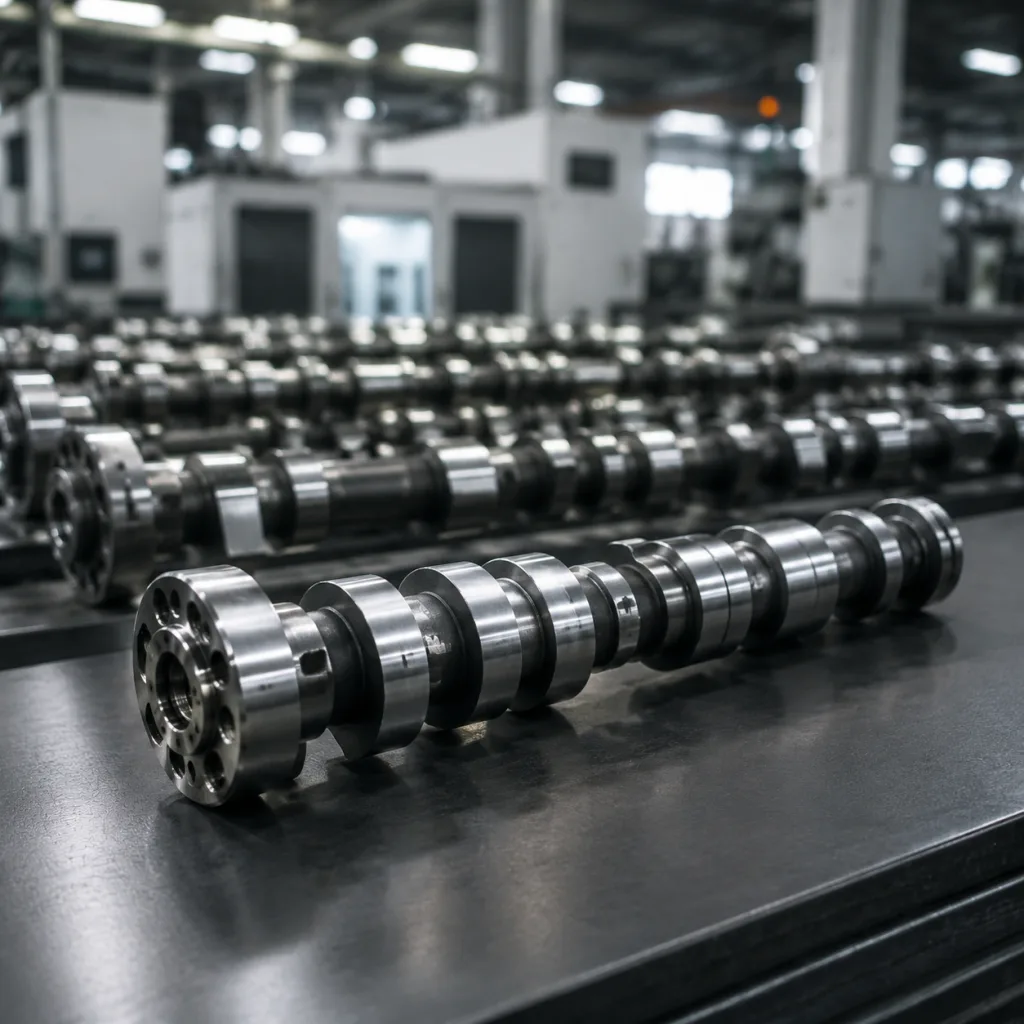
Treat the camshaft as a timed valve-train component, not a machined bar with lobes. A part that drops into the cylinder head can still open the valve too early, too late or by the wrong amount. The buyer’s first gate should therefore be functional equivalence: fitment, timing relationship, oil-film stability and wear resistance for the expected service interval.
Land Rover replacement demand often spans several engine generations, regional fleets and intake/exhaust or left/right bank variants. That makes visual comparison risky. A controlled camshaft Land Rover replacement sourcing file should lock down these items before price negotiation goes too far:
Journal diameter against drawing or master sample, commonly controlled within ±0.010–0.020 mm depending on design
Journal roundness and cylindricity, typically targeted below 0.005–0.010 mm for stable oil film
Lobe lift, base circle and flank profile consistency, with lift variation usually held within ±0.03–0.05 mm after approval
Thrust face width and end-float compatibility, checked against the cylinder-head or cam-carrier specification
Gear, sprocket, phaser, dowel, keyway or sensor trigger alignment, including angular position where timing is affected
Surface hardness and case or chill depth on lobes and journals, supported by batch test records
Oil-hole diameter, chamfer and gallery alignment to reduce start-up scuffing risk
Export packaging that prevents corrosion, denting and bending during 30–45 day sea freight plus inland handling
A practical approval gate is: identify sample, measure master, release drawing or inspection plan, approve pilot batch, then repeat production under locked process parameters. Buyers can review broader engine programme options in our catalog and the engine-component family page at /products/engine-components.html.
Failure Modes Hidden in Small Tolerance Errors
Camshaft failures rarely begin with an obvious defect. A lobe profile error under 0.10 mm can still shift valve lift enough to affect combustion quality. An oversized journal can squeeze the oil film. An undersized one can lower pressure at the bearing interface. On roller-follower designs, crown, taper and surface finish influence tracking, noise and edge loading.
Material choice should follow the engine load and follower design. Typical aftermarket routes include chilled cast iron, ductile iron, induction-hardened steel and forged steel. Driventus selects the route by application requirement, then verifies it through incoming material inspection, heat-treatment control and final measurement. The procurement file should include chemical composition, tensile or hardness data, heat number and furnace or induction-hardening batch reference.
Control item
Procurement target
Typical verification method
Lobe lift variation
±0.03–0.05 mm after sample approval, or drawing-specific
Cam profile measuring system
Base circle variation
Usually ≤0.02–0.03 mm across matched lobes
Cam profile measuring system
Journal diameter
Commonly ±0.010–0.020 mm, drawing-specific
Micrometer, air gauge or CMM
Journal roundness
≤0.005–0.010 mm process target
Roundness tester or CMM
Total runout
Often ≤0.03–0.05 mm across datum journals
Dial indicator or CMM fixture
Lobe surface hardness
Application-specific, often 50–60 HRC equivalent for hardened steel routes
Rockwell or Vickers hardness test
Chilled or case depth
Commonly 1.0–3.0 mm where specified
Metallographic section or hardness traverse
Oil hole position
Full alignment with oil gallery, no blocked burrs
Optical, pin-gauge or fixture inspection
Surface finish
Journals typically Ra 0.2–0.4 μm; lobes typically Ra 0.4–0.8 μm unless specified
Roughness tester
</tr></thead><tbody> </tbody></table>If the buyer provides an OE part-number cross-reference, keep it in the procurement file only as application evidence, for example OE 06A… or OE 11251… where relevant. Driventus does not claim approval or endorsement by any vehicle manufacturer.
Proof Package: What to Ask Before the Pilot Order
For a new reference, do not approve on a polished prototype. Ask for 3–5 first-article samples made through the intended production route. Dimensional inspection shows whether the sample matches the master data; validation evidence shows whether the route can repeat it.
A useful proof package includes:
First article inspection report listing every critical-to-function dimension with actual readings, not pass/fail marks only
Cam profile report showing lift curve, base circle, opening/closing ramp and angular relationship to datum features
Material certificate and heat-treatment record for the production batch, including heat number and furnace or induction cycle ID
Surface hardness report for lobes, journals and thrust areas, with test locations clearly marked
Metallographic report where chilled depth, nodularity, carbide distribution or case depth is specified
Runout and straightness inspection after heat treatment and final grinding, because straightening before grinding is not enough
Oil-hole inspection after cleaning, including burr control and airflow or pin-gauge confirmation where galleries are small
Salt spray or corrosion-resistance assessment for packaging validation where long transit is expected, commonly 48–96 hours depending on buyer standard
Installation trial on a representative cylinder head, cam carrier or dedicated fixture to confirm end float, rotation torque and sensor clearance
For emissions-controlled vehicles, the camshaft affects combustion and aftertreatment indirectly through valve timing and cylinder filling. Vehicle-level standards such as ECE R-83 relate to emissions performance; they do not certify an aftermarket camshaft. The procurement requirement is more direct: controlled geometry, repeatable production and batch evidence tied to each shipment.
Traceability Scenario: When a Workshop Claim Arrives
Imagine a distributor receives three workshop claims for follower noise after installation. Without traceability, the discussion becomes subjective: oil quality, fitting practice, mileage, customer use. With traceability, the supplier can isolate the furnace batch, machining lot, grinding date, operator shift, inspection record and packing date. That is the difference between a contained technical review and a programme-wide commercial dispute.
Camshafts are high-liability parts because one defect can create engine damage, labour claims and lost workshop confidence. Supplier qualification should therefore include process audit evidence, not just catalogue coverage and unit price. For higher-risk references, ask the supplier to identify control points for casting or forging, rough machining, heat treatment, straightening, grinding, washing, preservation and final packing.
Driventus operates under IATF 16949:2016 and ISO 9001:2015 quality-management frameworks. Buyers can review our quality system for information on inspection flow, process control and batch traceability. For regulated markets, material and chemical compliance should also be considered, including REACH (EC) No 1907/2006 for applicable substances in products and packaging.
A practical B2B audit checklist should cover:
Control plan for casting, machining, heat treatment, grinding, cleaning, anti-rust treatment and packing
Gauge calibration records for micrometers, profile testers, CMM fixtures, hardness testers and roughness gauges
Measurement-system control, with GR&R evidence for critical dimensions where PPAP-style approval is required
Batch coding on product labels, inner sleeves and export cartons, linked to furnace batch, machining lot and inspection report
In-process inspection frequency, for example first-off, patrol checks every 20–50 pieces and final AQL sampling as agreed
Non-conforming material procedure, quarantine marking, root-cause analysis and corrective-action closure timing
PPAP-style documentation where requested by OEM, Tier-1 or repair-chain customers, including process flow and control plan
Packaging drop, corrosion and handling checks for export shipments, especially where mixed cartons or pallet repacking is used
For distributor programmes, set a warranty feedback rule before launch. Returned-part analysis works only when the field part can be connected to production history. A realistic record-retention target is at least 5 years, or longer where the customer contract requires it.
Import Planning: The Commercial Risks After Technical Approval
Many replacement camshaft programmes pass the bench check and still fail commercially. The common reason is weak fitment data. Import managers should request application files with engine code, model-year range, fuel type, valve-train configuration, bank position, intake/exhaust position, sensor-trigger notes and supersession logic. If the buyer supplies a sample, tag it with engine code, VIN range if available, OE reference, installation position and observed market demand.
For multi-location repair chains, carton labels must work at branch level. Recommended fields include part number, application summary, production batch, quantity, country of origin, barcode, gross/net weight and handling notes. Anti-corrosion oil, VCI paper, end caps, foam supports or sealed PE sleeves may be required depending on transit time and warehouse humidity. For sea freight, specify pallet height, carton strength, desiccant use and whether mixed references are allowed on the same pallet.
Lead time should be split into development and repeat supply. A new camshaft requiring reverse engineering, drawing release, tooling or fixture development typically needs 45–75 days before first samples, then 20–35 days for sample review, correction and pilot approval. Existing references with approved tooling are usually quoted at 30–60 days for production after deposit and artwork approval, depending on material availability and order size. Air freight suits first articles and urgent warranty stock. Sea freight should handle replenishment because camshafts are dense and damage-sensitive.
Clarify MOQ and price logic before engineering starts. Existing references may be feasible from 50–100 pieces per part number. Newly developed or low-volume references often require 200–500 pieces per part number to absorb fixture, tooling and inspection-plan costs. Unit price is normally driven by material route, hardness process, grinding time, profile complexity, inspection level, packaging specification, annual forecast and scheduled call-offs. Buyers needing application-specific profiles, private-label packaging or modified inspection plans can discuss custom manufacturing with the Driventus engineering team.
RFQ Q&A: Details That Prevent Bad Quotes
What application data should be included? Provide target application, engine code, model-year range, fuel type and valve-train layout. Include intake/exhaust position, left/right bank, sensor features and phaser details where applicable.
How should cross-references be handled? If available, list the required OE cross-reference format, such as OE 06A… or OE 11251…, but treat it as fitment evidence rather than proof of technical equivalence.
What engineering inputs help the supplier quote accurately? State whether a sample, drawing, CAD file or 3D scan is available. If metallurgy must be confirmed, note whether the supplier has permission to section a sample.
Which material and process details belong in the RFQ? Define the required or acceptable route: cast iron, ductile iron, chilled iron, forged steel or induction-hardened steel. Add heat-treatment, hardness, chill-depth or case-depth expectations with the acceptable test method.
Which tolerances and reports should be requested? List critical tolerances for journal diameter, lobe lift, base circle, runout, oil-hole position and thrust width. Define the inspection report format, sampling plan and AQL level, for example 100% checks on profile-critical features and AQL 1.0–2.5 for visual or packaging checks.
What commercial and logistics terms reduce later disputes? Specify packaging for sea, air or mixed transport, including anti-rust period, carton limits, palletisation and barcode format. Add annual forecast, first order quantity, MOQ expectation, delivery schedule, call-off plan, currency, Incoterms, destination port, tooling-charge treatment, labelling requirements, REACH-related declarations and country-of-origin marking.
For aftermarket distributors, the safest path is a controlled sample batch before container-volume replenishment: RFQ review, feasibility confirmation, sample quotation, first-article production, inspection approval, pilot order and scheduled repeat orders. OEM and Tier-1 buyers may require additional documentation aligned with IATF 16949:2016 expectations, including process flow, control plan, measurement reports and change-control approval before any material, tooling or process revision.
Frequently asked questions
Verify lobe profile, journal dimensions, runout, hardness, oil-hole alignment, thrust features and application data. Ask for first article inspection, material records, heat-treatment evidence and batch traceability before volume orders.
Yes. Driventus can support private-label packaging, buyer part numbering, barcode labels and agreed inspection documentation for qualified B2B programmes, subject to application data, forecast, MOQ and commercial review.
No. Driventus is an independent aftermarket manufacturer; brand names are referenced for fitment only. We supply replacement components based on dimensional matching, process control and buyer-approved specifications.
For application review, sample validation, MOQ planning or repeat-order scheduling, send drawings, samples or fitment data and [request a quote](/contact.html).