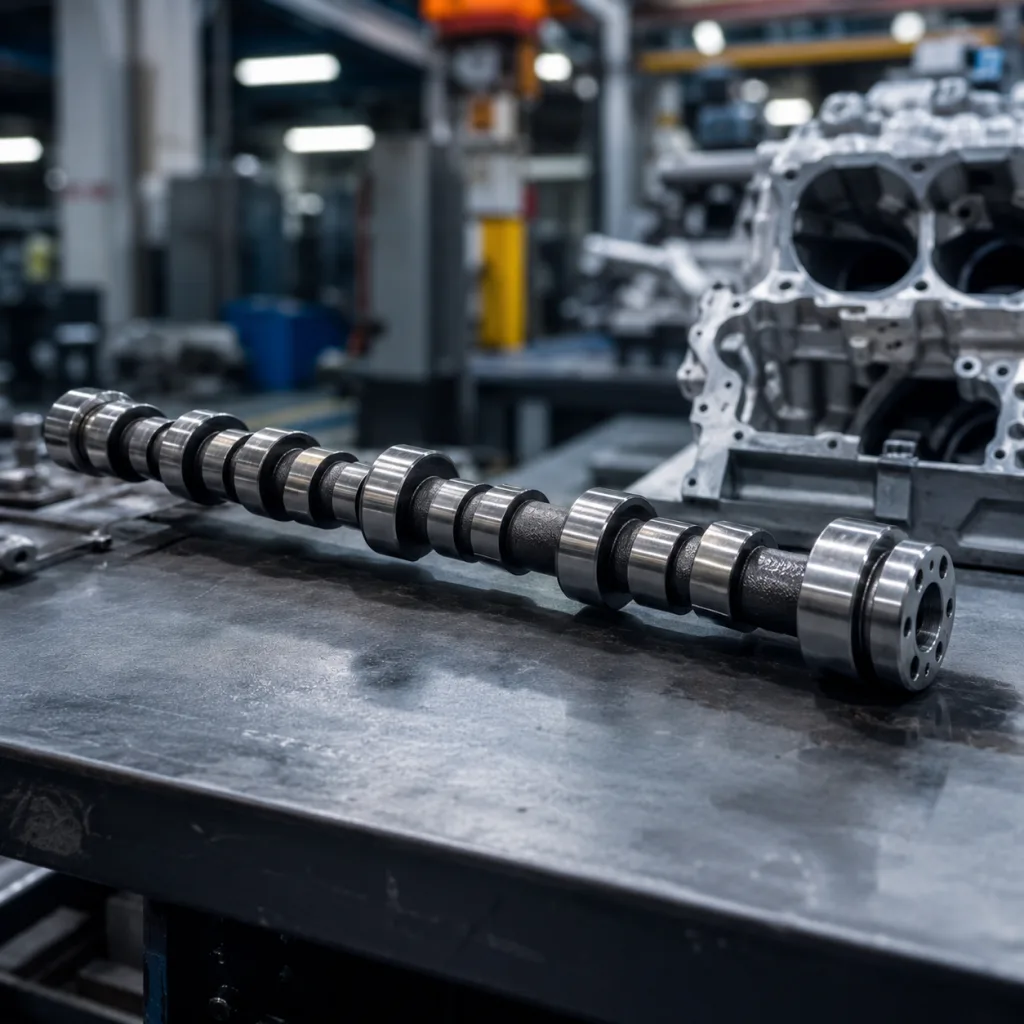
Buying Porsche-fitment camshafts from China is an engineering decision before it is a purchasing decision. The supplier must prove control of metallurgy, lobe geometry, heat treatment, surface finish, cleanliness, packaging and timing repeatability across batches. A polished sample is not enough.
For distributors and engine rebuild specialists, one premature failure can erase the margin from an entire order. For OEM and Tier-1 programmes, the pressure is different: process capability, PPAP-style discipline, controlled changes and traceable records. This guide explains how to judge a camshaft Porsche manufacturer China option without relying on generic supplier claims. It covers technical qualification, commercial planning, factory audit evidence, export controls and quotation comparison for aftermarket, private-label and programme supply.
Driventus manufactures engine and powertrain components in Taizhou, Zhejiang, and supplies B2B buyers in more than 60 countries under IATF 16949:2016 and ISO 9001:2015 systems.
Start With the Risk, Not the Unit Price
The first sourcing filter is not the lowest FOB number. It is whether the factory can define, measure and repeat the camshaft characteristics that affect valve timing, friction, noise, oil-film stability and fatigue life.
Before commercial negotiation, ask for the drawing basis, application list, material grade, heat-treatment route, lobe profile control plan and final inspection template. A serious supplier should say exactly what is being produced from: approved drawing, reverse-engineered master sample, existing aftermarket specification or customer-owned design. If the technical documents are vague, inconsistent or unavailable in English, the price is not yet comparable.
Make the first quotation carry its assumptions. It should state the Incoterm, such as EXW, FOB Ningbo or FOB Shanghai; sample charge; sample lead time; mass-production MOQ; lead time after deposit and packaging approval; inspection level; and whether individual anti-rust packing and export cartons are included. In a camshaft Porsche manufacturer China project, this prevents a cheap headline price from becoming expensive after inspection, engineering review and packaging are added.
Use these questions as the first gate:
Does the supplier manufacture camshafts in-house or trade finished parts?
Which steps are internal: rough turning, drilling, grinding, polishing, heat treatment, straightening, washing and packing?
Are cam profile grinders, CMMs, roundness testers, hardness testers and surface roughness instruments available on site?
Are batch records linked to material heat numbers, furnace lots, machining routes and inspection reports?
Is change control documented under IATF 16949:2016 and ISO 9001:2015 procedures before material, heat-treatment, tooling or process-route changes?
Can the supplier support neutral packaging, private-label packaging, distributor barcoding and carton-level traceability?
Driventus is an independent aftermarket manufacturer; brand names are referenced for fitment only. No approval, sponsorship or endorsement by any vehicle manufacturer is claimed.
Spec Deep-Dive: What Must Be Measured
Camshaft durability comes from the relationship between base material, hardening method, lobe contact stress, journal loading and lubrication. Avoid loose descriptions such as “steel camshaft” or “high quality casting”. They do not tell you what will survive repeated service cycles.
A qualified supplier should state the material specification, hardness range, heat-treatment method and inspection standard for each programme.
Parameter
Typical sourcing requirement
Buyer verification
Material route
Chilled cast iron, alloy cast iron or forged steel, depending on application
Material certificate and incoming inspection record
Chemical composition
Grade-specific carbon, silicon, chromium, molybdenum or nickel limits where required
Spectrometer report or mill certificate by heat number
Lobe surface hardness
Commonly 50–60 HRC for hardened steel routes or equivalent drawing-defined hardness for chilled cast iron
Batch hardness test report with test positions
Effective case depth
Typically 0.8–2.0 mm where induction or carburizing is specified
Section test or validated heat-treatment record
Journal diameter tolerance
Often ±0.005–0.015 mm depending on drawing and bearing design
CMM or calibrated micrometer data
Cam lift deviation
Commonly within ±0.02–0.05 mm against master profile for aftermarket supply
Cam profile measurement report
Phase angle deviation
Drawing-defined, commonly controlled within ±0.5°–1.0° cam angle for timing-critical profiles
Profile and datum timing report
Runout
Often controlled within 0.02–0.05 mm after heat treatment and finish grinding
Runout report at defined datum points
Surface roughness
Lobes and journals typically Ra 0.2–0.8 μm depending on material and follower type
Ra report from calibrated instrument
Cleaning
No abrasive residue, metal chips or machining swarf; no visible rust before packing
Final wash and visual inspection record
</tr></thead><tbody> </tbody></table>Historical data matters more than one perfect sample. Ask for actual measured values from at least three recent production lots. Gauge calibration should be traceable, and inspection frequency should be written into the control plan rather than left to shop-floor judgment.
A practical control plan may require 100% visual and runout checks, first-piece dimensional approval after setup, and profile measurement by lot or by a defined quantity such as every 50–100 pieces, depending on risk and customer requirements.
Where safety or emissions-related platforms are involved, confirm whether the final vehicle or engine programme must also meet regulations such as ECE R-83 for emissions compliance. The camshaft supplier cannot certify the complete vehicle, but the component must not introduce uncontrolled variation that affects timing, combustion stability or durability.
Commercial Scenarios That Change MOQ and Lead Time
Treat camshafts as controlled rotating engine components, not fast-moving catalogue hardware. MOQ and lead time depend on tooling status, annual volume, SKU mix, inspection workload and packaging complexity.
Typical scenarios look different:
Existing aftermarket SKU: MOQ may be 50–100 pieces per SKU when tooling, fixture data, material route and inspection plans are already released; trial orders may be negotiated at 20–30 pieces if combined with other engine components.
New development SKU: MOQ is usually 100–300 pieces per SKU because engineering review, sampling, fixture setup, validation and documentation work must be recovered.
Existing sample request: Samples commonly require 15–30 days after confirmation.
New development sample: Samples often require 45–75 days depending on drawing quality, material route and heat-treatment validation.
Repeat mass production: Repeat orders commonly need 30–45 days after deposit and packaging approval.
New SKU production: New SKUs may need 60–90 days after sample approval.
Private-label packaging: Add 7–15 days for artwork confirmation, barcode testing, carton drop checks and label approval.
Mixed-container purchasing: Camshafts can be consolidated with pistons, crankshafts, gaskets, water pumps and other engine components to improve freight efficiency.
Compare price by scenario, not only by line item. A 100-piece existing SKU, a 300-piece annual call-off and a low-volume private-label order do not carry the same setup, packaging or reporting cost. Barcode creation, carton printing, separated QC reports and special inner protection may be minor details individually, but together they can change the landed cost.
Confirm quotation validity as well. Alloy surcharges, exchange rates and freight carton costs can move quickly, so a 15-day quotation is not the same risk as a 60-day quotation.
For established parts, allow time for sample approval, pre-production confirmation, batch inspection and export packing. For new camshaft development, lead time depends on drawing availability, master sample quality, tooling complexity, profile measurement requirements and validation scope. Clarify whether the quotation includes sample measurement reports, PPAP-style documentation, packaging design, anti-rust specification and sea freight carton requirements.
Payment terms should match risk. Many China suppliers quote 30% deposit and 70% before shipment for first orders. Qualified repeat buyers may negotiate staged releases, blanket orders or monthly consolidation.
Buyers can review our catalog for engine component categories and use custom manufacturing when an application needs drawing-based development rather than standard aftermarket supply.
Audit the Batch Trail From Steel to Carton
A remote quotation cannot qualify a critical engine component. Start with document review, then audit the factory through your internal team or a third-party inspector. The goal is not to admire the showroom. It is to test process capability, traceability and containment controls.
Documents to request before audit
Business licence and export registration details
IATF 16949:2016 and ISO 9001:2015 certificates with site and scope confirmation
Process flow diagram and control plan for camshaft production
Material certificates for recent production batches, linked to heat numbers
Heat-treatment records, furnace traceability, quench media control and hardness reports
Final inspection report template with measured characteristics and acceptance limits
Calibration list for gauges and measurement equipment, including due dates and external calibration certificates
Packaging specification and corrosion-protection method, including salt-spray or storage-life assumption where available
Nonconforming product procedure, 8D or corrective action examples and customer complaint closure records
Production areas to inspect
Follow the part flow: incoming material, rough machining, heat treatment, straightening, grinding, polishing, washing, final inspection, rust prevention and packing. Confirm that SKUs, left/right variants and engineering levels cannot be mixed during work-in-process handling. For multi-SKU orders, label control and segregation are as important as machining accuracy.
During the audit, follow one real batch from raw material to finished carton. The batch traveler should identify material heat number, operator, machine or line, heat-treatment lot, inspection status, rework approval and packing quantity. Ask the auditor to select three to five finished camshafts randomly and reconcile carton label, part marking if used, final inspection report and packing list. If the records do not connect, you have a traceability gap.
Process capability needs evidence. For critical dimensions such as journal diameter, lobe lift, base circle and runout, request recent Cp/Cpk data where stable production exists. Many buyers use Cpk ≥1.33 for normal critical characteristics and ≥1.67 for special or safety-critical characteristics, subject to drawing and customer requirements. If the supplier cannot provide statistical capability, require launch containment: 100% inspection for the first mass-production batch and a written reaction plan for out-of-tolerance findings.
The supplier’s quality system should define drawing control, inspection frequency, measuring-equipment calibration, nonconforming product segregation and engineering-change approval. For B2B importers, these controls reduce the risk of receiving parts that look acceptable at receiving inspection but fail timing, dimensional or durability verification later.
Failure Modes in Packaging and Export Documentation
Camshafts are metal engine components, but export mistakes still create real cost. Rust, lobe impact, carton collapse, missing pallet marks or weak customs paperwork can delay a shipment or make a technically sound part unusable on arrival.
Buyers importing into the EU, UK, US, Canada, Australia, Brazil or other regulated markets should confirm documentation needs before the first shipment leaves China. Relevant requirements may include REACH (EC) No 1907/2006 for chemical substance restrictions in the European market, RoHS controls where applicable to supplied assemblies, customer-specific restricted substance lists and destination packaging rules.
If pallets are used, confirm treated wood, fumigation markings or alternative pallet materials. For corrosion protection, check that the oil, VCI paper or bag material is acceptable for the destination market and does not create cleaning or handling problems for engine builders.
A robust export packing specification should prevent these failure modes:
Lobe or journal impact: Use individual protection such as VCI bag plus foam, molded tray or separated sleeve packing.
Carton puncture: Add end protection for long hollow or forged designs.
Rust during storage: Define the rust-prevention method and storage period, commonly 6–12 months under dry warehouse conditions when VCI and sealed cartons are used correctly.
Manual-handling damage: Define inner carton, master carton and pallet configuration; many importers prefer master cartons below 20–25 kg.
Warehouse receiving errors: Confirm barcode or SKU label position, with EAN, UPC, Code 128 or customer-specific format approved before printing.
Lost batch traceability: Put batch numbers on carton labels and packing lists, linked to final inspection reports.
Transit damage: Use drop-test or transit-test expectations, such as ISTA-style checks or customer-defined 0.8–1.0 m carton drop review for export cartons.
For shipment documents, confirm commercial invoice, packing list, bill of lading, certificate of origin if required, insurance document where applicable, HS code review and customer-specific declarations before booking. Many camshafts are classified under engine or motor-vehicle parts headings depending on market interpretation, so the importer should confirm the final HS code with its customs broker rather than relying only on a supplier template. If wood pallets are used, specify ISPM 15 marking; if plywood or plastic pallets are used, state this on the packing list to avoid customs delay.
Driventus exports to more than 60 countries and supports B2B documentation for distributors, wholesalers, OEM/Tier-1 programmes and repair-chain supply. For buyers managing multiple engine component lines, consolidation can reduce logistics cost, simplify supplier management and improve receiving efficiency.
Quotation Comparison: Choose the Lowest Total Risk
A low camshaft quotation may exclude engineering support, inspection reports, packaging, warranty handling, stable material control or documentation time. Compare total sourcing risk, not only EXW or FOB price.
Use this matrix before supplier nomination:
Evaluation item
Low-risk supplier evidence
Higher-risk warning sign
Certification
Valid IATF 16949:2016 and ISO 9001:2015 scope covering manufacturing
Certificate does not match site or activity
Traceability
Heat number, batch number and inspection report linkage
Reports issued without batch identification
Dimensional control
Cam profile, runout, journal size and roughness records with tolerances shown
Only visual inspection claimed
Engineering support
Drawing review, sample report, feasibility comments and change control
“Copy sample only” with no measurement plan
Packaging
Defined anti-rust, impact protection, carton weight and label standard
Loose packing or unclear carton standard
Commercial terms
MOQ, lead time, Incoterms, payment terms, validity and warranty process stated
Price quoted without assumptions
Launch control
Sample approval, pre-production approval and first-batch inspection plan
Mass production started without signed sample approval
Cost stability
Material, tooling, packaging and documentation assumptions separated
Sudden add-on charges after nomination
</tr></thead><tbody> </tbody></table>A practical landed-cost comparison includes unit price, tooling or fixture charge, sample cost, inspection report cost if charged separately, private-label setup, inner protection, carton and pallet cost, domestic China freight to port, ocean or air freight, duty, customs brokerage and expected warranty reserve.
For example, Supplier A may be USD 1.00 cheaper per unit but require a higher MOQ, weaker packaging or extra incoming inspection in your warehouse. The real cost may exceed a supplier with clearer process control and stronger batch documentation.
For long-term supply, nominate a factory that can scale from sample order to repeat monthly shipments without changing the approved process route. Build the purchase order around the approved drawing or specification revision, agreed tolerance table, packaging code, Incoterm, lead time, AQL or inspection level, warranty response time and change-control requirement.
The strongest supplier is usually the one that gives clear assumptions, measurable controls and realistic lead times, not the one that replies with the shortest quotation. If your team needs standard camshafts and related engine components, see our catalog and engine components. If you need drawings reviewed or a new SKU assessed, request a quote with the application, target volume and packaging requirement.
Frequently asked questions
Provide the application, engine code where available, sample photos, drawing if available, annual volume, target market, packaging requirement, target MOQ, preferred Incoterm, required lead time and any OE cross-reference format already used in your system. Avoid sending brand-owned part numbers unless you have the right to use them.
Yes. Driventus supports neutral and private-label packaging for qualified B2B orders. Packaging artwork, barcode format, carton specification, anti-rust method, carton weight limit and batch traceability should be confirmed before mass production.
No. Driventus is an independent aftermarket manufacturer; brand names are referenced for fitment only. We do not claim approval, sponsorship or endorsement by any vehicle manufacturer.
For camshaft sourcing, send your application list, annual volume, target MOQ, required lead time, target market and packaging requirements so our engineering and export teams can review feasibility. Contact Driventus at /contact.html