Brake Pad Service Buying Guide for Trade Buyers
Brake pad service is both a workshop requirement and a supply-chain decision. For distributors, repair chains, fleet operators, and maintenance buyers, the question is not simply whether a pad fits a caliper. A service-ready pad set must combine stable friction, controlled noise, predictable wear, compliant materials, and repeatable availability across many vehicle applications. This guide helps procurement teams specify and source brake pads for service programmes without relying on consumer-facing claims. It covers friction material selection, validation evidence, kit and packaging requirements, quality controls, and supplier questions to resolve before purchase orders are issued. Driventus manufactures aftermarket brake pads for B2B supply programmes and supports cross-reference development, private-label packing, and application coverage planning. Driventus is an independent aftermarket manufacturer; brand names are referenced for fitment only.
What Buyers Should Define Before Sourcing
A brake pad service programme usually spans many vehicle platforms, axle positions, and stocking priorities. Before comparing quotations, buyers should define the commercial and technical scope in writing so every supplier is working from the same brief.
Key inputs include:
- Vehicle parc focus: passenger car, light commercial vehicle, SUV, taxi, fleet, or mixed aftermarket coverage
- Axle position: front, rear, or both
- Brake system type: floating caliper, fixed caliper, electric parking brake, or drum-in-hat rear system
- Performance priority: stable cold bite, high-temperature fade resistance, low-dust operation, low noise, or long service life
- Regulatory market: EU, UK, US, Canada, Australia, Brazil, or multi-market distribution
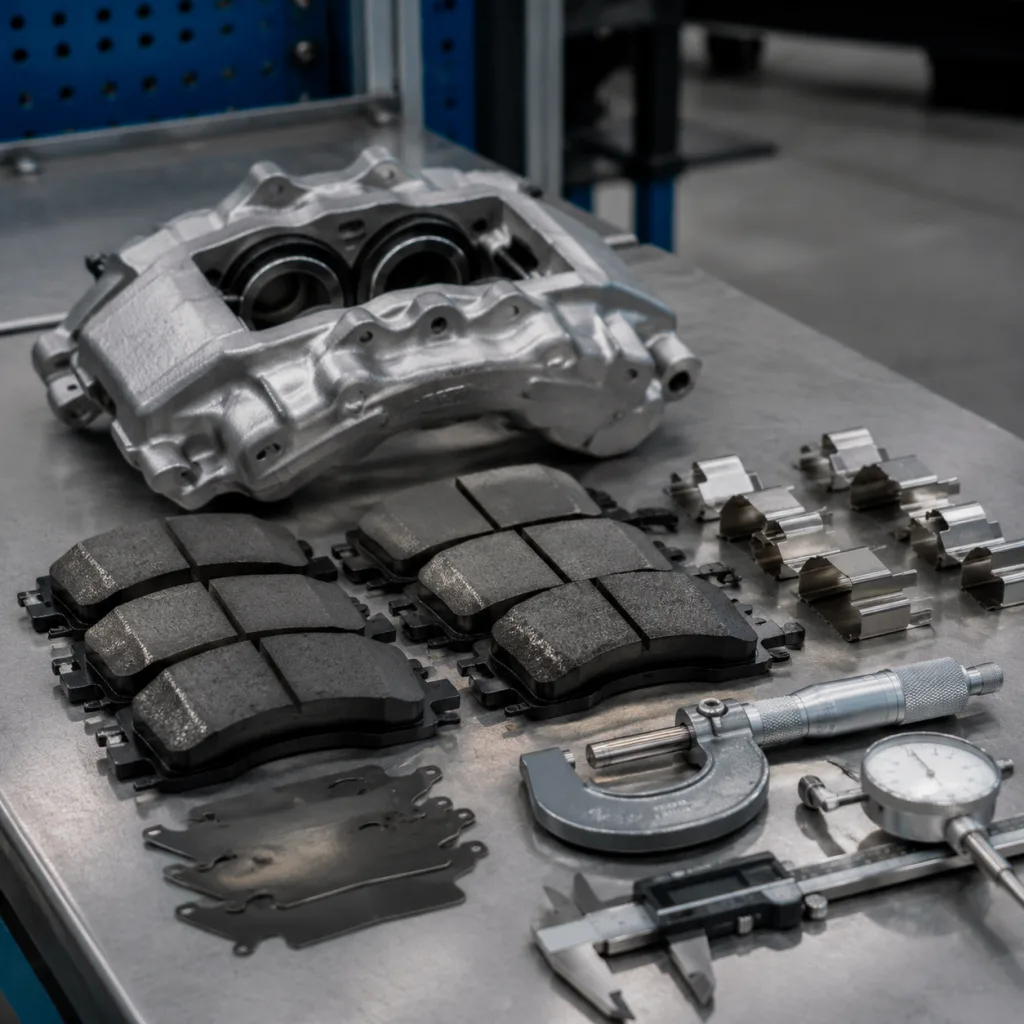
- Pack format: axle set, bulk workshop pack, private-label box, or kit with accessories
- Documentation needs: inspection reports, material declarations, batch traceability, and test summaries
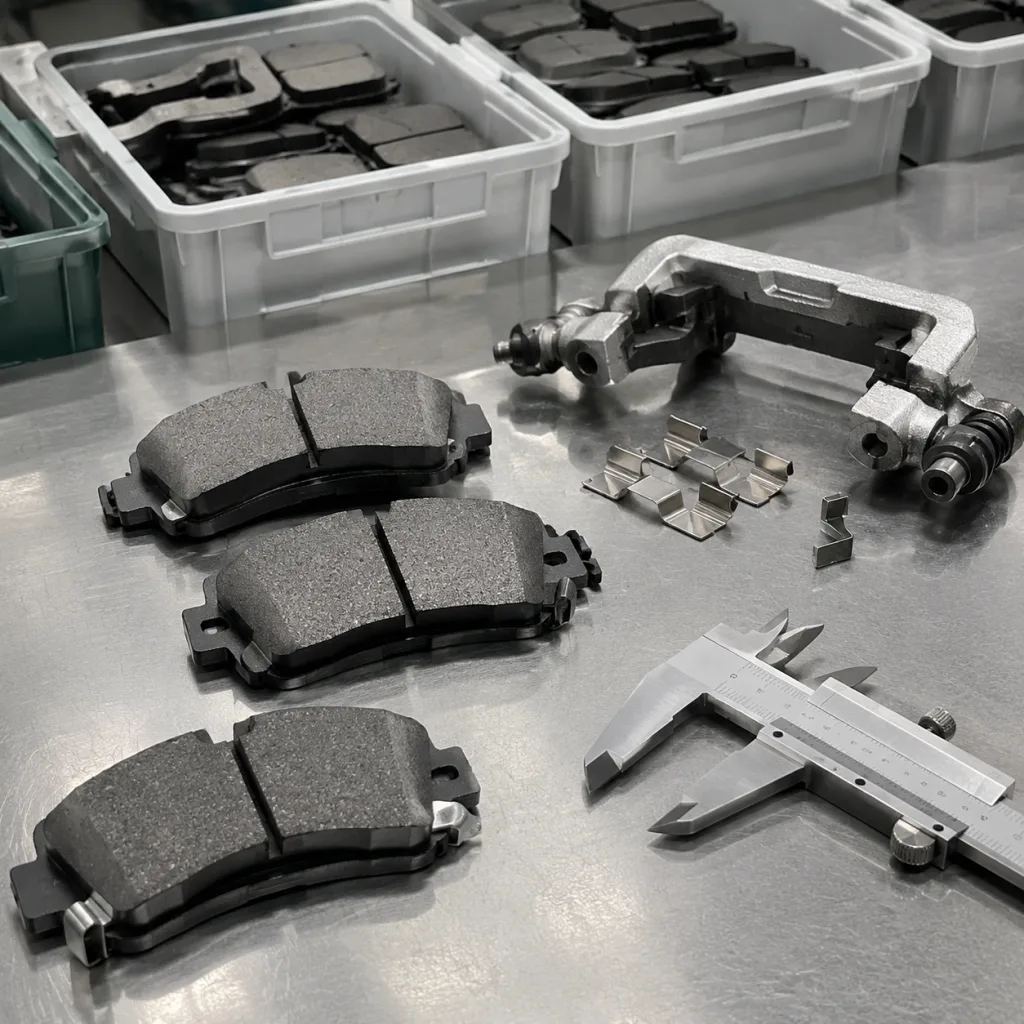
The word “fitment” should be treated carefully. Dimensional fit is only one requirement. A service pad also needs correct compressibility, shear strength, backing plate coating, chamfer design, slot layout, shim attachment, and bedding behaviour. For high-volume programmes, procurement teams should request sample approval by application group rather than approving only one visual reference.
Buyers can review our catalog to map current brake pad coverage and identify gaps for stocking plans.
Friction Material Choices and Service Trade-Offs
Brake pad service performance depends heavily on the friction formulation. No single compound is optimal for every vehicle use case. A city delivery van, a taxi, a family SUV, and a private passenger car can place different demands on heat capacity, noise control, dust level, pedal feel, and rotor wear, even when the pad outline looks similar.
| Material type | Typical strengths | Typical trade-offs | Suitable B2B use case |
|---|---|---|---|
| NAO / organic | Quiet operation, low rotor aggressiveness | Lower heat margin under heavy use | Passenger car service, low-noise positioning |
| Ceramic-based | Low dust, stable noise behaviour, clean wheels | Higher material cost, application-sensitive bedding | Premium aftermarket, retail-focused distributors |
| Semi-metallic | Good heat transfer, strong high-temperature performance | More noise risk, higher disc wear if poorly matched | Light commercial, fleet, mountainous regions |
| Low-metallic NAO | Balanced bite and fade resistance | Dust and noise control require careful formulation | Broad aftermarket coverage |
| Validation item | What it indicates | Procurement note |
|---|---|---|
| Dynamometer friction test | Cold, normal, and elevated-temperature friction stability | Request curves or summary results, not only pass/fail wording |
| Shear strength test | Bond integrity between friction material and backing plate | Important for heavy use and hot-climate service |
| Compressibility check | Pedal feel and hydraulic response consistency | Compare by formulation and application family |
| Noise evaluation | Squeal tendency under defined conditions | Review shim, chamfer, slot, and grease recommendations together |
| Wear measurement | Pad and disc wear balance | Low pad wear alone is not enough if rotor wear is high |
| Salt spray or corrosion check | Backing plate coating durability | Relevant for winter markets and coastal regions |