Rear Brake Pads Replacement: B2B Fitment Guide
Rear brake pads replacement is a routine service item, yet for distributors, wholesalers, and repair-chain operators it is also a high-sensitivity fitment category. Small deviations in backing plate geometry, shim stack height, chamfer position, coating build, or caliper clearance can lead to noise complaints, uneven wear, installation delays, and avoidable returns. For import managers and sourcing engineers, the buying decision is therefore not limited to price per set. The supplier must prove that each pad reference follows OE service dimensions, uses a stable friction formulation, remains consistent across production lots, and ships with documentation suitable for EU, UK, North American, Australian, Brazilian, and other destination markets. This guide explains the technical checks Driventus applies when developing aftermarket rear brake pad references, including dimensional matching, material controls, validation testing, packaging, labelling, and procurement evidence. Driventus is an independent aftermarket manufacturer; vehicle brand names and OE numbers are referenced for fitment identification only.
Fitment Targets for OE-Equivalent Rear Pads
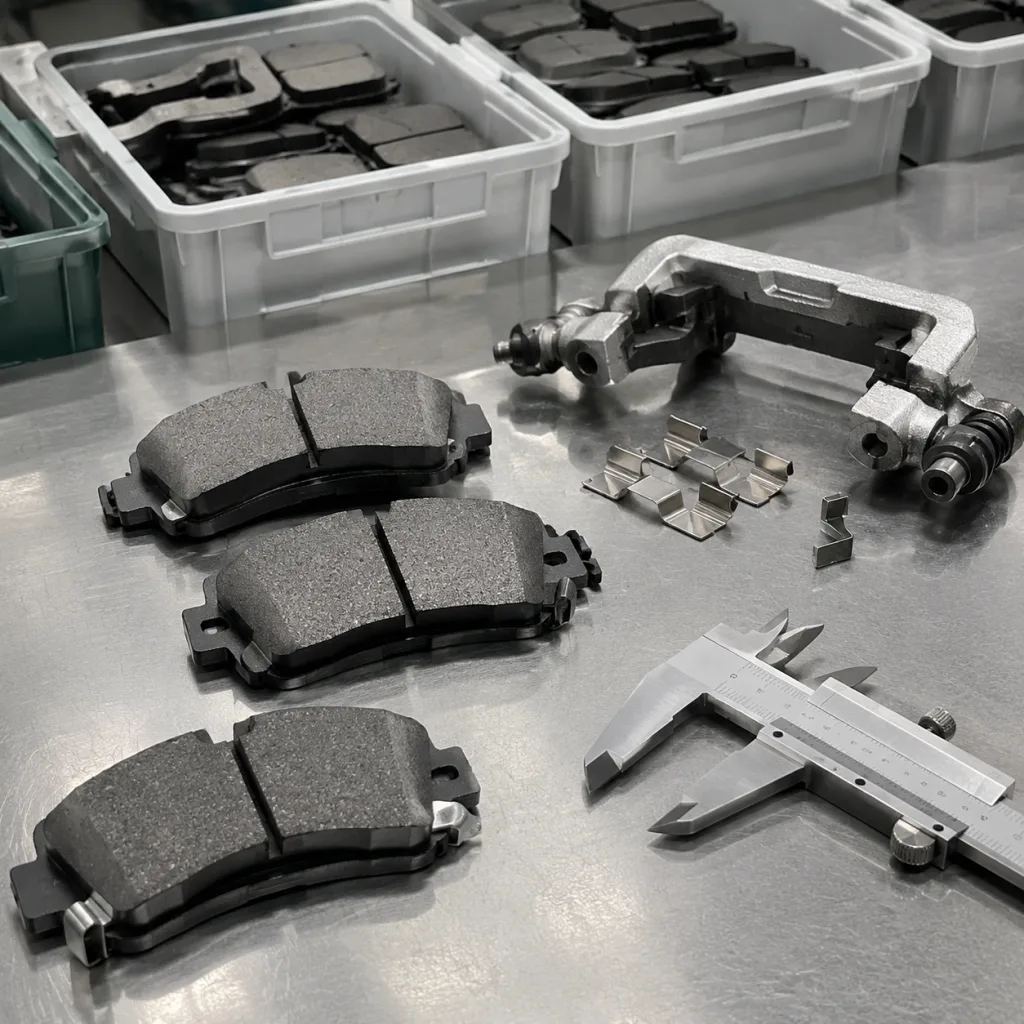
Rear brake assemblies often carry lower braking load than front systems, but their installation envelope can be less forgiving. Many rear calipers include parking brake levers, electric parking brake motors, wear sensors, anti-rattle hardware, or tight abutment channels. A pad that looks correct in a catalog photo may still drag, rattle, or fail to seat if the abutment ears, clip interface, coating thickness, or backing plate stack height falls outside the service window.
For a replacement program, Driventus begins with OE samples, vehicle application data, caliper interface checks, and verified interchange information. Buyers can review active brake pad references through our catalog. Where an application requires buyer-owned drawings, private-label friction grades, or market-specific packaging, we support custom manufacturing under controlled development files.
Key fitment characteristics include:
- Backing plate outline profile checked against OE service sample and approved production drawing
- Overall pad thickness controlled to prevent caliper piston over-extension, assembly interference, or excessive clearance
- Friction block length, width, chamfer, and slot position matched to the rotor sweep area
- Shim material, adhesive layer, and tab geometry reviewed for vibration and noise control
- Wear sensor slot, clip location, and electric parking brake clearance verified where applicable
- Edge paint, coating build, and burr condition assessed in sliding-contact areas
OE part-number cross-references may be supplied in generic interchange form, for example OE 06A… or OE 11251…, only when supported by buyer data or confirmed application records. Driventus does not claim approval, sponsorship, or endorsement by any vehicle manufacturer.
Dimensional and Material Controls
Brake pad sourcing should distinguish appearance approval from measurable process control. A pad set can match the expected shape while still failing on plate flatness, ear thickness, burr height, shim retention, or lining compressibility. Driventus manages these risks through incoming steel inspection, blanking control, friction mix traceability, curing records, coating checks, and final sampling before shipment.
| Control point | Typical procurement requirement | Why it matters |
|---|---|---|
| Backing plate thickness | Drawing-controlled, lot recorded | Affects caliper clearance and pedal feel |
| Ear width and abutment geometry | Measured against approved sample | Prevents binding, click noise, or loose fit |
| Friction material density | Batch controlled | Supports consistent wear, noise, and brake balance |
| Pad compressibility | Application-specific test window | Helps manage pedal travel and vibration |
| Shear strength | Validated after curing | Confirms bond integrity between lining and plate |
| Coating coverage | Salt-spray and visual inspection where specified | Reduces corrosion-related fit complaints |
| Shim retention | Pull and heat-age checks where specified | Reduces noise and warranty claims |
| Test or check | Purpose | Buyer evidence to request |
|---|---|---|
| Dimensional first-article report | Confirms drawing and sample match | CMM or gauge report with revision control |
| Shear strength test | Confirms lining-to-plate bond | Lot result and minimum acceptance value |
| Compressibility test | Checks pedal feel consistency | Test curve or summary by material code |
| Dynamometer performance test | Reviews friction stability and fade recovery | Test report by application or formulation |
| Noise evaluation | Screens squeal risk | SAE J2527-based or equivalent test summary |
| Corrosion exposure | Checks plate and shim durability | Salt-spray duration and post-test findings |
| Road or vehicle fit check | Confirms installability | Vehicle or caliper bench-fit record |