aftermarket replacement parts · 2026-06-14

Best Online Car Parts Store for B2B Sourcing

For procurement teams, the best online car parts store is not the site with the largest retail listing or the lowest displayed price. It is a supplier that can support stable aftermarket replacement parts, documented quality controls, repeatable fitment data, and export-ready commercial processes. Distributors, repair-chain buyers, and Tier-1 sourcing teams need more than a shopping cart. They need confirmed MOQ, realistic lead times, batch traceability, packing standards, inspection records, and a clear route for resolving dimensional or material questions before shipment. Driventus Auto Parts manufactures engine and powertrain components in Taizhou, Zhejiang, and exports to more than 60 countries. Our online presence is designed for B2B evaluation: buyers can review the catalog, assess the quality system, discuss custom manufacturing, and request a quote without relying on retail-style assumptions. Driventus is an independent aftermarket manufacturer; brand names are referenced for fitment only.

What B2B Buyers Should Expect Online

A retail website is built for quick checkout. A procurement-grade supplier website should help buyers verify technical, commercial, and export requirements before they place an order. For aftermarket replacement parts, that means clear product-family coverage, OE part-number cross-reference structure where applicable, dimensional confirmation, material disclosure, and documentation support.

A serious online sourcing channel should help answer practical questions such as:

  • Does the supplier manufacture the product or only trade inventory?
  • Which parts are produced in-house, and which processes are subcontracted?
  • Are MOQ, sample availability, and production lead time defined by product family?
  • Can the supplier provide inspection data, packaging specifications, and batch traceability?
  • Is the factory prepared for customer audit, video audit, or third-party inspection?

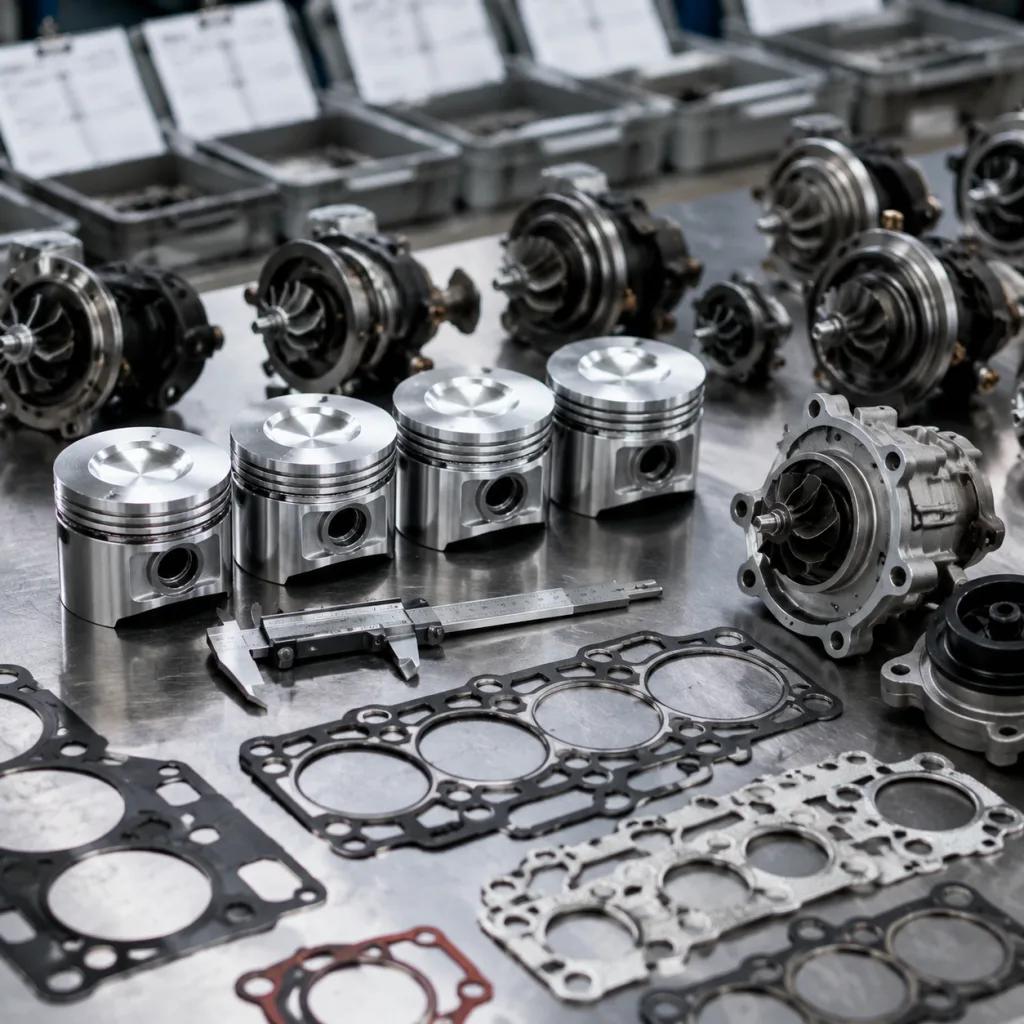
Driventus focuses on engine and powertrain components, including pistons, piston rings, crankshafts, camshafts, cylinder head gaskets, full gasket sets, water pumps, oil pumps, turbochargers, timing components, and related repair parts. Buyers can start with our catalog, then request drawings, samples, cross-reference review, or packing proposals according to their market channel.

For high-volume distributors, the best online car parts store is not simply a transaction platform. It is a qualification gateway: it shortens supplier screening while keeping the technical checks needed for repeat imports.

Supplier Qualification Criteria

Procurement teams should compare online suppliers using measurable criteria, not page count or displayed SKU volume. A supplier with 80,000 copied listings but weak documentation can create more risk than a manufacturer with narrower coverage and stronger process control.

</tr></thead><tbody> </tbody></table>Driventus operates under IATF 16949:2016 and ISO 9001:2015 quality management frameworks. These certifications do not replace buyer-specific validation, but they provide a structured base for document control, nonconforming product handling, corrective action, supplier management, and process monitoring.

For buyers in the EU, UK, US, Canada, Australia, and Brazil, documentation should also match destination-market import requirements. Depending on the shipment and product type, this may include a commercial invoice, packing list, certificate of origin, fumigation-free packaging declaration where relevant, and product-specific material information.

MOQ, Lead Time, and Commercial Controls

The commercial value of an online parts supplier depends on how reliably it converts enquiries into repeatable orders. MOQ and lead time should be discussed by product family because a gasket set, water pump, piston, and crankshaft follow different production routes.

Evaluation area What to verify Why it matters for importers
Manufacturing roleFactory ownership, in-house machining, assembly, and inspection capabilityReduces communication gaps and supports corrective action
CertificationsIATF 16949:2016 and ISO 9001:2015 certificates where applicableConfirms formal automotive quality management processes
Product dataFitment notes, dimensions, material grades, and OE-style references only when applicableReduces catalog errors and warranty disputes
MOQ and lead timeMinimum order by SKU, mixed-container options, and sample timingSupports inventory planning and launch decisions
TraceabilityBatch number, production date, inspection record, and packing-list linkageEnables controlled response to field claims
Compliance supportMaterial declarations and restricted substance review under REACH (EC) No 1907/2006 when requestedSupports EU and UK import due diligence
Audit readinessFactory profile, process flow, test equipment list, and video audit supportHelps sourcing teams approve new suppliers faster

</tr></thead><tbody> </tbody></table>Lead time depends on tooling status, raw material availability, order mix, and packaging requirements. Repeat items are easier to schedule when distributors provide rolling forecasts or quarterly demand estimates. New items need more time for sample build, dimensional review, packaging artwork approval, and pre-shipment inspection.

A practical sourcing process is:

1. Send part numbers, application list, annual forecast, and target market. 2. Confirm available references, technical drawings, and sample status. 3. Review MOQ, Incoterms, carton configuration, and labelling rules. 4. Approve samples or pilot order inspection results. 5. Place the bulk order with agreed batch traceability and shipping documents.

This process is slower than retail checkout, but it fits wholesale and chain-repair supply. It reduces the risk of receiving parts that match a listing but fail the buyer’s catalog, packaging, or claims process.

Quality Evidence Behind the Listing

A product page should be treated as the start of technical review, not final proof of quality. For engine and powertrain parts, buyers should request evidence related to material, dimensions, surface finish, pressure sealing, rotation, balance, or endurance, depending on the part and application.

Typical controls at Driventus include incoming material inspection, in-process dimensional checks, assembly checks, final inspection, and retained batch records. Product-specific controls may include hardness testing for shafts, surface roughness checks on journals, leakage testing for pumps, coating inspection for gaskets, and dynamic balance checks for turbocharger rotating assemblies.

Relevant standards depend on product type and market. IATF 16949:2016 and ISO 9001:2015 govern quality management systems. REACH (EC) No 1907/2006 is relevant for restricted-substance communication in the European market. For emissions-related vehicle systems, regulations such as ECE R-83 may be relevant to the broader vehicle compliance context, although replacement engine components should be evaluated according to their function, application, and buyer requirements. Brake test standards such as SAE J2527 are not validation standards for engine parts; they are a useful reminder that buyers should match standards to the correct product family rather than accept generic claims.

Buyers reviewing the quality system should ask for records that correspond to the actual part being sourced. A useful inspection file may include:

  • Material certificate or material declaration where applicable
  • Key dimension report against drawing or approved sample
  • Surface finish, hardness, leakage, or balance result when relevant
  • Batch number and production date traceability
  • Packing specification with carton dimensions and pallet plan
  • Corrective action format for nonconformance handling

The strongest online supplier can connect product claims to controlled records. That evidence matters more than broad wording such as premium quality or OE style.

When Custom Manufacturing Is Required

Not every buyer needs a catalog item. Some distributors require private-label packaging, region-specific kit contents, material changes, or development for low-coverage applications. OEM and Tier-1 buyers may require drawing-based production, PPAP-style documentation, special-characteristics control, or defined test plans. In these cases, the best online car parts store for B2B procurement is the supplier that can move from catalog supply to engineering review without forcing the buyer to start over with a new source.

Driventus supports custom manufacturing for selected engine and powertrain components. Typical projects include reverse engineering from samples, production to buyer drawing, private-label gasket set configuration, shaft machining, pump assembly, and packaging programs for wholesale distribution.

Buyers should prepare the following before requesting development:

  • Drawing, sample, or full application data
  • Target annual volume and launch date
  • Required material, coating, heat treatment, or performance condition
  • Critical dimensions and inspection method
  • Packaging, label, barcode, and language requirements
  • Required approval documents and audit format

For custom items, tooling cost, sample lead time, and validation scope should be agreed before price negotiation is finalized. Unit price alone does not define project cost. A lower quotation may become expensive if tooling ownership, dimensional responsibility, or change control is unclear.

Driventus is an independent aftermarket manufacturer; brand names are referenced for fitment only. No vehicle manufacturer approval or endorsement is implied when a part is described by application, fitment, or OE-style reference.

How to Shortlist an Online Supplier

A structured shortlist helps buyers compare suppliers consistently. The process should combine online research with direct technical questioning, then test how well each supplier supports documentation, quality review, and communication.

Use this checklist before approving a new source:

  • Confirm whether the company is a manufacturer, trading company, or mixed supplier.
  • Review product focus; narrow technical depth is often better than unfocused coverage.
  • Ask for IATF 16949:2016 and ISO 9001:2015 certificate copies and scope.
  • Request sample inspection data for one high-risk SKU.
  • Check whether MOQ and lead time are realistic for your channel.
  • Confirm private-label, neutral packing, or branded packing capability.
  • Ask how warranty claims are reviewed and what evidence is required.
  • Verify export experience to your destination market.
  • Request a factory audit file, video audit, or third-party inspection option.
  • Test communication speed with a technical question, not only a price request.

For a distributor, the right online supplier should protect catalog accuracy and stock continuity. For a repair chain, it should support consistent fitment and reduce comeback risk. For OEM and Tier-1 sourcing teams, it should provide process transparency and disciplined change control.

Search engines may rank many websites for best online car parts store, but procurement teams should rank suppliers by evidence: certification, manufacturing control, technical records, and responsiveness. A clear online catalog is useful; a controlled factory process is what makes repeat supply viable.

Frequently asked questions

A B2B supplier should provide more than product listings. Buyers should expect MOQ details, lead-time confirmation, quality certificates, fitment review, inspection records, export documents, and audit support. Manufacturing capability and traceability are more important than retail checkout speed.

Yes. Driventus supports private-label and neutral packing programs for selected engine and powertrain components. Buyers should provide target markets, carton and label requirements, annual forecast, and any barcode or language rules before quotation.

No. Driventus is an independent aftermarket manufacturer; brand names are referenced for fitment only. Application data and OE-style references are used to help buyers identify compatibility, not to imply approval, endorsement, or supply relationship with a vehicle manufacturer.

If you are qualifying a new supplier for aftermarket replacement parts, share your SKU list, target market, MOQ expectations, and documentation requirements. You can [request a quote](/contact.html).

Request a Quote
Product group Typical sourcing consideration Common buyer requirement
Pistons and ringsAlloy grade, skirt coating, ring groove tolerance, and pin fitSample approval before bulk order
Crankshafts and camshaftsMaterial, heat treatment, journal finish, and hardness profileDimensional report and packing protection
Gaskets and gasket setsMLS layer design, coating, rubber bead consistency, and kit contentCross-reference and set-content confirmation
Water pumps and oil pumpsCasting quality, bearing, seal, impeller design, and flow verificationLeakage and rotation checks
TurbochargersCHRA balance, actuator setting, and housing matchTest report and installation guidance
Timing componentsChain or belt specification, sprocket accuracy, and tensioner performanceKit configuration control