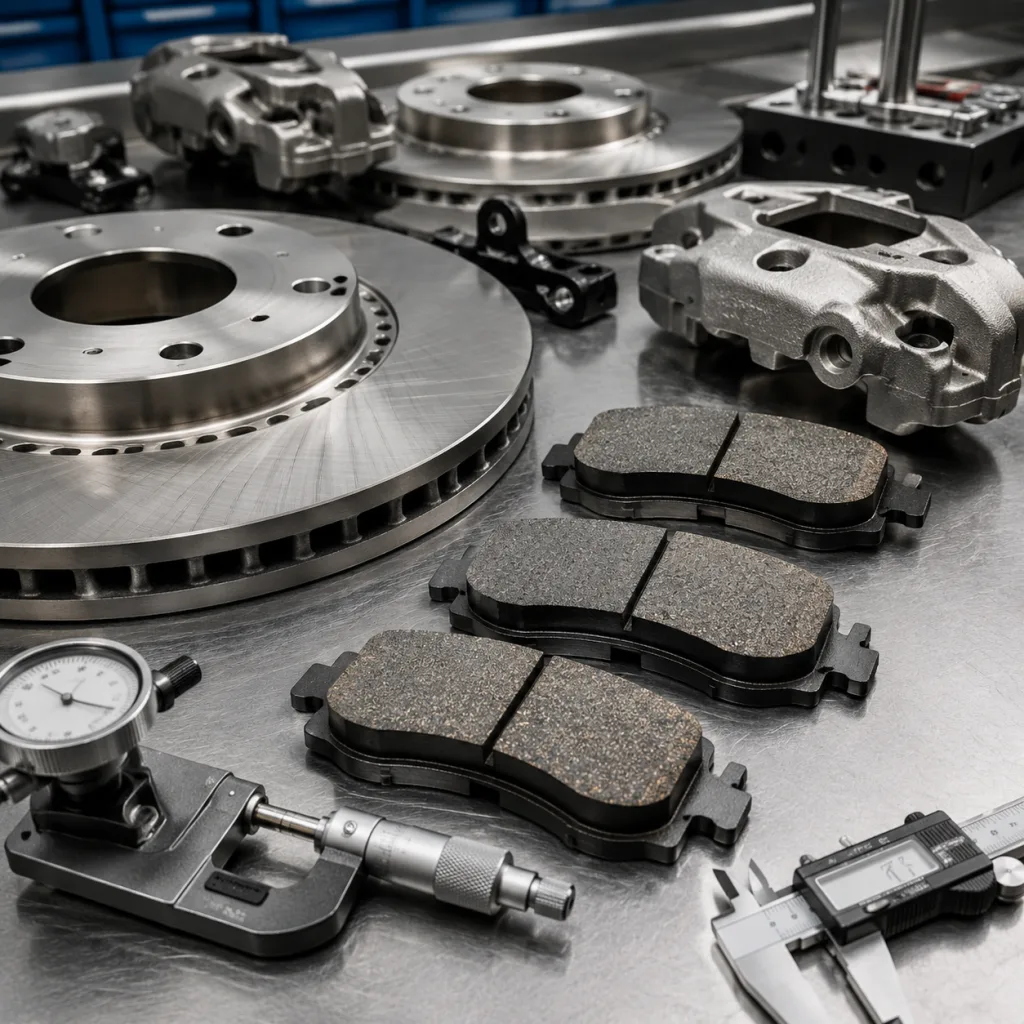
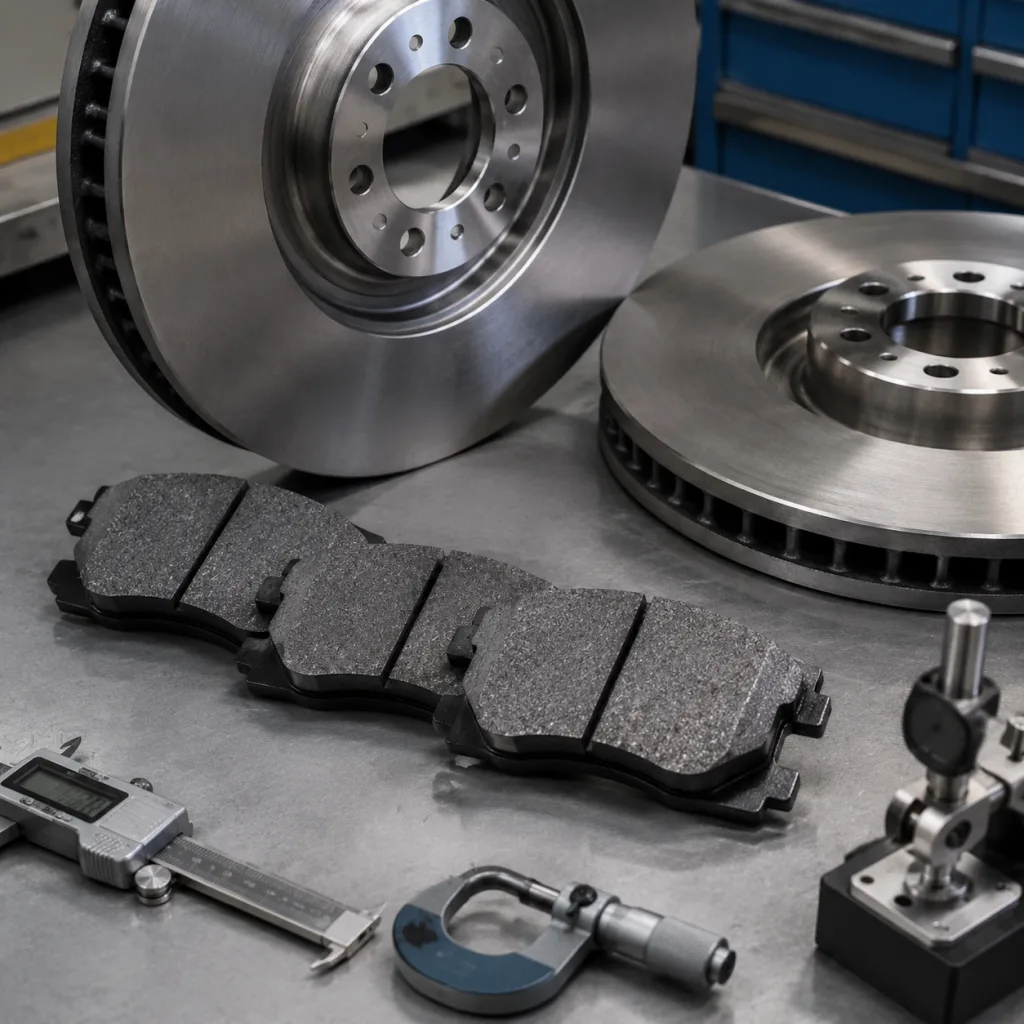
Front and rear brake pads are often purchased within the same aftermarket programme, but they do not share the same operating profile. Front axle pads normally carry more braking load, reach higher peak temperatures, and wear faster under repeated stops. Rear axle pads contribute to vehicle stability, parking brake or EPB compatibility, low-speed noise control, and balanced friction recovery. For distributors, repair chains, wholesalers, and import managers, the buying decision should therefore extend beyond price per set. A reliable sourcing programme needs axle-specific friction targets, controlled dimensions, correct hardware, predictable bedding behaviour, accurate packaging, and batch-level traceability. This guide outlines practical procurement criteria for aftermarket brake pad sourcing, including material selection, test evidence, fitment data, and supplier audit points. Driventus is an independent aftermarket manufacturer; brand names are referenced for fitment identification only.
Why Axle Position Changes the Specification
During braking, a passenger vehicle transfers load toward the front axle. Front pads therefore tend to be larger, work under higher surface pressure, and require stronger resistance to fade at elevated temperature. Rear pads may carry less load, but they affect pedal balance, electronic stability control response, corrosion recovery after wet parking, and noise during low-speed manoeuvres.
For B2B buyers, front and rear brake pads should not be treated as interchangeable friction blocks. Even when a backing plate looks similar, the friction grade, chamfer geometry, slot position, shim construction, wear sensor interface, and accessory kit can differ by axle and caliper system.
Procurement point
Front axle focus
Rear axle focus
Typical braking load
Higher thermal and pressure load
Lower load but stability-sensitive
Common wear pattern
Faster wear and heat-checking risk
Taper wear, glazing, and corrosion effects
Noise sensitivity
Medium to high
High at low speed and reversing
Hardware dependency
Caliper clips, abutment contact, sensor routing
Parking brake, EPB clearance, anti-rattle clips
Formulation priority
Fade resistance and friction stability
NVH control and modulation
</tr></thead><tbody> </tbody></table>When building a range, buyers should require the supplier to identify axle position in the item master, carton label, fitting kit list, and EDI data. Consistent classification reduces warehouse picking errors, incorrect installations, and warranty disputes.
Material Choices and Trade-Offs
Brake pad material selection affects margin, warranty exposure, installer confidence, and end-user satisfaction. The right formulation depends on vehicle weight, wheel size, driving cycle, rotor metallurgy, climate, and local regulation. Buyers should be cautious with broad marketing claims such as “premium ceramic” unless the supplier can define the formulation family, performance target, and validation method.
Material family
Typical strengths
Procurement risks to check
Low-metallic NAO
Strong bite, good heat transfer, suitable for many European applications
Higher dust and possible noise if shim design is weak
Ceramic NAO
Lower visible dust, stable low-noise behaviour, common in North America
Cold bite and recovery should be validated on heavier vehicles
Semi-metallic
Good durability and thermal capacity for high-load use
Rotor wear and noise risk if fibre and lubricant balance is poor
Copper-reduced formulations
Supports regulatory compliance programmes
Confirm friction stability after any reformulation
</tr></thead><tbody> </tbody></table>Published regulations and standards can influence the sourcing route. For chemical compliance in the EU, buyers should consider REACH (EC) No 1907/2006. For replacement brake lining performance in Europe, ECE R90 is the key regulatory reference for many applications. SAE J2527 is widely used for brake squeal evaluation, while SAE J2784 is commonly referenced for brake effectiveness testing. A useful test report should state sample quantity, test conditions, acceptance criteria, and production batch linkage; a summary that only says “passed internal test” is not enough.
A practical specification should define friction code range, compressibility target, shear strength requirement, density range, hardness range, and post-cure control. For high-volume SKUs, request retained samples from first production lots and compare friction surface appearance, backing plate coating, edge finish, printing, and shim adhesion across shipments.
Fitment Data, Cross-References, and Range Coverage
Accurate application data is a commercial requirement, not an administrative extra. A brake pad line with weak fitment data can create returns and installer frustration even when the parts are manufactured correctly. Importers should require cross-reference tables covering axle position, pad shape, thickness, caliper system, wear indicator type, accessories, and market-specific notes.
A robust item record should include:
Axle position: front, rear, or set configuration.
Pad dimensions: length, width, total thickness, backing plate thickness, and friction thickness.
Hardware: clips, springs, bolts, shims, wear sensors, and grease sachets where applicable.
Vehicle data: model year range, engine notes, body type, and gross vehicle weight where relevant.
Cross-reference structure: OE-format references only when supplied or approved in the customer data set.
For distributors expanding a braking programme, our catalog can be used to review available brake pad families and related braking components. If a buyer needs private-label pad shapes, modified accessories, or market-specific packaging, custom manufacturing can support drawing review, tooling discussion, and sample approval.
Driventus does not claim approval or endorsement by any vehicle manufacturer. Brand names and OE-style references are used only to identify fitment and interchange.
Quality Controls Buyers Should Request
Supplier qualification should move beyond certificates. IATF 16949:2016 and ISO 9001:2015 show that a management system is in place, but buyers still need part-level evidence. Because brake pads are safety-related components, incoming inspection, in-process controls, final inspection, and traceability must be visible in the control plan.
Recommended sourcing checklist:
Backing plate dimensional tolerance: verify against drawing and caliper clearance requirements.
Flatness and parallelism: confirm pad seating and even piston load.
Friction material thickness: measure total thickness and friction layer thickness separately.
Bonding integrity: review shear strength and thermal shock validation.
Compressibility: check cold and hot values where specified by the customer.
Coating performance: verify the salt spray or corrosion resistance method used for backing plates.
Shim retention: inspect adhesive bond, rivet condition, and edge lift after heat exposure.
Batch traceability: link raw materials, mixing batch, pressing batch, curing batch, and final carton label.
A factory audit should confirm that weighing, mixing, hot pressing, curing, scorching, grinding, chamfering, slotting, coating, and packaging are controlled processes. Nonconforming product should be physically separated, clearly identified, and documented. Calibration records should cover thickness gauges, hardness testers, dynamometer equipment, shear fixtures, and weighing systems.
Driventus operates under IATF 16949:2016 and ISO 9001:2015 aligned controls. Buyers can review our quality system before supplier qualification or sample nomination.
Buying Commercially Without Increasing Warranty Risk
A low unit price can be outweighed by claims, returns, reboxing labour, delayed replenishment, and lost distributor confidence. For front and rear brake pads, commercial evaluation should consider total programme cost rather than FOB price alone.
Important variables include MOQ by pad shape, shared tooling availability, annual volume forecast, packaging complexity, accessory inclusion, inspection level, documentation requirements, and change-control discipline. A repair chain may value low noise, fast installation, and consistent pedal feel. A wholesale distributor may prioritise range breadth, barcode accuracy, carton durability, and stable replenishment. An OEM or Tier-1 buyer will usually require PPAP-style evidence, drawing control, and structured change notification.
A balanced RFQ should ask for:
Unit price by annual volume tier and currency.
MOQ per SKU and per shipment.
Standard lead time for existing tooling and new tooling.
Sample lead time and sample quantity.
Formulation family and regulatory declaration.
Test evidence, including ECE R90 where applicable.
Packaging artwork workflow and approval timing.
Warranty claim process, analysis lead time, and credit policy.
For many import programmes, the safest approach is to begin with high-turning pad shapes, validate field feedback, and expand the range quarterly. This limits slow-moving inventory while building confidence in formulation, data accuracy, and logistics performance.
Sample Approval and Ongoing Supplier Management
Initial samples should be production-intent parts, not display pieces. Buyers should request the same backing plate coating, shim, chamfer, slot, friction mix, printing, accessory kit, and packaging that will be used in mass production. If any element changes between sample approval and shipment, the supplier should issue written change notification before production continues.
A practical approval sequence is:
1. Confirm drawing, application data, and accessory list. 2. Receive sample pads with batch number and inspection report. 3. Check dimensions, finish, fitment, hardware, and packaging. 4. Review friction and noise test data where available. 5. Approve pilot order with clear acceptance criteria. 6. Monitor first shipment claims and installation feedback. 7. Lock the approved construction in the supplier control plan.
Ongoing management should include periodic carton audits, dimensional rechecks, and review of claim samples. If a buyer reports noise, judder, uneven wear, or weak cold bite, the supplier should request installation conditions, rotor condition, vehicle application, mileage, photographs, and returned parts. Without this evidence, root-cause analysis becomes speculative.
Driventus supports distributors, wholesalers, repair chains, and sourcing teams with range planning, sample review, and production documentation. For a structured RFQ, buyers can request a quote with target SKUs, annual volume, market destination, and packaging requirements.
Frequently asked questions
Not always. Front axle pads usually need higher fade resistance, while rear axle pads may prioritise noise control, modulation, corrosion recovery, and parking brake or EPB compatibility. The correct choice depends on vehicle platform, duty cycle, and validation requirements.
Common references include IATF 16949:2016 and ISO 9001:2015 for quality management, REACH (EC) No 1907/2006 for chemical compliance in the EU, ECE R90 for many replacement brake lining applications, SAE J2527 for brake squeal evaluation, and SAE J2784 for brake effectiveness testing.
Include pad drawings or cross-references, axle position, annual volume, destination market, packaging format, hardware requirements, certification expectations, sample quantity, and target lead time. Clear fitment data reduces quoting errors, sample delays, and later warranty disputes.
If you are building or reviewing a brake pad sourcing programme, share your SKU list, destination market, annual volume, and packaging requirements. Driventus can respond with range availability, sample options, and production details at /contact.html