aftermarket replacement parts · 2026-06-14

Wheel Hub Replacement: OE-Match Checks for Buyers

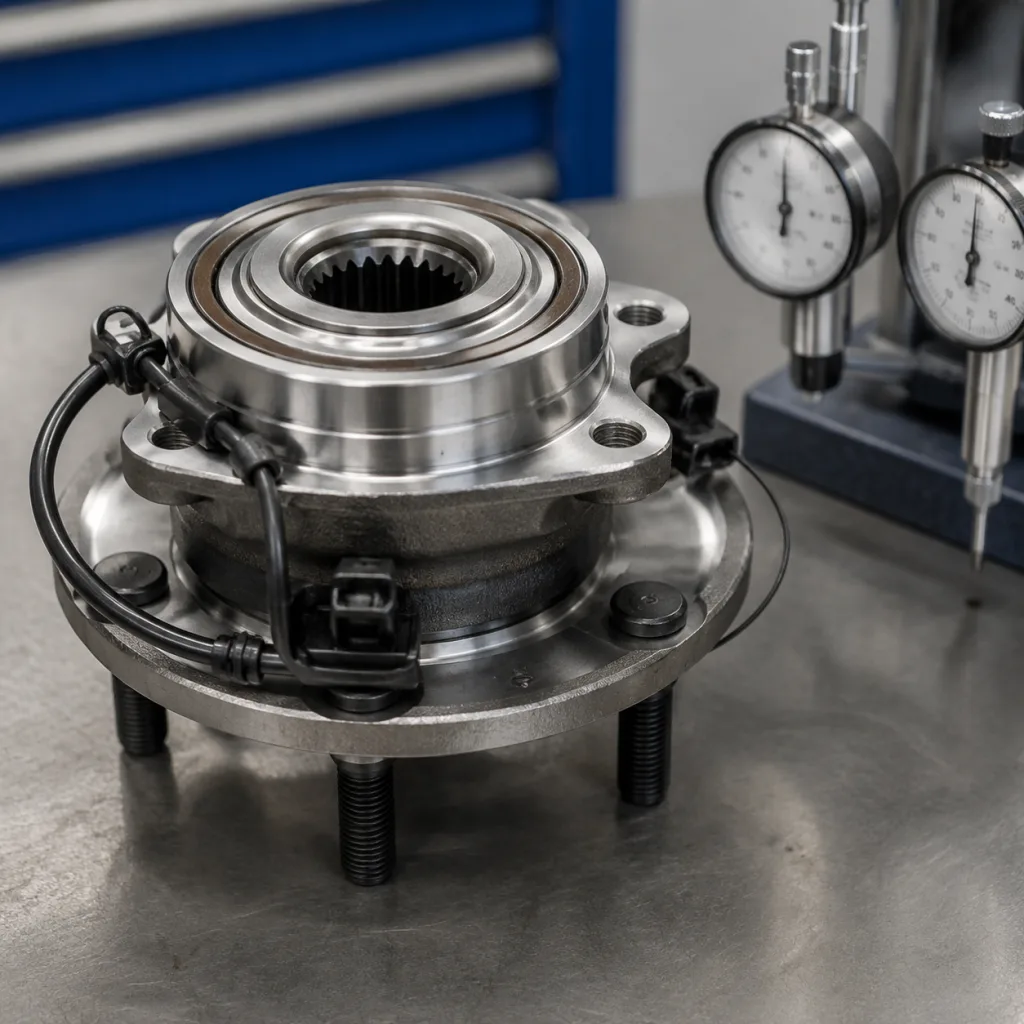
For procurement teams, wheel hub replacement is not a generic catalogue decision. A hub must reproduce the OE interface, bearing geometry, sensor path, and mounting stack-up closely enough to install cleanly, run quietly, and reach the intended service life. Small sourcing errors create expensive returns: a flange offset that shifts brake alignment, an ABS encoder that sends an unstable signal, a stud pattern that looks close but is not interchangeable, or a seal package that cannot resist road splash and grit. A strong sourcing process starts with dimensional control, then confirms function through validation data. Driventus is an independent aftermarket manufacturer; brand names are referenced for fitment only. The practical question for buyers is whether the replacement part matches the OE function with acceptable warranty risk across repeat orders, not just whether it appears in a catalogue cross-reference.

What buyers should match first

Fitment is the first filter, but it should mean more than bolt pattern. A hub can share the same nominal diameter and still create installation or durability problems if the bearing seat, flange offset, stack height, or sensor interface differs from the OE part.

Minimum data to verify

  • Vehicle application by axle position: front or rear
  • OE reference number and supersession history
  • Bolt pattern, centre bore, flange offset, and overall stack height
  • Bearing type: unitised hub, hub with pressed bearing, or separate bearing set
  • ABS/ESC integration: encoder ring, magnetic encoder, or no sensor feature
  • Fastener thread, wheel stud count, and torque requirements

Ask for the dimensional drawing before comparing prices. On repeat programmes, a measured sample is more useful than a catalogue image because it exposes the tolerance stack that affects brake alignment, wheel seating, and sensor clearance. This is especially important when aftermarket listings reference OE-style numbers such as 06A and 11251 families across different markets. The target is not interchangeability on paper alone. It is repeatable installation across production lots, suppliers, and vehicle platforms.

OE-equivalence means function, not just appearance

For replacement parts, OE-equivalence is a functional claim. It should cover the dimensions and materials that control wheel-end load, seal retention, brake alignment, and sensor signal stability. Visual similarity is not enough.

</tr></thead><tbody> </tbody></table>If the hub includes an integrated wheel speed sensor path, request signal test data instead of relying on a simple pass/fail statement. Confirm whether the encoder is moulded, pressed, or machined in place, and whether runout is checked after final assembly. For importers and distributors, a hub that fits the OE envelope but misses one of these functions can still become a claims problem. Published management systems such as quality system coverage under IATF 16949:2016 and ISO 9001:2015 are useful indicators of process discipline, but they do not replace application-specific validation.

Validation data that reduces returns

A reliable wheel hub replacement programme depends on evidence. The validation package should show that the hub can survive field conditions, not only that it measures correctly on a bench.

Ask for these checks

  • Dimensional inspection on critical features, including bore, flange, and mounting faces
  • Bearing preload or internal clearance confirmation, where relevant
  • Radial and axial runout data after assembly
  • Torque-to-failure or clamp-load verification on wheel fasteners
  • Corrosion screening aligned to customer requirements and REACH (EC) No 1907/2006 compliance for restricted substances
  • Packaging controls that prevent flange, stud, and sensor-surface damage in transit

Where customers need a broader test matrix, corrosion and durability checks can be tied to their own validation plan, including road load, contamination, water exposure, and thermal cycling. Some programmes also reference standards such as SAE J2527 for accelerated exposure work, depending on the surrounding component set and customer specification. The key is to make the evidence traceable to the application, production route, and acceptance criteria.

A simple procurement rule helps: if the supplier cannot show the measurement method, sample size, and acceptance limit, the data is not ready for purchasing approval.

How Driventus supports replacement programmes

Driventus supplies wheel-end and powertrain components for aftermarket and B2B channels, with process control designed for repeat orders and private label programmes. For buyers comparing suppliers across regions, the practical difference is whether geometry, material specification, inspection records, and packaging remain stable from batch to batch.

Our catalogue is organised for cross-reference work, including the our catalog page for component families and the custom manufacturing path for application-specific builds. This helps when a customer needs a direct replacement for a regional OE reference while also controlling labelling, carton design, coating requirements, or documentation for import review.

What to expect from a serious replacement supplier:

  • Drawing review before quotation
  • Sample approval against measured dimensions
  • Production traceability by batch
  • Packaging designed to protect machined faces, studs, seals, and sensor surfaces
  • Documentation for importer review, warehouse receipt, and customer approval

If a programme requires a special stud pattern, bearing variant, corrosion target, or packaging standard, it is usually faster to solve the sourcing question before launch than after the first claims report. For quotation and technical review, use request a quote.

Procurement checklist before you place a PO

Use this checklist to separate a true replacement from a part that only looks similar.

  • Confirm OE reference, axle position, and vehicle build range
  • Match flange offset, bolt circle, bore, and stack height
  • Verify sensor architecture, encoder position, and ABS/ESC compatibility
  • Review material, coating, heat treatment, grease, and seal specification
  • Request sample inspection report, validation summary, and lot traceability
  • Align packaging to export route, palletisation, and warehouse handling
  • Confirm lead time, MOQ, forecast flexibility, and re-order stability

If your sourcing team buys across several brands or regions, keep a shared benchmark file with measured dimensions, photos, inspection results, and validation notes. That record reduces confusion when catalogue descriptions differ by market and helps new suppliers quote against the same technical baseline.

A basic comparison table is often enough to detect risk early:

Item What to confirm Why it matters
Bearing ratingDynamic and static load valuesControls service life under cornering loads and pothole impact
Seal designLip type, material, grease retentionProtects against water, dust, grit, and noise-related failures
Flange geometryOffset, thickness, runout targetSupports correct brake alignment and wheel seating
Sensor interfaceEncoder location, air gap, and polarityHelps prevent ABS/ESC warning faults
Material specSteel grade, heat treatment, corrosion coatingAffects fatigue strength and rust resistance

</tr></thead><tbody> </tbody></table>This approach is practical for distributors, repair chains, and OEM-adjacent buyers that need fewer surprises after delivery and fewer warranty discussions after installation.

Frequently asked questions

Not always. Some applications use a complete hub assembly with an integrated bearing, flange, studs, and sensor features, while others use a separate bearing and carrier. Confirm the OE architecture before ordering.

Ask for a dimensional drawing, material and coating specification, inspection report, sample traceability, and validation summary. For compliance review, request the supplier's IATF 16949:2016 or ISO 9001:2015 scope where relevant.

No. Use brand names only for fitment reference, then verify dimensions and function against the OE part number, drawing, or measured sample. Driventus is an independent aftermarket manufacturer; brand names are referenced for fitment only.

If you need a measured wheel hub replacement match, send the OE reference, application details, target annual volume, and packaging requirements through /contact.html, and we will review the fitment data with you.

Request a Quote
Supplier claim Procurement check Decision
Fits the vehicleMeasured against OE drawing or approved sampleAccept only if all critical dimensions match
Quiet operationNoise, preload, and runout dataPrefer documented test evidence
Corrosion resistantCoating spec and exposure testTie to shipping route, storage, and climate
Drop-in replacementInstallation notes and torque specVerify with sample build