aftermarket replacement parts · 2026-06-14

Car Parts Websites: What Procurement Buyers Should Check

Procurement teams use car parts websites to screen suppliers before issuing RFQs, but a clean interface does not prove technical fit or supply reliability. For aftermarket replacement parts, the strongest signals are clear OE cross-references, controlled dimensions, material specifications, test evidence, and a documented quality system. A reliable listing should show whether the part matches the intended engine code or application revision, which tolerances are controlled, how the supplier identifies batches, and what evidence supports repeat production. This matters whether the category is pistons, crankshafts, gaskets, water pumps, turbochargers, or other engine and driveline components. Driventus is an independent aftermarket manufacturer; any brand names are referenced for fitment identification only. The sections below explain what to verify on a supplier site, how to compare listings, and which documents to request before approving repeat orders.

What a usable product page should show

A useful supplier page gives engineers and buyers enough information to shortlist a part before a long email exchange. The page should move from application data to technical evidence: first confirm the fitment, then check whether the supplier can repeat the part at scale.

Use our catalog as a benchmark for the minimum data set, and review the quality system page for the records that should support each listing.

A procurement-ready page should include:

  • OE cross-reference and engine family, not only vehicle make and model.
  • Engine code, application notes, or revision status where variants exist.
  • Main dimensions, material grade, and surface treatment where relevant.
  • MOQ, lead time, pack quantity, and available shipping discussion.
  • Batch traceability or lot identification for repeat orders.
  • Current certificate scope and a direct path for technical questions.

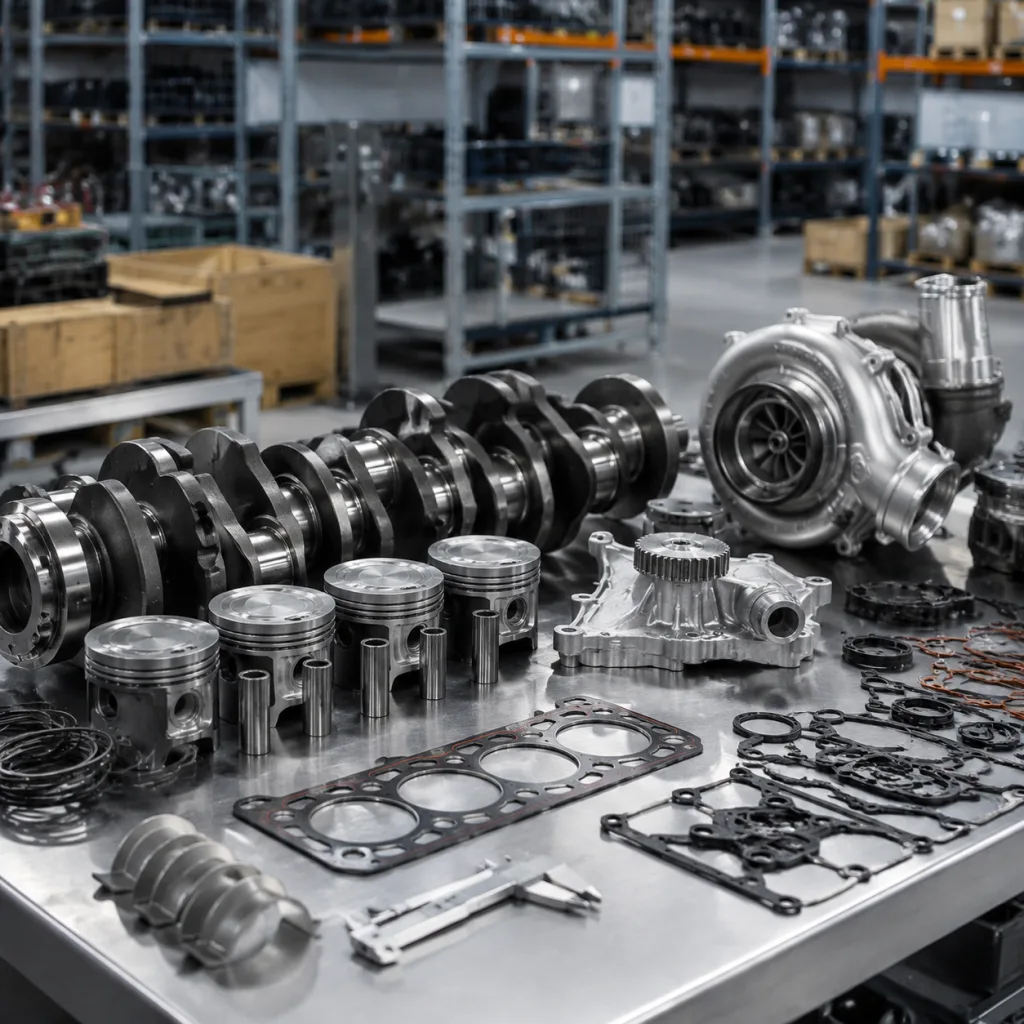
For engine parts, a listing that omits bore, stroke, pin diameter, gasket thickness, impeller details, or flange pattern leaves too much room for error. If the part belongs to a family, the page should separate variants clearly instead of relying on one shared photo gallery or a broad model label.

Compare suppliers before you compare prices

Price only becomes meaningful after the part is technically comparable. A low unit cost on a listing that lacks dimensions, certificate scope, or a sample policy can turn into rework, returns, or line downtime.

</tr></thead><tbody> </tbody></table>Use this comparison to rank car parts websites before requesting quotations. If a supplier is transparent on technical data but vague on lead time, the gap can be handled during negotiation. If the site is weak on fitment data or quality evidence, it is a poor candidate for repeat supply no matter how attractive the displayed price looks.

Fitment checks that reduce returns

Fitment is not the same as visual similarity. Two parts can look alike and still fail because of a tolerance mismatch, material difference, or application revision. OE cross-references are useful, but they should be confirmed against measurements rather than treated as standalone proof.

A practical verification set for aftermarket replacement parts is:

  • OE number cross-reference, using the same format as the supplier listing, such as OE 06A107065.
  • Critical dimensions such as bore, stroke, compression height, thickness, shaft diameter, or mounting depth.
  • Mating interface data, including bolt pattern, flange offset, sealing surface width, hose connection, or port orientation.
  • Material specification, coating, and heat treatment when the load case depends on them.
  • Photos of the actual sample part and packaging, not only catalogue renders.
  • Revision notes that explain differences from nearby variants in the same family.

For engine families, engine components should be matched by application and revision, not by a broad model label alone. If the supplier cannot explain how a part differs from adjacent variants, the risk of mispicks, returns, and warranty disputes increases quickly.

Documents that support repeat buying

For repeat supply, buyers need more than a product page. Request documents that show whether the supplier can control process variation over time and support your internal audit trail.

Signal Low-confidence site Procurement-ready site
Fitment dataGeneric vehicle listOE number, engine code, and revision notes
Engineering detailPhoto onlyDimensions, material, tolerance, and finish
Quality evidenceUnverified claimsCurrent certificates, scope, and inspection records
Supply termsHidden until checkoutMOQ, lead time, pack quantity, and Incoterms discussion
SupportGeneric contact formNamed sales or engineering contact

</tr></thead><tbody> </tbody></table>A supplier that cannot provide current documents for the exact site and product line is not ready for a controlled buying process. For export markets, ask for written confirmation on local regulatory requirements during the RFQ stage, not after shipment is booked.

When to move from catalog parts to custom manufacturing

Catalog parts solve most standard replacement needs. Custom work becomes appropriate when the buying requirement involves a controlled change to material, coating, packaging, labeling, validation level, or dimensional tolerance.

This is where custom manufacturing becomes relevant. Typical triggers include:

  • A non-standard gasket thickness for a known engine family.
  • A revised piston crown design for a defined duty cycle.
  • A coating or material change to support temperature, wear, or corrosion requirements.
  • Packaging changes for warehouse pick efficiency or private label distribution.
  • A higher validation level for a customer quality gate.

Before moving to a custom build, lock the revision, target annual volume, sample approval method, inspection criteria, and re-order tolerance window. If the part will be sold in the EU or supplied into regulated channels, align the RFQ with the relevant compliance scope from the start. For technical applications, ask whether testing records can be aligned with standards such as SAE J2527 or ECE R-83 where those standards are relevant to the product, test method, and market.

When comparing multiple suppliers, keep the selection focused on controlled dimensions, evidence, and repeatability. That is how car parts websites become useful for sourcing decisions, not just browsing.

Frequently asked questions

Check the OE cross-reference, engine code, main dimensions, material, MOQ, lead time, and certificate scope. If those details are missing, the listing is not ready for procurement review.

No. Brand names can help identify an application reference, but they do not prove fitment. Verify the OE number, application revision, and measurements before placing an order.

Request samples, drawings, or dimensional reports before the first PO and again after any revision, tooling change, or material update. This reduces fitment risk in repeat supply.

If you are comparing aftermarket supply options for repeat orders, start with [our catalog](/products.html) and the relevant [quality system](/quality.html) documents, then [request a quote](/contact.html).

Request a Quote
Document What it tells procurement What to confirm
IATF 16949:2016 certificateAutomotive quality system disciplineScope, site address, issue date, and validity
ISO 9001:2015 certificateBaseline quality managementScope and whether the listed part family is covered
REACH (EC) No 1907/2006 statementEU chemical compliance statusCurrent declaration and substance exclusions where applicable
First article or dimensional reportMeasured conformity to drawingSample size, date, and tolerance limits
Material test recordChemical or mechanical consistencyHeat number, batch code, and lab method
Control plan or inspection planHow routine production checks are managedCritical characteristics, frequency, and responsibility