wheel bearing · 2026-06-12

Wheel Bearing Replacement: B2B Fitment and QA Guide

Wheel bearing replacement is a high-volume aftermarket category where small specification gaps can become expensive returns. For distributors, wholesalers, and multi-location repair chains, the sourcing decision goes beyond unit price. It depends on dimensional equivalence, bearing grade, seal design, ABS encoder compatibility, packaging control, and batch traceability. A bearing may match the application listing yet still create warranty exposure if preload varies, sealing is weak, or the magnetic encoder does not match the vehicle sensor system. This guide outlines the technical checks procurement teams should use when evaluating replacement wheel bearing assemblies, hub units, and kits for passenger cars and light commercial vehicles. It also explains how Driventus manages cross-reference review, sample validation, production inspection, and documentation under IATF 16949:2016 and ISO 9001:2015. Driventus is an independent aftermarket manufacturer; brand names are referenced for fitment identification only.

What Buyers Should Confirm Before Ordering

For B2B buyers, the first control point is application accuracy. A wheel bearing can share the same bore and outside diameter as another part but differ in flange offset, wheel speed sensor format, bolt circle, spline count, mounting height, or integrated encoder position. These details are often not visible in a catalogue thumbnail, and they are difficult to correct after inventory has entered branch distribution.

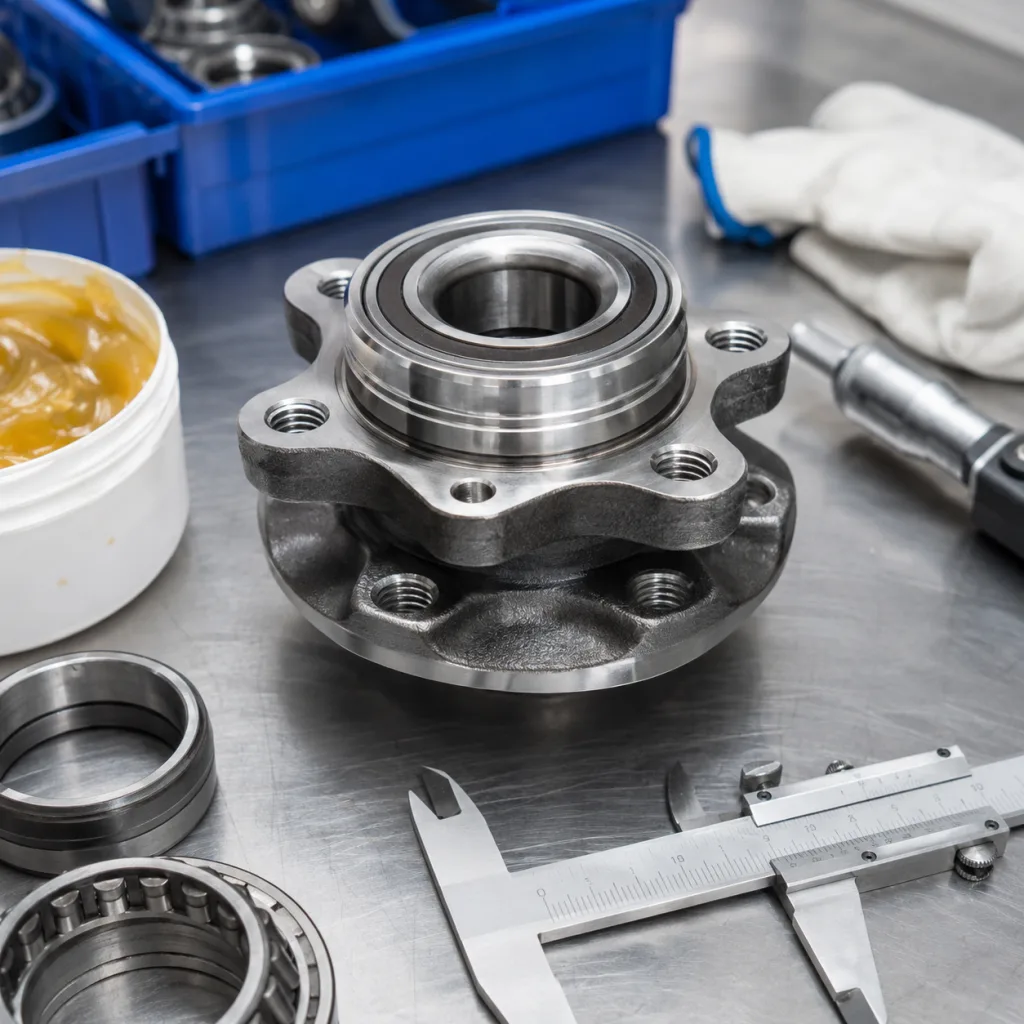
Procurement teams should request drawing-level data or approved sample measurement before committing to bulk orders. For hub units, this means checking flange runout, stud position, mounting face height, ABS ring or magnetic encoder orientation, and spline geometry. For cartridge bearings, it means confirming inner diameter, outer diameter, width, chamfer, seal type, and internal clearance.

A practical sourcing file should include:

  • OE cross-reference format, such as OE 06A… only where the buyer provides the reference.
  • Vehicle application range, model year, engine type, axle position, and drivetrain notes where relevant.
  • Dimensional drawing with critical-to-fit features marked.
  • Material and heat treatment specification for rings, rolling elements, and hub flange.
  • Seal construction, grease type, and operating temperature range.
  • ABS encoder type: passive tone ring, active magnetic encoder, or no sensor.
  • Packaging specification, label fields, barcode format, and country-of-origin marking.
  • Agreed inspection evidence for samples, pilot orders, and repeat production.

Driventus can review buyer reference lists against our catalog and confirm whether an existing part number, private-label kit, or custom manufacturing route is the better fit.

OE-Equivalent Dimensions and Functional Match

Wheel bearings are precision safety-related components, so visual similarity is not enough. Small differences in shoulder height, press-fit dimension, or encoder location can affect installation load, sensor signal, brake disc alignment, and service life. Replacement parts should be assessed by functional equivalence: the part must install correctly, run quietly, communicate with the vehicle electronics where applicable, and maintain sealing performance in real operating conditions.

</tr></thead><tbody> </tbody></table>Dimensional inspection normally uses calibrated gauges, CMM measurement for hub features, runout checks, and roughness testing on sealing and mounting surfaces. For bearing rings and hub flanges, buyers should also request hardness ranges and evidence of metallurgical control. The goal is to avoid two common risks: a part that needs abnormal force during installation and a part that appears to fit but later causes noise, vibration, heat build-up, or ABS faults.

Repair chains also need consistent installation behaviour across locations. Press-in units should have stable chamfer geometry and correct shoulder support. Hub assemblies should include required fasteners or installation notes where the agreed kit specification calls for them, especially when torque-to-yield hardware or encoder orientation is application-sensitive.

Validation Testing and Quality Documentation

A reliable wheel bearing replacement programme combines design review, sample validation, and production control. Driventus operates under IATF 16949:2016 and ISO 9001:2015, with process documentation covering incoming material inspection, machining, heat treatment verification, assembly, greasing, sealing, and final inspection. Buyers can review our quality system before planning a factory audit or supplier approval process.

Typical validation and control items include:

Feature Why it matters Procurement check
Bore and outer diameterControls press fit and seatingConfirm measured values against drawing, not catalogue text only
Width and offsetAffects hub position and brake alignmentMeasure total width, flange height, and mounting face height
Internal clearance or preloadAffects noise, heat, and service lifeRequire controlled assembly process and batch inspection records
Seal lip designProtects grease from water and road contaminationInspect seal material, contact pressure, and dust shield compatibility
ABS encoderControls wheel speed signalVerify pole count, sensor side, and magnetic strength where applicable
Stud or bolt patternDetermines direct installationCheck PCD, thread, knurl, and protrusion length
Mounting surface finishInfluences seating, runout, and corrosion resistanceReview roughness, coating, and contact-area protection

</tr></thead><tbody> </tbody></table>Published standards should be applied according to product type and customer requirement. IATF 16949:2016 and ISO 9001:2015 guide quality management and process control. Material declarations may be prepared in line with REACH (EC) No 1907/2006 and RoHS requirements where the destination market requires them. Vehicle emissions standards such as ECE R-83 are not wheel bearing performance standards. If they appear in wider vehicle compliance files, they should not be treated as a substitute for bearing validation.

The most useful supplier evidence is batch-specific. Generic certificates have limited value unless they are supported by inspection data tied to the purchase order, production date, line or cavity where relevant, and shipment lot. This level of traceability helps buyers contain field issues quickly instead of blocking a full product family unnecessarily.

Replacement Kit Specification for Distributors

Distributors often sell wheel bearings as kits rather than loose components because workshops need a complete installation package. Kit content should be defined in the purchase specification so that goods-in teams, warehouse staff, and branch managers are checking against the same bill of materials.

A typical B2B kit specification may include:

  • Bearing or hub assembly packed in an anti-corrosion bag.
  • Circlip, axle nut, bolts, or studs where applicable to the vehicle application.
  • ABS sensor cable clip or dust cap only where included in the agreed bill of materials.
  • Neutral, Driventus, or private-label box artwork.
  • Barcode label with part number, batch code, quantity, and country of origin.
  • Master carton with export marking and pallet plan.
  • Installation warning insert where pressing direction or encoder side is critical.
  • Corrosion protection method suitable for warehouse dwell time and sea freight exposure.

For buyers importing to the EU, UK, US, Canada, Australia, or Brazil, packaging must preserve traceability after repacking and regional distribution. A useful label structure includes supplier part number, buyer SKU, batch number, production date, carton quantity, and country of origin. If the bearing has a magnetic encoder, the packaging or insert should clearly identify the sensor side because incorrect installation can trigger ABS faults even when the mechanical dimensions are correct.

Private-label programmes should define artwork approval, label file control, carton compression requirement, pallet height, moisture protection, and change-control rules. Procurement teams should also specify acceptable corrosion protection duration, especially where inventory may remain in regional warehouses for 6 to 18 months before sale.

Common Failure Modes After Installation

Warranty claims linked to wheel bearing replacement are not always manufacturing defects. Installation load, contamination, incorrect torque, worn mating parts, and mismatched ABS encoders can create the same symptoms as a defective bearing. A capable supplier should help buyers separate product issues from field conditions through structured claim review.

Test or control Purpose Common evidence requested by buyers
Dimensional inspectionConfirms critical fitment geometryFirst article report, inspection sheet, CMM report
Rotational torque checkDetects preload or assembly variationBatch torque data and control limits
Noise and vibration screeningReduces NVH complaintsEnd-of-line test record or sample report
Seal performance reviewAssesses water and dust resistanceSeal drawing, material data, endurance evidence
Hardness and microstructure checksConfirms heat treatment stabilityHardness report and metallurgical section where required
Grease verificationConfirms lubricant type and fillGrease specification and fill-weight control
Traceability reviewLinks shipment stock to production historyBatch code, production date, and inspection record

</tr></thead><tbody> </tbody></table>For repair chains, a standard claim form improves root-cause analysis. It should capture vehicle details, mileage at installation, mileage at failure, torque procedure, tool type, photos, and whether ABS faults were present before replacement. For distributors, returned part segregation by batch and customer channel helps determine whether a claim is isolated, linked to a specific installation practice, or related to a production lot.

Driventus can support claim review with dimensional recheck, cut-open bearing analysis where appropriate, seal inspection, encoder-side verification, and comparison against retained production samples.

How to Source a Stable Replacement Programme

A stable wheel bearing replacement programme starts with a controlled part list. Buyers should rank SKUs by annual demand, warranty sensitivity, and vehicle parc coverage. High-volume front hub assemblies and common cartridge bearings deserve deeper validation than slow-moving parts because even a small defect rate can create significant branch-level cost.

Recommended sourcing sequence:

1. Provide the target SKU list, drawings if available, and OE cross-reference data supplied by your catalogue team. 2. Confirm dimensional equivalence, ABS encoder details, and vehicle application notes with the supplier. 3. Order samples for fitment, torque, noise, packaging, and label review. 4. Approve the bill of materials, label format, carton specification, and inspection plan. 5. Place a pilot order with batch-level documentation. 6. Review returns, installer feedback, and warehouse handling results before scaling to container quantities. 7. Lock the approved specification so later changes to materials, packaging, or sub-suppliers require notification.

MOQ and lead time depend on whether the item is in regular production, requires tooling, or needs private-label packaging. Existing SKUs can usually move faster than new hub designs requiring sample development and validation. For OEM or Tier-1 style projects, PPAP-style documentation can be discussed, but the submission level, timing, and approval criteria should be agreed in the sourcing contract.

Driventus is based in Taizhou, Zhejiang and exports engine and powertrain components to more than 60 countries. For wheel bearing buyers, the same procurement discipline applies: documented fitment, controlled production, repeatable packaging, and traceable shipments. To discuss a replacement bearing list, use the request a quote page with your target SKUs, annual volume, destination markets, and packaging requirements.

Frequently asked questions

Provide buyer SKU, application list, OE cross-reference if available, annual volume, packaging requirement, destination market, and any drawing or sample data. Photos alone are not enough for hub assemblies because offset, ABS encoder position, spline details, and mounting geometry must be confirmed.

Yes. Private-label supply can include buyer artwork, barcode labels, kit content control, carton marking, pallet plans, and traceability fields. Artwork files, label content, and packaging durability requirements should be approved before mass production.

Compatibility is controlled by confirming encoder type, sensor side, pole count, magnetic signal, and application notes before production. Packaging or inserts should identify the encoder side where incorrect pressing direction could cause ABS warning lights.

If you are building or reviewing a wheel bearing replacement sourcing programme, send your SKU list, target markets, annual volume, and packaging requirements. Driventus can confirm fitment options and quotation details at /contact.html

Request a Quote
Symptom reported Possible cause Inspection action
Growling noise soon after fittingIncorrect press load, damaged raceway, or poor preloadCheck raceway marks, torque data, and installation tool contact area
ABS warning lightWrong encoder side, damaged magnetic ring, or incompatible sensor typeVerify pole pattern, sensor gap, and part cross-reference
Wheel playIncorrect axle nut torque, worn hub seat, or wrong bearing widthInspect mounting surfaces and compare dimensions
Grease leakageSeal damage, overheat, or contaminationCheck seal lip, grease condition, and operating environment
Premature corrosionPackaging failure or long humid storageReview coating, bag seal, carton condition, and warehouse record
Uneven brake wear or vibrationHub runout, incorrect offset, or contaminated mounting faceMeasure flange runout and inspect seating surfaces