Brake Pads and Rotors Replacement for B2B Buyers
Brake pads and rotors replacement is a high-volume service category, yet B2B sourcing decisions still depend on precise geometry, stable friction performance and traceable production batches. For distributors, repair chains and private-label programmes, the risk is broader than early wear: poorly matched pads and discs can cause noise, vibration, warranty returns, uneven pedal feel and unnecessary SKU complexity across vehicle platforms.
This guide sets out the technical checks procurement teams should apply when selecting replacement brake pads and rotors for passenger cars and light commercial vehicles. It covers OE-equivalent fitment, friction and rotor material choices, validation testing, packaging control, supplier evaluation and RFQ preparation.
Driventus manufactures and sources automotive components for aftermarket and OE-service channels from Taizhou, Zhejiang, under IATF 16949:2016 and ISO 9001:2015 aligned processes. Driventus is an independent aftermarket manufacturer; brand names are referenced for fitment only.
Replacement Fitment Starts With OE-Equivalent Geometry
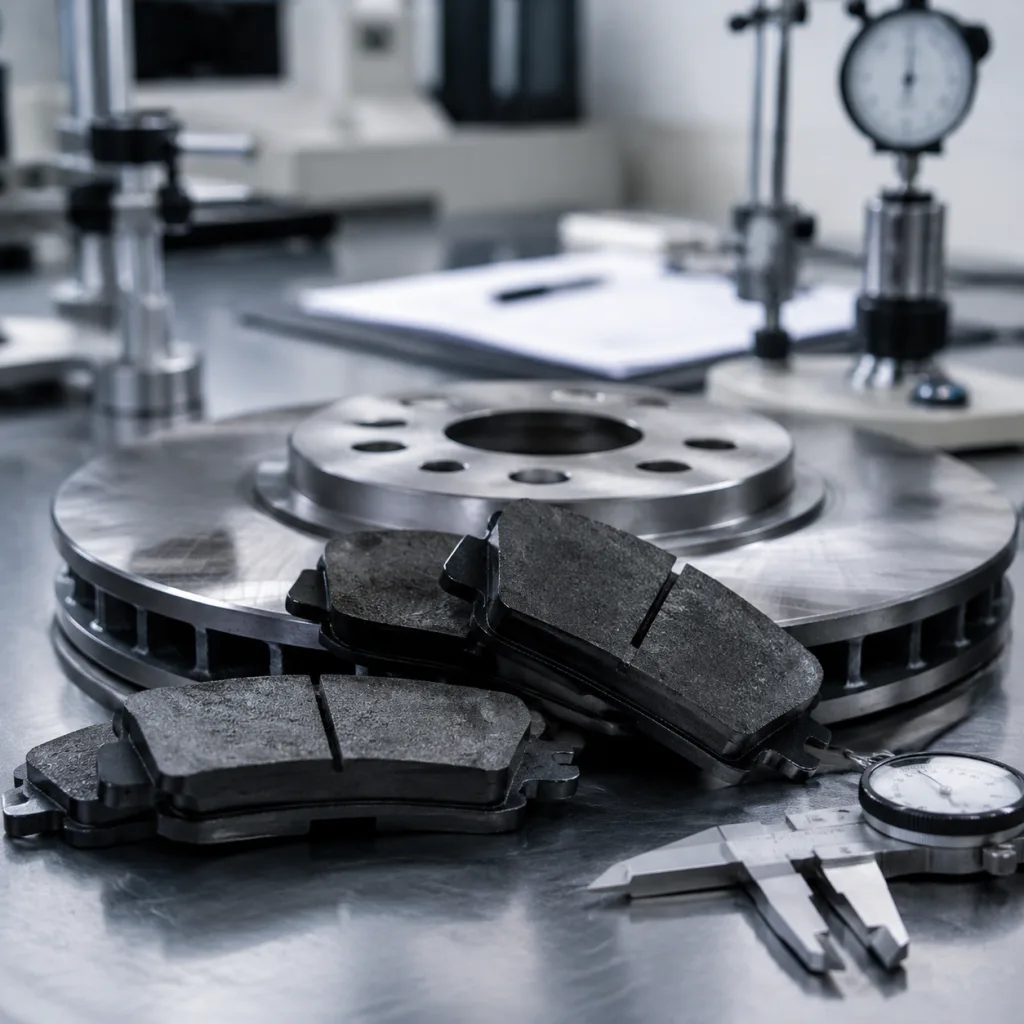
For brake pads and rotors replacement programmes, dimensional interchangeability is the starting point. A friction material may perform well on a dynamometer, but it will still fail commercially if the backing plate does not sit correctly in the caliper bracket or if rotor offset changes the running clearance.
Procurement teams should request fitment drawings, sample inspection reports and OE part-number cross-reference logic before confirming a range. Where a buyer provides reference numbers, they should be treated as fitment identifiers rather than approval claims. Internal databases may map generic references such as OE 06A… or OE 11251… when supplied by the buyer, but no replacement part should be described as vehicle-manufacturer approved unless formal approval exists.
Key dimensional controls include:
- Pad length and height: commonly controlled within ±0.20 mm, depending on application and drawing.
- Backing plate thickness: verified to maintain correct piston travel and caliper clearance.
- Friction block chamfer and slot position: matched to noise, dust and thermal requirements.
- Rotor outside diameter: checked against caliper sweep and dust-shield clearance.
- Rotor thickness and minimum thickness marking: controlled for service life and inspection compliance.
- Hat height and centre bore: critical for hub fit, bearing load, wheel location and runout control.
- Bolt pattern and countersink details: confirmed where rotor fixing screws or wheel-stud layouts differ by market.
Buyers should also compare hardware kits, wear-sensor options and axle-set packaging. A single pad shape can have several variants with different shims, clips, abutment hardware or sensors, so range management must separate true application differences from packaging preferences. This prevents one commercial SKU from being stretched across applications that require different service content.
Material Choices and Use-Case Trade-Offs
Brake friction material is a controlled compromise between stopping performance, rotor wear, dust, noise, temperature stability and regional regulation. There is no universal compound for every fleet, climate and price tier. Buyers should define the target market position, driving profile and warranty expectation before approving a formula.
| Material type | Common use case | Advantages | Procurement checks |
|---|---|---|---|
| Non-asbestos organic | Entry and mid-range passenger car lines | Low noise, moderate rotor wear, stable comfort | Heat fade, compressibility and dust level |
| Low-metallic | European-style braking feel and higher thermal demand | Strong bite and heat transfer | Noise control, corrosion protection on backing plate |
| Ceramic-based | Premium comfort ranges and lower dust targets | Low visible dust, good NVH control | Cold bite, cost consistency and regional demand |
| Semi-metallic | Light commercial, performance or higher load use | Temperature resistance and durability | Rotor wear, bedding behaviour and noise risk |
| Test or control point | Purpose | Typical evidence requested |
|---|---|---|
| Dynamometer friction testing | Measures fade, recovery and friction coefficient stability | Test curve, temperature profile, batch ID |
| SAE J2527 noise evaluation | Assesses brake noise tendency under defined conditions | Noise matrix and occurrence summary |
| Shear strength testing | Confirms bond strength between friction material and backing plate | Shear value report by production lot |
| Compressibility testing | Controls pedal feel and pad deformation | Cold and hot compressibility report |
| Rotor runout inspection | Reduces vibration and pedal pulsation risk | Runout measurement, usually in mm |
| Disc thickness variation control | Helps prevent brake judder and uneven pedal feedback | DTV readings, parallelism result, machining record |
| Salt spray or coating test | Checks corrosion resistance for coated parts | Hours tested, coating type and result |