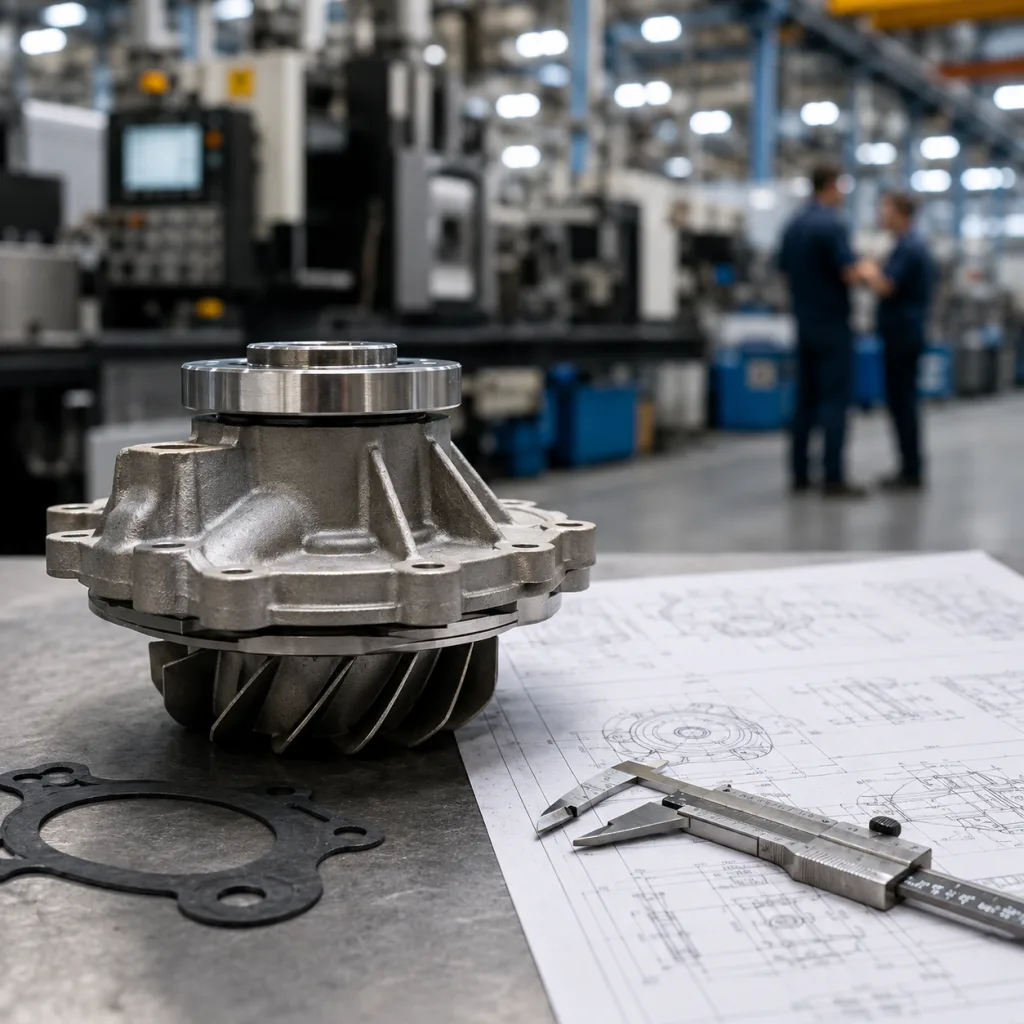
Water pump material decisions show up later as leakage claims, bearing noise, corrosion, fitment disputes and warranty chargebacks. The trap is treating the pump as “aluminium versus cast iron” or “plastic versus metal impeller”. A coolant pump is a controlled assembly: housing alloy, impeller grade, shaft finish, bearing package, seal-face pairing, gasket compound, coating and machining tolerance all have to work together under heat, glycol chemistry, vibration and mixed-service conditions.
For sourcing engineers, category buyers and import managers, the useful question is not “which material is best?” It is: which water pump material package matches the platform, market risk, validation budget and landed-cost target? This guide converts that decision into RFQ language for aftermarket and OEM supply programmes.
Driventus manufactures automotive water pumps in Taizhou, Zhejiang, with export supply to more than 60 countries. Production is managed under IATF 16949:2016 and ISO 9001:2015, with dimensional inspection, leakage testing and material verification applied by part family. Driventus is an independent aftermarket manufacturer; brand names are referenced for fitment only.
Decision Framework: Specify the Pump by Failure Risk, Not by Label
A coolant pump is a multi-material assembly. If the RFQ only says “aluminium pump”, “metal impeller” or “OE quality”, the supplier has too much room to substitute. Break the water pump material requirement into controlled components, then connect each component to a measurable acceptance point.
Component
Common specification
Procurement check
Housing
ADC12/A380 die-cast aluminium, AlSi9Cu3 equivalent, or HT200/HT250 grey cast iron
Alloy certificate, porosity class, pressure-test result, machined datum tolerance
Impeller
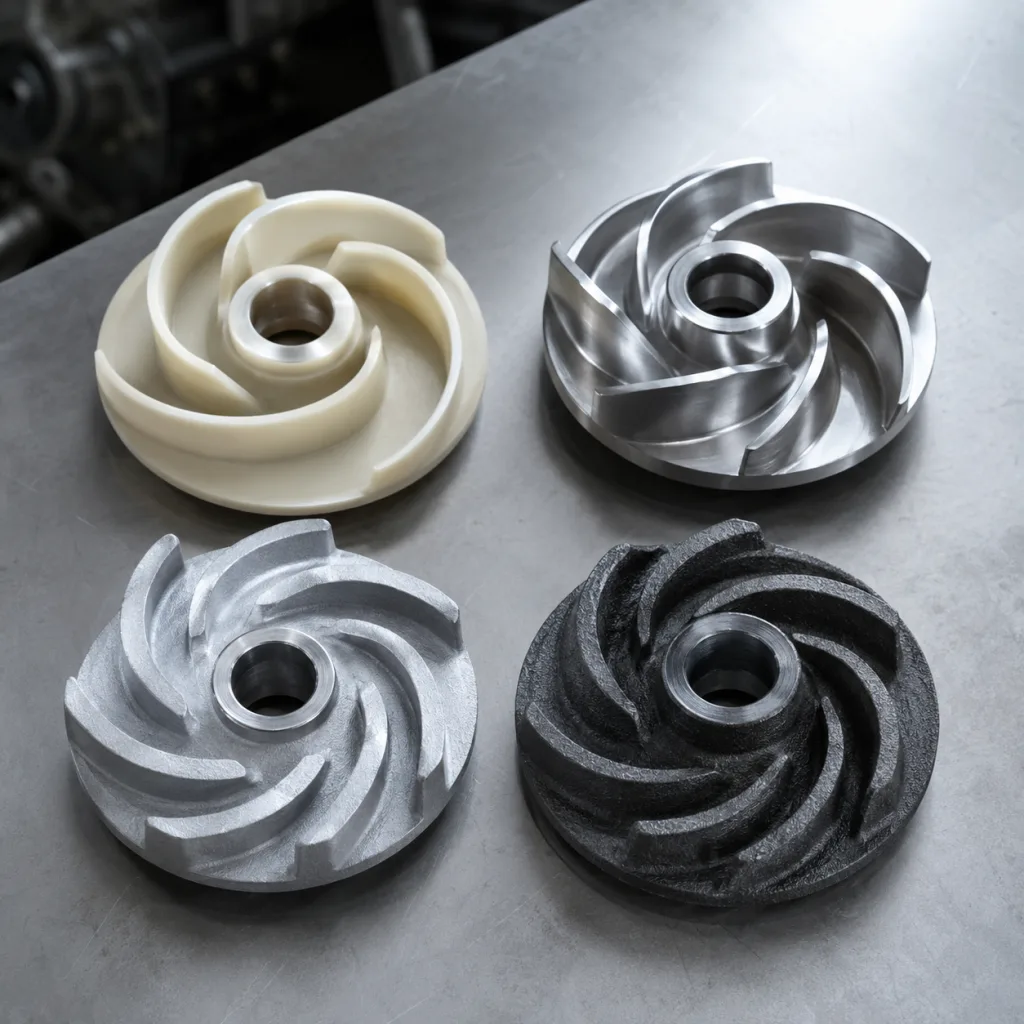
PPS-GF40, PA66-GF30/35, stamped steel, aluminium or cast iron
</tr></thead><tbody> </tbody></table>The highest sourcing risk is quiet substitution between batches. A factory may keep the housing shape but change the bearing source, seal compound, impeller resin or coating thickness. The drawing still looks right. The warranty result may not.
Use a simple approval rule: no material, bearing, seal, impeller, coating or critical-process change without written buyer approval and first-article confirmation. Then price each version against that controlled BOM.
MOQ follows the same logic. Standard catalogue pumps may be quoted from 100–300 pcs per reference when existing tooling and packaging are used. Private-label cartons, special impellers, upgraded seals or new castings often move MOQ to 500–1,000 pcs per reference, or to an annual call-off agreement. The cost is not only material. It includes mould setup, label printing, incoming material segregation, fixture confirmation and PPAP-style documentation.
If a supplier offers economy and heavy-duty versions, require separate BOMs, process controls, sample prices, mass-production prices and test summaries. Otherwise the comparison is not real.
Housing Deep-Dive: Where Aluminium Wins, Where Cast Iron Still Belongs
Housing material sets the pump’s weight, stiffness, corrosion exposure and machining behaviour. It also drives tooling cost. Aluminium is common because die-casting supports high-volume production and lower mass. Cast iron still appears on older platforms and some heavy-duty applications where stiffness, damping or legacy design requirements matter more than weight.
For ADC12/A380-type aluminium housings, buyers should control chemical composition, density or porosity limits, thread strength and flatness at the gasket interface. Useful checks include spectrometer confirmation by heat, X-ray or section inspection for first-off castings, and CMM inspection of machined datums. Mounting-face flatness is often around 0.05–0.15 mm depending on gasket design, but the drawing should decide the number. Do not negotiate the tolerance after the price is fixed.
Grey cast iron, such as HT200/HT250-type material, brings different risks. It is stiff and stable, but heavier and more corrosion-sensitive. When sourcing cast iron pumps, specify coating adhesion, internal cleanliness, rust-preventive oil or VCI packaging, and machined-surface protection for long-distance sea freight. For 30–60 day sea shipments, ask for a defined corrosion-protection period, such as 90 days indoor storage after arrival when cartons remain unopened.
A housing approval checklist should include:
Datum-to-datum dimensional tolerance agreed from drawing or sample approval; “same as sample” is not enough.
Mounting face flatness, bolt-hole positional tolerance and pulley-alignment datum recorded in inspection reports.
Thread go/no-go gauge control for threaded ports and accessory mounts, with plug-gauge frequency stated in the control plan.
100% leakage test after assembly, commonly 0.2–0.4 MPa air-under-water or dry air decay for 10–30 seconds, adjusted to the pump design.
Casting porosity acceptance at seal, bearing and pressure-wall areas, with rework or impregnation rules agreed before production.
Salt spray or coating validation where corrosion risk is material to the market, such as 48–96 hours neutral salt spray for plated or coated external steel parts.
Cost changes quickly when tooling changes. A housing made from existing die-casting tooling may need only sample machining and fixture confirmation, with samples available in about 15–30 days. New housing tooling can push launch timing to 45–75 days before PPAP or pilot approval. Compare tooling cost, sample cost, unit price and test-document cost separately; a low unit price can hide weak validation.
Comparison: Plastic, Steel, Aluminium and Cast-Iron Impellers
The impeller is where many buyers first notice a water pump material difference. It is also where material names can mislead. Flow depends on vane height, blade count, clearance, hub retention and balance. Material matters, but geometry and process control matter just as much.
Glass-fibre reinforced polymers such as PPS-GF40 and PA66-GF30/35 reduce rotating mass and resist corrosion. They need discipline in moulding shrinkage, fibre content, moisture conditioning and thermal ageing. For PA66, conditioning is especially important because moisture content affects dimensions and toughness. For PPS, resin grade and fibre control should be traceable.
Metal impellers remain valid on many legacy designs. Stamped steel versions can be economical and dimensionally stable, but coating, edge burrs and weld or rivet consistency must be controlled. Aluminium impellers offer low mass and stiffness but require casting and handling control. Cast iron is robust for some older constructions, although its weight can increase bearing load and balance sensitivity.
</tr></thead><tbody> </tbody></table>Coolant compatibility should match the target market, not a generic water bath. Ask whether the impeller and adjacent materials were checked with 50/50 ethylene-glycol coolant, organic acid technology coolant, silicate-containing coolant where relevant, and mixed-coolant scenarios if the aftermarket warranty environment is harsh. A practical endurance screen may combine 95–110°C coolant exposure, repeated thermal cycling and rotation under load. Severe programmes may require 120°C ageing or customer-specific cycles.
For EU, UK and North American channels, request material declarations relevant to REACH (EC) No 1907/2006, RoHS where the customer requires it, and any restricted-substance list from the distributor or fleet account. Rubber, plastic and coating systems need supplier declarations, incoming checks and change-control procedures.
Treat impeller upgrades as priced options. A PPS-GF impeller, SiC seal and branded bearing may raise the unit cost, but the package can reduce warranty exposure on high-temperature or high-mileage applications.
Failure Modes: Seal, Bearing and Shaft Issues That Look Like Material Problems
Many field failures blamed on “bad housing material” or “weak impeller material” begin somewhere else. A noisy bearing, rough shaft, poor press fit or unstable seal face can create leakage and vibration even when the casting is acceptable. These parts carry the rotating load and control the coolant boundary, so they need the same sourcing discipline as the visible components.
Start with traceability. Ask for approved supplier names or coded traceability for bearings and seals, especially when the programme includes warranty recovery, distributor chargebacks or high annual volume.
Key specification points include:
Shaft runout after assembly, commonly controlled around 0.02–0.05 mm TIR at the specified datum, subject to drawing and pulley offset.
Shaft hardness, often around HRC 45–60 depending on steel grade and surface process, with roughness at seal-contact areas controlled to prevent premature leakage.
Bearing axial and radial play, measured against the approved bearing supplier specification, with noise or torque checks after press-fit.
Seal face pairing, such as carbon/ceramic for standard service or carbon/SiC and SiC/SiC alternatives for tougher coolant chemistry and duty cycle.
Seal face flatness, spring load and elastomer compound, with EPDM commonly used for glycol coolant and HNBR considered where temperature or oil exposure requires it.
Weep-hole function, verified to avoid blocked leakage indication paths and to distinguish normal break-in staining from active leakage.
Pulley or flange press-fit force, recorded during process validation; use a minimum and maximum press-force window rather than “press to position” only.
Grease temperature capability, cage material and seal elastomer rating matched to engine bay exposure and belt load.
Leakage should be validated before shipment. A buyer-friendly plan is 100% static leakage testing after assembly, rotation or noise checks on critical references, and batch-level destructive checks for bearing press depth, impeller retention and flange pull-off. Define pressure, medium, dwell time and rejection rule. “No continuous bubble under 0.3 MPa for 20 seconds” is clearer than “tested OK”.
Driventus applies pressure testing and rotation checks according to the approved control plan for each pump family. Buyers can review audit scope and certification status through our quality system.
OE-style part numbers should be treated as fitment references only, for example OE 06A… or OE 11251… when supplied by the buyer. Driventus does not claim vehicle manufacturer approval or endorsement.
Evidence Ladder: Match Validation Depth to Programme Risk
A water pump material specification is unfinished until evidence proves that the assembly can survive production variation and service conditions. The evidence file should fit the programme. A 200-piece trial order for a slow-moving aftermarket reference does not need the same submission as a 50,000-piece annual programme. Both still need measurable acceptance criteria.
Use a ladder. For low-risk catalogue supply, request the essentials. For private label, add process controls and packaging validation. For OEM, Tier-1 or high-warranty exposure, require PPAP-level evidence.
Evidence item
Why it matters
Typical document
Material certificate
Confirms alloy, polymer or rubber grade
Mill certificate, resin COA or supplier declaration
Dimensional report
Confirms fitment-critical features
ISIR, PPAP dimensional layout or CMM report
Leakage test record
Confirms seal and housing integrity
100% test log or batch summary with pressure and dwell time
Endurance test
Screens bearing, seal and impeller retention
Bench test report with speed, temperature and duration
Thermal cycle test
Checks gasket compression and material expansion
Validation report with hot/cold cycle count
Packaging test
Reduces corrosion and transit damage
Drop, vibration, carton stacking or pallet report
Process capability
Shows repeatability on critical dimensions
Cp/Cpk study for selected CTQ dimensions
Change-control record
Prevents unapproved substitutions
ECN, deviation approval or supplier change notice
</tr></thead><tbody> </tbody></table>For OEM or Tier-1 supply, PPAP documentation should follow the customer-agreed submission level, including PSW, control plan, PFMEA, MSA, material evidence and initial process studies where required. For aftermarket programmes, a lighter file may be acceptable, but the control plan should still identify critical characteristics, inspection frequency and reaction plans.
Practical inspection frequencies may include 100% leakage testing, first/last-piece CMM checks per machining shift, hourly visual checks for casting and seal damage, and AQL-based packaging inspection before shipment.
Lead-time assumptions should be written down. Existing references with approved components may ship in about 30–45 days after deposit and packaging confirmation. Private label, new supplier approval or upgraded material packages may require 45–60 days. New tooling, endurance testing or PPAP-level submission can require 60–90 days or longer.
Driventus operates under IATF 16949:2016 and ISO 9001:2015, which support process control, traceability and corrective action management. These certifications do not replace part-specific validation, but they provide a framework for repeatable production.
Step-by-Step: Build an RFQ That Prevents Material Substitution
A strong RFQ does more than ask for a price. It tells the supplier which decisions are fixed, which alternatives are allowed and what evidence is needed before mass production. That prevents late disputes about material substitution.
Step 1: define the buying scenario. State the target market, annual volume, first-order quantity, packaging requirement, launch date, Incoterms and target price logic if available. Also state the commercial intent: lowest landed cost, OE-equivalent construction, heavy-duty upgrade or value-line product.
Step 2: lock the technical baseline. Include:
Application and fitment reference, with any OE-style reference supplied by the buyer and vehicle-engine-year coverage confirmed.
Required housing, impeller, shaft, seal and gasket materials where known, including allowed equivalents and banned substitutions.
Acceptance criteria for leakage, bearing noise, shaft runout, flange height, pulley concentricity and mounting dimensions.
Required compliance documents, including REACH (EC) No 1907/2006 declarations where applicable.
Packaging format, labelling rules, barcode content, pallet limits, carton strength and corrosion-protection period.
Audit, sample approval, PPAP or ISIR level, and lead-time expectations from sample to mass shipment.
MOQ, price breaks and call-off plan, such as 300 pcs trial order, 1,000 pcs annual forecast and quarterly release schedule.
Step 3: separate fixed costs from unit cost. Ask suppliers to quote sample cost, tooling or fixture cost, unit price at 100/300/500/1,000 pcs, private-label carton cost, test-document cost and freight-ready packing dimensions. This makes a standard catalogue pump comparable with a revised water pump material package using an upgraded bearing, SiC seal, PPS impeller or heavier coating.
Step 4: use real failure evidence if available. When replacing an existing supplier, provide failed samples, warranty return photos or inspection notes from rejected lots. If the programme is new, start with 5–20 sample pieces for fitment and bench checks before locking the annual call-off schedule.
A typical launch path is RFQ review, drawing or sample confirmation, quotation, sample order, first-article inspection, functional testing, packaging approval, pilot lot and mass-production release. Driventus can support standard aftermarket references, private-label supply and engineered changes where drawings and performance targets are available. To compare options or send an RFQ, use request a quote.
Frequently asked questions
It depends on the engine design. Aluminium reduces weight and suits high-volume die-casting, while cast iron offers stiffness for some older or heavy-duty applications. The correct specification should follow the original design intent, mounting geometry, corrosion exposure and coolant environment. Buyers should define alloy or casting grade, flatness, porosity, coating and leakage-test requirements rather than selecting by material name alone.
Not automatically. Glass-fibre reinforced polymers such as PPS-GF40 or PA66-GF30/35 can perform well when moulding, hub retention, coolant ageing and thermal cycling are controlled. Metal impellers can also fail if coating, balance, burr or corrosion control is poor. Buyers should compare validation data, impeller retention and coolant compatibility, not material names alone.
Request material certificates, dimensional reports, leakage test method, endurance or thermal cycle evidence, packaging specification and applicable compliance declarations. For higher-risk programmes, request PPAP or ISIR documentation, review the supplier control plan, confirm 100% leakage testing, and agree MOQ, lead time, price breaks and change-control rules before deposit.
If you are comparing water pump material specifications for aftermarket or OEM supply, Driventus can review drawings, samples, MOQ targets and annual volumes. Send the RFQ details through /contact.html