Crankshaft Jeep Wholesale Sourcing Guide
Crankshaft Jeep wholesale sourcing is not won by the cheapest quote. It is won by the supplier that can keep fitment, journal geometry, hardness, oil-passage cleanliness, balance, packaging, and paperwork stable after the first order.
That matters because Jeep-related aftermarket demand is fragmented. One market may need fast-moving gasoline references. Another may require diesel applications, repair undersizes, or private-label packing. A remanufacturer may care less about carton design and more about thrust width, runout, bearing clearance, and repeat machining data. A distributor may need 20 SKUs in one shipment without turning slow movers into dead stock.
Driventus manufactures engine and powertrain components in Taizhou, Zhejiang, with export supply to 60+ countries. Our crankshaft programme supports aftermarket distribution, private-label projects, and buyer-specific inspection plans for selected gasoline and diesel engine families. Driventus is an independent aftermarket manufacturer; brand names are referenced for fitment identification only. This guide gives buyers a practical way to qualify crankshaft jeep wholesale suppliers before moving from sample approval to repeat volume orders.
Start With the Buying Scenario, Not the Part Name
A Jeep application name is only a starting point. Wholesale demand changes by engine generation, destination market, repair economics, and channel. The same crankshaft enquiry can require very different controls depending on who will install, resell, or remanufacture the engine.
Use the buying scenario to set the sourcing route:
- Aftermarket distributor: prioritise SKU coverage, carton consistency, barcode labels, pallet marks, LCL or container consolidation, and reorder availability.
- Engine remanufacturer: focus on journal dimensions, straightness, thrust-face width, undersize bearing compatibility, and repeat data for STD, 0.25 mm, and 0.50 mm repair sizes where applicable.
- Repair-chain buyer: reduce installation risk with stable supply, damage-resistant packaging, clear claim handling, and reorder lead times inside a 30–60 day planning window.
- Custom project buyer: confirm application-specific material, counterweight design, oil-hole geometry, surface finish, flange details, pilot bore, or heat-treatment route through custom manufacturing.
A useful RFQ file should include engine code, displacement, model-year range, fuel type, destination market, transmission type where relevant, sample photos, annual demand by SKU, first-order quantity, required stock depth, target Incoterm, packaging preference, and inspection expectations. If an OE-style cross-reference is included, use a generic format such as OE 06A… or OE 11251… unless the number has been confirmed by the buyer’s own fitment database.
One decision should be made early: does the buyer accept an equivalent aftermarket design, or does the project require sample-to-sample duplication? That answer affects feasibility, pricing, inspection depth, and approval time. Driventus does not claim vehicle manufacturer approval, affiliation, or endorsement.
Spec Deep-Dive: What Must Be Fixed Before Price Lock
A crankshaft quotation should not be based on an application label alone. Jeep platform names can cover different engine families across North America, Europe, Latin America, Australia, and the Middle East. Treat every new SKU as a dimensional and metallurgical project until it is validated against a drawing, approved sample, or buyer inspection sheet.
| Sourcing item | What to verify | Typical control target to discuss | Procurement risk if missed |
|---|---|---|---|
| Material route | Forged steel or cast nodular iron, depending on application | Material certificate with heat/lot traceability | Fatigue performance gap or cost mismatch |
| Main journal diameter | Drawing or sample measurement with agreed tolerance band | Often ±0.005–0.010 mm depending on drawing | Bearing clearance complaints |
| Rod journal diameter | Nominal size and undersize repair options | STD plus 0.25 mm / 0.50 mm repair logic where applicable | Incorrect bearing pairing |
| Stroke | Centreline measurement | Commonly controlled within ±0.03–0.05 mm by reference | Compression variation and engine vibration |
| Runout / straightness | V-block or CMM measurement at defined datum points | Often ≤0.03–0.05 mm TIR for aftermarket control plans | Seal wear, vibration, and assembly rejection |
| Surface roughness | Ra on main and rod journals | Commonly Ra 0.2–0.4 µm unless drawing differs | Oil-film instability and bearing wear |
| Surface hardness | Nitriding or induction hardening where specified | Example discussion range: 50–60 HRC or HV equivalent by process | Premature journal wear |
| Fillet radius | Radius gauge or CMM confirmation | Must match bearing relief and stress requirement | Stress concentration and cracking |
| Oil-hole geometry | Chamfer, passage cleanliness, and alignment | Deburring plus visible/no-residue cleanliness check | Lubrication failure |
| Dynamic balance | Buyer-defined g·mm limit or approved sample benchmark | Example target: ≤10–30 g·mm depending on crank size and application | NVH issues and warranty exposure |
| Evaluation area | Acceptable evidence | Weak signal |
|---|---|---|
| Fitment control | Application matrix, sample comparison, dimensional sheet, buyer-approved cross-reference | Only vehicle model name in quotation |
| Process capability | Cpk data for selected critical journals where available, or at least trend records from repeat batches | No tolerance discussion |
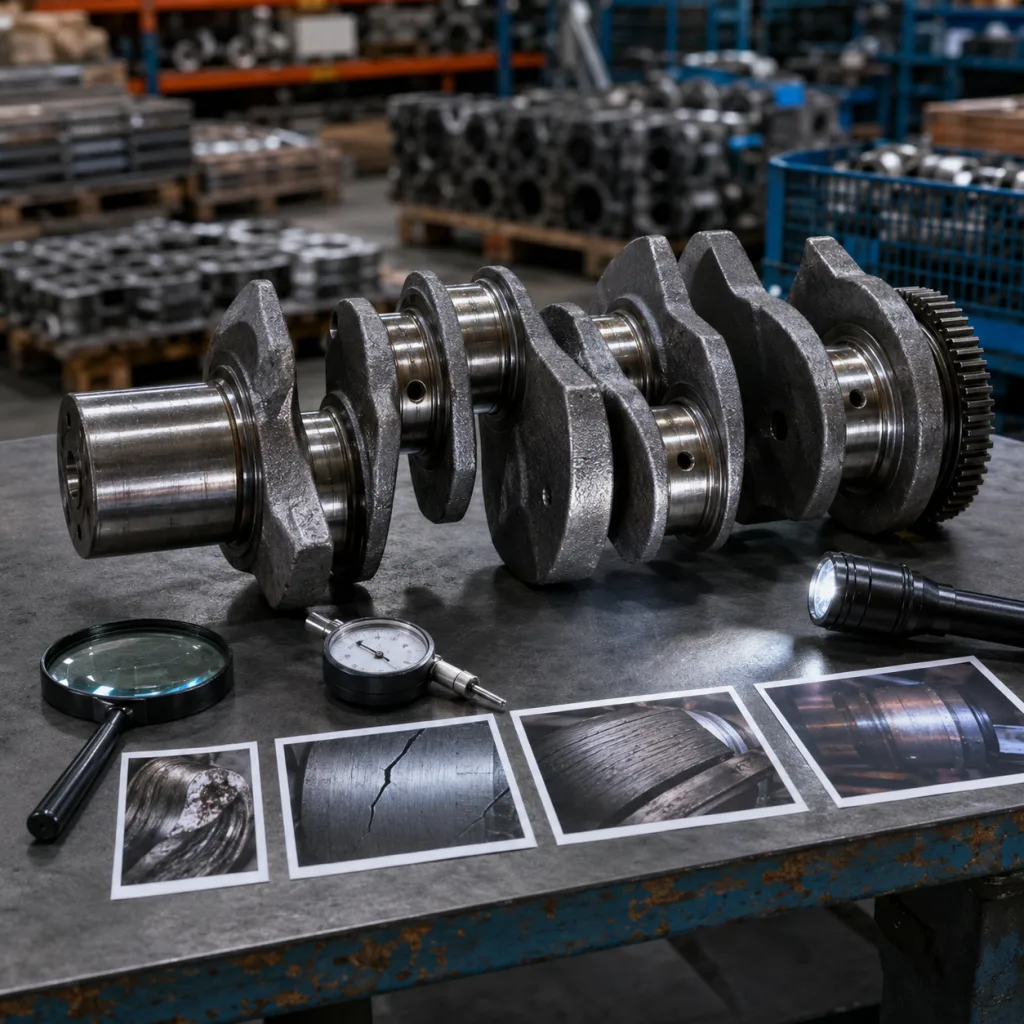
| Inspection | Final report with journal size, runout, hardness, roughness, oil-hole condition, and balance | Visual inspection only |
| Traceability | Batch number, material lot, production date, heat-treatment record, and packing label link | No link between part and production record |
| Packaging | VCI protection, journal sleeves, formed support, export carton, pallet plan, and drop-risk review | Loose packing or thin carton only |
| Audit readiness | IATF 16949:2016 and ISO 9001:2015 certificates, control plan, calibration records, and non-conformance examples | Refusal to share basic documents |
| Export support | HS code discussion, accurate packing list, carton dimensions, gross/net weight, and pallet marks | Manual documents with frequent errors |
| Commercial discipline | Written MOQ, payment terms, lead time, sample approval gate, and change-notice rule | Verbal price only |