Vehicle Air Filter Replacement for B2B Buyers
Vehicle air filter replacement is a high-frequency aftermarket category, yet many programmes still lose margin through preventable sourcing issues: poor sealing, incorrect intake geometry, limited dust-holding capacity, weak media stability, or inconsistent carton labelling. For distributors, importers, and repair-chain category teams, the buying decision goes beyond basic fitment. Each SKU must deliver repeatable OE-equivalent dimensions, stable filtration efficiency, controlled airflow restriction, and packaging data that supports warehouse picking at scale. This guide outlines the replacement criteria buyers should use when sourcing engine intake air filters for passenger cars and light commercial vehicles. It covers dimensional matching, media construction, validation testing, documentation, and supplier controls. Driventus is an independent aftermarket manufacturer; brand names are referenced for fitment only.
Replacement demand and SKU risk
Air filters are routine service parts, but service intervals vary widely by market, environment, engine layout, and fleet duty cycle. Dust-heavy regions, urban stop-start operation, construction fleets, agricultural support vehicles, and ride-hailing fleets often require more frequent replacement than vehicles used mainly on clean highways. For a distributor or repair chain, that demand creates volume opportunity together with significant SKU-management risk.
A replacement programme usually has three risk points:
- Application accuracy: the part must match the intake box, sealing land, height, clip position, and sensor-side airflow path.
- Performance consistency: filtration efficiency and airflow restriction must remain within the agreed specification across production batches.
- Operational control: carton marking, barcode data, pallet configuration, and cross-reference files must support regional distribution without manual correction.
Buyers should manage vehicle air filter replacement as a specification-controlled category rather than a commodity paper-element purchase. A visually similar filter can fail in service if gasket compression is wrong by only a small margin, pleat spacing collapses under humidity, the frame distorts during installation, or polyurethane flash prevents full seating in the airbox.
Driventus supplies engine and powertrain components to B2B customers in more than 60 countries. Air filter sourcing can be reviewed alongside related engine service lines in our catalog, depending on programme scope, vehicle parc, and market coverage.
OE-equivalence criteria for replacement air filters
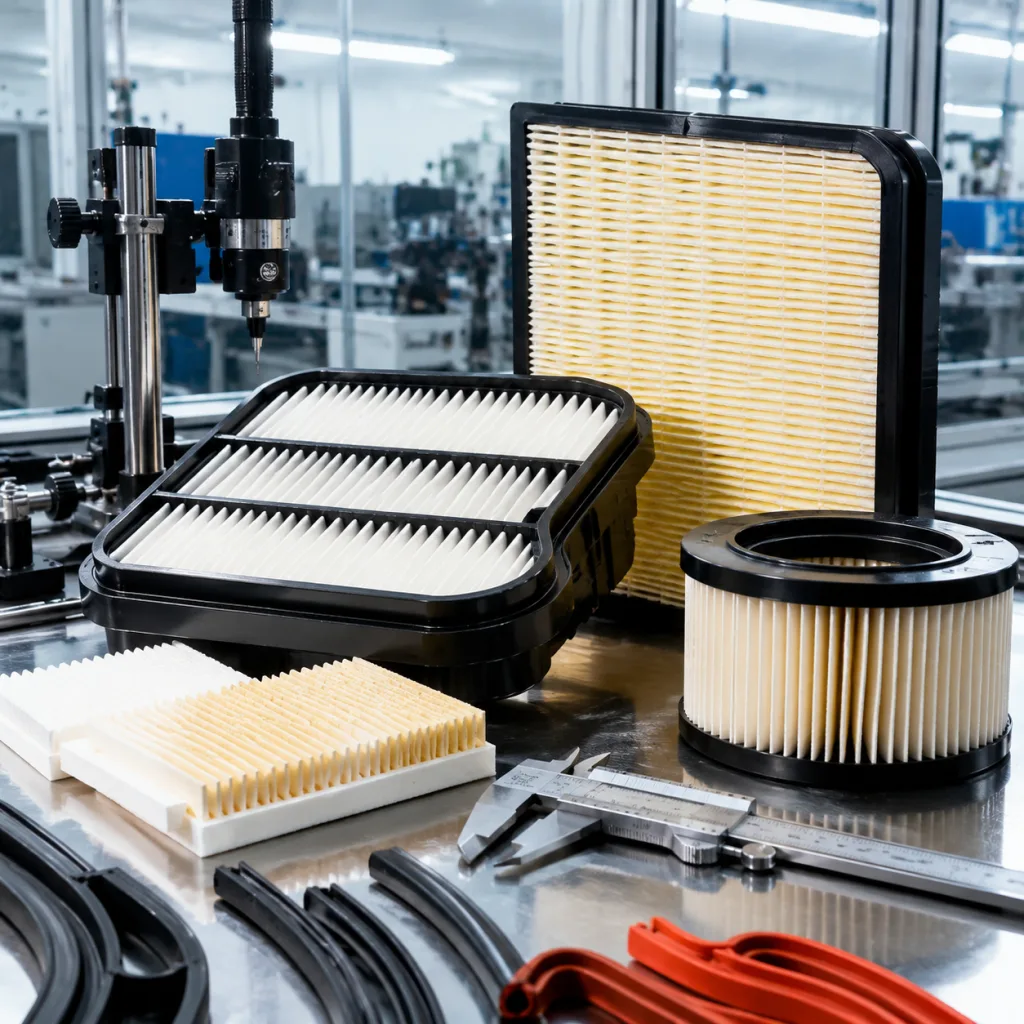
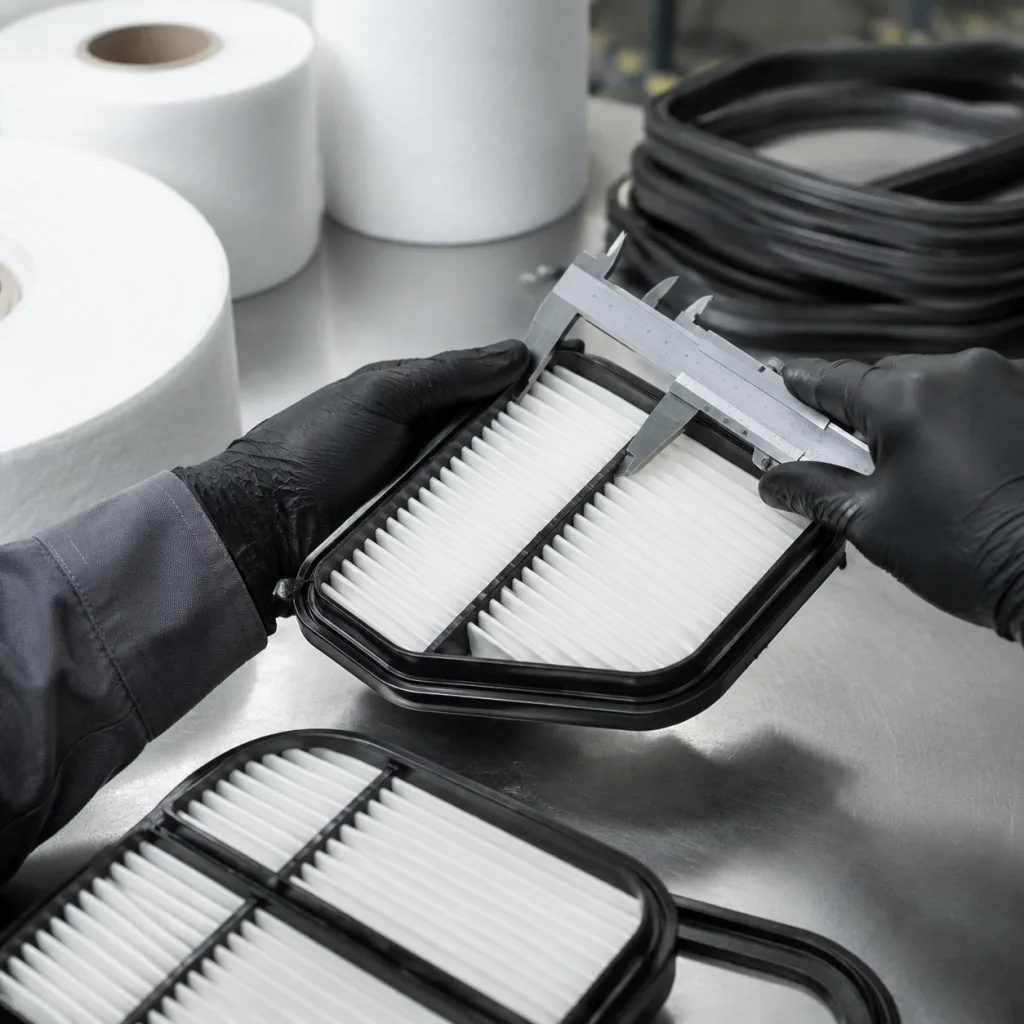
OE-equivalence for an intake air filter starts with controlled geometry. Procurement teams should request engineering drawings, first-article reports, or controlled inspection data instead of relying only on sample photos. For rectangular panel filters, critical dimensions include overall length, width, height, frame profile, gasket hardness, sealing rib location, pleat pack height, and corner radius. For cylindrical and radial-seal designs, inner diameter, outer diameter, end-cap concentricity, seal angle, and axial compression are just as important.
| Replacement factor | What to verify | Typical procurement evidence |
|---|---|---|
| Dimensional match | Length, width, height, seal profile, seating face | First article inspection report, drawing, CMM or fixture data |
| Intake sealing | Gasket compression, frame hardness, flash control | Material specification, compression test, visual AQL result |
| Airflow direction | Correct pleat orientation and sensor-side geometry | Application sample comparison, fitment photos, airflow test |
| Media stability | Pleat spacing, adhesive bond, humidity resistance | Media data sheet, burst or deformation check |
| Packaging accuracy | Part number, barcode, country labels, carton strength | Label proof, master carton drawing, drop-test record |
| Component | Common options | Procurement consideration |
|---|---|---|
| Filter media | Cellulose, synthetic, composite | Balance efficiency, restriction, cost, and humidity resistance |
| Frame or end cap | PU foam, rubber, plastic, metal mesh support | Must maintain seal under vibration and temperature change |
| Adhesive | Hot-melt, PU, plastisol depending on design | Must prevent media separation and bypass leakage |
| Support layer | Wire mesh, expanded metal, plastic grid | Required where pleat collapse risk is high |
| Packaging | Neutral, private label, repair-chain branded | Must match import, warehouse, and shelf display needs |