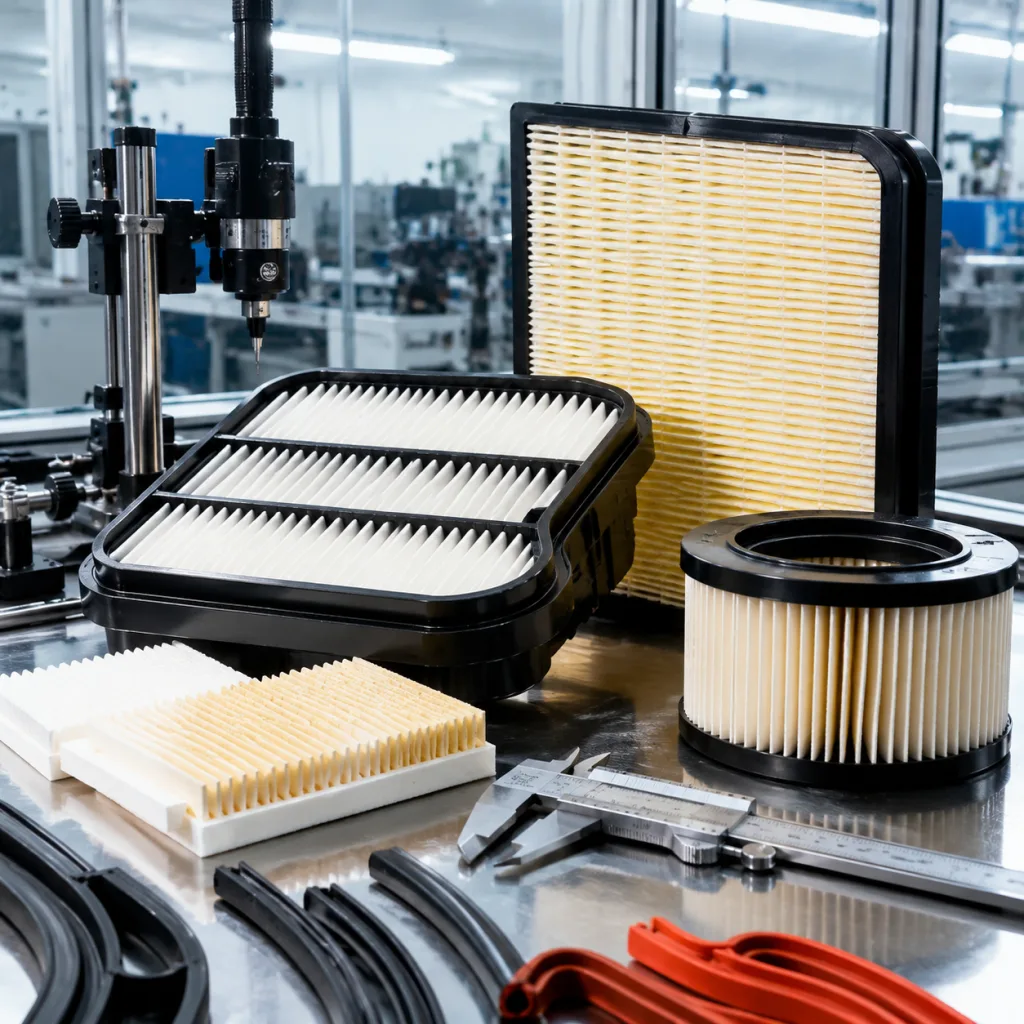
Auto air filter replacement is a high-volume aftermarket category for distributors, wholesalers, private-label programs, and multi-location repair chains. The part may look simple, yet purchasing issues often start with small deviations: a gasket that sits too low, media that changes between lots, adhesive that cures unevenly, or cross-reference data that treats similar housings as identical. A replacement air filter must seat securely in the air box, keep air flow within the engine management system’s expected range, and protect the intake tract from dust throughout the intended service interval. This guide outlines how B2B buyers can evaluate OE-equivalent air filters for passenger cars and light commercial vehicles, covering fit verification, media and seal construction, validation testing, application coverage, packaging control, and supplier documentation. Driventus manufactures engine and powertrain components in Taizhou, Zhejiang, under IATF 16949:2016 and ISO 9001:2015 systems. Driventus is an independent aftermarket manufacturer; brand names are referenced for fitment only.
Replacement Fit: What Must Match the OE Design
For replacement programs, the first sourcing requirement is physical interchangeability. A panel, round, or cylindrical air filter must locate in the housing without compression gaps, edge roll-over, cover interference, or technician workarounds. Even a 1–2 mm mismatch in gasket height can create bypass leakage, distort the cover, or make installation inconsistent across repair networks.
Buyers should validate samples against OE geometry, application data, and vehicle air box checks where possible. Cross-reference entries in distributor systems may use generic OE-style references such as OE 06A… or OE 11251… when linked to a catalogue family, but those references are not proof of fit unless dimensions, housing version, and engine application are confirmed.
Fit parameter
Typical procurement check
Risk if uncontrolled
Overall length and width
Drawing tolerance, sample measurement
Housing interference or loose seating
Gasket height and hardness
Caliper check plus Shore A reading
Dust bypass or cover distortion
Pleat pack position
Visual and fixture inspection
Uneven sealing load
Corner radius
Match to air box profile
Localised sealing gap
Frame rigidity
Compression and handling check
Deformation during installation
</tr></thead><tbody> </tbody></table>For broad aftermarket coverage, buyers should request application lists, barcode-level part identification, and carton labels that match their warehouse system. Internal cross-reference data should be reviewed before parts are added to our catalog or to a customer-specific stocking list.
Media, Frame, and Seal Specifications
An air filter is a controlled assembly of filtration media, frame, adhesive, and elastomer seal. Procurement teams should define these elements in the specification rather than relying on a visual sample. Similar-looking filters can differ in media weight, fibre composition, resin treatment, pleat count, frame stiffness, and seal recovery.
A practical B2B specification should include:
Filter media: cellulose, synthetic blend, or non-woven synthetic, with defined basis weight, thickness, and resin treatment where applicable.
Filtration efficiency: initial and dust-loaded efficiency measured under an agreed test method.
Air flow resistance: pressure drop at a defined flow rate, reported before and after dust loading.
Pleat geometry: pleat count, pleat height, spacing uniformity, and end stability.
Frame material: PP, PU, metal mesh, or composite structure according to the application.
Seal material: PU foam, rubber, or TPE with hardness, compression recovery, and heat-ageing criteria.
Adhesive control: bead position, curing condition, bond strength, and resistance to separation during handling.
Published filtration test methods such as ISO 5011 are commonly used to evaluate inlet air cleaning equipment. For production management, IATF 16949:2016 and ISO 9001:2015 support control plans, traceability, corrective action, and change management. For chemicals and material declarations in EU-facing supply chains, buyers may also request REACH (EC) No 1907/2006 compliance statements.
Driventus manages incoming material checks, in-process inspection, and final sampling through its quality system, with traceability from raw media batch to finished packaging lot.
Validation Tests for OE-Equivalent Performance
Replacement filters should be approved through objective testing, not appearance alone. A filter that installs correctly can still create excessive restriction, insufficient dust-holding capacity, media collapse, or seal leakage under vibration, humidity, and temperature cycling.
Test item
What it confirms
Typical evidence requested by buyers
Dimensional inspection
Housing fit and installation consistency
First article report, CMM or gauge data
Air flow resistance
Pressure drop at specified flow rate
Test curve or tabulated result
Filtration efficiency
Particle capture performance
Laboratory report under agreed method
Dust holding capacity
Service interval robustness
Dust loading curve
Seal compression test
Gasket recovery and sealing force
Before/after height data
Heat-ageing test
Stability of frame and seal
Aged sample report
Vibration or handling check
Assembly durability in logistics and use
Internal validation record
</tr></thead><tbody> </tbody></table>For category buyers, the most useful evidence is a connected document set: drawing, control plan, inspection standard, material declaration, and test report. If a supplier cannot link the tested sample to a production lot and approved specification, the result has limited purchasing value.
Repair chains also need predictable installation behaviour. A filter that requires excessive force can increase technician time and warranty returns, while a loose-fitting filter may pass a quick bench check but fail in dusty service. Validation should therefore combine laboratory metrics with practical fit checks in representative housings.
Replacement Interval and Application Coverage
Service interval recommendations vary by vehicle maker, engine type, operating environment, and market. Dust exposure, urban stop-start traffic, unsealed roads, agricultural use, and fleet duty cycles can shorten replacement intervals. Procurement teams should avoid universal mileage claims unless they are supported by vehicle service information, local maintenance policy, and the validated filter specification.
For B2B auto air filter replacement programs, the commercial objective is coverage accuracy rather than the longest possible application list. Incorrect supersession can create high return rates, especially where the same platform uses different air box designs across engine codes, production dates, emissions packages, or regional builds.
A reliable application file should include:
Vehicle make, model, engine, fuel type, and production year range.
Filter dimensions and shape category.
Notes on alternative housing versions.
Cross-reference source and revision date.
Packaging quantity, carton dimensions, and gross weight.
EAN, UPC, or customer-specific label code where required.
Distributors should also confirm whether the filter is sold individually, in workshop packs, or as part of a service kit. Multi-location repair chains often value stable packaging and scan-ready labels more than frequent artwork changes. For private label programs, Driventus can support custom manufacturing, including customer drawings, packaging requirements, and inspection documentation. No claim of vehicle manufacturer approval is implied unless a buyer provides a separate, verifiable approval document.
Procurement Controls for Consistent Supply
Auto air filter replacement programs are sensitive to small process changes because the parts move in high volume and are installed quickly. Buyers should confirm how the supplier controls media sourcing, mould condition, seal mixing, curing time, pleat forming, adhesive application, and final packaging.
A sourcing audit should cover production control and documentation, not only unit price. Useful questions include:
Is the media supplier fixed for the approved part number?
Are changes to media, adhesive, mould, frame material, or seal compound controlled by formal notification?
Are critical dimensions checked by fixture, gauge, or defined manual measurement?
Is there batch traceability on each carton or inner label?
Are humidity, compression, and carton stacking risks considered in packaging design?
Are nonconforming products segregated with clear disposition records?
For EU, UK, US, Canada, Australia, and Brazil importers, documentation may include certificates of conformity, material declarations, packing lists, country-of-origin information, and test summaries. Environmental and chemical documentation should be current; REACH (EC) No 1907/2006 statements are relevant for EU-facing supply chains.
Lead time also matters. A low-cost filter that misses a seasonal replenishment window can disrupt service campaigns and reduce fill rates. Buyers should align forecast volumes, minimum order quantities, carton configuration, and approval timing before launching the item.
How to Compare Supplier Offers
A fair comparison uses the same application list, specification level, validation expectations, and packaging assumptions. Unit price alone can hide differences in media grade, pleat count, gasket material, inspection frequency, traceability, and documentation support.
Offer element
Low-control offer
Better-controlled offer
Fit data
Basic cross-reference list
Dimensioned drawing plus application notes
Media definition
Generic paper description
Basis weight, type, efficiency, pressure drop
Quality evidence
Final visual check
Control plan, inspection report, traceable lot data
Packaging
Standard export carton only
Customer label, barcode, pallet plan
Change control
Informal substitution possible
Written approval before material or process change
Compliance
Certificate only on request
Stored document set for each approved item
</tr></thead><tbody> </tbody></table>For distributors building a new range, a staged launch is safer than adding hundreds of references at once. Start with high-moving part families, verify fit and return data, then expand coverage using the same approval discipline. For repair chains, field feedback should be structured around installation force, air box fit, scan-code accuracy, carton damage, and repeat complaint rate.
Driventus can review drawings, samples, or target references and propose replacement filter specifications for aftermarket supply. Buyers can request a quote with annual volume, target markets, packaging needs, and required validation documents. Driventus is an independent aftermarket manufacturer; brand names are referenced for fitment only.
Frequently asked questions
Check dimensions, gasket height, seal hardness, pleat pack position, media specification, air flow resistance, and filtration efficiency. Confirm that the application list matches engine codes, production dates, and housing versions, not only a visual sample.
ISO 5011 is commonly used for inlet air cleaning performance testing. IATF 16949:2016 and ISO 9001:2015 support automotive quality management, including process control, traceability, and corrective action. REACH (EC) No 1907/2006 may be requested for EU material compliance.
Yes. Driventus can support private label and customer-specific programs with drawings, packaging, inspection documents, and agreed validation requirements. Brand names are used only for fitment reference, not endorsement.
For replacement air filter sourcing, send target part families, annual volumes, packaging requirements, and validation needs. Contact Driventus to discuss supply options at /contact.html