valve stem seal · 2026-06-04

Valve Stem Seal Packaging Requirements for Export

Export packaging for valve stem seals has to do more than keep parts in a box. It needs to protect small rubber-metal components from compression set, sealing-lip damage, contamination, moisture exposure, label loss, and mixed-lot handling across sea, air, and consolidated freight. For procurement teams, the real question is not only whether the seals match the drawing, OD/ID, lip profile, spring design, and elastomer specification. It is whether they arrive ready for incoming inspection, barcode receiving, FIFO rotation, batch traceability, and low damage rates at the destination warehouse. That is why valve stem seal packaging requirements for export should be defined before shipment, not after the first claim. Inner pack design, carton compression strength, fixed case quantity, pallet pattern, barcode content, moisture-control method, and shipping documents should all be aligned with the purchase order and the buyer's receiving process. Driventus supplies engine and powertrain components from Taizhou, Zhejiang, and exports to buyers who need consistent pack-out for multi-country distribution, OEM programmes, and workshop networks. Driventus is an independent aftermarket manufacturer; brand names are referenced for fitment only.

What export packaging must protect

Valve stem seals are small, but the risks around them are not. A sealing lip can be nicked by sharp metal contact, a garter spring can be displaced by rough handling, and elastomer compounds can age faster if exposed to heat, dust, oil mist, ozone, UV light, or high humidity during extended transit. Export packaging should therefore control four things at once: mechanical damage, contamination, moisture ingress, and traceability loss.

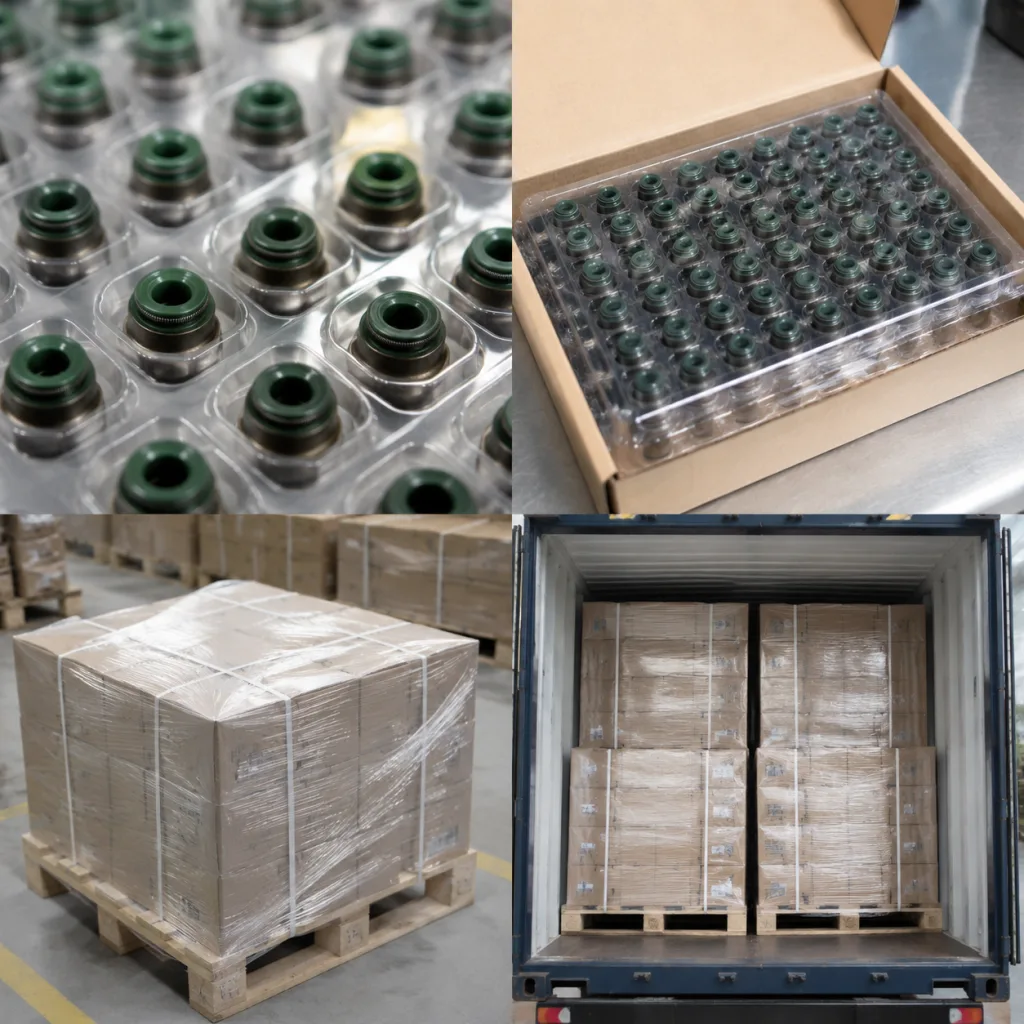
The inner pack is the first line of defence. Seals should not be poured loosely into large cartons where lips, springs, metal cases, or bonded inserts can rub against each other under vibration. Depending on the part geometry and order quantity, the inner pack may use individual bags, small counted polybags, thermoformed trays, dividers, or nested cavities that keep the sealing edge away from direct load. The aim is simple: avoid point pressure on the lip and prevent long-term compression of elastomer surfaces during stacking, storage, and container movement.

Contamination control matters just as much. Dust, carton fibre, metal swarf, oil residue, and moisture can all trigger receiving issues, especially for buyers supplying engine rebuilders, OEM service networks, or distribution centres with tight incoming inspection rules. Clean packing benches, closed inner bags, sealed cartons, and defined handling rules help protect product condition from final inspection through warehouse receipt.

A practical specification normally includes:

  • Inner pack that prevents direct rubber-to-rubber compression and protects seal lips, springs, and metal inserts
  • Clean, dry sealed polybag, barrier bag, or carton liner where required by route, season, or climate
  • Fixed quantity per inner bag and outer carton, such as 50, 100, 250, or 500 pieces where agreed by the buyer
  • Carton construction that maintains shape under stacking, vibration, and manual handling
  • Pallet stretch wrap, corner boards, top sheet, and pallet ID for ocean freight or consolidated loads
  • Label data that matches the packing list, commercial invoice, carton mark, and buyer purchase order

For buyers using multi-country distribution, the pack format should also support warehouse scanning, case-level identification, and easy separation by part number, lot, and destination. If you source related engine parts, you can review our catalog and the broader engine components range for coordinated pack standards.

Export packing specification checklist

The cleanest way to control packaging is with a written specification tied to the purchase order, drawing package, control plan, or supplier quality agreement. Verbal instructions get lost easily between sales, production, inspection, packing, and logistics teams. A written specification prevents disputes over pack count, case dimensions, label content, pallet height, carton marks, and moisture-control responsibility.

The specification should cover both the packaging itself and the data that travels with it. For valve stem seals, that usually means the inner pack method, quantity per bag, number of bags per carton, carton size, gross and net weight, label fields, barcode format, pallet pattern, and document requirements. If the buyer has multiple destination warehouses, the same part may need different labels, carton IDs, maximum pallet heights, or mixed-pallet rules for each market, so those rules should be stated clearly before production release.

</tr></thead><tbody> </tbody></table>For technical buyers, it is useful to include gross weight, net weight, carton dimensions, pallet dimensions, maximum pallet height, allowable mixed-pallet rules, and carton drop or compression expectations in the PO. That reduces receiving delays, helps freight forwarders calculate load plans accurately, and gives the supplier a clear standard for repeat shipments.

Materials, shelf life, and handling conditions

Packaging is not just about transport. It also affects product condition while the seals sit in storage before installation. Valve stem seals are commonly made from FKM, NBR, ACM, HNBR, or other elastomer compounds with a metal case, spring element, bonded insert, or engineered sealing lip depending on design. These materials should be kept away from direct sunlight, excessive heat, solvents, fuel vapour, oil contamination, ozone-generating equipment, and unnecessary mechanical compression.

Shelf-life expectations depend on the elastomer compound, customer standard, and storage environment. Many buyers reference ISO 2230 for rubber storage guidance, with typical controls around cool, dry, dark storage and protection from ozone and deformation. Export packaging should therefore support first-in, first-out handling and lot traceability. Date codes, batch numbers, and clear carton labels help warehouses rotate stock correctly instead of mixing older and newer lots. Where the buyer requires shelf-life control, the packing label or accompanying document should state production date, packing date, cure date, or expiry control in the format agreed with the customer.

A good export pack should define:

  • Storage temperature range at the destination warehouse, commonly a controlled ambient range such as 15-25 degrees C where the buyer specifies it
  • Relative humidity control requirement for long sea freight, monsoon season, or tropical storage
  • Maximum stack height for cartons and pallets, including whether cartons may be stacked after pallet removal
  • FIFO or lot-trace handling method by batch, cure date, or packing date
  • Shelf-life marking where the customer requires it
  • Protection from deformation during long-term storage, especially for sealing lips and spring-loaded designs
  • Rules for keeping cartons sealed until inspection, kitting, or picking

If the product is headed to humid regions, a sealed bag, desiccant, or carton liner is usually more reliable than depending on the outer corrugated carton alone. Desiccant quantity should be set by bag volume, transit time, and humidity exposure rather than added casually at packing. If the route includes multiple transhipments, outer cartons should be specified for abrasion resistance, crush resistance, tape adhesion, and readable labelling after repeated handling. For air freight, shorter transit times may reduce moisture risk, but the same rules for clean inner packing, stable counts, and traceable labels still apply.

Labelling and documentation for customs and receiving

Export documentation has to work for both customs clearance and warehouse receipt. Pack labels should stay legible after transit and should match the commercial invoice, packing list, purchase order, and any buyer-specific receiving file. Even when the parts are correct, a label mismatch can delay unloading, create quarantine stock, cause an ASN mismatch, or force manual relabelling at the receiving dock.

Minimum label data usually includes:

  • Supplier name and shipment reference
  • Customer purchase order, release number, or call-off number where required
  • Buyer part number, supplier part number, and clear product description
  • Quantity per carton and number of cartons
  • Batch, lot, or production order number
  • Country of origin
  • Production date, packing date, cure date, or date code where required
  • Gross weight, net weight, and carton dimensions where required
  • Carton number, such as 1 of 20, when the buyer needs case-level control

Where the customer requests barcode scanning, define the symbology, data structure, minimum print grade, label size, and label position in advance. Common controls include a scannable part number, quantity, batch number, PO number, and carton ID. A pre-shipment scan test should be performed on the actual carton label after carton sealing and stretch wrapping, because low contrast, wrap glare, curved placement, moisture staining, or damaged carton surfaces can make a theoretically correct barcode fail during receiving.

For regulated destinations, the shipping file should align with the buyer's import record, including product description, HS code used by the importer, declared country of origin, and any material declaration required under REACH (EC) No 1907/2006, RoHS where applicable, or other local compliance programmes. If wooden pallets are used, the ISPM 15 mark and fumigation or heat-treatment status should be confirmed according to destination rules.

If you need a controlled supply programme, Driventus can support custom manufacturing with customer-specific pack formats and document sets, backed by a documented quality system aligned to IATF 16949:2016 and ISO 9001:2015.

Validation tests before first export shipment

A packaging specification should be proven before it is released into regular supply. The first export shipment is not the place to discover that cartons collapse under pallet stacking, labels rub off under stretch wrap, or seals deform when counted into an oversized bag. Validation gives procurement, quality, and logistics teams evidence that the proposed pack can survive the intended route.

Common checks include carton drop testing, compression testing, vibration simulation, pallet stability verification, and label legibility review. Buyers may reference ISTA procedures, ASTM D4169 distribution-cycle testing, or their own packaging standard depending on shipment value and programme risk. For long ocean freight or humid markets, add humidity exposure, desiccant verification, and inspection after simulated storage. For high-volume programmes, it is also useful to verify picking efficiency: warehouse teams should be able to identify the part number, count the carton, scan the label, and separate lots without opening unnecessary packages.

Typical approval workflow:

1. Confirm part drawing, elastomer grade, order quantity, and batch traceability requirements. 2. Approve inner pack samples, carton samples, label artwork, carton marks, and pallet pattern. 3. Verify label content against the purchase order, packing list, invoice format, and ASN file where used. 4. Run transport simulation or a controlled pilot shipment on the intended route. 5. Inspect seals after the test for lip deformation, spring displacement, metal-case dents, contamination, and moisture signs. 6. Review receiving feedback, scan performance, carton condition, count accuracy, and damage rate. 7. Lock the approved pack standard into the supplier specification, quality agreement, or packaging work instruction.

For procurement teams, this matters most when product is being shipped to consolidated warehouses, regional distribution centres, or directly to aftermarket networks. One weak carton design can create receiving delays, repacking labour, short-ship disputes, claim investigation time, and unnecessary cost even when the manufactured valve stem seals meet the technical drawing.

How Driventus handles export-ready pack-out

Driventus operates as a vertically integrated manufacturer, so packaging can be aligned with production, inspection, and dispatch without uncontrolled third-party repacking. That reduces the risk of mixed batches, label mismatch, incorrect carton counts, and unnecessary handling after final inspection. For B2B export buyers, the main advantage is repeatability: the same part number can be packed, labelled, and documented to the same agreed standard shipment after shipment.

Our export process typically includes:

  • Batch identification at production release
  • Final inspection before pack-out, including visual checks for sealing lip, spring position, and contamination
  • Verification of inner pack format, bag count, case count, and carton condition
  • Carton labelling matched to the purchase order, packing list, and buyer part number where required
  • Carton sealing, pallet staging, stretch wrapping, top protection, and corner boards where required
  • Shipping document matching before handover to the forwarder
  • Support for customer-specific labels, carton counts, barcode content, palletisation, and market documentation

For buyers that manage regional stock across the EU, UK, US, Canada, Australia, Brazil, or other export markets, stable packaging is as important as part geometry. It supports faster receiving, fewer short shipments, cleaner traceability during claims review, easier stock rotation, and lower repacking labour at the destination warehouse. It also helps purchasing teams compare suppliers fairly, because damage rate, label accuracy, scan success, and receiving efficiency are part of the real landed cost.

If you need valve stem seal packaging requirements for export aligned to your inbound process, Driventus can review your target market, carton limits, barcode rules, pallet method, moisture-control expectations, and document requirements before quotation. To discuss a pack format or request pricing, request a quote.

Frequently asked questions

Include inner pack type, carton size, quantity per inner bag and carton, label content, pallet method, barcode rules, moisture-control requirement, and carton performance expectations. Also define lot traceability, shelf-life marking if required, and the documents that must match the shipment.

Often yes, especially on long sea freight lanes, tropical destinations, humid seasons, or uncontrolled storage environments. A sealed bag, carton liner, barrier film, or desiccant can reduce risk. The exact control should match route, climate, transit time, carton volume, and customer storage practice.

Yes. Driventus supports custom pack formats for B2B export programmes, including case count, labelling, barcode content, palletisation, moisture control, and document alignment. The design should be agreed before first shipment and frozen in the supplier specification.

If you need export packaging aligned with your receiving process, send your requirements and target market details through /contact.html.

Request a Quote
Item Recommended control Procurement note
Inner packIndividual tray, divider, small counted bag, or sealed bagPrevent seal lips, springs, and metal inserts from damaging each other
Moisture controlDesiccant, PE liner, VCI-free barrier film, or sealed carton liner where neededSpecify by freight lane, season, humidity exposure, and storage climate
CleanlinessClosed bags, clean packing area, and foreign-material checkReduce dust, fibre, oil, and loose-particle claims
Carton strengthDouble-wall corrugated or tested equivalent for export, commonly 5-ply or 7-ply depending on loadConfirm stack height, pallet load, and compression resistance before shipment
Case countFixed quantity per carton and per inner bagKeep units per case stable across batches and warehouse receipts
Label dataPart no., batch, qty, origin, date code, PO, carton ID, and shipment referenceMatch shipping documents exactly
BarcodeAgreed symbology such as Code 128, EAN-13, GS1-128, or QR where requiredTest readability on the actual carton surface before shipment
PalletisationStretch wrap, corner boards, pallet label, top protection, and ISPM 15 status if wooden pallets are usedAlign with destination import rules and warehouse handling limits