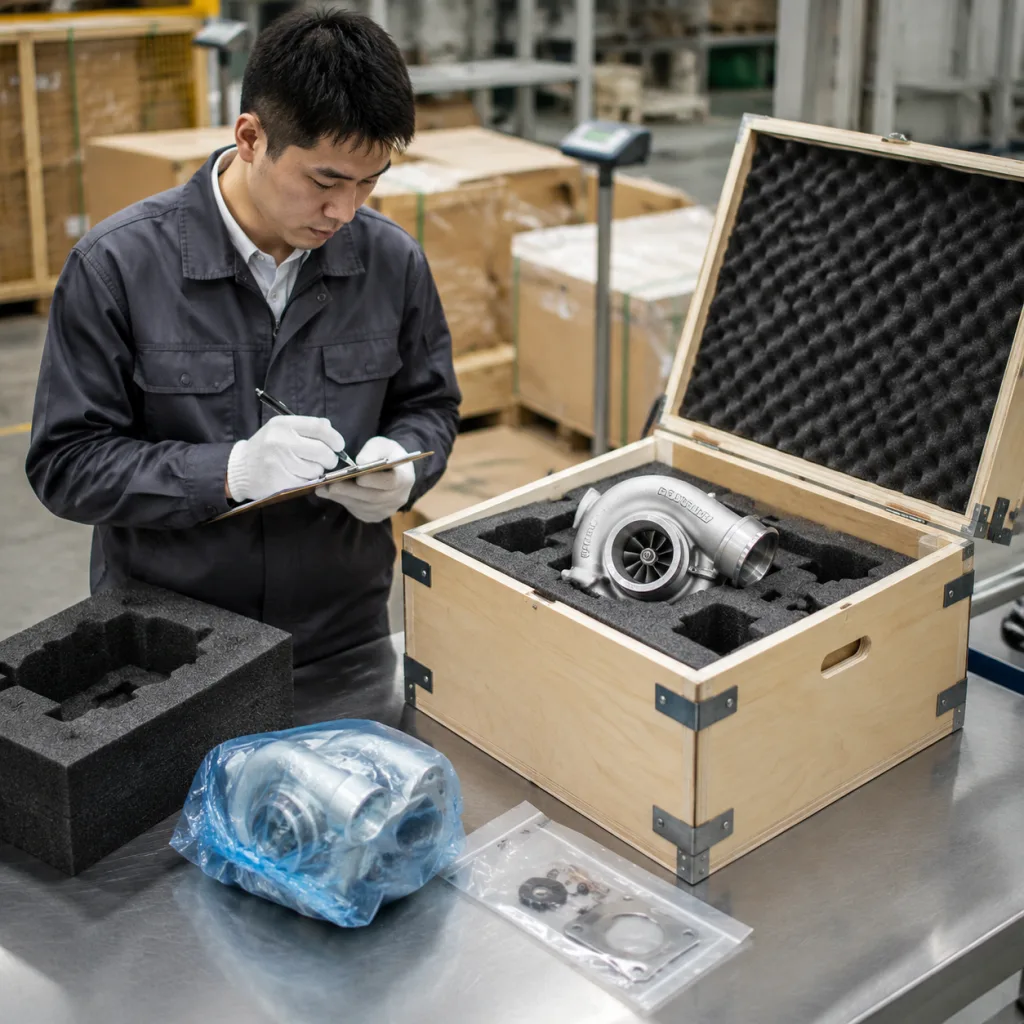
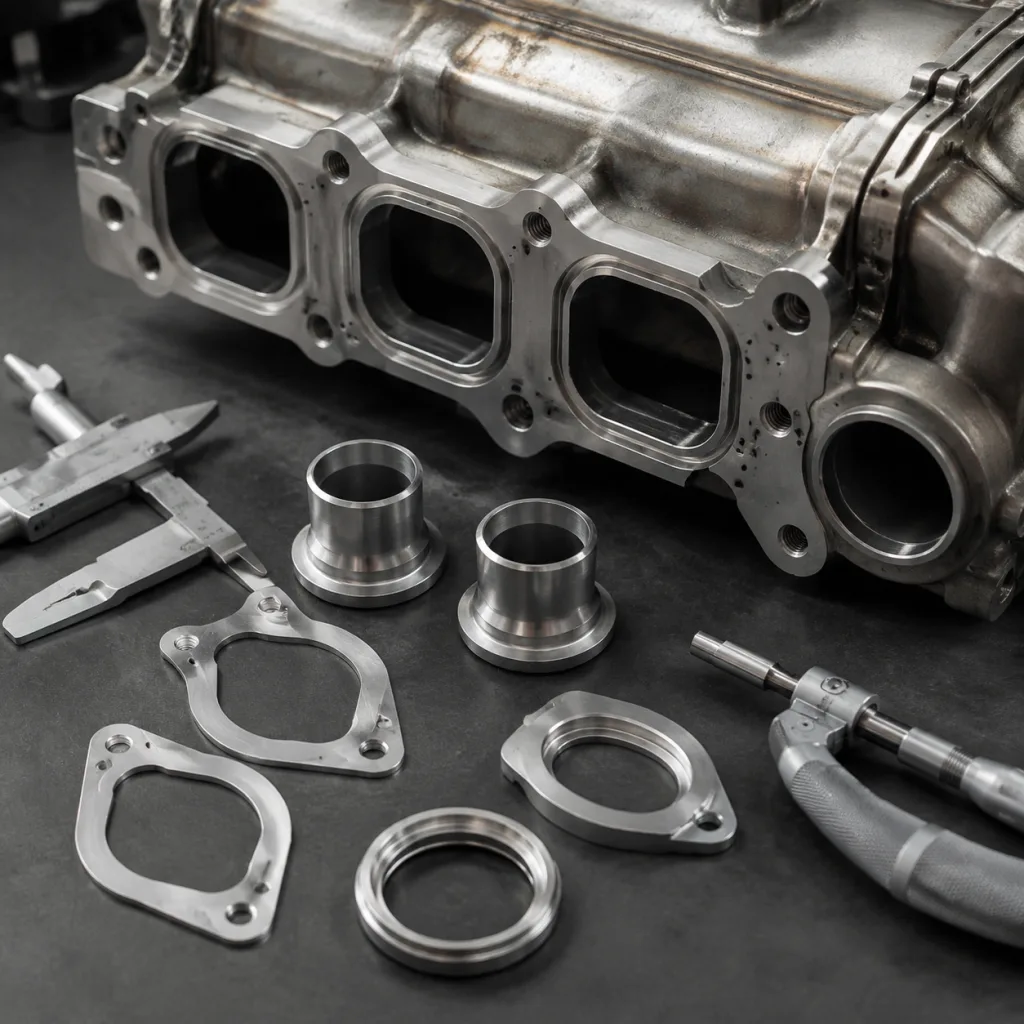
Turbochargers are sensitive to impact, contamination, and moisture during international transit. For export shipments, packaging is not just a shipping task; it is part of product quality control. Buyers should define how the unit is cleaned, sealed, cushioned, labelled, palletised, and verified before the order leaves the factory.
Driventus is an independent aftermarket manufacturer; brand names are referenced for fitment only. We manufacture turbocharger-related components in Taizhou, Zhejiang, and ship to more than 60 countries under IATF 16949:2016 and ISO 9001:2015 controls. The real sourcing question is simple: which packaging spec survives the route you actually use, without rust, movement, label loss, or receiving disputes? This guide focuses on the decision points, failure modes, and buyer checks that matter most when you write turbocharger packaging requirements export into a PO or RFQ.
Which pack level fits your route?
Start with the lane, not the carton. The right pack for a 2-day regional courier move is usually too light for ocean freight, and the “export standard” label means very little unless the supplier defines what it includes.
Use this decision frame:
Short parcel or domestic lane: capped ports, light cushioning, strong barcode labels, modest moisture control
Air freight: lower carton weight, tighter restraint, better drop resistance, clear dimensional controls
Mixed-SKU programme: separate inner packs, clear lot coding, and carton logic that prevents pick errors
If you need one sentence for the PO, use this: the packaging must protect the turbocharger through the full route, including storage, transload, and final-mile handling, without corrosion, internal movement, or traceability loss.
For buyers handling reman, new, and service-swap units together, do not let them share one ambiguous pack format. A clean specification will separate product classes, define the inner pack for each, and state whether the supplier may combine references in one master carton. That small detail prevents many receiving disputes later.
Where export packs fail first
Most packaging claims fail for predictable reasons. The unit was fine at dispatch, then the route exposed a weak point.
Common failure modes include:
uncapped oil or air ports that admit dust or moisture
insufficient restraint that lets the turbocharger shift and strike the box wall
weak cartons that bow, split, or crush under stack load
poor desiccant sizing on humid or long dwell lanes
labels that smear, peel, or disappear after abrasion or condensation
actuator damage caused by loose connectors or unsupported cables
You can reduce claims by writing the failure mode into the requirement. For example, instead of saying “good packaging,” say the pack must prevent product-to-carton contact under normal vibration, keep all machined openings sealed, and maintain readable labels after handling and moisture exposure.
A practical acceptance target is simple: no exposed machined ports, no loose movement once sealed, no oil staining on the outside of the pack, and no carton damage that exposes the product. If the part includes an actuator or solenoid, the connector should be restrained so it cannot rub or bend in transit. The package should protect the assembly, not merely contain it.
What must be written into the PO?
Use a written specification. A vague note like “export standard” leaves too much room for interpretation.
Requirement area
What to specify
Primary sealing
End caps or plugs on all oil, air, and coolant openings
Corrosion control
VCI bag, sealed polybag, or equivalent; desiccant where route risk warrants it
Internal restraint
Foam, moulded insert, or tray that stops movement in all axes
Outer carton
Double-wall corrugated box with defined compression or edge-crush target
Pallet build
Stretch wrap, corner boards, banding, and stable stack height
Labelling
Part number, quantity, country of origin, lot code, and any OE cross-reference
Documents
Packing list, invoice, and compliance papers in a water-resistant sleeve
</tr></thead><tbody> </tbody></table>Also define physical limits. State the target carton gross weight, maximum stack height, carton dimensions, and whether a single unit may ship in a parcel carton or must go on a pallet. For many B2B programmes, a single-unit carton in the 4 kg to 12 kg range is easier to handle safely, but the right limit depends on the product family and freight mode.
Include cosmetic tolerances too. Say whether minor scuffing is acceptable, whether crushed corners are a reject condition, and whether any label smear is a nonconformance. If the shipment includes an inspection report or calibration record, require it in an outer pouch, not loose inside the carton.
How should materials change by lane?
Packaging should match transit risk. A pack that works in a clean domestic system may fail after 30 to 45 days in a humid container.
Material choices that usually make sense
Plastic caps or plugs: close all exposed ports
VCI film or sealed polybag: slows oxidation during storage and transit
Cushioning insert: EPE foam, moulded pulp, or a custom tray with no hard contact on machined faces
Outer carton: double-wall board for export cartons carrying a single unit
Pallet base: heat-treated wooden pallet where destination rules require it
For sea freight, moisture control matters more than presentation. For air freight, weight and drop resistance matter more than long dwell protection. For cross-dock or e-commerce fulfilment, the labels need to survive abrasion and repeated scans. In other words, the pack should reflect the route, not a generic warehouse habit.
If the shipment is exposed to tropical humidity or long container dwell, size the desiccant to the route, not just the box. Many buyers ask for VCI plus desiccant on sea freight, and some require a humidity indicator card for higher-risk lanes. If rust claims are a frequent concern, ask for a hold period before dispatch so the packed unit can be checked again after sealing.
Driventus can support custom manufacturing when a buyer needs route-specific pack formats, mixed-SKU kits, or private-label carton data.
Air freight: net/gross weight, carton drop resistance, and dimensional stability
Domestic transload: stack height, fork entry clearance, and label durability
Cross-dock or e-commerce: barcode readability after repeated scans and handling abrasion
What quality controls should the supplier show?
Packaging should sit inside a controlled process, not a one-off warehouse instruction. It is reasonable to ask suppliers to align packaging control with IATF 16949:2016 and ISO 9001:2015. For some materials and lubricants, REACH (EC) No 1907/2006 may also matter.
Ask for evidence, not just a statement. Useful checks include:
seal condition before carton close
carton compression or stack performance
rust-prevention condition at dispatch
final label match to part number and lot
photo evidence of the packed unit, closed carton, and pallet face
If the supplier uses vibration or drop testing, ask for the actual test height, duration, and pass/fail standard. “Tested” is not enough. You want the method and the result.
Buyer-side acceptance criteria can stay practical: no rust on machined surfaces, no loose parts when the carton is gently shaken, and no visible movement of the turbocharger inside the inner pack after simulated vibration. If the supplier cannot describe the test in plain terms, the control is probably weaker than it looks.
Treat shipment release as a final gate. Once the cartons leave the factory, most packaging mistakes are expensive to unwind.
1. Confirm the turbocharger is clean, dry, and capped. 2. Confirm internal restraint prevents movement in all axes. 3. Confirm corrosion protection matches transit time and climate. 4. Confirm the outer carton and pallet are rated for the route. 5. Confirm labels remain legible after handling and moisture exposure. 6. Confirm the packing list matches the order line, lot, and quantity. 7. Confirm photos are available for the packed unit, carton, and pallet. 8. Confirm the release record states carton count, gross weight, and pallet count. 9. Confirm any special inserts, brackets, or actuator supports are installed before sealing. 10. Confirm the buyer’s tolerance for scuffing, label placement, and box compression is documented.
For programme orders, define one approval sample and do not skip it: one packed unit, one master carton, and one pallet photo set signed off before mass shipment. That removes argument later about what “acceptable” means.
If you are matching a specific reference family or kit structure, our catalog can help align the pack with the exact product set before release. If you need a non-standard crate, mixed packing, or dedicated labelling, custom manufacturing is the right starting point.
What should you ask in RFQ?
The RFQ stage is where most of the cost is won or lost. Ask for packaging as a separate line item, not as something hidden inside the unit price.
Use questions like these:
What is the standard unit pack for each turbocharger reference?
What changes are available for ocean, air, and parcel freight?
Can the supplier show photos of the packed unit and pallet configuration?
Are part numbers and lot codes printed on the carton and inner pack?
Is moisture protection included by default or added by request?
What is the normal lead time for custom carton artwork or insert tooling?
What is the MOQ for standard cartons, custom inserts, and private-label print?
What is the price delta per unit for VCI, desiccant, or reinforced cartons?
What is the sample lead time for first-article pack approval?
What is the shipment lead time after pack approval for repeat orders?
Ask for a commercial structure that separates standard pack, export upgrade, and one-time tooling or artwork. That makes factory-to-factory comparison far easier. It also tells you whether the supplier has a real packaging process or just a box supplier.
For buyers comparing multiple factories, packaging capability is often a useful proxy for process discipline. Stable pack design usually indicates stable routing, traceability, and final inspection. If you are ready to align specification, volume, and shipment route, request a quote.
Frequently asked questions
Turbochargers contain precision rotating parts and narrow oil passages. Poor packaging can cause impact damage, corrosion, or contamination before installation, which turns a sellable unit into a claim.
Not always. Use them when route time, humidity, or storage risk justifies it. Sea freight and long dwell times usually need stronger corrosion protection than short domestic moves. For high-risk lanes, buyers often require both VCI and desiccant, plus sealed end caps.
Yes. For programme orders, Driventus can support route-specific packaging, private-label artwork, custom carton or insert design, and approval samples under a defined specification.
If you need an export pack spec for a turbocharger programme, send your route, volume, target carton weight, labelling requirements, and any corrosion or stack-height limits, and we will review the best option with you. Start here: /contact.html