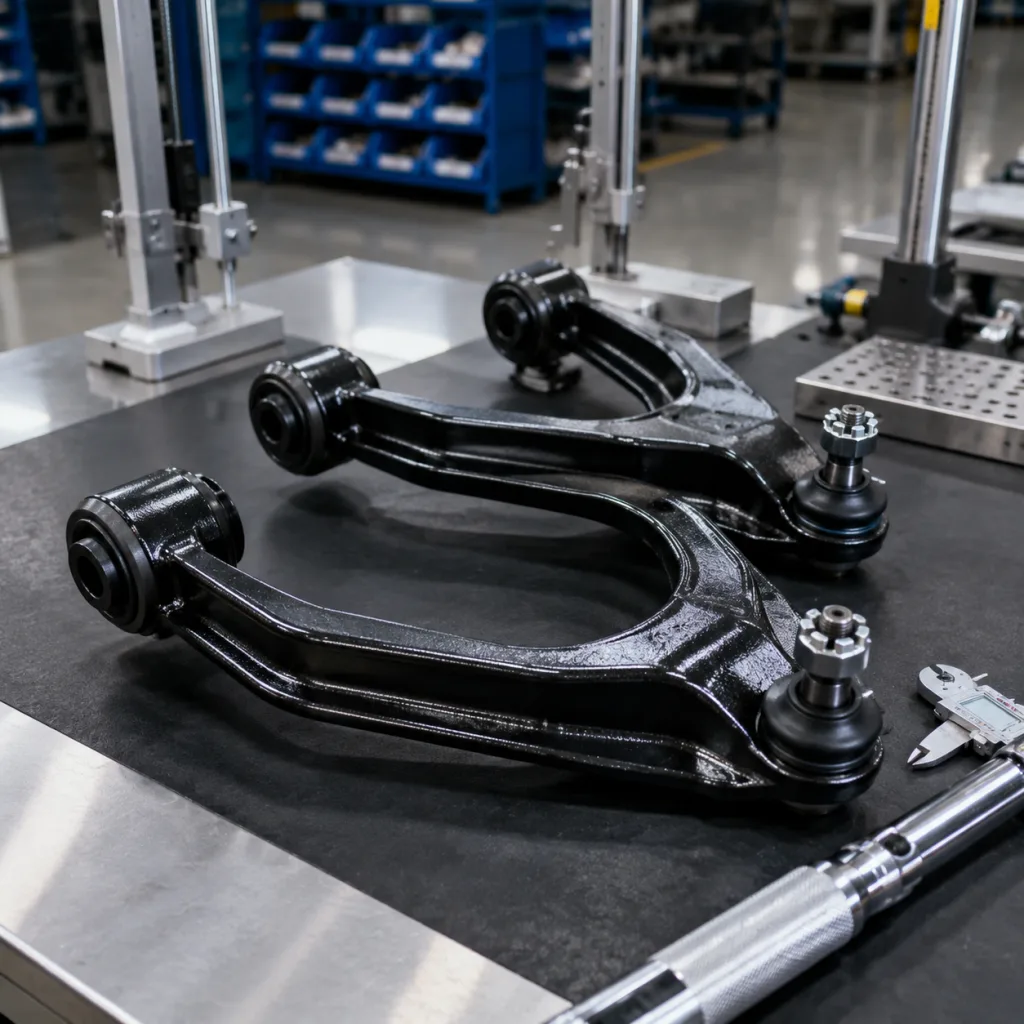
Tie rod end replacement is a routine steering-service item, but for distributors, wholesalers, and repair-chain buyers it is also a high-sensitivity product category. A small dimensional error can limit toe adjustment, change joint preload, cause boot interference, or lead to early noise and looseness claims. Procurement teams therefore need more than a catalogue match. They need evidence that the part follows the intended geometry, thread form, articulation range, material specification, corrosion protection, and validation plan. This guide sets out practical sourcing checks for OE-equivalent aftermarket tie rod ends, with emphasis on fit confirmation, durability testing, batch control, and documentation. Driventus manufactures steering and powertrain components in Taizhou, Zhejiang, under IATF 16949:2016 and ISO 9001:2015 quality systems for B2B export programmes. Driventus is an independent aftermarket manufacturer; vehicle brand names are referenced for fitment only.
Replacement Fit Starts With Geometry Control
For a tie rod end, fitment is not limited to whether the thread screws into the rack end or adjusting sleeve. The ball stud taper, thread pitch, shank length, housing offset, ball-centre height, and boot envelope all influence installation, steering travel, and alignment range. A part that appears interchangeable in a catalogue can still create clamp-up, toe-adjustment, or boot-clearance problems if these dimensions drift.
Procurement teams should request a dimensional report against an approved sample, buyer drawing, or agreed datum scheme. Where the buying specification references OE part numbers, list them only when they are provided by the buyer, source catalogue, or lawful fitment database. Brand-owned numbering should be treated as a fitment cross-reference, not as evidence of vehicle-maker approval.
Key fitment points to verify before approving a replacement programme include:
Feature
Procurement check
Why it matters
Ball stud taper
Major/minor taper diameter and taper angle
Controls knuckle seating and clamp load
Thread form
Diameter, pitch, handedness, and thread length
Affects rack-end or sleeve engagement
Ball-centre height
Measured from mounting face or thread datum
Maintains steering geometry
Articulation angle
Minimum movement before boot or housing contact
Prevents binding at suspension travel limits
Overall length
Housing centre to thread end
Supports correct toe adjustment range
Boot clearance
Installed boot diameter and height
Reduces rubbing, tearing, and grease loss
</tr></thead><tbody> </tbody></table>For importers carrying multi-application programmes, the same discipline should be applied to left-hand and right-hand variants, inner and outer positions, and regional chassis differences. A controlled cross-reference file linked to our catalog reduces order errors and helps distributors maintain clean interchange data.
Materials, Heat Treatment, and Joint Construction
A replacement tie rod end is exposed to steering impact loads, road splash, temperature cycling, salt spray, vibration, and repeated angular movement. The supplier should define the main materials and processes rather than describing the part only as “OE quality”. Clear specifications help buyers compare quotes, identify uncontrolled substitutions, and investigate claims if field performance changes.
Typical technical specification items for an aftermarket steering joint are:
Housing: forged or machined steel, with controlled bore geometry for bearing retention.
Ball stud: medium-carbon or alloy steel, heat treated for strength and wear resistance.
Bearing liner or seat: polymer, sintered metal, or engineered composite depending on design.
Boot: chloroprene rubber, EPDM, or thermoplastic elastomer specified for grease, ozone, and temperature resistance.
Grease: lithium or synthetic grease selected for low-temperature movement and water resistance.
Surface protection: zinc-based coating, phosphate plus coating, or equivalent corrosion-control process.
Fasteners: castle nut, lock nut, cotter pin, washer, or prevailing-torque nut according to application.
Buyers should ask whether the supplier controls ball stud hardness, thread rolling, taper grinding, housing bore consistency, and boot material verification in-house or through approved subcontractors. For safety-relevant steering items, outsourced processes should still be covered by incoming inspection, supplier approval, and quality records under the IATF 16949:2016 management system.
Regulatory documentation may also be required for EU and UK import programmes. REACH (EC) No 1907/2006 substance controls can apply to rubber compounds, coatings, greases, and packaging materials. A steering joint is not approved under an emissions regulation such as ECE R-83, so that type of certificate should not be used as evidence of steering performance. Importers should instead maintain clear compliance files for materials, restricted substances, and destination-market labelling obligations.
Validation Tests for OE-Equivalent Performance
Tie rod end replacement parts should be validated to the intended load case, not only checked for appearance. A credible supplier should provide a test plan, acceptance criteria, sample quantity, equipment reference, and retained records. Test names may vary by internal specification, but the performance objective should be easy for a buyer or auditor to understand.
Validation area
Typical method
Evidence to request
Pull-out strength
Axial load applied to ball stud until separation or limit load
Load curve and minimum force result
Push-out or socket retention
Load applied through stud and housing
Retention value and failure mode
Rotational torque
Initial and post-cycle breakaway torque
Torque range and consistency data
Articulation endurance
Cycled through defined angle under load
Cycle count, wear, noise, and looseness result
Dust boot sealing
Water, mud, ozone, or temperature exposure
Boot cracking, leakage, and retention result
Corrosion resistance
Salt spray or cyclic corrosion exposure
Exposure duration, coating condition, and red-rust criteria
Dimensional audit
CMM, gauges, thread rings, taper gauges
Inspection report by cavity, line, or batch
</tr></thead><tbody> </tbody></table>Published quality standards such as ISO 9001:2015 and IATF 16949:2016 define management-system expectations, but they do not replace part-specific validation. Certification confirms that the factory operates under a documented system; it does not prove that a particular tie rod end meets the buyer’s drawing, sample, or durability target. For repair-chain programmes, buyers should also consider trial installation feedback from selected branches before national rollout.
Brake noise test standards such as SAE J2527 are not applicable to steering joints and should not be cited as tie rod durability evidence. A competent supplier will distinguish relevant steering validation from unrelated vehicle-component tests. Driventus can align inspection and validation documents with buyer drawings, approved samples, and quality system requirements.
Batch Control, Packaging, and Aftermarket Claims Risk
The commercial cost of a steering-joint defect often exceeds the unit cost of the part. Warranty handling, labour reimbursement, distributor returns, vehicle downtime, and emergency replenishment can erode programme margin quickly. Replacement programmes should therefore include batch traceability, clear labelling, and packaging that protects functional surfaces from the factory to the workshop.
Each carton or bag label should support traceability back to production date, inspection lot, and supplier batch. For private-label distributors, the format should match destination-market requirements, including part number, position, quantity, country of origin, and barcode where required. Packaging should protect the taper, threads, and boot from impact or compression. Thread protectors, partitioned cartons, or formed trays may be justified for high-value SKUs, mixed-container shipments, and long-distance export routes.
Common claim drivers include torn boots caused by compressed packing, incorrect nuts in mixed kits, coating damage from loose bulk packing, and left/right mislabelling. These failures are usually preventable with pre-shipment checks, barcode discipline, packaging validation, and a final kit-content review.
For high-volume SKU families, importers should request a control plan covering:
Critical dimensions and measuring frequency.
Stud torque and articulation checks.
Boot fit and grease-fill verification.
Coating thickness or corrosion-control inspection.
Kit-component confirmation for nuts, washers, pins, and labels.
AQL sampling method for final inspection.
Retention-sample period and batch recall process.
Repair chains may also need consistent installation notes, especially where a lock nut must be replaced, a cotter pin must be fitted, or a specific torque sequence is required. These notes should be factual and application-specific, avoiding any claim of vehicle manufacturer approval.
Supplier Evaluation for Replacement Programmes
A strong sourcing decision combines part evidence, factory process control, and commercial readiness. The lowest quoted price is not always the lowest delivered cost if dimensional drift, mixed packaging, slow corrective action, or weak catalogue data creates returns.
For aftermarket distributors and wholesalers, evaluate whether the factory can support catalogue breadth, cross-reference maintenance, neutral packaging, private-label requirements, pallet consolidation, and repeatable lead times. For OEM and Tier-1 service programmes, add PPAP-style documentation if required by the buyer, even where the product is supplied as independent aftermarket stock. For multi-location repair chains, focus on fill rate, consistent kit contents, installation clarity, and rapid corrective action.
A practical supplier scorecard can include:
Evaluation item
What to confirm
Commercial effect
Certification
IATF 16949:2016 and ISO 9001:2015 certificates in scope
Supports audit readiness
Engineering data
Drawings, samples, cross-reference file, inspection plan
Documentation for EU, UK, US, Canada, Australia, and Brazil
Reduces customs disruption
Corrective action
8D or equivalent response process
Limits repeat claims
</tr></thead><tbody> </tbody></table>The supplier review should also check communication discipline: who owns engineering questions, who approves packaging artwork, and how quickly containment actions begin after a claim. These practical details matter when a distributor manages hundreds of steering SKUs across multiple markets.
Driventus supports replacement steering programmes with catalogue supply and custom manufacturing for buyer-owned drawings, validated samples, and private-label packaging. The objective is not to claim endorsement by any vehicle brand. It is to supply dimensionally matched, tested aftermarket components with transparent documentation.
Procurement Checklist Before Purchase Order Release
Before placing a production order, buyers should close the gap between catalogue selection and controlled supply. The following checklist is suitable for tie rod end replacement sourcing when launching a new SKU, changing suppliers, or moving an existing programme into private-label packaging.
Confirm vehicle application range, steering position, and regional chassis differences.
Approve dimensional comparison against sample, drawing, or agreed datum scheme.
Review material specification for housing, stud, bearing seat, boot, grease, and coating.
Check validation results for pull-out strength, rotational torque, endurance, sealing, and corrosion.
Confirm kit contents and packaging method through pre-production samples.
Review labelling, barcode, country-of-origin, and carton strength requirements.
Agree MOQ, lead time, inspection level, payment terms, and spare packaging stock.
Require batch traceability and corrective-action response timing.
Keep REACH (EC) No 1907/2006 and other destination-market substance documentation on file.
This approach is especially useful where one distributor imports several hundred steering SKUs and needs consistent data across many vehicle platforms. It also helps repair chains avoid workshop disruption after a central purchasing decision, because the same approval logic can be applied across branches, suppliers, and replenishment orders.
Driventus is an independent aftermarket manufacturer; brand names are referenced for fitment only. Buyers can share drawings, samples, annual demand, target packaging, and destination markets when they request a quote.
Frequently asked questions
Request a dimensional report, material specification, validation summary, packaging sample, batch traceability plan, and controlled cross-reference file. Critical dimensions include taper, thread pitch, ball-centre height, overall length, and articulation angle. Certification under IATF 16949:2016 and ISO 9001:2015 supports process control, but it should be reviewed together with part-specific test evidence.
Yes, if the geometry, thread form, taper, articulation range, and installation hardware are equivalent for those applications. The supplier should maintain a controlled interchange file and avoid unsupported brand-owned claims. Any OE-style reference should be used only as a fitment cross-reference, not as an approval statement.
Most avoidable claims come from dimensional mismatch, torn boots, wrong kit hardware, poor corrosion protection, or mixed left/right packaging. Use pre-production samples, final inspection, protective packaging, barcode controls, and batch traceability. For large programmes, trial fitment and installation feedback from selected workshops can reduce rollout risk.
For catalogue tie rod supply or buyer-specific tie rod end replacement programmes, share your target SKUs, drawings, samples, destination markets, and annual volume with the Driventus team at /contact.html