Throttle Body Specifications: Dimensions, Materials, Tolerances
Throttle body specifications define the dimensional, material, functional, and commercial limits that determine whether a part fits, seals, and controls airflow correctly. For procurement teams, the useful data is not a marketing description; it is bore diameter, flange pattern, actuator type, connector style, finish, tolerance band, MOQ, target price, and lead-time assumptions that affect assembly and inventory planning. This matters for aftermarket replacement, OE cross-reference work, and private-label programs where the buyer must confirm fitment before committing volume. Driventus is an independent aftermarket manufacturer; brand names are referenced for fitment only. We produce throttle bodies in Taizhou, Zhejiang and supply B2B customers in more than 60 countries under IATF 16949:2016 and ISO 9001:2015 controls. The sections below show the specification fields that should appear on a sourcing sheet, the material and coating choices typically used, the commercial logic buyers should request, and the verification tests that support stable production.
Core dimensions buyers should verify
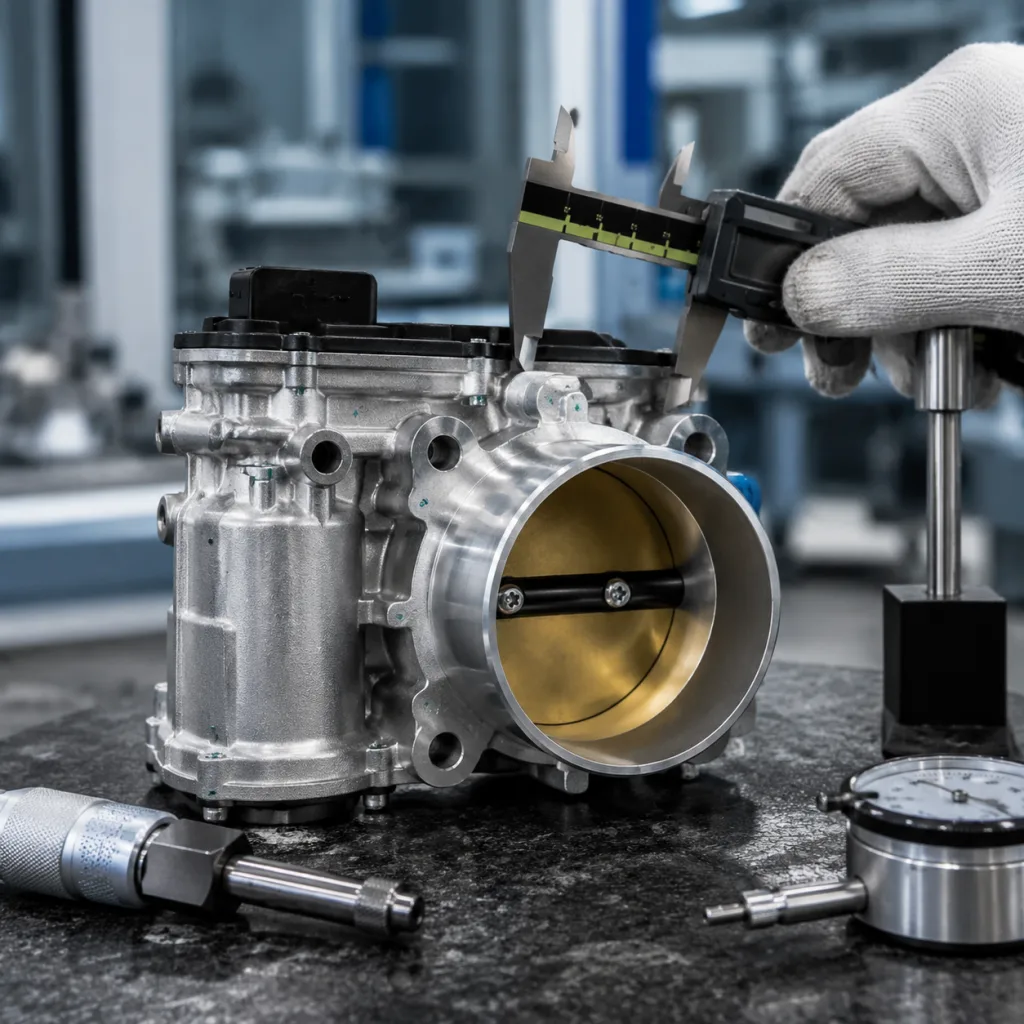
For throttle body specifications, the first priority is geometric compatibility. Even small deviations in bore size, bolt-circle diameter, or gasket land width can cause air leakage, unstable idle, or installation delays.
Specification field
Typical sourcing requirement
Practical buyer note
Bore diameter
Match OE nominal size within agreed tolerance, often ±0.02 to ±0.10 mm depending on design
Controls airflow and idle behaviour
Flange pattern
Hole count, spacing, and orientation to drawing
Prevents fitment mismatch
Mounting face flatness
Commonly ≤0.05 mm across sealing face unless drawing calls out tighter
Supports gasket sealing
Shaft alignment
Concentric and repeatable, typically checked with fixture or CMM
Reduces binding and wear
Connector interface
Pin count, keying, and cavity orientation
Ensures electrical compatibility
Actuation type
Cable, electronic, or integrated motor
Determines calibration and harness fit
Plate angle at closed stop
Defined by assembly datum and control strategy
Affects idle stability and limp-home response
Return position repeatability
Typically verified across lots and temperature conditions
Reduces warranty risk
</tr></thead><tbody> </tbody></table>For electronic units, buyers should also request plate angle range, closed-throttle stop position, sensor output curve, and open-position travel. If the part is being sourced against an OE reference, include the OE number, such as OE 06A107065, on the drawing and inspection record before RFQ release. When a target fitment is unclear, ask for the supplier’s measured reference sample data rather than relying on catalogue text alone.
Materials and surface finishes
Material selection affects durability, corrosion resistance, machining stability, and total installed cost. Most production throttle bodies use aluminium alloy housings because they balance weight, machinability, and thermal stability. In some applications, the blade, shaft, and fasteners use stainless steel or plated steel for wear resistance and corrosion control.
Common procurement items to specify:
Housing alloy grade or internal material standard, such as ADC12, A380, or an equivalent buyer-approved alloy
Blade material and thickness, often 1.0 to 2.0 mm depending on design
Shaft material, hardness, and surface finish
Bush or bearing material, including bronze, PTFE-lined, or polymer options
Coating type on the bore and external surfaces, such as anodize, conversion coating, or low-friction film where used
Corrosion resistance requirement after salt exposure or humidity cycling
Deburring and edge-break requirement at all airflow edges
When a finish is not clearly defined, two parts with the same nominal size can behave differently in service. Coating thickness, bore roughness, and edge treatment all influence friction and contamination build-up. For export programs, confirm compliance with REACH (EC) No 1907/2006 where applicable and keep restricted-substance declarations in the technical file. A buyer should also request surface roughness targets for the bore and sealing areas, especially when the part is used in stop-start or high-contamination duty cycles.
Functional tolerances and assembly control
A throttle body is a matched assembly, not a single machined body. The plate, shaft, spring, sensor, and housing must work together within a narrow window. Buyers should ask for the tolerance stack on the following points:
Bore roundness and cylindricity, often controlled within 0.01 to 0.03 mm depending on size
Plate-to-bore clearance at closed and open positions
Shaft radial play and axial endplay
Spring preload or return force, measured at assembly and after cycling
Motor or sensor installation angle
Connector location relative to datum surfaces
Stop-screw position and tamper-control method where applicable
For aftermarket supply, the key question is whether the part repeats the same installed behaviour across batches. A part can meet nominal dimensions and still fail if the closed-throttle position or return force drifts. Request first-article inspection, in-process checks, and final functional testing on every production lot. For programmes that include OE 06A107065-style cross-references, dimensional equivalence should be confirmed against the reference sample, not only the printed catalogue data.
For commercial control, define which dimensions are critical-to-quality and which are reference-only. That distinction lets the factory apply tighter inspection to the functional interfaces while avoiding unnecessary cost on non-critical cosmetic features. Buyers should also ask whether the supplier holds MSA, gauge R&R, or fixture calibration records for the relevant inspection points.
Commercial terms buyers should request
Strong throttle body specifications also include sourcing terms that prevent confusion after PO release. A practical RFQ should capture the price curve, minimum order quantity, sample policy, and lead-time structure before negotiation starts.
Commercial field
Typical buyer request
Practical use
MOQ for trial order
50 to 200 pcs per part number, depending on tooling and packaging
Supports pilot demand and fitment checks
MOQ for repeat order
200 to 500+ pcs, often lower for shared tooling families
Keeps unit cost stable
Sample price
Free, refundable, or charged at production-rate plus freight
Clarifies validation cost
Tooling charge
Separate line item if new machining fixture, mold, or test jig is required
Prevents hidden NRE cost
Production lead time
Commonly 30 to 45 days after order confirmation for standard builds
Supports inventory planning
Sample lead time
Often 7 to 15 days for drawing-based or stocked parts
Speeds fitment review
Price break logic
Tiered by annual volume, packaging, and finish complexity
Helps buyers forecast landed cost
</tr></thead><tbody> </tbody></table>In practice, price depends on machining complexity, coating, sensor content, packaging, and forecast stability. A simple mechanical throttle body with existing tooling can cost materially less than an electronic unit with a new sensor calibration, harness, or custom label. Buyers should request a price ladder at 1k, 5k, and 10k units, plus a separate quote for sample and tooling. If the supplier cannot state whether the price includes inspection, packaging, and export cartons, the RFQ is incomplete. Lead time should also be split into sample, first production lot, and repeat-order timing because those values are usually different.
Validation tests used in sourcing
A credible spec sheet should include test evidence, not only dimensions. At minimum, request the validation set used for the part family and how often it is repeated.
Test type
Typical purpose
Reference standard or method
Dimensional inspection
Confirms drawing conformity
CMM, gauges, and calibrated fixtures
Endurance cycling
Checks wear and return stability
Internal duty-cycle method, often thousands of open-close cycles
Vibration resistance
Verifies connector and sensor retention
OEM or customer profile
Salt spray or corrosion exposure
Assesses coating durability
ASTM B117 or customer method
EM compatibility, if applicable
Checks electronic interference
Customer or vehicle-level method
Emissions-related validation
Supports vehicle calibration work
ECE R-83 where relevant
Leakage or air-flow stability test
Confirms sealing and repeatable throttle response
Supplier fixture or customer-defined method
</tr></thead><tbody> </tbody></table>If the programme includes emissions-sensitive calibration, ask how the throttle body was validated within the wider intake and control strategy. For some markets, buyers also request road-dust or fuel-vapour contamination checks. Published standards such as SAE J2527, where used for corrosion or environmental exposure, should be named explicitly in the dossier. The buyer should also request the acceptance criteria, not only the test name: pass/fail thresholds for leakage, return force, sensor signal drift, and post-test functional recovery should be written into the approval file.
How Driventus supports procurement teams
Driventus supplies throttle bodies and related engine components from a vertically integrated manufacturing base in Taizhou, Zhejiang. That matters for buyers who need controlled machining, traceable inspection, and repeatable batch output rather than spot-market sourcing.
What procurement teams can request:
Dimensioned drawings with critical-to-quality features marked
Sample, pilot, and mass-production quotations with MOQ and lead-time breakdowns
Price options by annual volume, packaging level, and test scope
Our quality system is built around IATF 16949:2016 and ISO 9001:2015 controls, which supports supplier audits and recurring order stability. For buyers reviewing adjacent intake and engine parts, our catalog provides a broader view of the product range, and the engine-component overview is available at [/products/engine-components.html]. When needed, we can align to a customer drawing, confirm the inspection method, and quote the commercial terms separately from the technical specification so the buying decision is easier to compare across suppliers.
Spec sheet checklist for RFQs
Before you issue an RFQ, make sure the specification pack includes:
Part name, OE cross-reference, and application notes
Bore diameter, flange pattern, and mounting datum
Actuation type and connector details
Material grade, finish, and corrosion requirement
Tolerance table for critical dimensions
Test requirements and acceptance criteria
Packaging, labelling, and country-of-origin needs
Annual volume, MOQ target, sample policy, and requested lead time
Target price at 1k, 5k, and 10k units
Tooling or NRE assumptions, if any
A clean RFQ shortens clarification loops and reduces sample churn. If the drawing set is incomplete, ask for a controlled revision rather than accepting a vague catalogue description. That approach is usually faster than correcting a batch after purchase order release. Buyers should also state whether the quote must include freight terms, export packing, and post-test documentation, because those items often change landed cost more than the base part price does.
Frequently asked questions
Bore diameter, flange pattern, actuation type, connector layout, material grade, tolerance limits, and commercial terms matter most. Those items determine fit, sealing, control behaviour, MOQ, and landed cost. If possible, include the OE number, a reference sample, and the target annual volume.
Yes. At minimum, request dimensional inspection, functional cycling, and corrosion or vibration evidence where relevant. Validation helps confirm that the part repeats the same behaviour across batches, not only on a single sample. Ask for the acceptance criteria and the test frequency, not just the test title.
For standard aftermarket throttle bodies, trial MOQs are often 50 to 200 pieces and repeat-order MOQs are commonly 200 to 500+ pieces, depending on tooling and packaging. Sample lead time is often 7 to 15 days, while production lead time is commonly 30 to 45 days after order confirmation. Exact terms depend on complexity, customization, and forecast stability.
Yes. Driventus supports drawing-based production and private-label programmes through custom manufacturing. We can align materials, tolerances, inspection plans, MOQ, and lead time to the buyer’s technical file and forecast.
If you need a quotation or a drawing review, send your target specification, annual volume, and preferred MOQ through /contact.html.