Shocks and Struts Replacement: OE-Match Sourcing Guide
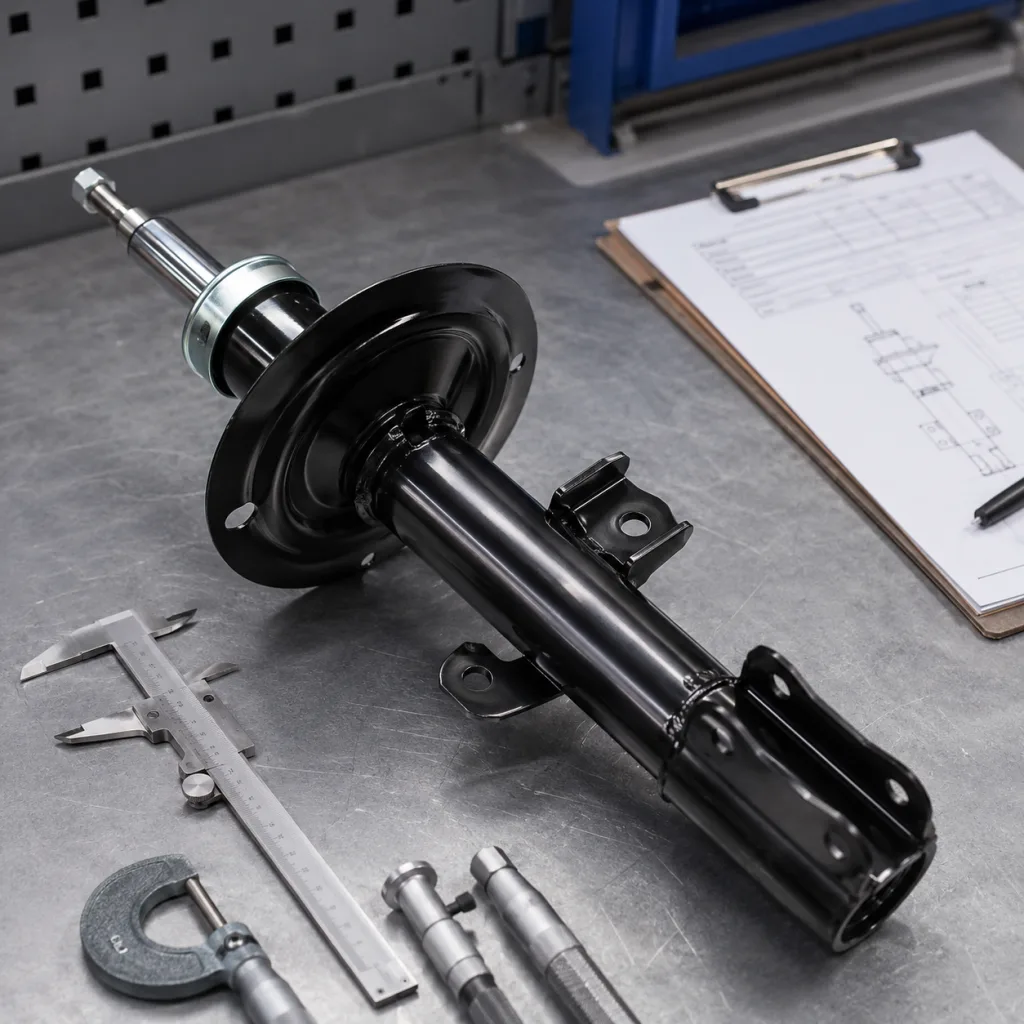
For procurement teams, shocks and struts replacement is not a generic suspension buy. It is a fitment-controlled part selection process that depends on mount geometry, extended and compressed length, spring seat location, valving, and corrosion protection. If any of those variables are off, the vehicle may pass a basic visual check but fail in service through noise, uneven tyre wear, poor damping, or incorrect ride height. Driventus supplies OE-equivalent suspension components for B2B buyers that need dimensional match, repeatable production, and documented validation. Driventus is an independent aftermarket manufacturer; brand names are referenced for fitment only. For catalogue coverage, production controls, and private-label support, see [our catalog](/products.html), [quality system](/quality.html), and [custom manufacturing](/oem-services.html). This article explains what buyers should verify before placing repeat orders, and how to reduce returns on replacement programmes across EU, UK, US, Canada, Australia, and Brazil.
What replacement buyers should verify first
For a suspension replacement programme, the first question is not price. It is whether the part matches the original installation envelope and performance target. Buyers should confirm:
Mount style: eye/eye, stem/eye, or knuckle mount
Free length, extended length, and compressed length
Stroke and bump-stop clearance
Spring perch height and seat diameter for strut assemblies
Rod diameter, body diameter, and thread specification
Surface protection, boot design, and top mount compatibility
A part can look correct in a photo and still fail on the vehicle. The useful procurement test is dimensional equivalence plus functional validation. That is especially important where OE 06A107065-style cross-references are used in catalogue mapping, because the reference only confirms fitment logic, not final performance on its own.
Dimensional checks that prevent returns
The most common return causes are simple measurement mismatches. Buyers should insist on controlled dimensions and documented tolerances before approval.
Check item
Why it matters
Typical procurement control
Mount centre distance
Controls fitment and suspension travel
Compare against OE sample and CAD
Extended/compressed length
Prevents topping-out or bottoming-out
Verify with fixture measurements
Rod and body diameter
Affects strength and packaging
Confirm against drawing revision
Spring seat position
Sets ride height and alignment
Measure from reference datum
Thread and stud spec
Ensures top-mount compatibility
Go/no-go gauge or thread callout
</tr></thead><tbody> </tbody></table>For strut assemblies, tolerance control should be documented at drawing level, not only in a catalogue note. Driventus builds to IATF 16949:2016 and ISO 9001:2015 processes, so buyers can request dimensional reports, sample inspection records, and traceable batch data before release.
How validation testing should be framed
Replacement parts should be tested as functional components, not just finished metal tubes. The test plan should reflect real installation and service conditions.
Core validation set
End-of-stroke durability under repeated compression and rebound
Seal integrity and gas retention where applicable
Salt spray resistance for exposed rods and brackets
Bushing and mount bond durability under cyclic loading
Noise, vibration, and harshness checks after installation
Road simulation or dyno correlation against OE reference samples
Where programmes require regional compliance alignment, buyers may also ask for REACH (EC) No 1907/2006 material declarations for chemical conformity and corrosion-related test references such as SAE J2527 for coated components. In European applications, fitment-related programmes may also reference ECE R-83 where the suspension package is reviewed alongside braking and chassis behaviour. The key point is consistency: the same part should behave the same across repeated production lots.
Commercial sourcing factors for repeat programmes
A suspension part is usually procured as part of a lifecycle programme, not a one-off purchase. That means lead time, MOQ, packaging, and channel control matter as much as the part itself.
</tr></thead><tbody> </tbody></table>For wholesale and multi-location repair networks, the most efficient model is a stable cross-reference list, a controlled sample approval stage, and a reorder file that locks drawing revision and packaging revision together. That reduces mis-picks and keeps the same part moving through all branches.
Choosing the right product family for your programme
Not every suspension replacement programme needs the same product format. In some cases, a stand-alone shock absorber is sufficient. In others, the correct supply item is a complete strut, top mount kit, or matched assembly.
Shock absorber only: suitable when the spring and mount are reused and still within spec
Strut assembly: preferred when spring seat, tube, and mounting hardware are replaced together
Matched kit: useful for multi-vehicle programmes with a standardised service package
OE-crossed variant: practical when catalogues must map to a known OE reference without brand claims
For buyers expanding a suspension range, it can help to align this line with adjacent chassis or engine-cooling portfolios in our catalog and broader engine and powertrain lines such as engine components when sourcing is centralised.
What to request before approval
Before you approve a supplier, ask for a short technical pack. A good pack should include:
Drawing with revision code and key dimensions
Material declaration and surface treatment note
Sample inspection report with measured values
Functional test summary with test conditions
Packaging specification and carton count
Photo set of the finished part and label format
This is the cleanest way to compare bids from multiple factories. It also makes it easier to confirm whether the supplier can support long-term replacement demand rather than only a single shipment. If you need a controlled quotation, traceability summary, or packaging review, use request a quote to start the process.
Frequently asked questions
Check mount type, extended and compressed length, body diameter, spring seat height, and top mount interface. A cross-reference alone is not enough; ask for a dimensional drawing and measured sample report.
For quality control, request IATF 16949:2016 and ISO 9001:2015. For chemical and coating-related compliance, REACH (EC) No 1907/2006 and relevant corrosion test references such as SAE J2527 are useful.
Yes. Driventus supports B2B supply, traceability, and custom manufacturing for approved programmes. Brand names are referenced for fitment only, and every quotation can be aligned to your drawing, packaging, and label requirements.
If you are building a repeatable replacement programme, send your OE reference, target market, and annual volume through /contact.html and we will review the fitment file with you.