shock absorber · 2026-06-14

Shock Absorber Replacement for B2B Buyers

Shock absorber replacement is a high-volume aftermarket category, yet procurement risk is often higher than the unit price suggests. A damper that matches a catalogue listing can still create claims if stroke length, bracket geometry, bushing hardness, damping force, corrosion protection, or export packaging are not controlled. For distributors, repair chains, and importers, the goal is more than broad fitment coverage. It is repeatable OE-equivalent function across production batches, supported by dimensional inspection, damping validation, and traceable quality records. This guide outlines the technical checks that should sit behind sourcing decisions for hydraulic and gas-charged shock absorbers. It is written for buyers who compare suppliers, approve samples, reduce warranty exposure, and maintain fill rates across multiple vehicle applications. Driventus is an independent aftermarket manufacturer; brand names and OE references are used for fitment identification only.

Replacement Fitment Starts With Dimensional Control

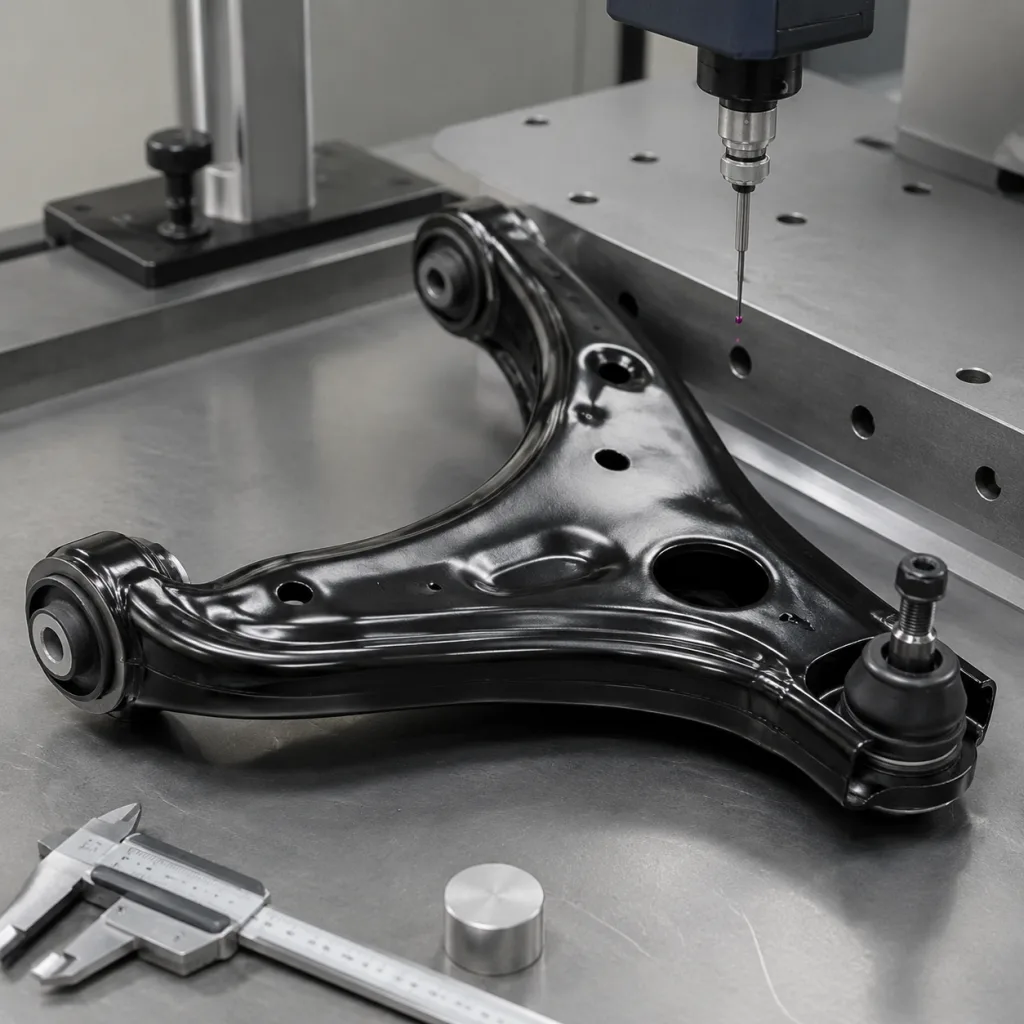
A shock absorber is usually selected by application, but production approval should begin with measured geometry. Small deviations can cause knocking noise, premature bushing wear, tyre contact, installation stress, or the impression of incorrect ride height after fitting. For B2B sourcing, the supplier should provide drawings, first-article reports, or inspection records for every fast-moving reference before the first purchase order.

Key fitment dimensions include:

</tr></thead><tbody> </tbody></table>For catalogue-managed programmes, buyers should maintain cross-reference records by vehicle platform, axle position, model year, and suspension variant. OE part-number cross-references may be listed where a catalogue uses generic formats such as OE 06A… or OE 11251…, but they should not be treated as evidence of vehicle manufacturer approval. The correct control point is measured interchangeability, supported by sample validation, application notes, and batch inspection.

OE-Equivalent Performance Requires More Than Matching Shape

Shock absorbers convert suspension movement into heat through controlled hydraulic restriction. A part can physically fit the vehicle but still deliver poor ride comfort, loose handling, topping noise, or excessive body movement if damping force is outside the intended curve. Replacement lines should therefore be evaluated by force-velocity data as well as by appearance and mounting geometry.

Procurement teams should confirm whether each reference is twin-tube hydraulic, twin-tube gas-charged, or mono-tube gas-charged. The architecture affects packaging space, heat dissipation, installation orientation, cost, and field failure modes.

Check point Why it matters Typical buyer verification
Extended lengthConfirms suspension droop limit and installation reachMeasure eye-to-eye, stud-to-eye, or pin-to-pin length on sample set
Compressed lengthPrevents the damper from bottoming before bump stop engagementBench compression check against drawing or master sample
StrokeConfirms usable damper travelCalculate extended length minus compressed length
Mounting typeControls installation compatibilityCompare eye, pin, clevis, stem, fork, or bracket design
Bushing inner diameterMatches bolt, sleeve, or mounting pin sizeCheck with vernier, plug gauge, or sleeve comparison
Bracket anglePrevents installation stress and side loadingVerify with fixture, gauge, or coordinate measurement
Dust cover clearanceAvoids rubbing during suspension articulationInspect movement through the travel range

</tr></thead><tbody> </tbody></table>Damping force should be checked in rebound and compression at agreed shaft speeds and temperatures. Many buyers compare samples with an approved master unit and define an acceptance band rather than one absolute value. This is practical because damping curves vary by application, axle load, suspension design, and vehicle mass. The supplier should also control piston valve stack, base valve, oil viscosity, gas pressure, rod diameter, and seal friction. A change to any of these inputs can shift performance even when the outside dimensions remain unchanged.

For broader programme planning, buyers can review application coverage in our catalog and prioritise samples by sales volume, warranty risk, and application complexity.

Validation Testing to Reduce Warranty Exposure

For a replacement programme, validation should confirm structural strength, damping consistency, corrosion resistance, sealing performance, and packaging survival. The test plan does not need to be identical for every SKU, but the method should be consistent, documented, and linked to the part revision being approved. Driventus production follows IATF 16949:2016 and ISO 9001:2015 process controls, with inspection records tied to batch traceability through the quality system.

Recommended validation items for shock absorber sourcing:

  • Dimensional inspection: extended length, compressed length, stroke, bracket position, weld location, stud thread, bushing dimensions, and sleeve alignment.
  • Damping force test: rebound and compression force at defined shaft speeds and temperature conditions, compared with drawing limits or master sample bands.
  • Endurance cycling: repeated compression and rebound cycles to check damping fade, oil leakage, abnormal noise, gas loss, and rod seal durability.
  • Salt spray or corrosion exposure: coating performance on outer tube, spring seat if applicable, brackets, welds, fasteners, and exposed edges.
  • Rod surface inspection: chrome finish, straightness, surface roughness, and absence of scoring, pits, burrs, or plating defects.
  • Leakage inspection: static and dynamic seal evaluation after cycling, side-load checks where relevant, and temperature exposure.
  • Packaging drop and vibration check: carton strength, internal separation, thread protection, barcode readability, and pallet stability after transport simulation.

Published standards should be applied where they are relevant to the product and destination market. Quality management can reference IATF 16949:2016 and ISO 9001:2015. Chemical compliance for European supply chains may require review against REACH (EC) No 1907/2006. Vehicle emissions standards such as ECE R-83 are not damper performance standards; if they appear in broader vehicle type-approval documentation, they should not be used as proof of shock absorber conformity.

Materials, Process Controls, and Inspection Points

A shock absorber contains several cost-sensitive components, and small savings in the wrong area can create large warranty costs. Buyers should pay close attention to material and process stability because many failures come from low-visibility details: poor rod plating, weak weld penetration, incorrect bushing compound, contaminated oil, inconsistent valve assembly torque, or inadequate cleaning before final assembly.

A practical sourcing specification should cover:

Design type Common applications Procurement considerations
Twin-tube hydraulicOlder passenger cars and light commercial vehiclesLower cost, comfort-focused tuning, more sensitive to aeration under severe use
Twin-tube gas-chargedBroad aftermarket coverageReduced foaming, consistent response, strong balance of cost and performance
Mono-tube gas-chargedHigher load, performance-oriented, or heat-sensitive applicationsBetter heat dissipation, higher internal pressure, tighter control needed for seal and rod finish

</tr></thead><tbody> </tbody></table>Incoming inspection at the buyer side can be simple but effective. For first shipments, check a statistically relevant sample for visual finish, mount geometry, thread quality, label accuracy, protective caps, and damping force if bench equipment is available. For repeat orders, focus on batch-to-batch consistency and complaint feedback by SKU, market, and installer type. Warranty analysis should separate installation damage from product issues, especially where mounting hardware has been reused, torque procedures were not followed, or the shock absorber was installed on a modified suspension.

Procurement Checklist for Distributors and Repair Chains

A well-structured RFQ reduces later disputes. Instead of asking only for price and lead time, buyers should send the expected application list, annual volume, packaging requirements, compliance market, and sample approval criteria. This is especially important for private-label programmes where carton format, label data, barcode structure, and pallet configuration must match warehouse systems.

For shock absorber replacement lines, include these RFQ items:

  • Target vehicle applications, axle position, model years, and left/right differentiation where relevant.
  • Required cross-reference format and any OE-style references already used in your catalogue.
  • Annual forecast by SKU, required initial stocking quantity, and expected replenishment rhythm.
  • Sample quantity for dimensional, fitment, damping, corrosion, and packaging evaluation.
  • Damping force acceptance method: drawing limits, master sample comparison, or buyer-defined curve.
  • Corrosion protection expectation for the destination market and road-salt exposure level.
  • Packaging format: plain, private label, pair pack, single pack, pallet configuration, barcode rules, and label language.
  • Compliance requirements, including REACH (EC) No 1907/2006 where applicable.
  • Warranty reporting process, batch traceability requirements, and corrective-action response expectations.

Driventus can support standard aftermarket references and custom manufacturing for distributors or Tier-1 customers requiring controlled drawings, packaging specifications, or application-specific tuning. The commercial decision should balance landed cost, inspection capability, service response, technical documentation, and supplier stability. A lower unit price has limited value if it increases returns, catalogue disputes, installer complaints, or emergency air-freight replenishment.

How to Approve Samples Before Purchase Orders

Sample approval should be treated as a controlled gate rather than a sales formality. For a fast-moving reference, approve at least three areas: physical fit, damping behaviour, and packaging. If the programme includes multiple vehicle families, do not assume one accepted SKU proves the entire range. Select samples that represent different mounting types, body lengths, rod diameters, bracket designs, and demand levels.

A practical approval flow is:

1. Confirm catalogue data, vehicle application, axle position, suspension variant, and cross-reference list. 2. Measure all critical dimensions against the drawing, supplier inspection report, or master sample. 3. Check mounting hardware, bushings, sleeves, threads, dust cover movement, and installation orientation. 4. Run damping force tests in rebound and compression at agreed speeds and temperature conditions. 5. Inspect welds, paint coverage, rod finish, bracket alignment, and visible assembly quality. 6. Fit-check on a representative vehicle or fixture where available. 7. Review carton strength, label content, barcode scan, internal protection, and pallet stability. 8. Record approval status, deviations, corrective actions, and final release conditions before mass production.

This process is especially useful for multi-location repair chains because installation feedback is dispersed. Centralised sample records allow purchasing, technical support, warehouse teams, and warranty staff to use the same acceptance criteria. They also give the supplier a clear basis for corrective action if field issues appear after launch.

Frequently asked questions

Provide vehicle applications, axle position, model years, annual volume by SKU, required packaging, target market, cross-reference format, and sample approval criteria. If available, include drawings, master samples, damping force curves, or warranty history from the current supplier.

Yes, a single reference can cover several applications when dimensions, mounting style, stroke, and damping characteristics are suitable. Buyers should still verify suspension variant, axle load, left/right position, model-year notes, and any special chassis conditions before approving a consolidated reference.

For manufacturing control, IATF 16949:2016 and ISO 9001:2015 are relevant quality management standards. For EU supply chains, chemical compliance review may include REACH (EC) No 1907/2006. Certifications should be supported by inspection reports, traceable batch records, and sample validation.

If you are reviewing a shock absorber replacement programme or replacing an existing supplier, share your application list and packaging requirements to [request a quote](/contact.html).

Request a Quote
Component Common requirement Risk if uncontrolled
Piston rodHardened and chrome-plated steel with controlled surface finishSeal wear, leakage, corrosion, stick-slip noise
Outer tubeWelded steel tube with coating or paint protectionRust perforation, cosmetic claims, reduced service life
Piston and valvesControlled orifice, shim, and valve stack assemblyIncorrect damping, noise, uneven ride response
OilStable viscosity and anti-foaming characteristicsDamping fade, cavitation, inconsistent performance
Seal systemOil-resistant elastomer and controlled lip geometryLeakage after cycling, heat exposure, or low-temperature use
BushingsRubber or bonded rubber-metal assembly to specified hardnessClunking, vibration transfer, early cracking
Welded bracketsFixture-controlled position and penetrationMisfit, bracket fracture, installation stress