piston ring · 2026-06-06

RoHS Testing for Piston Ring: Buyer Verification Steps

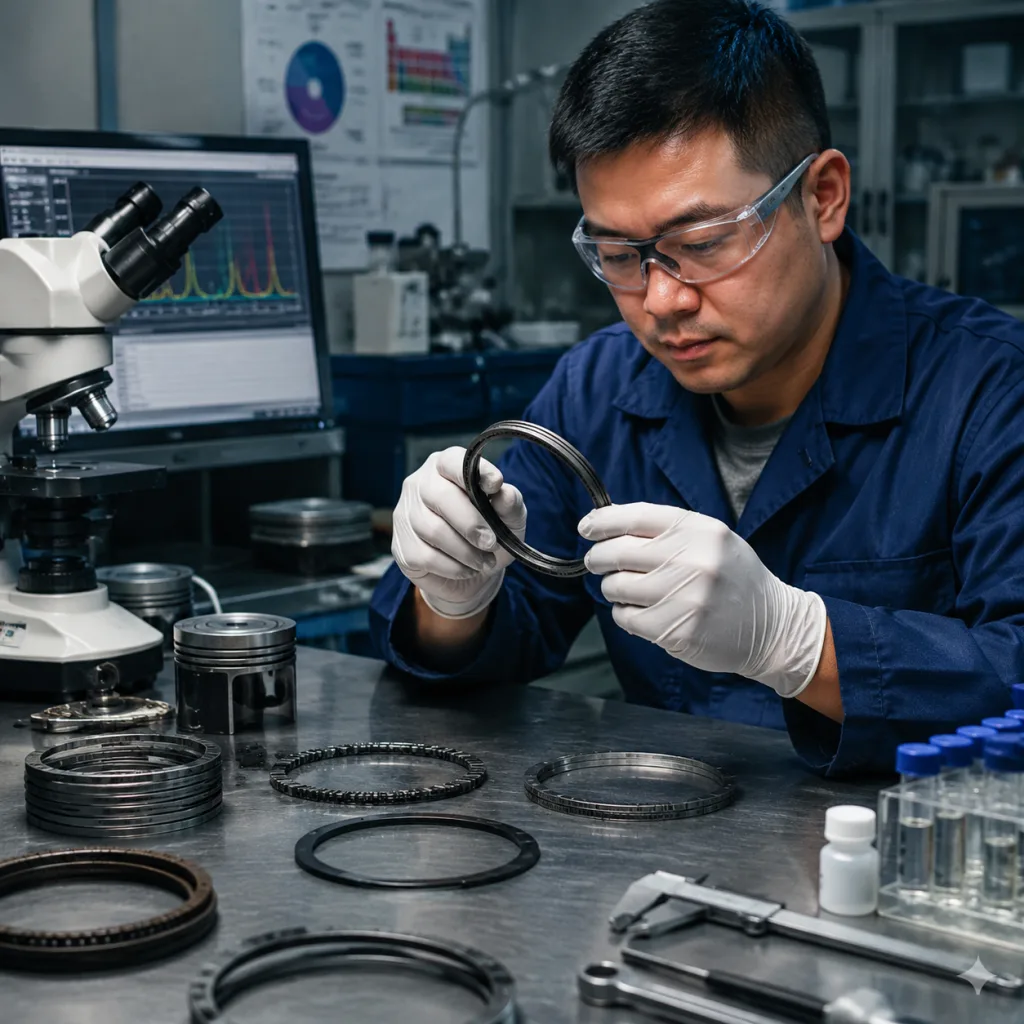
Buyers are often asked for a RoHS certificate for a piston ring set without much context on why RoHS applies in the first place. That usually leads to one of two avoidable mistakes: paying for the wrong test, or accepting a declaration that does not really match the part being supplied. A better approach is to define the end market, the customer requirement and the full material structure before ordering any testing. In rohs testing for piston ring applications, substance limits are checked at the homogeneous material level, not at the finished-part level. That means the cast iron ring body, nitrided case, PVD or plasma-sprayed running face, oil-ring expander, label adhesive and packaging may all need separate review. For conventional automotive use, REACH (EC) No 1907/2006 and Directive 2000/53/EC on end-of-life vehicles are often the main substance frameworks; RoHS becomes relevant when the end product or purchasing contract specifically calls for it. In practical terms, buyers should confirm scope first, map the materials second, choose the right verification method third, and only then decide whether a full IEC 62321 test package makes sense.

Start with regulatory scope

First, confirm which legal framework the supplier declaration is supposed to cover. A piston ring is a mechanical component, so the opening question is not simply "Can it be tested for RoHS?" It is "Which regulation actually matters for this part, in this market, for this application?"

  • Directive 2011/65/EU (RoHS 2) plus Commission Delegated Directive (EU) 2015/863 restrict 10 substances: lead (Pb), mercury (Hg), cadmium (Cd), hexavalent chromium [Cr(VI)], polybrominated biphenyls (PBB), polybrominated diphenyl ethers (PBDE), di(2-ethylhexyl) phthalate (DEHP), butyl benzyl phthalate (BBP), dibutyl phthalate (DBP) and diisobutyl phthalate (DIBP).
  • REACH (EC) No 1907/2006 governs SVHC communication and related article obligations, typically at 0.1% w/w per article for Candidate List communication.
  • Directive 2000/53/EC (ELV) is often more directly relevant for mainstream automotive engine parts and IMDS-based material reporting.
  • IATF 16949:2016 and ISO 9001:2015 do not define substance thresholds, but they do indicate how well a supplier manages change control, traceability and supplier oversight.

Under RoHS, the default concentration limit is 0.1% by weight in each homogeneous material for Pb, Hg, Cr(VI), PBB, PBDE, DEHP, BBP, DBP and DIBP, and 0.01% (100 ppm) for Cd. "Homogeneous material" means a material that cannot be mechanically disjointed into different materials, such as a steel substrate, a phosphate layer, a polymer bag or an adhesive film. So a compliant ring set is not judged as one blended mass.

If a supplier relies on an exemption, ask for the exact exemption number, annex reference, technical basis and current expiry status where applicable. A generic statement like "RoHS compliant" is not enough unless it also names the directive reference, substance list, part number, drawing revision and declaration date. For buyers, the first real control point is scope clarity: destination market, end-use equipment, part revision, and whether the request is regulatory, OEM-specific or purely contractual.

Map every homogeneous material in the ring set

Before sending anything for screening or lab analysis, break the ring set into homogeneous materials instead of treating it as one simple item. This step avoids false confidence, and it also keeps buyers from spending money on unnecessary testing.

Typical material map

  • Ring body: grey cast iron, ductile iron, alloy steel or stainless steel
  • Running face: plasma-sprayed molybdenum, chrome-ceramic layer, nitrided case or PVD coating such as CrN/TiN depending on design
  • Surface treatment: manganese phosphate, black oxide, passivation, rust preventive oil or other conversion finish
  • Oil ring assembly: upper/lower rails plus expander spring, often sourced from different sub-suppliers and heat lots
  • Packaging: tray, PE bag, VCI paper, ink, barcode label, label adhesive and customer-specific inserts

For technical review, it helps to note the likely thickness or mass contribution of each layer, even though RoHS compliance is not mass-averaged. A piston ring body may weigh several grams of ferrous alloy, while a phosphate layer is often only a few g/m², a PVD layer may sit in the micron range, and a label adhesive may represent only a small amount of material. Even so, those low-mass layers can still trigger non-compliance because RoHS is assessed per homogeneous material, not by total part weight.

The most common risk points are usually:

  • lead in free-machining alloys, bronze-filled ancillary parts or contaminated recycled metal streams
  • cadmium in legacy plating or poorly controlled subcontract surface treatment
  • hexavalent chromium in passivation or conversion coatings, especially where older print requirements still say "chromate"
  • phthalates in PVC bags, flexible labels, inks, adhesive systems or polymer packing accessories
  • brominated flame retardants in plastic trays or customer-specified electronic-service packaging, though this is less common for standard ring sets

A supplier declaration that covers only the base metal is not enough if the delivered set also includes coated rails, an expander spring, anti-rust treatment or customer-directed packaging. In rohs testing for piston ring programmes, buyers should check whether the supplier actually controls the whole assembly or is combining inputs from multiple sub-tier sources. If the declaration does not identify each material family and subcomponent, it is not complete enough for approval.

Match the verification method to the risk

Substance compliance is usually built on both documents and testing, not on a single certificate. The right verification method depends on material risk, programme stage and the cost of a bad release. A stable, low-risk part from a mature supplier does not need the same level of testing as a new coating stack or an unfamiliar sub-tier source.

</tr></thead><tbody> </tbody></table>For piston rings, XRF works well as a first-pass screen on the ring body, rails and accessible metallic coating systems. It is not enough when the part includes polymeric accessories, adhesive labels, anti-corrosion wraps, or when the customer specification specifically asks for phthalate or Cr(VI) confirmation. It is also worth remembering that handheld XRF results are strongly affected by spot size, surface curvature, coating thickness, measurement time and calibration mode. On a narrow ring section, a quick reading across two materials can create a misleading average.

A practical buyer workflow is to use XRF for triage, then move to confirmatory lab work only for the materials and lots that carry real risk. For example, a clean XRF result on a ferrous ring body may reduce concern around Pb/Cd/Hg, but it does not close out packaging, label adhesive or any chromated subcontract finish.

Use a buyer checklist before approval

A concise checklist helps buyers avoid both overbuying and underbuying verification. The aim is not to gather the largest pile of documents. It is to gather the right evidence for the specific part and market.

1. Confirm end-use scope. Establish whether the ring is for automotive engine service only, for equipment within RoHS scope, or for a customer programme that contractually adopts RoHS limits. 2. Freeze the part definition. Record drawing revision, material grade, ring profile, coating specification, packaging specification, label format and country of sale. Review each ring-set variant separately. 3. Request documentation at material level. The minimum pack is a supplier declaration, a full material breakdown, a test-method reference, issue date, authorised signature and the exact part numbers covered. 4. Verify sub-tier coverage. Oil ring expanders, coatings, packaging and preservatives often come from different sources. The declaration should map those sub-components, not just the main ring body. 5. Select representative samples. Use production parts from the same plant, process route, coating line and packaging line as the shipment. Prototype samples are weak evidence if the final process has not been frozen. 6. Check traceability depth. For metallic parts, ask for linkage to heat number, melt or coil lot where available; for coatings and packaging, ask for batch or work-order traceability. A lab report with no lot link is weaker evidence than many buyers assume. 7. Review change control. Ask how the supplier manages plating chemistry changes, steel grade substitutions, coating recipe changes, packaging substitutions and artwork changes. This is where a robust quality system matters. 8. Retest based on risk, not routine. A new supplier, a new subcontract coater, a customer complaint, an abnormal XRF result or a raw-material change should trigger retesting. Stable long-run parts may only need periodic surveillance. 9. Document the approval basis. Record why the part was accepted, which documents were reviewed, which lots were sampled and which materials were actually tested so future audits can follow the logic without starting from zero.

If you are comparing multiple sources from our catalog or a wider engine components programme, keep the checklist consistent across suppliers so the evidence is truly comparable. That makes sourcing decisions easier to explain when procurement, quality and the customer are all reviewing the same part.

What to ask a manufacturer

Material compliance is much more dependable when the factory controls the upstream process instead of collecting certificates after the fact. For piston rings, ask the manufacturer to show how compliance is built into purchasing, process control and release, not just into paperwork.

Ask for the following:

  • approved material specifications for ring bodies, expanders, coatings, oils and packaging materials
  • incoming chemical certificates tied to lot numbers, heat numbers or batch IDs where applicable
  • surface-treatment controls for phosphate, nitriding, passivation, plating and any anti-corrosion finish
  • a declared test strategy showing when the supplier uses document review, XRF screening and external lab confirmation
  • traceability from finished set back to heat, coating batch, packing batch and shipment record
  • documented handling of customer-specific packaging, private-label changes and artwork revisions
  • a defined escalation route when a sub-tier material changes or when a substance concern is raised
  • retention rules for compliance records, ideally aligned with customer and automotive traceability requirements

For stronger sourcing confidence, ask how the supplier separates RoHS, REACH and ELV evidence in its files. A capable manufacturer should be able to explain why a ring set may be acceptable for ELV and REACH purposes yet still need extra RoHS-specific confirmation for packaging or for an electronic-equipment customer. It should also be able to explain which items are tested internally, which are screened by portable XRF, and which are sent to an ISO/IEC 17025-accredited laboratory.

If the part requires a different coating stack, ring tension or packing format, custom manufacturing should follow the same substance-control workflow as the standard part. Driventus can provide compliance documents aligned to customer scope across our catalog, but the evidence package should always be checked against the actual drawing, revision and destination market. Driventus is an independent aftermarket manufacturer; brand names are referenced for fitment only. For commercial review or sample planning, you can request a quote. In the end, the best suppliers are the ones that can explain not only what was tested, but why that specific material, lot and method were selected.

Frequently asked questions

No. RoHS applies to electrical and electronic equipment within the scope of Directive 2011/65/EU, or to parts that are contractually required to meet RoHS limits. Many conventional automotive engine rings are reviewed primarily against ELV and REACH requirements instead. Buyers should confirm the end-use, customer contract and destination market before specifying a test plan. If RoHS is required, the assessment should be made at homogeneous material level rather than by issuing a broad statement for the finished ring set.

Usually no. XRF is a useful screening tool for lead, cadmium, mercury, total chromium and total bromine in accessible materials, but it does not by itself verify phthalates and it cannot directly prove the absence of hexavalent chromium. Results are also affected by geometry, coating thickness, surface condition and measurement time. It is best used as part of a layered approach that includes a material declaration, supplier traceability and confirmatory lab testing where the risk justifies it. For high-volume programmes, XRF is often the fastest way to compare suppliers and flag outliers before paying for full analysis.

Ask for a declaration naming the legal framework, a material breakdown at homogeneous material level, supporting lab reports where relevant, lot or batch traceability, and change-control records. For automotive programmes, it is also sensible to align the pack with REACH and ELV substance reporting so one document set can support multiple customer audits. If coatings, packaging or sub-assemblies come from outside the main factory, request evidence that those sub-tier sources are covered and that the documents reference the exact part revision being supplied.

If you need a substance-control checklist or a sample validation plan for a ring programme, Driventus can support the review. Send the drawing, coating specification and target market to [request a quote](/contact.html) so the document set can be matched to the actual part and destination market.

Request a Quote
Method What it confirms Good use case Main limitation
Full material declaration from supplierSubstance content by homogeneous material, often supported by mill, coating or packaging dataMature parts with stable BOM and low process-change frequencyDepends on supplier discipline, sub-tier reporting and revision control
XRF screening aligned to the IEC 62321 seriesRapid screen for Pb, Cd, Hg, total Cr and total Br on accessible surfaces/materialsIncoming audit samples, supplier comparison, lot triage, coated metal checksCannot directly identify phthalates, usually cannot detect light elements, and total Cr does not confirm Cr(VI)
ICP-OES / ICP-MS after acid digestion, or AAS where applicableQuantified elemental content versus ppm thresholdsConfirmation after XRF flags, high-risk alloys, springs, plating or coatingsDestructive, requires representative sampling and has higher cost/lead time
Cr(VI) confirmatory testing per wet-chemical methods in the IEC 62321 frameworkPresence/absence or quantified status of hexavalent chromium in conversion coatingsPassivated, plated or chromated metallic surfacesTime-sensitive sample handling and false negatives are possible if surface chemistry changes after production
GC-MS analysis for phthalatesQuantified DEHP, BBP, DBP, DIBP in polymers, inks, adhesives or filmsBags, labels, adhesive tapes, protective caps or customer packagingNot relevant for bare metal unless a non-metallic layer is actually present