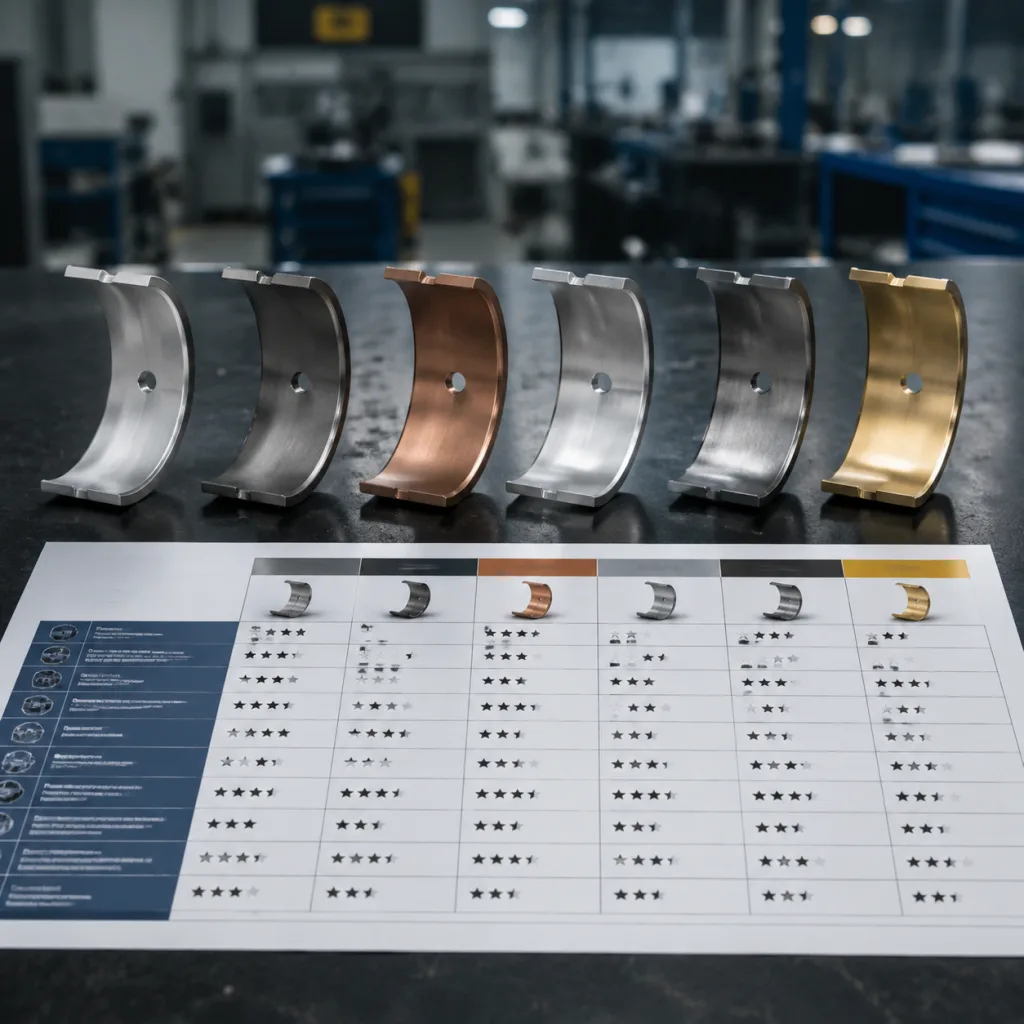
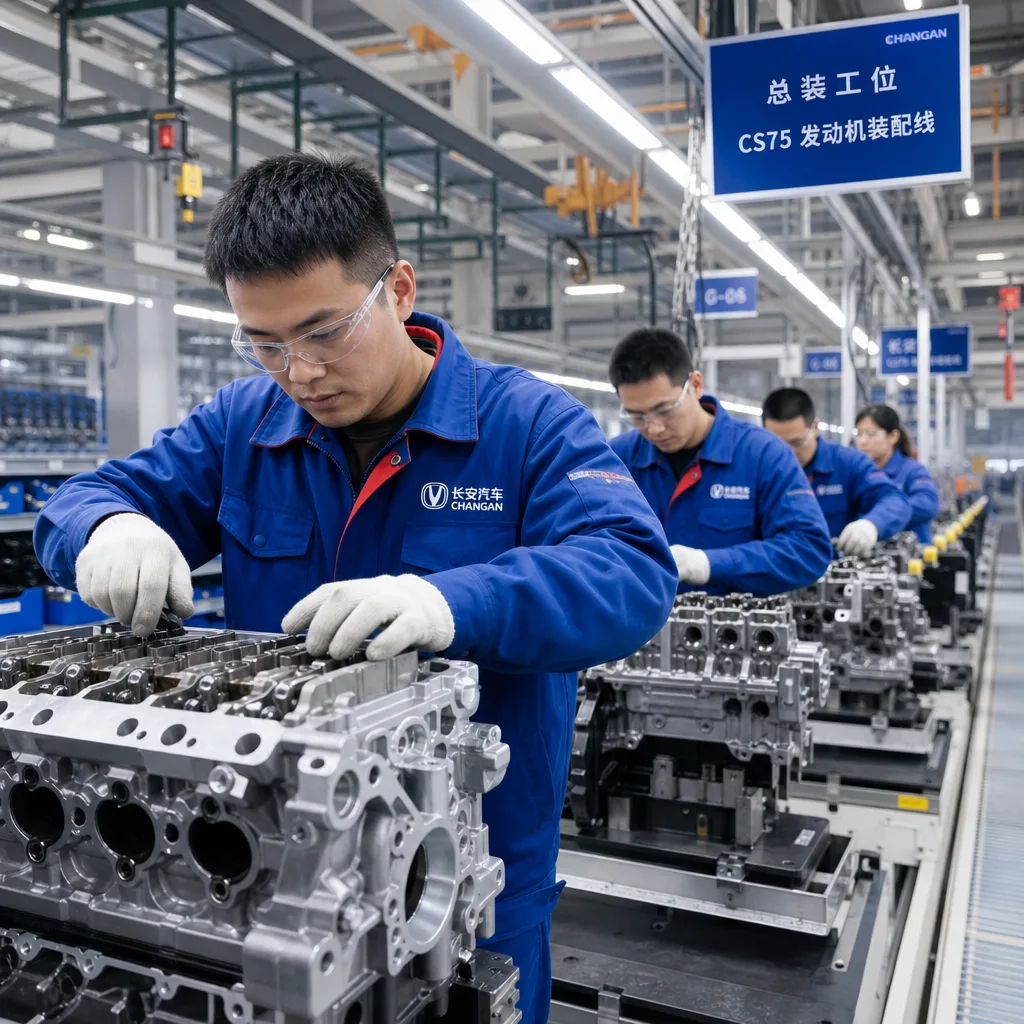
Rod bearing material grade comparison matters when you are sourcing engines that must maintain an oil film, tolerate load spikes, and hold consistent dimensional control. For procurement teams, the key question is not which material sounds stronger, but which grade matches the application, validation plan, and target cost. In practice, rod bearings are selected by overlay chemistry, backing type, fatigue resistance, embeddability, conformability, and compatibility with the crankshaft finish and lubricant package. Driventus is an independent aftermarket manufacturer; brand names are referenced for fitment only. We manufacture engine and powertrain components in Taizhou, Zhejiang, and operate to IATF 16949:2016 and ISO 9001:2015 systems. This article compares common bearing material grades used in replacement and OE-style programmes, and shows what buyers should verify before releasing a PO.
Choosing the right grade: what actually matters
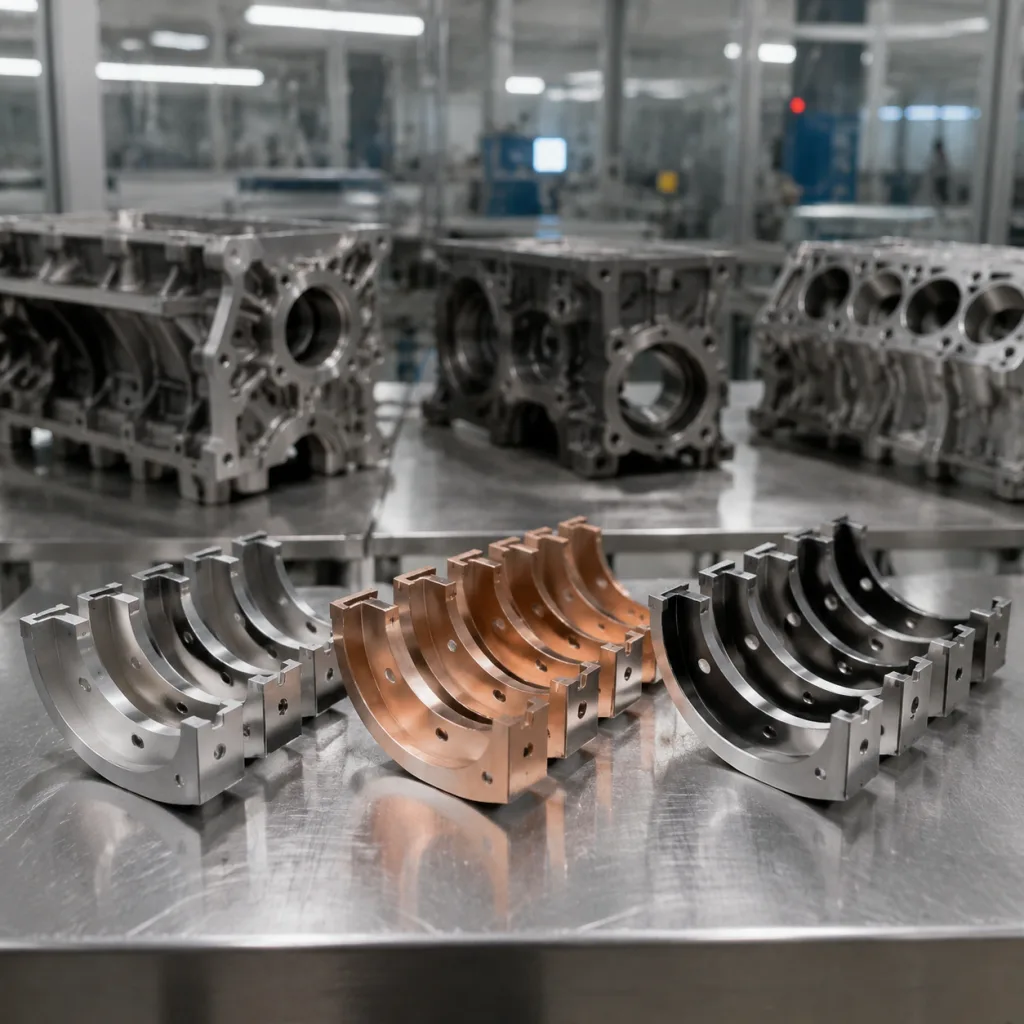
Rod bearings are usually built as a multi-layer shell, and the full stack matters. The backing supplies stiffness, the lining carries load, and the overlay helps protect the bearing during short periods of boundary contact. When buyers compare grades, they should evaluate the whole construction rather than only the visible surface.
Material grade
Typical structure
Main strength
Main limitation
Common use
Trimetal
Steel backing, copper-lead or copper-free intermediate layer, soft overlay
High fatigue strength and load capacity
More sensitive to contamination when oil control is poor
Passenger car and light commercial engines
Bimetal
Steel or aluminium backing with a softer bearing layer
Good conformability and cost control
Lower peak load capacity than trimetal in many designs
High-volume replacement programmes
Aluminium-based
Aluminium alloy bearing layer on steel backing
Good corrosion resistance and lead-free chemistry
Must be matched carefully to load and surface finish
Modern emissions-focused engines
Copper-lead legacy grades
Steel backing with copper-lead layer and overlay
Strong load-carrying capability
Lead content and regulatory pressure
Older OE applications and specific industrial engines
</tr></thead><tbody> </tbody></table>For technical sourcing, ask for layer composition, backing thickness, overlay thickness, and hardness range. If a supplier cannot state these clearly, the comparison is incomplete. Buyers should also request typical numeric targets: overlay thickness often sits around 5–15 μm for soft overlays and can be 0.01–0.05 mm on specialty designs, while intermediate bearing layers are commonly specified in the 0.15–0.35 mm range depending on shell size. Wall thickness tolerance is frequently held within ±0.005–0.015 mm on precision programmes, with crush height and eccentricity controlled in the drawing rather than left to interpretation. These numbers vary by engine family, but a supplier should be able to quote them immediately.
Failure modes: which grade resists what
The right grade depends on load, duty cycle, oil quality, and the engine’s tolerance for contamination. A trimetal shell can be a strong choice when the engine sees high combustion loading and repeated start-stop cycles. An aluminium-based grade may be the better fit when the programme prioritises lead-free chemistry and stable wear behaviour under clean oil conditions.
Key trade-offs
Load capacity: Often higher on trimetal constructions because the intermediate layer improves fatigue resistance; many buyers target safety margins of 1.3x to 1.8x the expected peak bearing load in validation.
Embeddability: Usually better on softer bimetal or overlay-rich designs, which can trap small particles; this matters when oil filtration is coarse or service intervals are long.
Conformability: Important when crankshaft geometry, housing bore roundness, or thermal distortion is less than ideal; a practical target is maintaining full-face contact without edge loading at hot clearance.
Corrosion resistance: Aluminium-based layers can perform well in corrosive environments, depending on lubricant chemistry and fuel dilution exposure.
Cost: Bimetal is usually simpler to produce, but the lowest unit price does not always produce the lowest failure rate.
For procurement, the more useful question is which failure mode the grade is meant to resist. A grade that survives momentary dirt ingestion may be preferable to one with slightly higher static strength but weaker embeddability. Buyers should ask for the limiting failure mode from the supplier: fatigue cracking, wipe, seizure, cavitation, edge loading, or fretting at the parting line. That answer should guide the grade choice more than a generic “heavy duty” label.
Comparison table for shortlisting suppliers
This comparison helps frame supplier discussions during RFQ and PPAP-style validation.
Decision factor
Trimetal
Bimetal
Aluminium-based
Fatigue resistance
High
Medium
Medium to high, design dependent
Conformability
Medium
High
Medium
Embeddability
Medium
Medium to high
Medium
Corrosion resistance
Medium
Medium
High in many chemistries
Lead-free suitability
Depends on design
Depends on design
Usually strong
Typical cost
Higher
Lower
Medium
Best fit
High-load or severe-duty engines
Value-focused replacement lines
Modern, regulated applications
</tr></thead><tbody> </tbody></table>Use this table as a first filter only. Final selection still depends on shell thickness, crush, tang, oil groove geometry, and crankshaft surface specification. In RFQs, buyers should specify the actual acceptance bands, not only the nominal size. Typical rod bearing oil clearance targets are often in the 0.020–0.060 mm range for passenger-car applications and can be broader on larger-displacement engines, but the correct number must come from the engine drawing or service literature. If the supplier proposes a grade without confirming the clearance target, parting-line crush, and journal finish, the comparison is incomplete.
Spec deep-dive: what the datasheet must prove
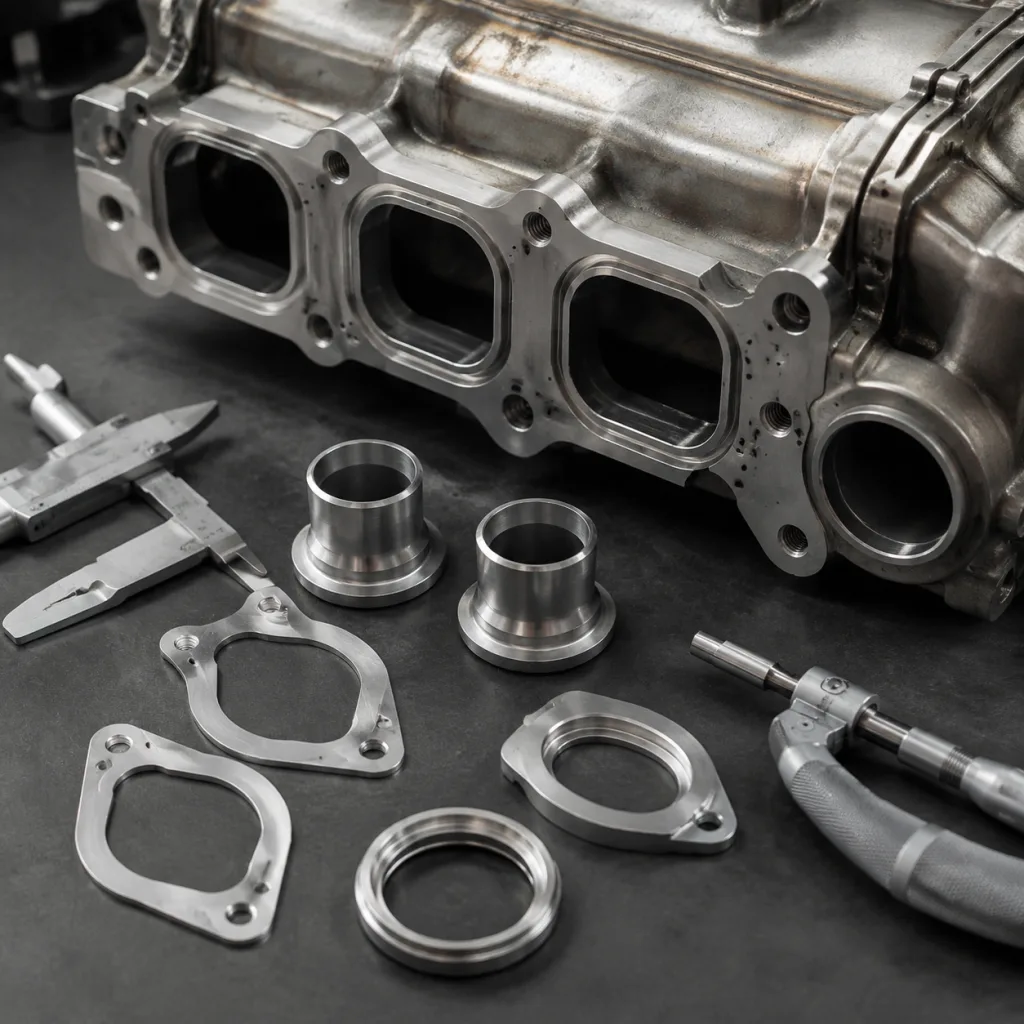
A complete datasheet should support interchange control and production release. At minimum, request the following:
Material stack description and alloy family
Shell thickness and wall tolerance
Overlay thickness and uniformity range
Hardness specification or range
Crush height and seating behaviour
Oil groove and chamfer geometry
Coating details, if present
Dimensional control plan and inspection frequency
Traceability lot code and packaging standard
If you source to OE cross-reference numbers, confirm the application by engine code and bore class, not by part number alone. That is especially important where one family uses multiple rod bearing grades across production years. For broader engine programme sourcing, you can review our catalog and related engine components.
A buyer-ready datasheet should also state measurable controls such as surface roughness on the bearing ID and OD, usually in the Ra 0.2–0.8 μm range depending on coating, and hardness values such as 65–90 HB for softer bearing layers or higher localized microhardness for overlay systems. Ask whether dimensions are checked 100% or by sampling, and request the AQL or control plan. If the supplier cannot state whether the shells are packed by matched set, cavity, or lot, the traceability plan is not robust enough for a controlled programme.
Validation path: standards and supplier controls
For procurement teams, grade comparison should end in validation, not assumption. Ask for test data tied to the same drawing revision and the same material stack you intend to buy.
Relevant standards and controls include IATF 16949:2016, ISO 9001:2015, and REACH (EC) No 1907/2006 where chemical compliance applies. For durability work, some programmes also reference oil- and wear-related test methods such as SAE J2527 in adjacent validation contexts, although the exact plan depends on the engine family and customer specification.
If the programme includes custom dimensions, special coatings, or packaging requirements, use custom manufacturing to define the specification before sampling. Our quality system explains how we control traceability, inspection, and release criteria.
A practical validation plan usually includes a dimensional PPAP-style sample report, a run-in inspection of bearing overlay condition after initial fitment, and a teardown check after a defined durability interval. Buyers should align sample quantities with risk: 10–15 pilot sets may be enough for a simple replacement line, while 25–50 sets is more realistic when validating a new material stack or special coating. For critical applications, ask for recordable evidence of journal contact pattern, clearance after assembly, and post-test wear measurements on both upper and lower shells.
Sourcing workflow: from RFQ to release
A practical sourcing process reduces mismatch between the selected grade and the real operating window.
1. Confirm engine family, OE 06A107065-style cross-reference format if applicable, and bearing position. 2. Define operating load, oil viscosity, and expected service interval. 3. Select the material grade based on fatigue, embeddability, and corrosion priorities. 4. Review dimensional report, coating specification, and lot traceability. 5. Validate fitment with crankshaft finish, housing bore geometry, and oil clearance targets. 6. Release only after sample inspection and agreed test evidence.
For procurement support, request a quote with the target application, annual volume, drawing revision, and any special compliance requirements.
To make the PO actionable, include minimum order quantity, target price band, and lead-time expectations in the RFQ. In this category, MOQ often depends on whether the shell is a standard catalog size or a custom stack-up: catalog SKUs may accept 100–300 sets per order, while custom dimensions or special coatings often require 500–1,000 sets or a tooling commitment. Lead time is usually 15–30 days for stocked or repeat parts, 30–45 days for standard production, and 45–60+ days when new tooling, coating qualification, or special packaging is involved. Buyers can reduce risk by asking for tiered pricing at 500, 1,000, and 5,000 set breaks, plus separate pricing for sample lots, sea freight, and expedited air shipment. If the supplier cannot tie MOQ and lead time to specific finish, coating, or packaging requirements, the commercial offer is not yet complete.
Frequently asked questions
There is no universal winner. Trimetal often offers strong fatigue resistance, while aluminium-based grades can suit regulated modern engines. The correct choice depends on load, oil control, and validation data.
Only if the dimensions, oil clearance, coating, and application requirements match. Grade changes can alter embeddability, wear behaviour, and fatigue margin, so confirm with testing before release.
Request the material stack, dimensional tolerance, coating details, traceability method, and compliance evidence to IATF 16949:2016, ISO 9001:2015, and REACH (EC) No 1907/2006 where relevant.
If you are comparing grades for a current programme, send the engine code, drawing revision, and annual volume through our contact form at /contact.html.