aftermarket replacement parts · 2026-06-15

Replacement Fuel Injectors: B2B Sourcing Criteria

Replacement fuel injectors carry higher sourcing risk than many aftermarket engine parts because small deviations in flow, spray pattern, coil resistance, sealing geometry, or connector fit can create warranty exposure across many vehicle applications. For distributors, importers, and repair-chain buyers, the decision is not only about unit price. Each part must align with OE fitment data, pass repeatable flow validation, tolerate relevant fuel chemistry, and arrive with traceable batch documentation. Procurement teams also need evidence that specifications remain stable across repeat orders, especially when injector families include long-tail applications with uneven demand. Driventus manufactures engine and powertrain replacement parts in Taizhou, Zhejiang, under IATF 16949:2016 and ISO 9001:2015 systems. This guide outlines practical evaluation points for petrol and diesel aftermarket injector programmes. Driventus is an independent aftermarket manufacturer; brand names are referenced for fitment only.

OE-Equivalent Fitment Starts With Controlled Reference Data

Injector interchange is highly application-specific. A credible aftermarket programme should start with OE cross-reference mapping, verified vehicle application data, and physical sample comparison. Buyers should ask how the supplier updates reference data when OE supersessions, engine-code variants, regional calibration differences, or connector revisions appear.

Critical fitment parameters include:

  • Overall length and sealing stack height: Controls rail-to-manifold compression and leak risk.
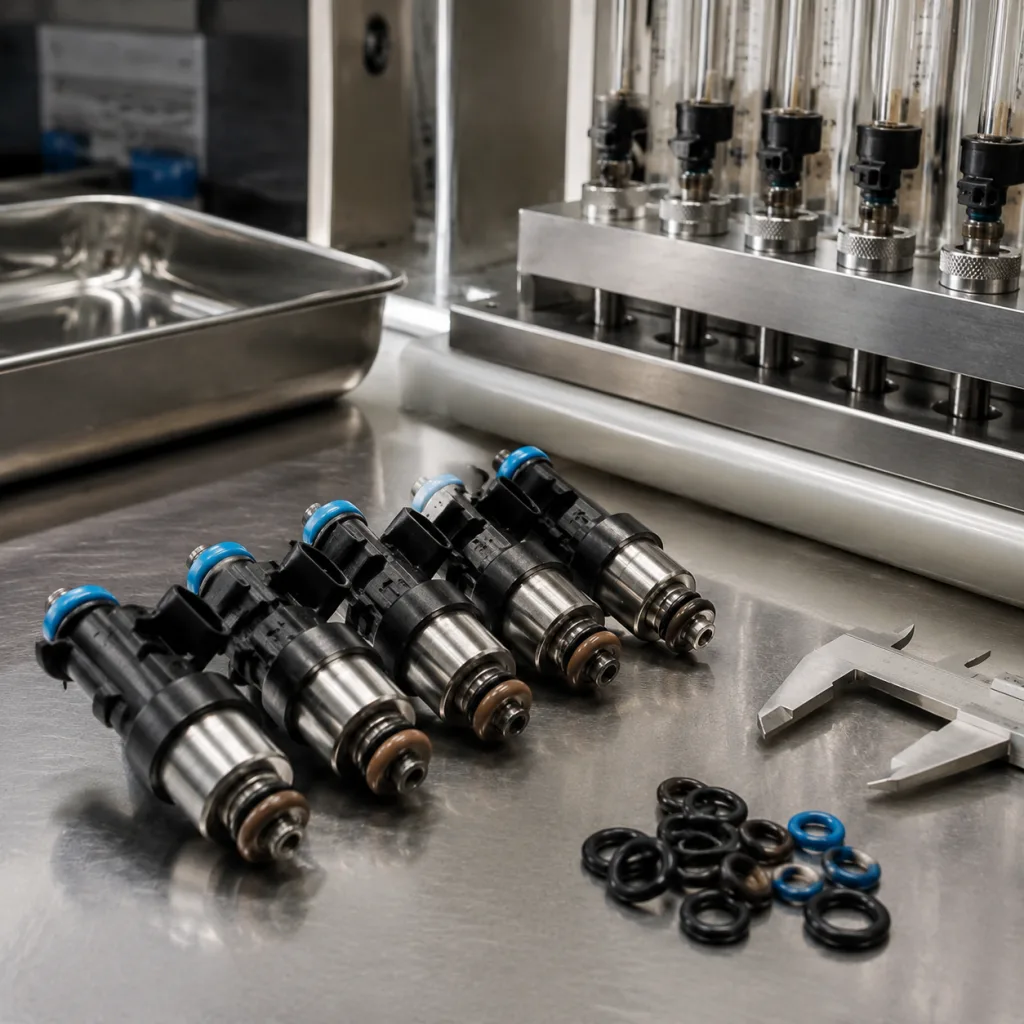
  • O-ring groove diameter and width: Affects assembly force and long-term sealing.
  • Nozzle tip geometry: Influences seating depth, atomisation position, and heat exposure.
  • Connector keying and terminal position: Prevents harness mismatch and intermittent faults.
  • Fuel rail interface: Must match clip position, inlet filter size, and pressure rating.

For procurement teams building a broad range, the supplier should provide a structured part list, cross-reference logic, and sample approval records. Generic catalogue claims are not enough because similar-looking injectors may differ in flow rate, resistance, nozzle layout, or connector details. Review application coverage through our catalog and request supporting dimensional data for critical SKUs. If the programme requires private-label packaging or regional part-number mapping, confirm that customer references are separated from internal production control numbers so traceability is not lost after relabelling.

Functional Validation Beyond Dimensional Match

A fuel injector may fit correctly but still fail performance validation. Flow rate, leakage, opening response, closing response, and spray consistency should be checked under defined pressure, pulse width, and temperature conditions. Buyers should request batch test data instead of relying on sample photographs, catalogue images, or visual inspection alone.

</tr></thead><tbody> </tbody></table>For petrol injectors, atomisation consistency, calibrated flow, and response time are often the main concerns. For diesel common-rail injectors, pressure capability, internal leakage, return flow, and precision machining become more critical because operating pressures and tolerances are higher. Driventus aligns production control with documented inspection plans under its quality system, including incoming material checks, in-process control, and final inspection records. Buyers should define which test data must accompany each shipment before issuing a blanket purchase order, and should keep the same evidence requirements for repeat orders rather than only the first approval batch.

Materials, Cleanliness, and Fuel Compatibility

Material selection has a direct effect on field performance. Elastomers must remain stable in petrol, diesel, ethanol blends, biodiesel blends where applicable, and regional fuel additives. Metallic components need corrosion resistance, dimensional stability, and controlled surface finish to avoid particle shedding. For export markets, suppliers should also understand substance-control obligations such as REACH (EC) No 1907/2006 for restricted chemicals in supplied articles and packaging.

Validation item Why it matters Typical procurement evidence
Static leakagePrevents hot-start issues, fuel dilution, and emissions complaintsLeak test record at specified pressure and hold time
Dynamic flowConfirms delivery under pulsed operationFlow report at defined pulse width and pressure
Spray patternSupports stable combustion and drivabilityPattern inspection record or bench image set
Coil resistanceConfirms ECU compatibility and heat stabilityElectrical test data by batch
Response timeReduces misfire and trim deviation riskOpening and closing response test
Packaging cleanlinessPrevents contamination before installationClean cap, sealed bag, and inlet protection check

</tr></thead><tbody> </tbody></table>Cleanliness is frequently underestimated in replacement fuel injectors sourcing. Small particles can affect spray formation, interfere with needle movement, or cause sealing issues after installation. Buyers should ask about ultrasonic cleaning, filtered assembly environments, protective capping, and the packaging sequence from final inspection to carton sealing. For large programmes, define acceptable cleanliness criteria in the purchase specification and include incoming inspection sampling at the destination warehouse. This helps identify contamination risk before parts enter regional distribution or repair-chain inventory.

Supplier Qualification for Aftermarket Programmes

Injector sourcing involves both engineering and supply-chain risk. A distributor may need 300 active references with uneven demand, while a repair-chain buyer may focus on a smaller set of high-turn SKUs with strict service-level expectations. Supplier qualification should therefore cover quality certification, manufacturing process control, lead time, MOQ flexibility, change notification, and complaint handling.

A practical supplier checklist:

  • IATF 16949:2016 and ISO 9001:2015 certification status.
  • Process flow chart and control plan availability for injector production.
  • PPAP-style documentation when required by OEM or Tier-1 customers.
  • Batch traceability from material lot to finished goods shipment.
  • Defined AQL inspection level for appearance, dimensions, and function.
  • Export packaging suitable for sea and air freight.
  • Private-label, neutral-label, or customer-label capability.
  • Corrective action process with containment, root cause, and verification.

For EU, UK, US, Canada, Australia, and Brazil importers, stable communication matters as much as production capability. Confirm whether the supplier can provide HS code support, carton data, pallet specifications, country-of-origin marking, and documentation needed for customs clearance. For parts that require special geometry, connector changes, or customer-owned drawings, Driventus can support custom manufacturing with controlled engineering review before tooling or production release. Buyers should also agree how engineering changes, material substitutions, and packaging revisions will be approved before they reach production.

Specification Points to Lock Before Purchase Order

Procurement teams reduce downstream disputes when they convert assumptions into written specifications. The purchase order or technical appendix should define the part reference, application range, test requirements, packaging, labelling, and documentation. This is especially important when sourcing replacement fuel injectors from multiple factories or when consolidating a legacy supplier base.

Recommended PO specification points:

  • Part number and approved cross-reference list.
  • Drawing revision or approved sample reference.
  • Nominal flow rate and permitted tolerance at stated pressure.
  • Coil resistance range at stated temperature.
  • Leak test pressure and hold time.
  • O-ring material, hardness range, and colour if required.
  • Connector type, key position, and terminal plating requirement.
  • Packaging format, barcode rules, and country-of-origin marking.
  • Batch traceability and inspection report requirements.
  • Warranty handling process and response time for claims.

Regulated emissions performance is vehicle-system dependent. Buyers should avoid any supplier claim that a replacement injector alone guarantees compliance with standards such as ECE R-83 or US emissions requirements. The part must support proper system function, but certification responsibility depends on the complete vehicle application, calibration, installation condition, maintenance state, and local legal framework. Driventus does not claim approval or endorsement by any vehicle manufacturer. Written specifications help align supplier quality control with importer expectations and provide a clear reference if a claim investigation is required.

Commercial Evaluation: Cost, Risk, and Continuity

Unit price is only one part of landed cost. Buyers should compare warranty exposure, inspection cost, inventory risk, documentation quality, and supplier responsiveness. A lower-price injector that needs 100% incoming testing may cost more than a better-controlled part supplied with reliable batch reports.

Component area Common sourcing requirement Risk if uncontrolled
O-rings and sealsFuel-compatible elastomer with controlled hardnessSwelling, shrinkage, external leakage
Coil windingStable resistance over heat cyclesHard start, misfire, ECU fault codes
Filter basketCorrect mesh and secure retentionReduced flow or debris migration
Nozzle plate or tipPrecision aperture geometryUneven spray and poor atomisation
Plastic connector bodyHeat and fuel-vapour resistanceCracking, loose terminals, poor latch retention
Protective capsClean, secure, non-shedding materialContamination during storage or transport

</tr></thead><tbody> </tbody></table>For high-volume programmes, request pre-production samples, run internal fitment checks, and compare test data from at least two batches. For long-tail references, focus on dimensional accuracy, packaging protection, stable reorder availability, and clear discontinuation notice if demand falls below economic production levels. Replacement fuel injectors should be treated as precision engine components, not commodity accessories. A structured approval process protects margin, reduces claims, and supports reliable service levels across distributor and repair-chain networks.

Frequently asked questions

Request dimensional data, approved cross-references, flow and leakage test results, coil resistance range, seal material information, packaging specification, and the batch traceability method. For critical programmes, approve physical samples before placing a production order.

Yes. Driventus can support neutral, private-label, and customer-specified packaging when artwork, labelling rules, carton data, and destination-market requirements are confirmed before production. Packaging approval should be completed with pre-production samples.

Driventus does not claim approval or endorsement by any vehicle manufacturer. Driventus is an independent aftermarket manufacturer; brand names are referenced for fitment only. Buyers should evaluate parts against OE-equivalent dimensions, function tests, and application data.

For injector range development, sample review, or landed-cost quotation, send the target references and annual volume estimate to [request a quote](/contact.html).

Request a Quote
Commercial factor Low-control sourcing risk Better procurement approach
MOQExcess inventory on slow-moving SKUsTiered MOQ by part family and demand class
Lead timeStock-outs during seasonal demandRolling forecast with confirmed production slots
WarrantyUnclear responsibility and slow responseWritten claim process and batch traceability
DocumentationMissing test data or carton detailsPre-shipment document checklist
PackagingDamage, contamination, or relabelling costApproved packaging sample before mass order
Range expansionInconsistent references across suppliersSingle data template for new SKU approval