serpentine belt · 2026-06-15

Serpentine Belt Repair: OE-Equivalent Sourcing Guide

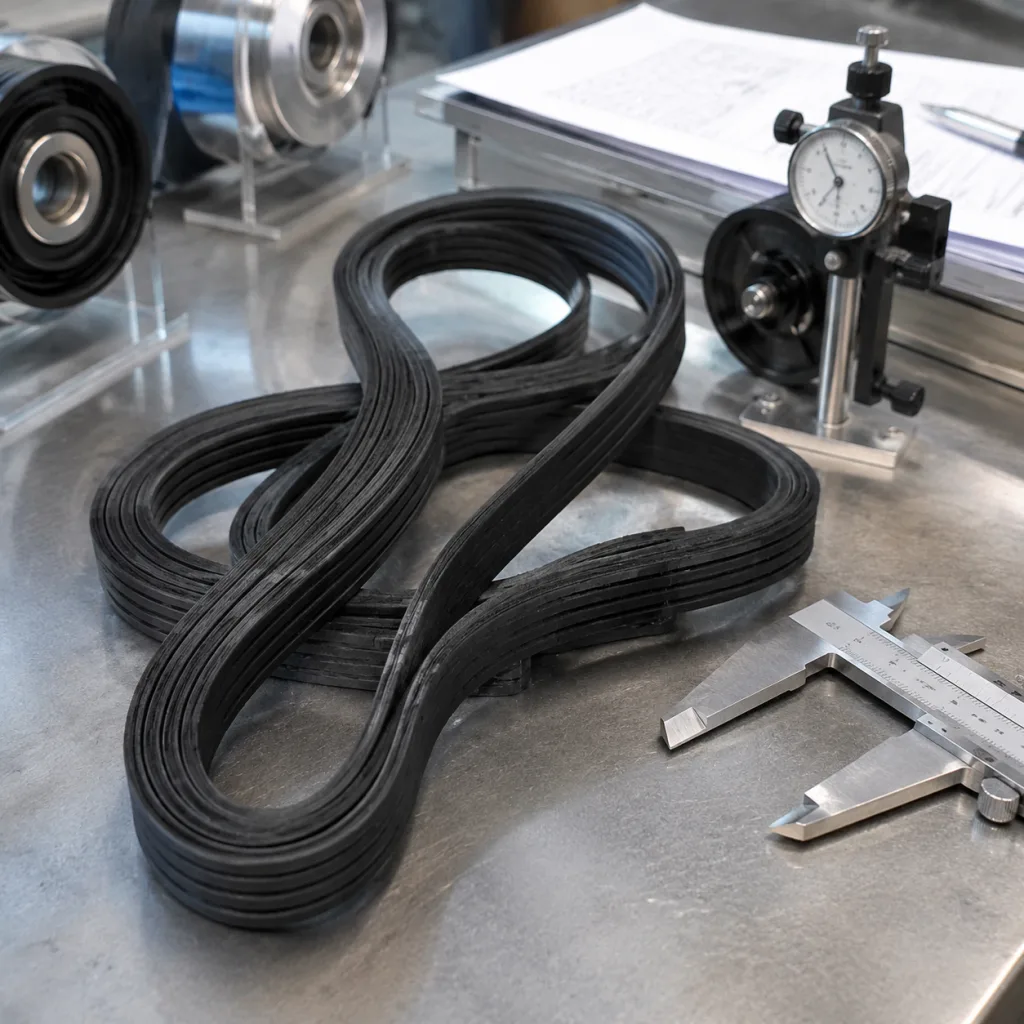
Serpentine belt repair is often viewed as a workshop task, but for distributors, repair chains and sourcing teams it is also a product-risk decision. A replacement belt may follow the pulley path and still create warranty exposure if rib geometry varies, cord adhesion is weak, or heat-ageing performance is not proven. Procurement teams need belts that match OE routing length, rib count, pulley contact behaviour and operating temperature demands—not just a catalogue interchange. For 2026 sourcing programmes, buyers should assess dimensional control, compound selection, batch traceability, packaging accuracy and validation evidence before approving supply. Driventus manufactures engine and powertrain components in Taizhou, Zhejiang, under IATF 16949:2016 and ISO 9001:2015 systems for export customers in more than 60 countries. Driventus is an independent aftermarket manufacturer; brand names and OE-style references are used for fitment identification only.

What procurement teams should define before replacement approval

Aftermarket demand for serpentine belt repair comes from scheduled service, noise complaints, cracking, glazing, contamination, misalignment and accessory-drive failures. A procurement specification should therefore begin with application coverage and service conditions, then move to price, packaging and logistics.

A replacement belt should be approved against the vehicle application, belt path, tensioner type and pulley profile. Multi-rib belts look simple, yet small variation in effective length, rib pitch or backside thickness can shift the tensioner position, increase noise or encourage belt walk. Repair chains also need clear carton and sleeve identification so technicians can choose the correct belt quickly across multiple branches.

Key sourcing inputs include:

  • Rib count, such as 4PK, 5PK, 6PK or 7PK profiles
  • Effective length and outside length reference method
  • Rib pitch and included angle compatibility with pulley grooves
  • EPDM compound requirement for heat, ozone and crack resistance
  • Cord material, commonly polyester or aramid depending on load
  • Operating temperature range and heat-ageing target
  • Interchange references and application notes by engine code
  • Batch traceability, date code and carton labelling format
  • Storage-life expectations and warehouse handling conditions

For broad product-family planning, buyers can review our catalog and align application coverage before sampling. Where a repair-chain programme needs private labelling, non-standard carton packs, bilingual labels or market-specific assortment kits, custom manufacturing can be evaluated at the same time.

Dimensional match and OE-equivalent fitment checks

A belt should not be approved simply because it can be fitted to the engine. After installation, the tensioner arm must sit within its working range and still retain enough travel to compensate for bedding-in and service-life elongation. A belt that is too short can overload bearings, idlers and automatic tensioners; a belt that is too long can slip during alternator load, air-conditioning engagement or cold start.

Procurement drawings and inspection plans should state how dimensions are measured, the belt conditioning state, the measuring tension and the sampling plan used for each batch. In this context, an OE-equivalent approach means matching functional geometry and performance for the aftermarket application. It does not mean claiming approval by a vehicle manufacturer.

</tr></thead><tbody> </tbody></table>Cross-references should be managed carefully. If a customer supplies an OE-style reference, such as OE 06A… or OE 11251…, it should be used only for fitment mapping, catalogue search and internal interchange control. Driventus does not claim approval, endorsement or supply status from any vehicle manufacturer.

Materials, construction and validation testing

Modern accessory-drive belts are commonly based on EPDM because the material offers stronger heat, ozone and crack resistance than older chloroprene formulations. For sourcing engineers, however, a material name is not enough. The compound should be supported by test data, and the belt must also show stable cord adhesion, curing consistency and rib-grinding accuracy.

Typical construction includes a ribbed EPDM traction surface, tensile cords positioned at a controlled neutral axis, an EPDM or fabric-backed outer layer and adhesion systems between rubber and cord. Changes in compound formulation, cord supplier, fabric treatment, mixing process or curing parameters should trigger change-control review under the supplier quality agreement.

Attribute Procurement check Why it matters
Rib profilePK profile geometry against approved drawingSupports pulley seating and reduces noise risk
Effective lengthControlled measurement under specified tensionKeeps tensioner position within service range
Rib countApplication-specific count, e.g. 6PKPrevents misalignment and edge wear
Backside thicknessBatch measurement against control rangeAffects idler contact and flex fatigue
Cord positionCross-section inspectionControls elongation and load distribution
Surface finishVisual and gauge inspectionHelps identify moulding, grinding or curing defects
Marking accuracyPart number, length and date-code verificationReduces picking errors and warranty disputes

</tr></thead><tbody> </tbody></table>Published standards can support the quality framework when used correctly. IATF 16949:2016 and ISO 9001:2015 are relevant for automotive quality management and documented process control. REACH (EC) No 1907/2006 may apply to chemical compliance for EU-bound shipments. Buyers may also encounter SAE J2527 in brake-friction discussions or ECE R-83 in emissions topics, but those are not serpentine belt approval standards and should not be presented as belt-performance evidence.

Common field failures and replacement implications

A strong replacement programme looks beyond the returned belt and asks why the first repair failed. For distributors and repair chains, structured return analysis helps separate manufacturing defects from system problems such as seized pulleys, weak tensioners, worn idlers, incorrect routing or fluid contamination.

Typical inspection logic:

Validation area Typical test focus Buyer evidence to request
Heat ageingHardness change, crack resistance, tensile retentionBefore/after test report by lot or programme
Ozone resistanceSurface cracking under controlled exposureLaboratory report with condition details
Flex fatigueRib cracking, cord separation, length stabilityCycle test record and acceptance criteria
AdhesionRubber-to-cord bonding strengthPeel or separation test result
Noise and slipPulley rig behaviour under load variationApplication or bench validation summary
Dimensional stabilityLength change after conditioningInspection report and process capability data
Chemical complianceRestricted-substance review for target marketMaterial declaration or compliance statement

</tr></thead><tbody> </tbody></table>In serpentine belt repair, technicians may replace the belt while leaving the tensioner and idlers in service. Procurement teams supporting repair chains should review field data by vehicle age and mileage to decide where kit options make sense. A belt-only part may be suitable for scheduled maintenance, while a belt-and-tensioner kit can reduce comeback risk on high-mileage fleets, delivery vehicles and applications with known tensioner wear.

Supplier controls for distributors, OEM service channels and repair chains

A sourcing decision should include more than a clean sample and competitive price. Buyers should audit how the supplier controls rubber mixing, cord preparation, extrusion, curing, grinding, marking, packaging and final inspection. Lot traceability is especially important for high-volume distributors because one dimensional or marking issue can spread quickly across several warehouse locations.

Driventus applies process controls through its automotive quality system, including incoming material checks, in-process inspection and final sampling. For belts, practical buyer documentation can include control plans, inspection reports, material declarations, packing specifications, retention samples and corrective-action procedures.

A suitable supplier file should cover:

  • IATF 16949:2016 and ISO 9001:2015 certificate status
  • Drawing revision and application interchange approval record
  • Material declaration for REACH (EC) No 1907/2006 where required
  • Batch number format and traceability retention period
  • Pre-shipment inspection plan and AQL agreement
  • Private-label marking, carton artwork and pallet requirements
  • Lead time by stock belt, new tooling or custom kit
  • Warranty handling process with photo and sample-return rules
  • Change-notification rules for compound, cord or process updates

For buyers comparing factories, a realistic audit should include measurement equipment condition, ageing-test capacity, cord storage control, shelf-life management and containment procedures. If a supplier cannot identify which material lot, production date or inspection record relates to a returned batch, the commercial risk is difficult to manage.

Commercial specification checklist for 2026 sourcing

The most efficient RFQ packages are specific. They allow the supplier to confirm feasibility, pricing, tooling needs, validation timing and packaging cost without repeated clarification. For serpentine belt repair programmes, the RFQ should separate immediate catalogue items from new development items and private-label assortments.

Include these items in the sourcing file:

  • Target markets: EU, UK, US, Canada, Australia, Brazil or other regions
  • Annual volume by part number and launch schedule
  • Belt profile, rib count and effective length for each SKU
  • Application list and any supplied OE-style references, such as OE 06A…
  • Packaging format: bulk, sleeve, colour box, kit or private label
  • Required documents: certificate copies, test reports, inspection records
  • Compliance requirement for REACH (EC) No 1907/2006 where applicable
  • Incoterms, port, shipment frequency and buffer-stock expectations
  • Warranty threshold and return-analysis process
  • Barcode, label language and carton-marking requirements

A well-defined RFQ helps avoid mismatched assumptions about belt length, labelling, compliance paperwork or warranty handling. It also allows the supplier to identify where a standard catalogue belt is suitable and where a custom belt, kit or packaging configuration is required. Buyers preparing 2026 programmes can use request a quote to share drawings, interchange lists, sample requirements or annual volume forecasts.

Frequently asked questions

Request dimensional inspection reports, compound and ageing-test data, adhesion results, batch traceability records and certificate status for IATF 16949:2016 and ISO 9001:2015. For EU-bound goods, confirm REACH (EC) No 1907/2006 documentation where applicable.

No. An OE-style cross-reference is used for fitment mapping and catalogue interchange only. It does not mean approval, endorsement or supply status from a vehicle manufacturer. Driventus is an independent aftermarket manufacturer; brand names are referenced for fitment only.

A kit is useful where field data shows repeated failures from worn tensioners, rough idlers or high-mileage accessory-drive systems. Belt-only supply is often suitable for scheduled maintenance, but repair chains may reduce comeback risk by offering application-specific kits.

If you are building a 2026 replacement belt programme, Driventus can review your interchange list, packaging needs and validation requirements. Share your RFQ details at /contact.html

Request a Quote
Field symptom Likely cause Procurement implication
Rib cracking across multiple ribsHeat ageing, ozone exposure or long service intervalConfirm compound ageing data and storage control
Edge frayingPulley misalignment or belt walkVerify rib geometry and application mapping
Squeal at start-upLow tension, contamination or slip under alternator loadReview effective length and tensioner position
Glazed rib surfaceSlip, oil exposure or pulley wearConfirm field notes before accepting warranty debit
Cord separationAdhesion failure, overload or incorrect installationRequest batch traceability and adhesion records
Backside wearIdler roughness or incorrect belt pathImprove installation guidance and carton diagrams
Repeated early failureTensioner, pulley or accessory-drive faultConsider kit supply and stronger service notes