Rear main seals are small, but export failures often begin with small handling mistakes: a deformed sealing lip, a displaced garter spring, fibre contamination inside the bag, or a carton that collapses after six weeks at sea. Buyers assessing rear main seal suppliers should treat packaging as a controlled process, not a warehouse afterthought. The pack format needs to protect the elastomer or PTFE sealing edge, keep assembly sleeves in place where fitted, preserve lot traceability, and hold up through repeated hand-offs from factory to port, customs, and local distribution. In ocean freight, that usually means 30 to 60 days of vibration, humidity cycling, and stack load. In air shipments, it means tighter unit-load stability and clearer piece-level identification. This checklist outlines what procurement teams should verify before approving export packs for NBR, ACM, FKM, and PTFE rear main seals, including materials, labels, palletisation, documentation, and transit validation.
Start with the shipment profile
Export packaging should be defined from the logistics route backward. A rear main seal moving by sea to Rotterdam or Santos needs different controls from a weekly air shipment to Toronto. Before approving any tray or carton, buyers should first define the shipment profile.
Skip that step, and suppliers often fall back on a generic "export carton." That may be fine for short domestic truck moves, but not for long international lead times, container humidity, or repeated cross-docking. The shipment profile becomes the design basis for every later decision: tray depth, bag thickness, carton board grade, pallet pattern, labels, and test method.
Minimum data set
Seal construction: rubber-covered OD, metal case, PTFE lip, cassette type, with or without assembly sleeve
Unit quantity and inner-pack quantity: piece count per tray, bag, inner box, and master carton
Transport mode and dwell time: air, LCL/FCL ocean, cross-dock, and expected storage period after arrival
Destination compliance: REACH (EC) No 1907/2006 statements, country-of-origin marking, and any buyer barcode format
Pallet standard: pallet footprint, maximum stack height, and whether wood packaging must comply with ISPM 15
It also helps to document the likely stress points along the route:
Manual loading versus palletised forklift handling at origin
Whether cartons will be floor-loaded in containers or shipped on pallets
Probability of humidity exposure during port storage or customs delay
Whether the buyer will break pallets and redistribute by parcel or regional truck after import
Whether inner packs must support line-side handling, dealer distribution, or e-commerce resale
For rear main seals, those route details matter because the product is sensitive in very specific ways. A spring-loaded radial shaft seal can look fine from the outside while the garter spring has shifted internally. A PTFE design may show no obvious carton damage, yet still arrive with lip set after weeks of side load. A cassette seal may tolerate more contact at the outer structure, but still suffer abrasion on the critical running face if partitions are too loose.
Procurement teams should turn the shipment profile into a written packaging specification instead of relying on verbal instructions. A useful specification normally defines:
Approved primary pack type and dimensions
Acceptable bag material and thickness range
Maximum quantity per inner and per master carton
Carton board construction and bursting or edge-crush performance requirement
Pallet size, overhang rules, stack height, and wrapping method
Required label fields and barcode symbology
Validation test standard and revalidation triggers
The practical point is straightforward: "standard export pack" is not precise enough for supplier approval, incoming inspection, or freight-claim handling. A written, shipment-profile-based specification gives purchasing, quality, and logistics teams one reference from RFQ through SOP and into repeat orders.
Match the pack to the seal design
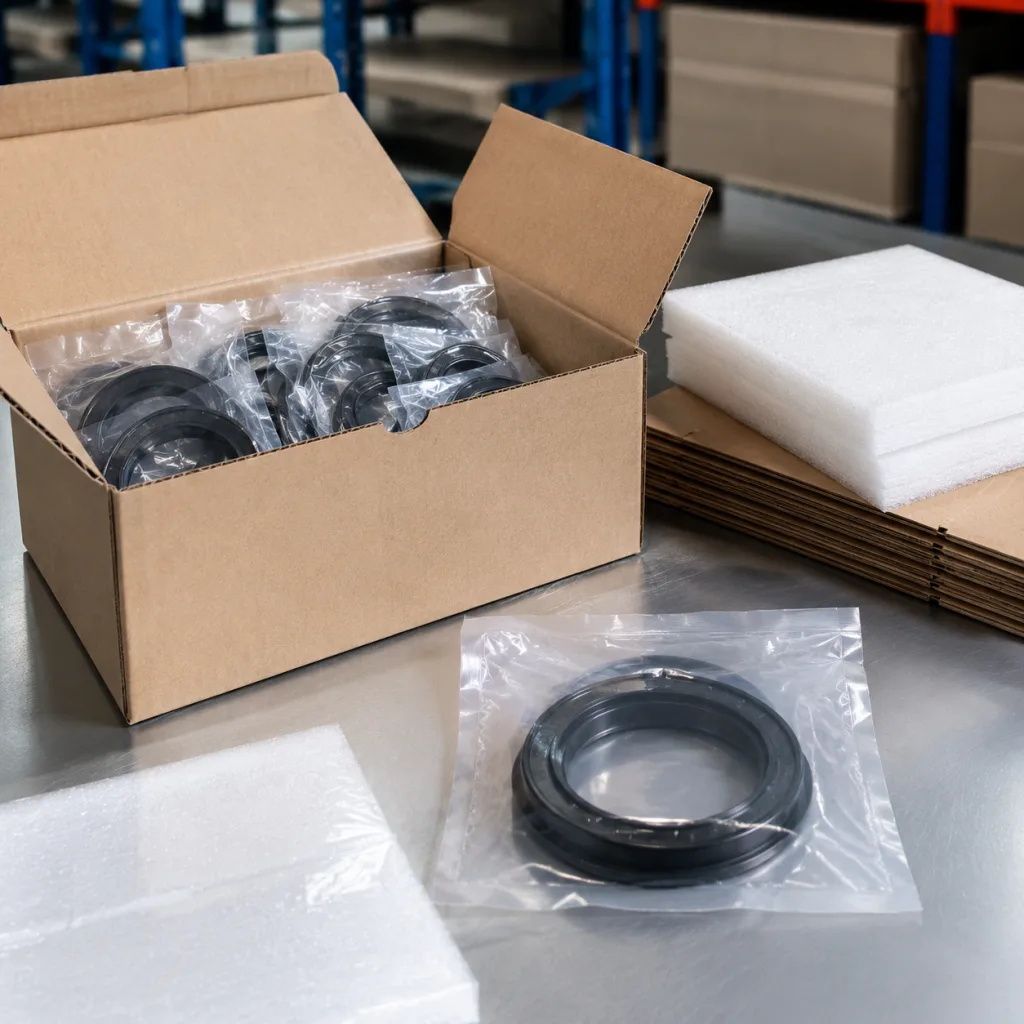
Rear main seals are usually damaged in transit when the sealing edge takes load, the spring shifts, or dirt reaches the lip area. Primary packaging should isolate each seal from abrasion and prevent axial or radial distortion. In most programs, individual pockets are safer than bulk bags.
The right pack format depends on the seal geometry and how sensitive the running edge is. A simple NBR seal may travel well in a format that would be unsuitable for a PTFE rear main seal supplied with a pre-fitted installation sleeve. Buyers should review more than material type alone. Section profile, outside diameter, exposed metal surfaces, and any feature that can catch, compress, or detach in transit all matter.
Seal design
Main transport risk
Recommended primary pack
Secondary pack note
NBR or ACM spring-loaded seal
Lip nicking, garter spring displacement
Individual thermoformed PET or PP tray pocket, then 50-80 micron PE bag
Inner box should stop parts sliding between pockets
FKM seal with metal carrier
Corrosion staining, dust contamination
Tray or divider pack plus low-migration PE bag
Add humidity control if ocean transit exceeds 30 days
PTFE rear main seal with assembly sleeve
Sleeve loss, lip set from side load
One-piece rigid tray that locks the sleeve in position
Do not stack bare parts face to face
Cassette-type seal
Flange damage, face abrasion
Partitioned cell pack with full-face support
Use higher board grade because unit weight is higher
</tr></thead><tbody> </tbody></table>### Design rules for primary packaging A robust primary pack for rear main seals should do four things at once: 1. Keep load away from the sealing lip and any pre-lubricated or finished running surface 2. Prevent part-to-part contact during vibration 3. Hold orientation so the seal does not rotate, tip, or invert inside the pack 4. Limit contamination from paper dust, loose fibres, moisture, and handling debris
For many exporters, thermoformed trays are the most reliable control method because they create repeatable cavities. The cavity should support non-critical outer geometry rather than press on the lip. If a seal includes an installation sleeve, the tray should positively retain both sleeve and seal as one stable unit. Simple flat trays with no contour may work on short routes, but they usually allow movement inside the carton during ocean vibration.
Material selection for trays and bags
Tray and bag materials should be chosen for compatibility as well as cost.
PET trays are commonly used where stiffness and dimensional repeatability are needed.
PP trays can be a good option where impact resistance and lower brittleness at handling temperatures matter.
PE bags are widely used as an economical dust barrier, but thickness and seal integrity should be controlled.
Low-migration bag films are preferable when buyers are concerned about residue transfer, especially on cleaner exposed surfaces.
VCI is not automatically required for every rear main seal; use it only where exposed metal surfaces and route conditions justify it, and verify compatibility with the seal materials.
Bagging should not create a second problem by compressing the tray pocket or forcing the seal against the cavity wall. Overfilled inner bags, tight banding around bagged trays, or carton dimensions that squeeze the stack can all transfer load back into the part.
Avoid common packing mistakes
Several shortcuts regularly lead to damage claims:
Loose bulk packing of seals in one bag or one carton
Face-to-face stacking of unsupported PTFE seals
Trays with cavities too shallow to prevent part movement
Dividers made from rough board that sheds fibres into the lip area
Cartons with excessive void space, allowing trays to bounce during transit
Stretch wrapping inner packs so tightly that tray walls deform
Secondary packaging matters too
Even a well-designed primary tray can fail if the secondary pack is wrong. Inner cartons should fit the tray count closely enough to stop migration, but not so tightly that insertion bows the tray. If void fill is needed, use clean, non-abrasive materials that do not shed dust. For heavier cassette seals, verify that partitions and carton bottoms are rated for the actual unit weight, not a nominal weight carried over from an earlier project.
A practical review question helps here: if the carton is turned, vibrated, or stacked for a month, where does the load go? If the honest answer is "possibly into the lip, face, or sleeve," the design needs revision.
Avoid loose bulk packing. It may save packaging cost, but it raises claim risk, especially on PTFE designs. If a buyer needs mixed packs for service kits or private-label cartons, ask for a validated layout through custom manufacturing instead of repacking standard trays at the warehouse stage.
Control labels, traceability, and documents
Rear main seals are usually low-value line items, but traceability expectations are not low. Under IATF 16949:2016 and ISO 9001:2015 controls, the supplier should be able to link each carton label to production date, compound batch, inspection release, and packing operator.
In export programs, labels do more than help warehouse staff. They are the fastest way to isolate a suspect lot, clear customs, confirm receiving counts, and investigate freight claims. A rear main seal may arrive physically usable, but if the label is unreadable or incomplete, it still creates avoidable risk in stock control and recall containment.
Minimum label fields
Supplier item number and buyer part number
Lot or batch code
Quantity per inner pack and master carton
Date code or packing date
Country of origin
Material or seal type where agreed, for example NBR, FKM, or PTFE
In many programs, buyers also require:
Purchase order number or release number
Serial shipping container code or pallet ID
Barcode or QR code in a specified symbology
Revision level of the packaging specification
Gross and net weight at carton or pallet level
Destination or ship-to code for multi-warehouse networks
Traceability should exist at three levels
A mature export pack usually carries traceability at: 1. Piece or unit-pack level, where practical, especially for service or aftermarket distribution 2. Inner-pack level, so opened cartons can still be controlled in the buyer warehouse 3. Master-carton and pallet level, to support receiving, warehousing, and shipment reconciliation
That layered approach matters when cartons are broken down after import. If only the outer pallet carries a label, traceability may disappear as soon as inventory is redistributed to other sites.
Label durability is part of packaging performance
Carton labels should remain readable after humidity cycling and manual handling. Ink that transfers onto the bag or part is a defect, not a cosmetic issue. Adhesives should resist edge lift in humid conditions, and barcode contrast should still scan after normal abrasion in ports and distribution centres.
Procurement and quality teams should verify:
Label stock does not detach from corrugated surfaces in high humidity
Thermal transfer ribbon or print method does not smear
Ink or adhesive does not contaminate the bag or seal
Barcodes scan through normal handling wear
Human-readable text remains legible even if the outer stretch wrap is removed or damaged
Documents to request with first shipments
For customs and compliance files, ask for REACH (EC) No 1907/2006 declarations, packing list format, and pallet treatment evidence where wood is used. A complete first-shipment document set often includes:
Commercial invoice and detailed packing list
Packaging specification or approved packaging drawing
Lot-coding logic explanation
Country-of-origin statement
REACH (EC) No 1907/2006 declaration and any other requested material compliance statements
ISPM 15 evidence for wood pallets or wood packaging, where applicable
Transit-test summary or packaging validation report if requested in sourcing approval
Retained photos of inner pack, master carton, pallet pattern, and labels
Connect documents to physical labels
The strongest suppliers make the paperwork and the physical pack line up exactly. The carton quantity on the packing list should match the printed carton label. The pallet ID in the shipping notice should match the pallet label. The lot code on the inner pack should link back to production and inspection records without manual interpretation.
That consistency reduces disputes when a buyer receives shortages, mixed lots, or damage. It also speeds containment if there is a quality issue unrelated to packaging, because the buyer can identify affected inventory by lot instead of quarantining all stock.
A mature quality system should make these records routine, not exceptional.
Validate the export pack before mass shipment
Packaging approval should include transit simulation, not just a visual check. For ocean or regional truck distribution, many buyers use ASTM D4169 to define vibration, shock, and compression testing. For parcel-style shipments, ISTA 3A is a common screen. Preconditioning to ASTM D4332 helps expose board weakness and label failure before the real shipment does.
The point of validation is not simply to show that one sample arrives intact. It is to show that the packaging system can repeatedly protect the seal in the expected shipping environment. Rear main seals are well suited to structured validation because damage is often subtle: lip distortion, spring movement, sleeve separation, and contamination can all happen without obvious carton collapse.
What should be tested
Validation should cover the full approved shipping configuration, not loose components tested separately. That means:
Actual production seal or a dimensional equivalent
Real tray material and pocket geometry
Actual bag film and sealing method
Approved inner box and master carton
Intended pallet pattern, wrap, corner protection, and strapping if used
Realistic carton fill count and gross weight
If the supplier tests a lighter carton, fewer trays, or a hand-built pallet that differs from normal production, the result has limited value. The tested sample should match the real outbound condition as closely as possible.
Useful validation elements for rear main seal exports
A practical packaging validation program may include:
Preconditioning for temperature and humidity exposure to challenge board, labels, and adhesives
Vibration testing to identify tray walk, part movement, abrasion, and pallet instability
Shock or drop events to assess corner impact and tray retention
Compression or stack load testing to confirm carton and pallet performance over dwell time
Post-test inspection of seals, sleeves, labels, bags, and carton integrity
For ocean freight, some buyers also request longer dwell simulations or retained samples after environmental conditioning, especially when the route includes tropical ports or extended customs storage.
Set clear acceptance criteria
No deformation at the sealing lip or carrier face
No dislodged spring, missing sleeve, or tray breakout
No unreadable label, torn bag, or mixed lot
Carton and pallet remain stable at the specified stack height
These criteria should be written before testing starts. Otherwise, teams can be tempted to accept borderline results because the outer carton still looks acceptable. With rear main seals, a pass should depend on part condition first and package appearance second.
Inspect the product, not only the box
After testing, inspect multiple parts from different positions in the load:
Top, middle, and bottom cartons on the pallet
Outer and central tray positions inside the carton
Parts from edge pockets and centre pockets
Units nearest any carton seam, divider, or void-fill contact point
This sampling helps reveal whether load concentration or vibration is affecting only certain positions. Bottom-layer trays may show compression marks while upper layers do not, or seals near a carton sidewall may collect more fibre contamination if corrugated abrasion is occurring.
Revalidation should be change-driven
For master cartons above roughly 12 to 15 kg, record an edge crush target or equivalent board grade instead of a generic "5-ply" note. Do not approve a pack after one successful sample only. Re-run the test when tray geometry, carton board, supplier location, or pallet pattern changes.
Other common revalidation triggers include:
New seal design or changed sleeve geometry
Change in bag supplier or film thickness
New warehouse, co-packer, or palletisation line
Change from air to ocean freight, or from FCL to LCL
Significant increase in carton quantity or pallet height
Repeated field damage claims even if the part drawing is unchanged
A disciplined validation process turns packaging from a purchase-price variable into a controlled quality characteristic.
Use a procurement checklist at RFQ and PPAP stage
Before nomination, ask the supplier for a packaging drawing, piece count, board specification, pallet layout, and photos of the packed part. During PPAP or first article approval, confirm that the shipping pack matches the sample pack exactly. For repeat orders, hold the packaging revision in the same change-control process as the seal drawing.
This is one of the easiest places for sourcing teams to cut downstream claims. If packaging is reviewed only after commercial award, there is usually pressure to accept whatever the supplier already uses. By raising the right questions at RFQ and PPAP stage, buyers can compare suppliers on packaging capability as well as part price and lead time.
At RFQ stage, request evidence not general statements
A strong RFQ package for rear main seal export purchasing should ask for:
Packaging drawing or specification with dimensions
Proposed tray material and cavity count
Bag material and nominal thickness
Inner box and master carton board specification
Carton quantity and gross weight
Pallet footprint, stack height, and estimated pallet quantity
Label format and sample traceability codes
Photos of a comparable packed product
Details of any previous export validation for similar seal designs
This information helps buyers compare offers on a like-for-like basis. A low unit price may be offset by poor pallet efficiency, higher damage risk, or missing compliance documentation.
At PPAP or first-article stage, verify actual execution
During PPAP or first article approval, buyers should do more than review drawings. Physically compare the approved sample with the intended serial pack. Confirm:
Part orientation in the tray
Support points relative to the sealing lip and running face
Retention of assembly sleeve where fitted
Bag sealing quality and cleanliness inside the pack
Actual counts per tray, inner, and carton
Label content, format, and scan performance
Carton closure method and tamper evidence if required
Pallet stability with the real stacking pattern
If possible, request retained sample photos from the supplier's packing line and a signed reference sample. That makes later claim discussions much clearer if the production shipment differs from approval.
Integrate packaging into change control
For repeat orders, hold the packaging revision in the same change-control process as the seal drawing. That means a supplier should not change tray geometry, board grade, bag film, count per carton, or pallet pattern without formal notification where the agreement requires it. Packaging changes can alter freight density, warehouse handling, and part protection even when the seal itself is unchanged.
A practical buyer checklist is:
Can the pack prevent any load from reaching the sealing lip?
Is each lot traceable at unit, inner-box, and carton level?
Has the export configuration been tested for the intended route?
Are pallet materials, labels, and declarations aligned with your import requirements?
Can the supplier support non-standard tray counts or private-label cartons through custom manufacturing?
You can expand this checklist into an internal approval gate by adding:
Is the carton gross weight acceptable for manual handling at both origin and destination?
Does the pallet pattern maximise container use without causing overhang or instability?
Are compliance documents available before shipment release, not after arrival?
Is there a revalidation trigger list agreed in writing?
Has responsibility for freight damage claims been defined in the purchase terms?
If you are consolidating engine hard parts and seals in one programme, review our catalog and related engine components before sending the RFQ. Driventus is an independent aftermarket manufacturer; brand names are referenced for fitment only.
Frequently asked questions
For PTFE and spring-loaded designs, usually yes. Individual pockets reduce lip contact, prevent spring shift, and keep assembly sleeves in place. For heavier cassette seals, partition packs can work if full-face support is provided. Loose bulk cartons carry higher risk and should be validated before approval.
Ask for the packing specification, carton and pallet drawing, lot-coding logic, REACH (EC) No 1907/2006 declaration, country-of-origin statement, and ISPM 15 evidence if wood pallets are used. If your process requires PPAP or first article approval, add transit-test records and retained pack photos.
Revalidate when the seal design, tray, bag material, carton board, pallet pattern, warehouse location, or transport route changes. Many importers also recheck annually for high-volume programmes or after any freight damage claim. Packaging control should follow the same change-management discipline as the part itself.
If you need a pack review against your import specification, send the seal drawing, annual volume, destination market, and target carton quantity to [request a quote](/contact.html).