Price to Change Serpentine Belt: Cost Drivers for Buyers
The price to change serpentine belt systems is often framed as a simple retail repair bill, yet B2B buyers need a wider cost view. A replacement event may involve the belt, automatic tensioner, idler pulleys, diagnostic time, vehicle downtime, warranty handling, and parts availability across branches or distributors. For repair chains and aftermarket distributors, the belt purchase price is only one input in a larger operating-cost equation. A low-cost belt that causes chirp, slip, premature wear, or repeat workshop visits can quickly erase any saving. For OEM and Tier-1 sourcing teams, the priorities shift toward compound consistency, dimensional control, validation evidence, traceability, and supply stability. This article breaks down the main cost drivers, inspection points, and sourcing checks behind serpentine belt replacement. Driventus is an independent aftermarket manufacturer; brand names are referenced for fitment only.
What Buyers Should Include in Replacement Cost
For a retail customer, serpentine belt replacement is usually quoted as parts plus labour. For procurement teams, the more useful model is the full replacement cycle: diagnosis, installation, related components, downtime, and aftersales handling.
A practical cost model includes:
Cost element
What it covers
Why it matters for B2B buyers
Belt unit cost
EPDM belt, packaging, labelling, import cost
Direct margin impact for distributors
Labour time
Inspection, belt removal, routing, installation
Affects workshop throughput and fleet downtime
Tensioner or pulley replacement
Related rotating parts
Reduces repeat failure risk when wear is present
Diagnostic time
Noise, slip, charging, cooling, or A/C checks
Prevents belt replacement when the fault is elsewhere
Warranty handling
Returns, credit notes, technical review
Can exceed the part value if quality is inconsistent
Vehicle downtime
Repair bay occupancy and lost vehicle use
Critical for fleets and multi-location repair chains
</tr></thead><tbody> </tbody></table>The price to change serpentine belt components therefore depends on whether the job is a belt-only service or a correction to the front-end accessory drive system. A seized idler, weak automatic tensioner, oil contamination, misaligned pulley, or failing alternator clutch can expand the repair scope and raise the true cost.
Typical Cost Ranges and Labour Variables
Market pricing varies by country, workshop labour rate, engine layout, vehicle class, and access around the accessory drive. The figures below are not quotations; they are planning ranges for estimating cost exposure.
Vehicle/application type
Common belt-only labour time
Typical parts scope
Cost sensitivity
Compact passenger car
0.3–0.8 hours
Belt only, sometimes one idler
Low to medium
Light commercial vehicle
0.6–1.2 hours
Belt plus tensioner inspection
Medium
Transverse engine with limited access
0.8–1.8 hours
Belt, idler, tensioner as needed
Medium to high
Heavy-duty or fleet application
1.0–2.5+ hours
Belt kit and accessory checks
High, due to downtime
</tr></thead><tbody> </tbody></table>Labour differences are often larger than belt price differences. A belt that costs slightly more but installs cleanly, runs quietly, and stays within dimensional tolerance can reduce total replacement cost by avoiding rework.
For importers and repair chains, landed unit price should be reviewed alongside claim rate, fitment coverage, packaging accuracy, and technical data quality. Clear application notes, routing information, and batch traceability reduce wrong-part returns and service desk workload.
Driventus supports distributors with cross-reference and application matching through our catalog, including engine and powertrain components used by aftermarket and fleet channels.
Part Quality Factors That Affect Total Cost
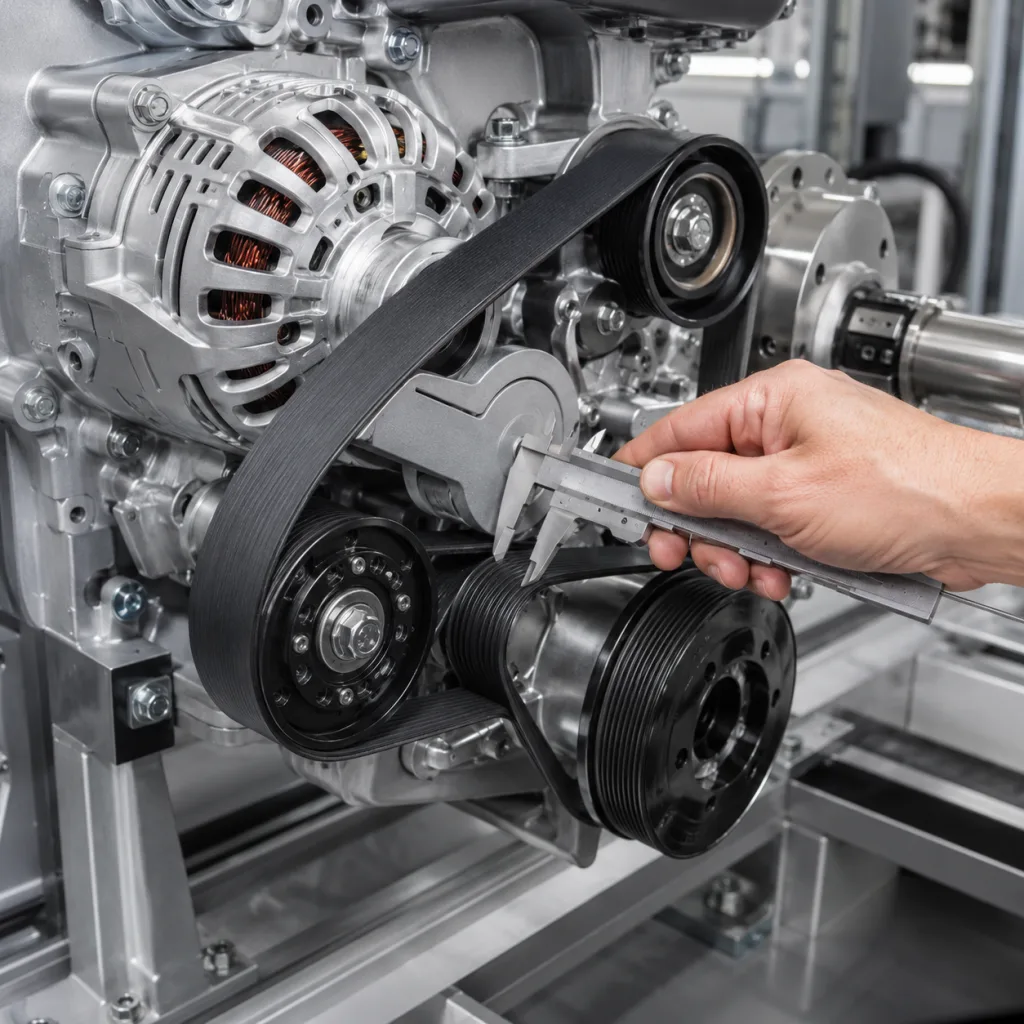
A serpentine belt runs across multiple pulleys and may drive the alternator, water pump on some applications, power steering pump on older systems, air-conditioning compressor, and other accessories. Because the belt works as part of a rotating system, small variations in geometry, compound behaviour, or tensile stability can appear as noise, slip, heat build-up, vibration, or early wear.
Key belt specifications to verify include:
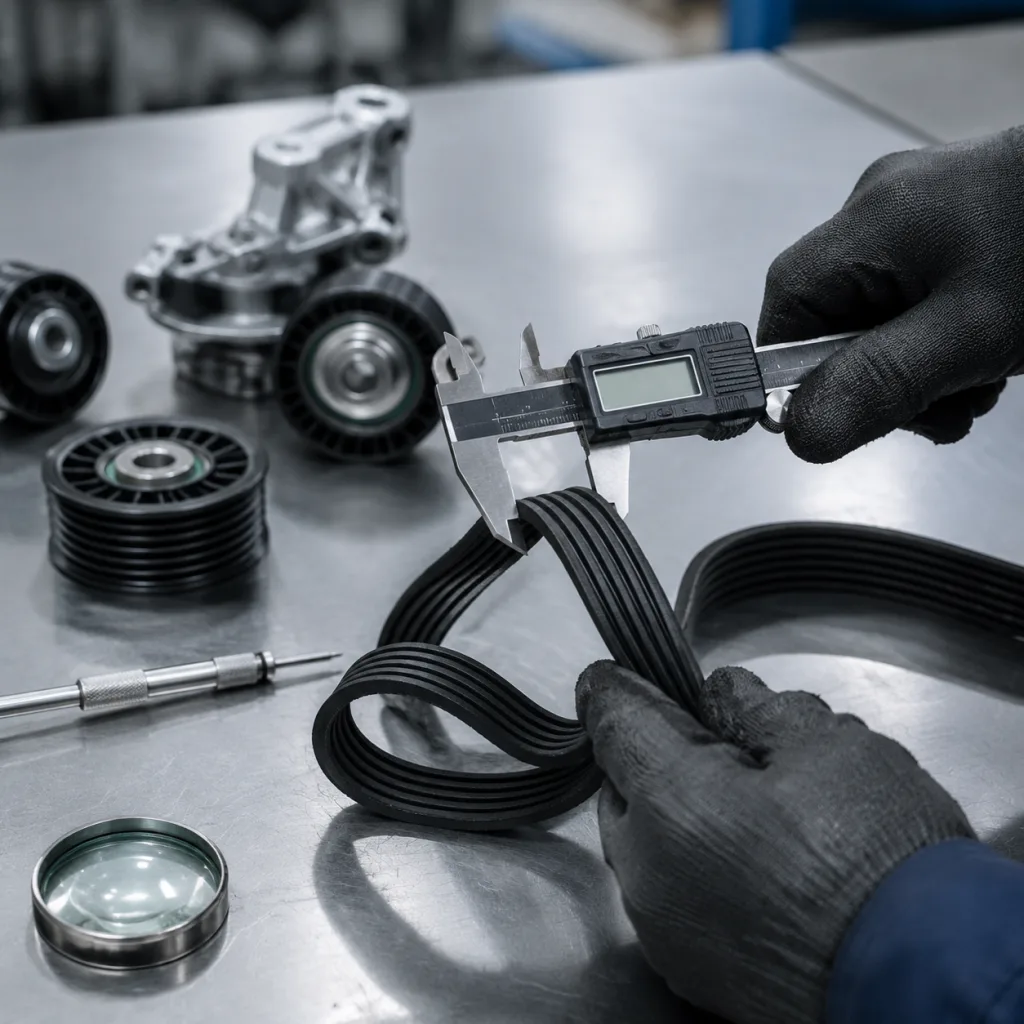
Rib profile: PK multi-rib geometry must match pulley grooves consistently.
Effective length: an incorrect length can move the tensioner outside its working range.
Width and rib count: a 6PK belt cannot be substituted for a different rib count.
Compound: EPDM is common for modern belts because it resists heat ageing better than older chloroprene compounds.
Cord stability: tensile member stretch affects tension retention over service life.
Backside fabric or surface finish: important where backside idlers are used.
Oil and coolant resistance: contamination can still damage belts, but compound selection affects tolerance.
Marking and traceability: batch codes support warranty review and containment.
Published quality systems do not replace product validation, but they create a framework for repeatable process control. Driventus operates under IATF 16949:2016 and ISO 9001:2015, with incoming material inspection, in-process checks, and final inspection aligned with our quality system.
For buyers in the EU and UK, material declarations and chemical compliance should also be part of supplier review. REACH (EC) No 1907/2006 is relevant when checking restricted substances in rubber compounds, coatings, and packaging materials.
Inspection Points Before Replacing the Belt
A belt-only replacement is appropriate when the belt is worn and the rest of the drive system is healthy. If the underlying fault is missed, the same vehicle may return with belt noise, charging problems, overheating, or accessory-drive complaints.
Recommended inspection sequence:
1. Check belt surface condition. Look for rib cracking, glazing, missing rib sections, edge fray, swelling, or contamination. 2. Inspect pulley alignment. Misalignment can cause edge wear, chirp, and belt walk. 3. Rotate idlers and pulleys by hand. Roughness, looseness, or noise indicates bearing wear. 4. Check automatic tensioner movement. A weak or seized tensioner can cause slip, vibration, and unstable belt tracking. 5. Look for fluid contamination. Oil, coolant, and power steering fluid can degrade belt surfaces. 6. Confirm routing. Incorrect routing can change wrap angle and accessory speed. 7. Verify accessory drag. A failing alternator clutch pulley, compressor, or pump can overload the belt.
For multi-location repair chains, a standard inspection checklist reduces inconsistent decisions between branches. It also helps distributors separate genuine product claims from installation issues, contaminated systems, or worn accessory-drive components.
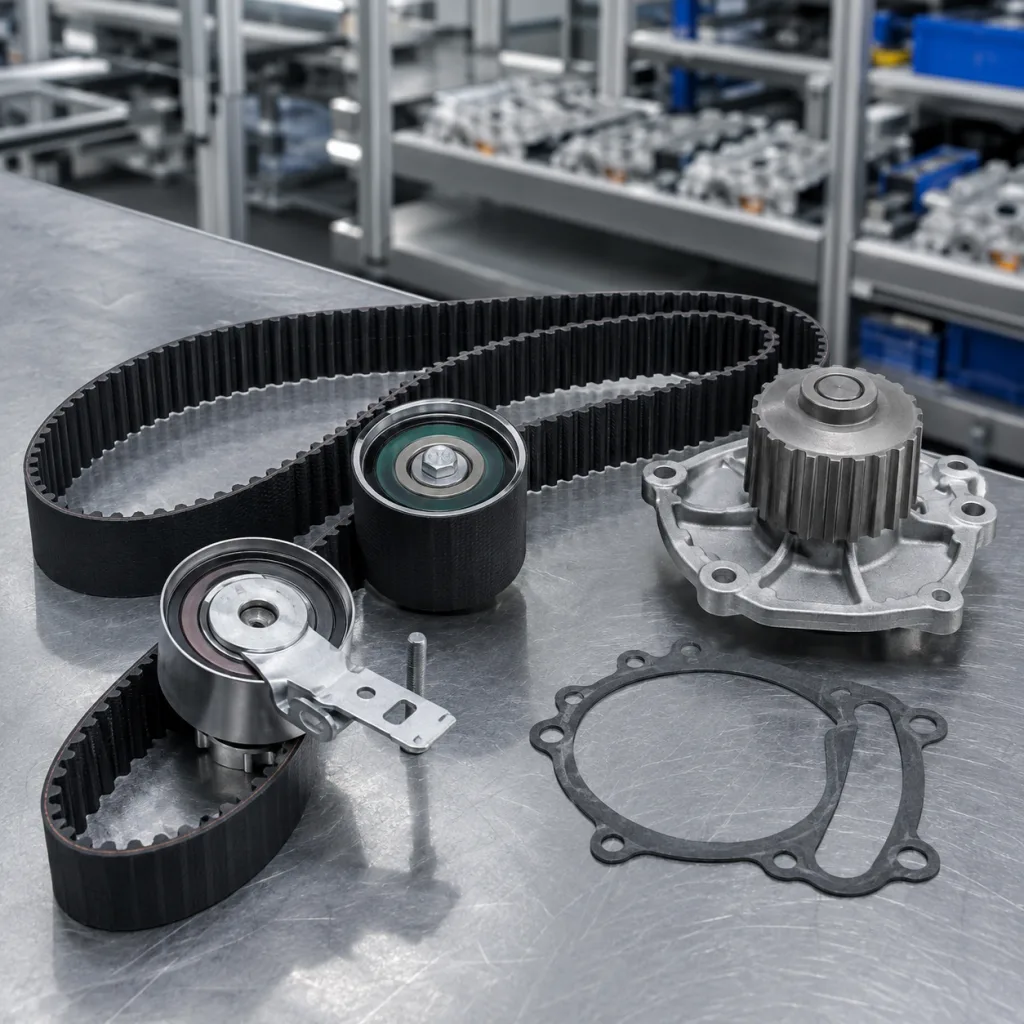
The price to change serpentine belt parts may be higher when the belt is replaced with a tensioner and idler kit, but that approach can be justified when bearing noise, uneven tensioner travel, pulley wear, or high fleet downtime risk is present.
Sourcing Criteria for Distributors and Repair Chains
A low purchase price does not always lead to a low operating cost. Serpentine belts are high-volume products with significant fitment risk, so application data, packaging accuracy, batch stability, and claim management all influence the buying decision.
Procurement teams should assess:
Sourcing criterion
Practical question to ask
Commercial impact
Application coverage
Are belt lengths, rib counts, and engine notes mapped clearly?
Reduces wrong-part returns
Dimensional control
Are effective length and rib profile checked by batch?
Improves fit and tensioner position
Material consistency
Is the EPDM compound controlled by formulation and supplier?
Reduces early cracking and noise
Packaging accuracy
Are labels, barcodes, and batch codes consistent?
Supports warehouse efficiency
MOQ and lead time
Can demand be balanced across fast and slow movers?
Protects stock availability
Warranty process
Is technical review available for claims?
Lowers dispute cost
Compliance support
Are material and quality documents available?
Supports importer due diligence
</tr></thead><tbody> </tbody></table>Driventus supplies B2B customers in more than 60 countries from Taizhou, Zhejiang. For standard lines, buyers can review fitment families in our catalog. For private-label projects, dimensional adaptation, packaging requirements, or belt kit development, our engineering team can discuss custom manufacturing.
Driventus does not claim vehicle manufacturer approval or endorsement. Products are developed for aftermarket fitment and buyer-specified requirements.
How to Reduce Cost Without Increasing Risk
Cost reduction should focus on repeatability, not only unit price. The strongest savings usually come from fewer wrong picks, fewer comebacks, cleaner warranty decisions, and better stock planning.
For distributors:
Rationalise SKUs by demand and vehicle parc, not only catalogue breadth.
Use OE part-number cross-references only when verified from reliable data sources.
Require batch traceability on labels and cartons.
Compare claim rate by belt family, installer type, and region.
Audit packaging readability, barcode scan rate, and carton durability.
For repair chains:
Use a standard inspection sheet for belts, pulleys, and tensioners.
Replace contaminated belts and correct the leak source.
Train technicians to check tensioner operating range after installation.
Track comeback reasons separately from part warranty claims.
Keep fast-moving belt lengths available at branch level.
For OEM and Tier-1 programmes, the review should also cover design validation, process capability, material certification, change control, and documented approval requirements. Buyers should request PPAP-style documentation where appropriate, even when the programme does not follow a formal automotive PPAP submission route.
The practical target is not the lowest invoice value; it is the lowest avoidable cost per successful repair. In the context of the price to change serpentine belt assemblies, that means reliable fitment, predictable installation, fewer noise complaints, and stable supply over the life of the programme.
Frequently asked questions
Labour time and related component condition often influence the final cost more than the belt itself. If the tensioner, idlers, alternator clutch pulley, or accessory pulleys are worn, the repair scope increases. For B2B buyers, wrong-part returns, downtime, and warranty handling should also be included in the cost model.
Not always. A belt-only replacement can be suitable if the tensioner and pulleys operate correctly. Replacement as a kit is more appropriate when the tensioner is weak, noisy, seized, leaking damping fluid, sitting outside its normal operating range, or paired with worn idlers.
Compare dimensional control, EPDM compound consistency, application data accuracy, packaging quality, lead time, MOQ, compliance documents, validation evidence, and warranty support. Certification to IATF 16949:2016 and ISO 9001:2015 is useful, but buyers should also review batch traceability and product-level test controls.
If you are reviewing belt supply, packaging options, or replacement cost exposure across a repair network, Driventus can support the comparison. To share drawings, fitment lists, or forecast volumes, [request a quote](/contact.html).