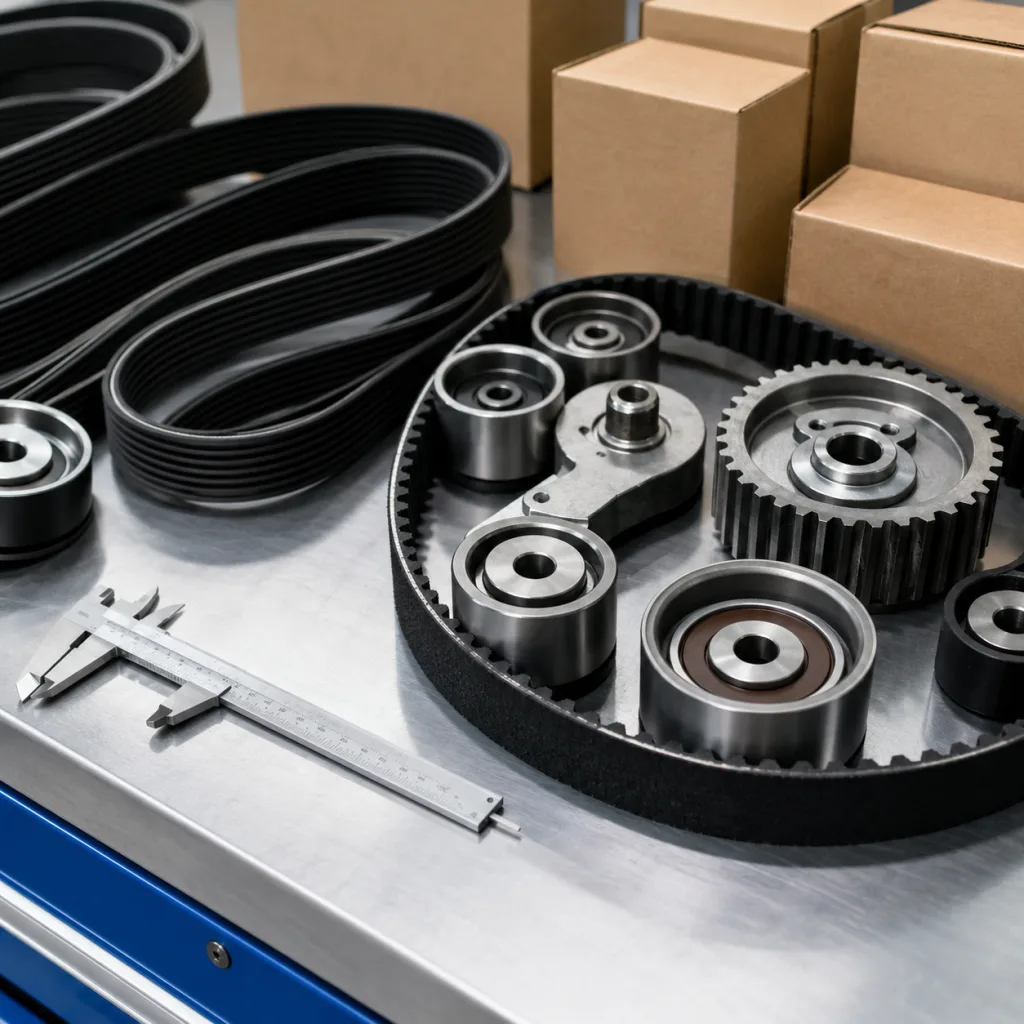
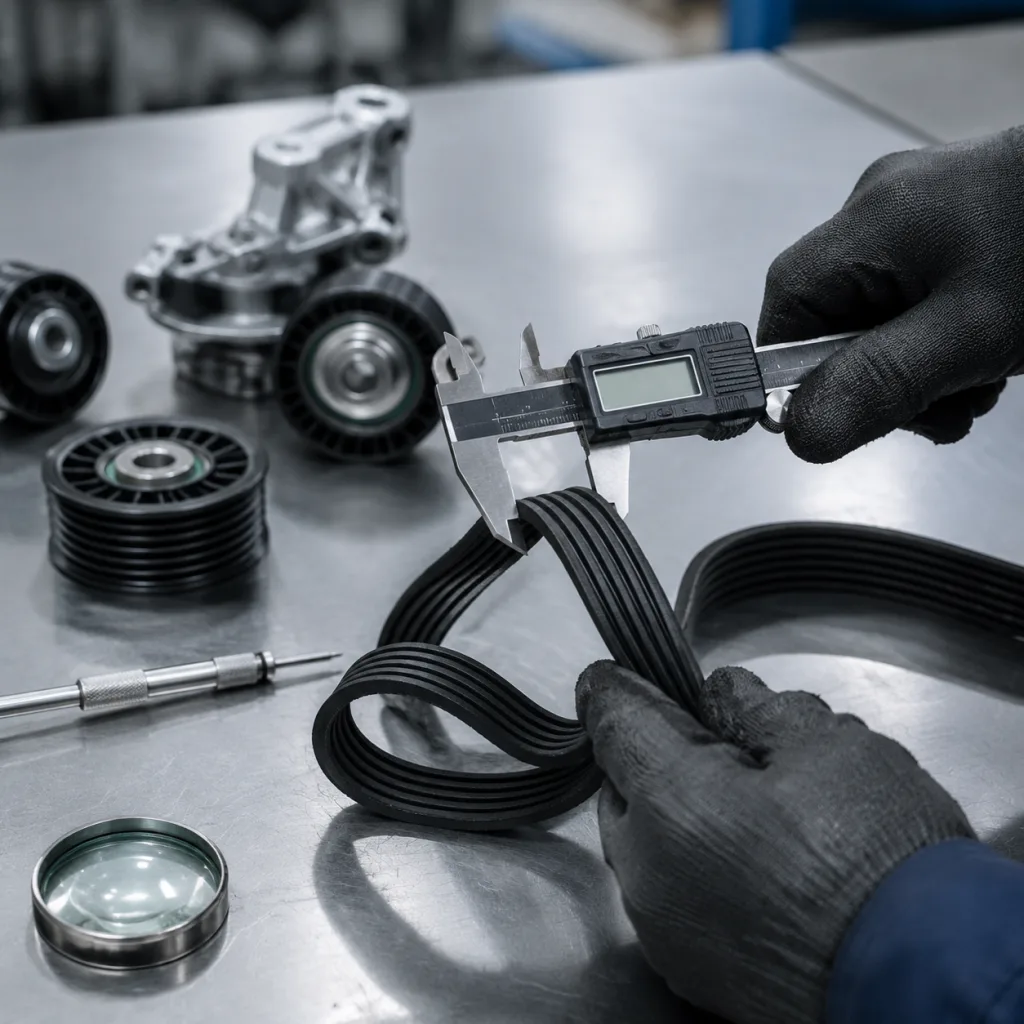
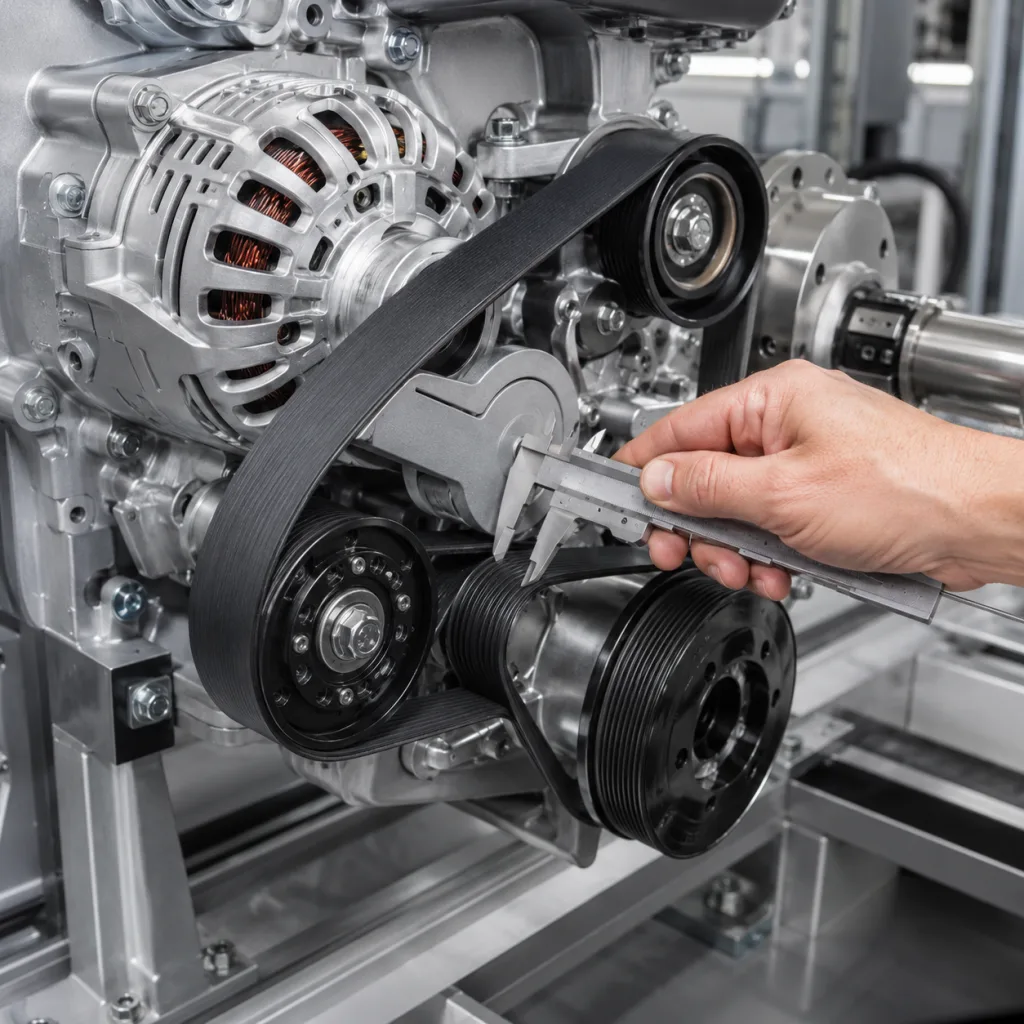
Engine belt replacement cost is often presented as a retail service price, but B2B buyers need a broader cost view. For distributors, repair chains and fleet workshops, the real figure includes the belt or kit, tensioners, idlers, water pump exposure, labour time, warranty handling, logistics, catalogue accuracy and stock availability. A low unit price can quickly become expensive if dimensions drift, rubber compounds age poorly, bearings are inconsistent or batch traceability is weak. This guide breaks down the main cost components for timing belts and accessory drive belts, explains why complete kits are often sourced instead of single belts, and provides practical benchmarks for procurement discussions. Driventus manufactures engine and powertrain components in Taizhou, Zhejiang, and supplies aftermarket distributors, OEM/Tier-1 programmes and multi-location repair groups in more than 60 countries. Driventus is an independent aftermarket manufacturer; brand names are referenced for fitment only.
Cost Ranges Buyers Should Separate
A procurement file should separate part cost, landed cost and installed service cost. Timing belt work is labour-intensive because access is restricted, engine timing must be locked, and an installation error can damage valves on interference engines. Accessory belt replacement is usually faster, but belt quality still affects noise, slip, charging performance, air-conditioning operation and customer returns.
Belt type
Typical parts scope
Common B2B cost drivers
Workshop time sensitivity
Timing belt only
Belt, sometimes no hardware
Tooth profile, tensile cord, rubber compound, oil and heat resistance
Pump casting, impeller material, seal durability, coolant compatibility
Very high; often selected to reduce repeat labour
Accessory drive belt
Serpentine or V-ribbed belt
Rib geometry, EPDM compound, length tolerance, noise control
Medium; fast job but high repeat-volume exposure
Accessory belt kit
Belt plus tensioner/idler
Spring tension, bearing grease, pulley alignment
Medium to high; reduces comeback risk
</tr></thead><tbody> </tbody></table>For a multi-branch repair chain, the more useful metric is cost per successful repair rather than belt price per piece. That metric includes technician time, rework, returns handling, vehicle downtime, warranty administration and the probability that the right SKU is available when the vehicle is in the bay.
What Changes the Installed Price
The installed price varies by engine layout, access time, labour rate and kit content. A transverse four-cylinder petrol engine may need less disassembly than a compact diesel engine with tight packaging. Some applications require removal of engine mounts, covers, auxiliary belts, coolant components or underbody panels before the belt can be reached.
Key variables include:
Engine design: Interference engines carry higher risk if timing is incorrect or the belt fails.
Belt location: Front-mounted accessory belts are faster to replace than enclosed timing belts.
Kit strategy: Replacing tensioners and idlers adds parts cost but reduces bearing-related failures.
Water pump access: If the pump is driven by the timing belt, many workshops replace it during the same service.
Labour rate: National, regional and contract labour rates can move the installed price more than the belt price.
Special tools and checks: Some engines require locking tools, torque-angle procedures and post-install inspection.
For distributors, catalogue accuracy has a direct cost impact. Incorrect belt length, tooth count, width or rib count creates emergency freight, branch credits, delayed repairs and lost workshop confidence. This is why OE part-number cross-references, VIN-range validation, engine-code mapping and application notes matter. When a customer cites a generic reference such as OE 06A107065 or 11251…, the sourcing team should confirm that the reference belongs to the relevant belt family before quoting, listing or cross-referencing it.
Parts Specification and Quality Controls
A belt is a wear component, but it is also a precision transmission part. Timing belt pitch, tooth geometry, width and tensile member position must remain stable under heat, oil mist, ozone exposure and repeated bending. Accessory belts need controlled rib geometry and compound consistency to prevent squeal, slip, edge wear and premature cracking.
Procurement specifications should cover:
Parameter
Why it affects cost
What buyers should request
Tooth count or effective length
Wrong dimensions cause immediate non-fitment
Drawing or application-specific dimensional check
Tooth/rib profile
Affects meshing, noise and load transfer
Profile verification by model family
Tensile cord material
Controls stretch and timing stability
Material declaration and batch consistency records
Rubber compound
Affects heat, ozone and oil-mist resistance
Compound type and ageing test summary
Tensioner bearing
Common source of noise and comeback claims
Bearing supplier control and rotational noise checks
Pulley runout
Misalignment accelerates edge wear
Concentricity and runout inspection data
Packaging and labelling
Prevents branch-level picking errors
Barcode, kit contents list and traceable batch code
</tr></thead><tbody> </tbody></table>Driventus operates under IATF 16949:2016 and ISO 9001:2015 frameworks. These standards do not guarantee that a part fits every application; they define process controls for quality management, traceability, corrective action and continual improvement. For European distribution, buyers may also request material declarations aligned with REACH (EC) No 1907/2006 where applicable. Driventus is an independent aftermarket manufacturer; brand names are referenced for fitment only.
Single Belt Versus Complete Kit
The lowest shelf price is usually a single belt. The lower operating cost is often achieved with a complete kit. A timing belt may fail because the belt material has degraded, but many field failures start with a seized idler, weak tensioner, leaking water pump, contaminated pulley path or incorrect installation tension.
For B2B buyers, kit sourcing has several advantages:
Fewer purchase lines and simpler branch replenishment.
Lower risk of technicians reusing worn tensioners or idlers.
Clearer warranty responsibility because matched parts come from one supplier programme.
Reduced vehicle downtime when all wear items are available for the first repair.
Easier private-label packaging with complete application notes.
The trade-off is inventory value. A full belt-and-water-pump kit ties up more capital than a belt-only SKU and needs more accurate demand planning because vehicle parc coverage, engine codes and service intervals differ by region. Category managers often carry belt-only items for price-sensitive channels and complete kits for repair chains where bay efficiency, first-time completion and warranty reduction are more important.
Driventus can support belt-adjacent engine component sourcing through our catalog, including water pumps, gaskets and related engine components. For buyers developing private-label or application-specific kits, custom manufacturing may include packaging configuration, batch labelling and drawing-based dimensional review.
How Procurement Teams Can Model Total Cost
A practical cost model should use a landed and installed view. The belt unit price is only one line in the calculation. For importers, distributors and repair networks, the following structure is more useful:
1. Factory unit price: Belt or kit price by SKU, MOQ and annual forecast. 2. Tooling or validation charge: Relevant for new applications, custom kits or private-label launches. 3. Packaging cost: Neutral box, private label, barcode, kit insert and pallet configuration. 4. Freight and duties: Sea freight, air freight for urgent launches, customs duty and local handling. 5. Inventory cost: Safety stock, slow-moving SKUs, branch transfers and forecast error. 6. Labour impact: Standard repair time, bay occupancy, rework rate and technician availability. 7. Warranty reserve: Expected claim rate, parts credit, labour participation policy and field analysis cost. 8. Obsolescence risk: Engine population decline, supersession control and old-stock write-downs.
A small saving on the belt can disappear if the claim rate rises or if stock accuracy falls. For example, a distributor moving 30,000 belt kits per year only needs a modest increase in returns, credits or emergency shipments to offset a lower purchase price. Buyers should therefore ask suppliers for dimensional inspection data, sample retention policy, batch traceability and failure-analysis response time.
Search demand for engine belt replacement cost is high because end users compare repair prices, but B2B teams can use that signal for assortment planning. If retail workshops receive frequent belt-cost enquiries, distributors need accurate kits, clear application coverage and stable replenishment. Driventus’ quality system supports batch tracking and corrective-action processes for these requirements.
Sourcing Checklist Before Awarding Supply
Before awarding a belt or kit programme, confirm commercial and technical inputs in the same review. Separating purchasing from engineering review can lead to low-cost awards that later create cataloguing errors, warranty disputes or branch-level service problems.
Recommended checklist:
Confirm application list by engine code, model year and market region.
Verify belt tooth count, width, pitch and material specification for timing applications.
Verify rib count, effective length and EPDM compound for accessory drive belts.
Request PPAP-style documentation where the programme requires OEM/Tier-1 discipline.
Confirm compliance documentation, including IATF 16949:2016, ISO 9001:2015 and REACH (EC) No 1907/2006 material declarations where applicable.
Agree MOQ, lead time, sample approval, packaging artwork, barcode format and warranty handling.
Review supplier response time for 8D corrective-action reports if field issues occur.
Driventus manufactures engine and powertrain components for export markets from Taizhou, Zhejiang. For belt-related service kits, the cost discussion often includes water pumps, gaskets, seals and pulleys rather than the belt alone. Buyers can compare current applications against our catalog and send a forecast, sample or drawing package to request a quote. Driventus is an independent aftermarket manufacturer; brand names are referenced for fitment only.
Frequently asked questions
Timing belts are usually enclosed and require controlled engine timing during installation. Labour time is higher, and incorrect timing can damage an interference engine. Accessory belts are normally easier to access and faster to replace, although tensioner and pulley condition still affect long-term repair quality.
Most distributors need both. Belt-only SKUs support price-sensitive channels and older vehicles. Complete kits suit repair chains and professional workshops because tensioners, idlers and sometimes water pumps are replaced together, reducing repeat labour and warranty ambiguity.
Request dimensional inspection records, material declarations, batch traceability, quality certificates such as IATF 16949:2016 and ISO 9001:2015, packaging specifications and warranty handling procedures. For regulated markets, ask whether material declarations align with REACH (EC) No 1907/2006 where applicable.
If you are reviewing engine belt replacement cost, belt kit sourcing, water pump inclusion or private-label packaging, share your application list and annual forecast with Driventus. Our team can review fitment data and cost structure through /contact.html