camshaft · 2026-06-02

Camshaft for Peugeot 308 Aftermarket Replacement: OE Match

Selecting a camshaft for Peugeot 308 aftermarket replacement is a precision fitment and validation exercise, not a simple catalogue match. Procurement teams need to confirm the engine code, intake or exhaust side, lobe profile, journal diameter, thrust-face location, cam sensor reference, VVT/phaser interface, oil-feed layout, and the valve-train hardware used on the original engine. A part can look correct in a cross-reference yet fail in service if lift, base circle, angular phasing, surface hardness, oil-hole position, or journal finish differs from the OE design. For B2B buyers, the goal is OE-equivalent geometry backed by controlled metallurgy, repeatable machining, lot-level inspection data, traceable materials, and packaging that protects precision-ground lobes and journals during export handling. Driventus is an independent aftermarket manufacturer; brand names are referenced for fitment identification only. This article covers what to verify before purchase, how to compare replacement routes, which quality records to request, and how to structure supply control before releasing stock into a distributor, workshop, fleet, or remanufacturing channel.

What defines an OE-equivalent replacement

For a camshaft replacement, OE-equivalent means the working geometry and functional interfaces reproduce the original shaft closely enough to keep valve lift, opening point, closing point, duration, overlap, and cam-to-crank timing inside the engine's calibrated operating window. On Peugeot 308 applications, that precision matters even more when the camshaft works with variable valve timing, a cam position sensor, hydraulic lash adjustment, roller followers, or a belt or chain drive that depends on accurate angular phasing.

Typical control points include:

  • Journal diameter, journal width, and centre-to-centre journal spacing
  • Lobe lift, lobe width, flank profile, opening and closing ramps, and nose radius
  • Lobe separation angle and angular relationship between cylinders
  • Base circle diameter, concentricity, and radial runout
  • Overall length, end-face geometry, and shoulder positions
  • Thrust-face location, thrust width, and thrust surface finish
  • Keyway, slot, dowel, taper, bolt pattern, or phaser mounting interface
  • Phasing reference for VVT components, cam sensor trigger wheels, or reluctor rings
  • Oil-feed holes, annular grooves, cross-drillings, and lubrication paths where applicable
  • Surface hardness and finish on lobe, journal, and thrust areas
  • Straightness, runout, and balance-related machining consistency

The common failure mode in replacement sourcing is not always immediate breakage. More often, it is a dimensional or angular mismatch. A 0.05-0.10 mm error in journal diameter can disturb oil clearance or bearing support. A few tenths of a millimetre in lobe height or thrust location can affect valve motion, axial control, idle quality, start-up noise, emissions behaviour, or top-end power. A small angular error at the phaser interface or trigger wheel can also create cam/crank correlation faults, even when the camshaft physically installs in the cylinder head.

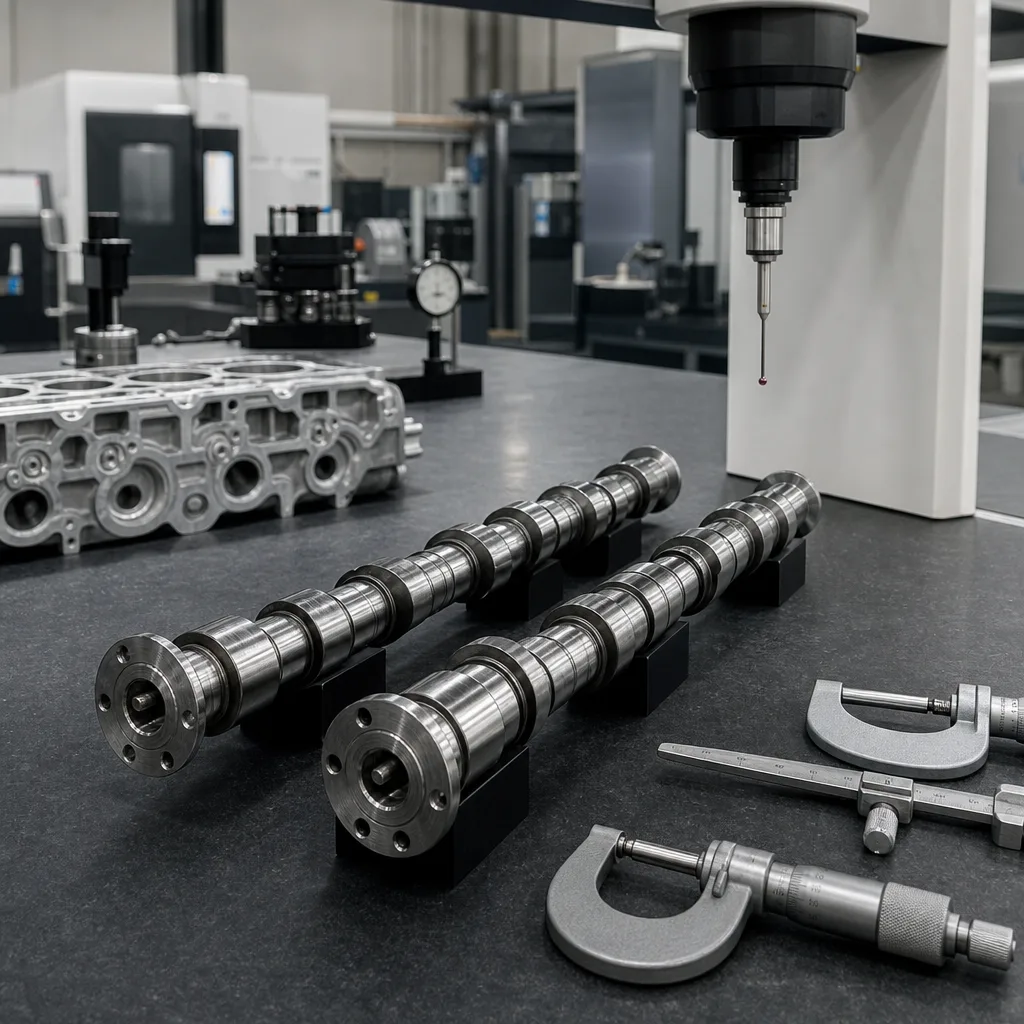
That is why buyers should request dimensional inspection reports, not just a part number label. A reliable supplier should identify datum points, critical-to-function dimensions, inspection equipment, sampling frequency, and lot acceptance limits. For B2B stock programmes, an OE-equivalent camshaft for Peugeot 308 aftermarket replacement should be approved as a precision engine component with controlled geometry and traceable process records, not handled as an ordinary machined shaft.

If you need a broader view of available engine parts, start with our catalog and the related engine components.

Fitment checks for Peugeot 308 programs

The Peugeot 308 has been supplied with multiple petrol and diesel engine families across different production years and markets, so fitment must be confirmed by engine code and camshaft side rather than model name alone. The same vehicle badge can cover different cylinder head layouts, timing drives, valve-train arrangements, emissions calibrations, and sensor configurations. In aftermarket sourcing, the fitment file is as important as the physical part.

Before ordering, verify the following against the vehicle record, OE service data, TecDoc-style catalogue data, or a stripped OE sample:

  • Engine family and exact engine code
  • Production year range, market application, and emission standard where relevant
  • Intake camshaft, exhaust camshaft, or matched camshaft set
  • Petrol or diesel application
  • Number of valves, cylinder head layout, and cam carrier arrangement
  • Presence and type of VVT or phaser mounting features
  • Cam sensor trigger pattern, tooth count, orientation, and wheel location
  • Timing drive type: belt, chain, gear, or mixed layout depending on engine design
  • Lifters, roller followers, rocker arms, and hydraulic lash adjustment arrangement
  • Oil-feed holes, grooves, and control passages used for lubrication or phaser actuation
  • Sprocket, phaser, gear, pulley, or vacuum-pump interface
  • OE drawing reference, service part number, or verified interchange reference
  • Supersession history in the original service channel

For fleet, distributor, and workshop supply orders, build the fitment matrix by engine code, production year, valve-train layout, cam side, timing interface, sensor reference, and OE number. This reduces returns and prevents the common catalogue error of treating all 308 variants as interchangeable. It also helps sales teams define the coverage boundary when one camshaft applies only to a specific engine family, production window, or intake/exhaust position.

Where a physical OE sample is available, compare both obvious and hidden features. Overall length, journal count, and lobe count are only the starting points. Buyers should also verify keyway or dowel position, dowel diameter, thread depth, oil-hole clocking, trigger wheel tooth form, end machining, thrust width, and whether the replacement is supplied as a bare shaft or with any fitted wheel, ring, or plug. Differences in these areas can block installation, cause sensor correlation codes, restrict oil delivery, or create noise after start-up.

If the part is being sourced for a controlled programme, ask for photos of machined features from the supplier's approval sample, not only finished-packaging images. A casting, forging, or tubular blank can look similar while the final machining differs in the details that matter to installers. Visual confirmation, drawing-based inspection, and a retained master sample give procurement and quality teams a firmer basis for approval before bulk release.

Replacement options compared

Different replacement routes can all look attractive at quotation stage, but they carry different risks in fitment, wear performance, documentation, and repeatability. For a camshaft for Peugeot 308 aftermarket replacement, the lowest unit price can become expensive if it leads to warranty claims, workshop delays, catalogue returns, or repeat labour.

</tr></thead><tbody> </tbody></table>For most procurement teams, OE-equivalent aftermarket is the practical balance. It can provide stable coverage, predictable availability, and lower risk of timing drift than generic parts, while avoiding the core-quality variation and limited scalability of worn cores. Buyers should still confirm that the aftermarket supplier controls the functional dimensions that determine installation and operation, rather than checking only packaging appearance or broad catalogue interchange.

A generic low-cost replacement may be acceptable for highly price-sensitive markets, but it creates risk when the supplier cannot provide inspection data, material traceability, or a defined fitment boundary. The real cost often appears after sale as returns, installer complaints, repeat labour, and loss of confidence in the distributor's engine-parts range.

A remanufactured or reground part can work when the core pool is controlled and the grinding process is validated. However, the buyer must confirm final lobe lift, duration, ramp profile, base-circle change, hardness after reprocessing, surface treatment, straightness, and compatibility with followers or hydraulic lash components. Regrinding can alter valve-train geometry if the engine design does not tolerate a reduced base circle, so it is best used in programmes where the full rebuild specification, follower selection, and lash compensation are managed together.

When comparing suppliers, ask which inspection method is used on critical dimensions, what acceptance limits apply, and whether every batch is traceable to a production lot. For first release, request an approval sample, first-article inspection report, marked critical dimensions, and a retained master sample process before placing repeat orders.

Materials, tolerances, and validation

A reliable camshaft programme depends on controlled metallurgy, accurate machining, stable heat treatment, and repeatable final inspection. The camshaft operates under sliding or rolling contact, cyclic load, oil-film variation, and repeated cold-start wear, so the material and surface condition must support durability as well as consistent valve timing. Depending on the OE design, aftermarket production may use chilled cast iron, forged steel, assembled/tubular steel, induction-hardened steel, nitrided surfaces, or other approved routes. The replacement route should match the functional requirements of the original part, not merely its external shape.

Exact values must follow the drawing, OE benchmark, or approved sample, but buyers commonly request the following controls:

  • Material grade confirmed by mill certificate, incoming material record, or spectrometer check
  • Heat-treatment or surface-treatment route documented by production lot
  • Runout and straightness controlled to a defined limit, commonly in the 0.02-0.05 mm range for precision-ground shafts where the design requires it
  • Lobe height, base circle, and journal diameter controlled to drawing tolerances, often within hundredths of a millimetre on critical ground features
  • Angular phasing of lobes, dowel/keyway, phaser interface, and trigger wheel measured from defined datums
  • Thrust width, shoulder position, and end float-related features measured against the approved sample
  • Surface roughness recorded for journals, lobes, and thrust faces; ground journal finishes are typically specified far finer than general machined surfaces
  • Hardness verification after heat treatment or surface treatment, with case depth or effective hardened layer confirmation where applicable
  • Magnetic particle, crack, or visual defect inspection on defined lots or high-risk features
  • Cleanliness checks for oil holes, grooves, cross-drillings, and machined passages
  • Final anti-corrosion protection before packing

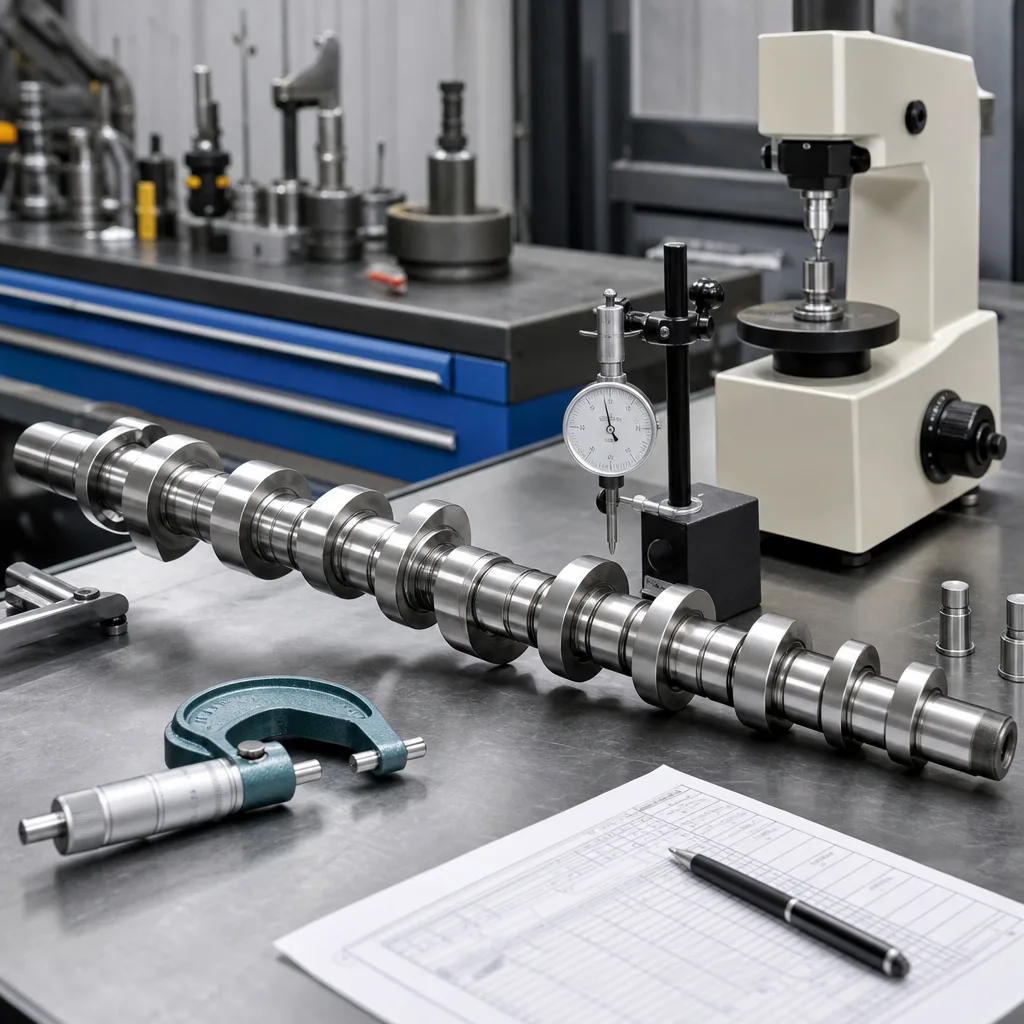
Validation should connect the drawing to the production process. A first-article inspection report confirms that the supplier can produce one correct part. Ongoing batch inspection confirms that the process remains stable after tooling wear, machine changeover, material lot changes, heat-treatment variation, or grinding wheel dressing changes. For higher-volume programmes, buyers may request capability data on key characteristics such as journal diameter, lobe height, phasing angle, thrust width, and runout.

Functional validation can include installation checks using a reference cylinder head or fixture, free-rotation checks after assembly, cam sensor trigger verification, phaser fit checks, and dimensional comparison against an OE sample. Where the camshaft interfaces with VVT hardware, phaser mounting dimensions, oil-control passages, bolt seating faces, and angular references deserve special attention. A burr, blocked oil path, rough thrust face, or minor angular offset can cause noise, timing faults, oil-pressure problems, or poor drivability even if the main journals measure correctly.

Packaging and corrosion protection are part of validation, not an afterthought. Precision-ground lobes and journals can be damaged by moisture, carton collapse, vibration, or metal-to-metal contact during export freight. For sea freight and mixed-pallet shipments, specify protective oil, VCI bagging where appropriate, end caps or end protection, separators, desiccant where required, and cartons strong enough to prevent impact marks on lobe noses and journals.

Where material declarations are needed, reference REACH (EC) No 1907/2006. For suppliers working to controlled automotive systems, IATF 16949:2016 and ISO 9001:2015 are baseline references for process discipline and document control. They do not replace part-level validation, but they help confirm that the supplier has a structured quality system behind the product.

You can review our quality system for document control, incoming inspection, and lot traceability practices. Where a programme requires drawing-based development, custom manufacturing is available for engineered replacements.

Sourcing, packaging, and supply control

Procurement teams usually need three things from a camshaft supplier: repeatable production, usable documentation, and packaging that protects precision surfaces. For aftermarket channels, that means clear part identification, intake/exhaust differentiation, barcode or lot marking, protective oil or VCI packaging, and carton protection that prevents journal, lobe, trigger-wheel, and thrust-face damage in transit. It also means the supplier must repeat the approved specification across future orders, not only provide one acceptable sample.

A clean sourcing file should include:

  • Confirmed application list by engine code, OE reference, year range, market, and camshaft side
  • OE service number, drawing reference, or validated sample reference
  • Material grade and heat-treatment or surface-treatment route
  • First-article inspection report and batch inspection report for critical dimensions
  • Control plan for journals, lobes, phasing points, thrust faces, oil holes, and sensor references
  • Surface hardness, case-depth, and surface-finish records where required
  • Lot traceability method, marking format, and retention period for records
  • Packaging specification for sea freight, air freight, courier shipments, and mixed pallets
  • Label content, barcode format, carton quantity, and intake/exhaust identification method
  • Lead time by lot size, MOQ, forecast volume, and reorder trigger point
  • Sampling plan for first article, pilot order, and repeat orders
  • Warranty handling process, claim evidence requirements, and failure analysis workflow

For distributors, the commercial risk is often caused by incomplete information. If the catalogue says the part fits too broadly, workshops may install it on the wrong engine variant. If labels do not clearly distinguish intake and exhaust camshafts, warehouse picking errors become more likely. If packaging allows corrosion or surface damage, a dimensionally correct part can arrive unusable. These are supply-control issues as much as manufacturing issues.

If the camshaft is part of a larger engine-parts programme, ask whether the factory can hold a release sample and replicate the same control plan on reorders. A retained sample gives both sides a physical benchmark for future disputes, engineering changes, and quality checks. For wholesalers and repair networks, this is especially valuable when the same part may be supplied over multiple shipments and sold through different branches.

Agree change-control expectations before the first bulk order. The supplier should notify the buyer before changing material source, blank type, machining route, heat-treatment supplier, surface treatment, inspection method, packaging structure, or any feature that affects installation. This protects catalogue accuracy and reduces the risk of unapproved variation entering stock.

For quotes, volume planning, or programme review, use request a quote.

Frequently asked questions

Match the engine code, camshaft side, timing drive type, OE reference, and VVT or sensor-wheel features. Model name alone is not enough because the Peugeot 308 was built with several engines and valve-train layouts.

Ask for first-article and batch dimensional inspection data, material and heat-treatment records, hardness or surface-finish results where required, lot traceability, packaging specification, and quality certificates. For regulated procurement, request declarations tied to REACH (EC) No 1907/2006.

Yes, if the part is OE-equivalent, traceable, and validated against the correct engine code and camshaft side. The main risk is fitment mismatch, so phasing, sensor reference, lobe geometry, and clear cross-referencing are essential.

If you need a camshaft matched to a specific Peugeot 308 engine code or a controlled aftermarket programme, send the part details and target volume through /contact.html

Request a Quote
Option Fit risk Dimensional control Typical use
OE-equivalent aftermarketLow when validated by engine code and cam sideHigh, with inspection on journals, lobes, thrust faces, oil features, and phasing pointsDistributor stock, workshop supply, reman channel, fleet maintenance
Generic low-cost replacementMedium to highVariable, often with limited inspection data and unclear tolerance controlSpot buying, price-led sales, high return risk
Reground or remanufactured coreMediumDepends on core quality, grinding control, hardness retention, and base-circle recoveryLegacy engines, controlled rebuild programmes, limited-availability applications
Genuine service partLow where correctly specifiedOE-controlled, where availableDealer repair, benchmark sampling, low-volume critical repairs