Camshaft for Toyota Yaris Aftermarket Replacement Guide
A camshaft for Toyota Yaris aftermarket replacement must match far more than the engine family name. Correct selection depends on the engine code, valve train layout, VVT/VVT-i hardware, journal geometry, oil-feed routing, cam position trigger design, and the emissions calibration used in the destination market. Even a small mismatch can affect idle stability, valve overlap, catalyst light-off, cold-start behaviour, OBD readiness, and diagnostic fault-code patterns. For distributors, repair chains, and importers, the standard is practical: the part should install without machining, reproduce OE-equivalent valve events, and pass dimensional, surface-finish, hardness, runout, cleanliness, and packaging checks against an approved drawing or verified sample. Driventus is an independent aftermarket manufacturer; Toyota and Yaris names are referenced for fitment identification only.
What to verify before ordering
Toyota Yaris applications differ by market, model year, engine code, cylinder head design, emission package, and production change. A listing that simply says "Yaris camshaft" is not enough for a reliable B2B order, especially when the same vehicle name can cover different engines across Europe, Latin America, the Middle East, Africa, and Asia. Before placing a repeat order, confirm these details with the buyer, workshop, or sample part:
- Engine code and displacement, such as 1KR-FE, 2NZ-FE, 1NZ-FE, 1NR-FE, or market-specific variants
- Fuel system and emission family, including gasoline MPI, hybrid application, Euro 4/5/6-equivalent calibration, or local-market calibration
- Model year range, VIN range where available, and destination market
- Intake or exhaust camshaft position; intake and exhaust shafts are not interchangeable on many VVT engines
- VVT/VVT-i or non-VVT configuration, including phaser mounting face, dowel or key location, central bolt thread, and oil-control groove layout
- Number of lobes, pump or distributor drive features where used, thrust face layout, and axial location method
- Cam sensor trigger format, tooth/window count, clocking angle, and distance from the reference face
- Journal count, journal diameter sequence, bearing width, thrust width, and oil-feed hole position
- Packaging, private label, barcode, country-of-origin marking, and traceability requirements
The strongest fitment file links the part number to the VIN, engine code, head casting reference where available, and either a physical sample or an approved drawing. That is usually faster and safer than trying to infer compatibility from a short sales description. For mixed fleets, separate intake and exhaust camshafts in the ordering data; many errors start when a buyer confirms the engine family but not the camshaft position.
For a wider sourcing view, review our catalog, our quality system, and custom manufacturing. A sound workflow starts with fitment confirmation, then moves to drawing comparison, first-article inspection, packaging approval, and replenishment planning. In replacement work, fitment accuracy matters more than broad marketing claims. A camshaft that looks similar but differs in lobe lift, base circle, journal oiling, thrust width, or VVT indexing can create drivability complaints even if it bolts into the cylinder head cleanly.
Replacement criteria that matter
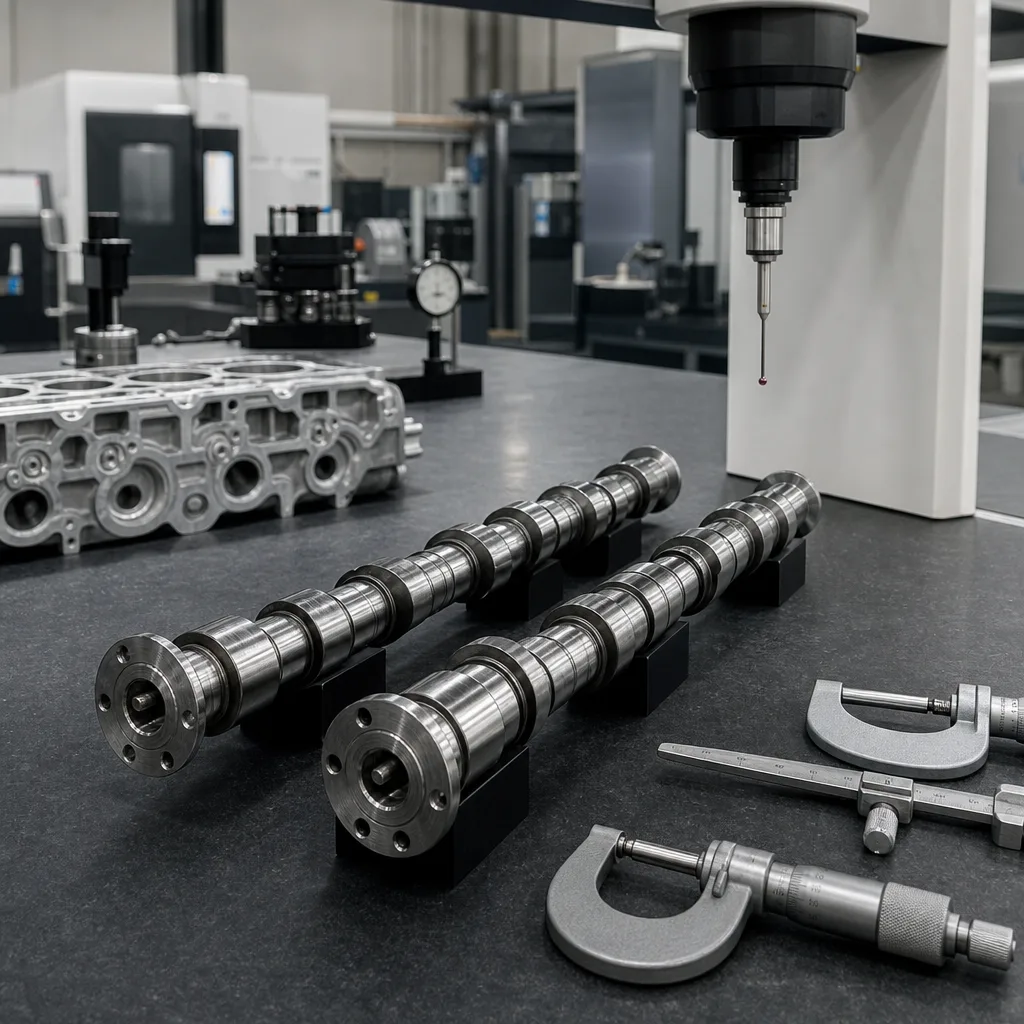
An OE-equivalent replacement should be checked against the original drawing or a validated sample, not copied from appearance. Camshafts are functional timing parts, so procurement should account for geometry, metallurgy, surface condition, and how the shaft interacts with the cylinder head, followers, valve springs, sensors, oil control valve, and VVT actuator. Key checkpoints include:
- Journal diameter, roundness, cylindricity, bearing width, and surface finish
- Lobe lift, base circle diameter, nose radius, opening and closing flank form, and lobe-to-lobe phasing
- Overall length, thrust width, shoulder location, end face runout, thread quality, and locating feature geometry
- Straightness and total indicated runout across the shaft, including centre journals and end features
- Hardness and effective case depth or chill depth on lobes and journals where applicable
- VVT interface dimensions, oil passage alignment, dowel/key clocking, actuator seating face, and trigger feature position
- Chamfer quality, burr control, oil-hole cleanliness, and absence of grinding burns or handling nicks
- Contact compatibility with the intended tappets, buckets, roller followers, or rocker arm wear pattern
A practical procurement rule is to require 100% inspection of critical-to-fit dimensions and statistical sampling for controlled secondary dimensions, then retain the measurement report with the batch record. For repeat programmes, request first-article approval, material certificates, heat-treatment evidence, control plan references, calibrated-gauge records, and retained samples from the approved lot. If a supplier cannot show the measurement method, tolerance band, measuring equipment, and acceptance limit, the comparison is incomplete.
For a camshaft for Toyota Yaris aftermarket replacement, bolt-on interchangeability is only the starting point. The part must reproduce the OE valve event closely enough to protect idle quality, low-speed torque, fuel economy, emissions stability, catalyst performance, and fault-code behaviour. A small angular error in lobe phasing or sensor trigger position can appear at the workshop as a crank/cam correlation code, unstable idle, VVT response fault, or unexplained loss of power. Commercial sourcing should therefore treat valve timing accuracy, trigger clocking, and inspection traceability as core requirements, not optional paperwork.
Materials and surface control
Most replacement camshafts are made from chilled cast iron, ductile iron with hardened lobes, or alloy steel. They are then machined, heat treated where required, ground to profile, and finished to the specified lobe and journal surface condition. The correct material route depends on the original design, target duty cycle, follower type, lubrication environment, and required wear margin. A capable supplier should be able to explain whether the shaft is produced as a casting, forging, or machined steel component, and how that process delivers the required hardness, case depth, and wear behaviour.
Typical control points include:
- Material traceability to heat lot, melt number, casting batch, or bar-stock certificate
- Chemical composition confirmation where required by the drawing or buyer specification
- Hardness verification on critical lobe and journal surfaces using an agreed scale such as HRC, HRB, HBW, or HV
- Effective case depth, induction-hardened depth, nitrided layer, or chilled layer confirmation where applicable
- Lobe and journal finish after grinding, polishing, or superfinishing, with Ra/Rz values recorded on the inspection report
- Straightening control after heat treatment and final machining, with final runout checked before packing
- Cleanliness after machining, deburring, washing, magnetic particle inspection where specified, and oil-hole clearing
- Corrosion protection for storage, sea freight, and long export transit
Surface control deserves close attention because a camshaft can fail early from poor finish even when nominal dimensions are correct. Excessive roughness can accelerate follower or bucket wear, while residual burrs around oil holes can release particles into the lubrication system. Grinding burn, chatter marks, incorrect lobe taper, or poor edge radiusing may lead to noise, scuffing, or abnormal contact patterns during the first service interval. For packaged export stock, rust prevention should match the shipping lane and storage time: anti-rust oil, VCI paper or bags, sealed polybags, end protectors, separators, and desiccant may all be relevant depending on humidity, transit duration, and warehouse conditions.
For export programmes, we align production with quality system controls based on IATF 16949:2016 and ISO 9001:2015. Material compliance screening for REACH (EC) No 1907/2006 is part of the normal documentation set when required by the buyer. Where market access or warranty exposure is sensitive, confirm that the replacement camshaft does not alter the certified engine behaviour. In markets with emissions oversight, that means checking the impact against relevant rules such as ECE R-83 where applicable.
New aftermarket versus regrind or used core
A procurement decision should rest on dimensional control, repeatability, available documentation, and warranty risk. The lowest unit price is not always the lowest programme cost once returns, installation labour, diagnostic time, and distributor reputation are included. The table below compares the common options.
| Option | Fitment risk | Durability risk | Procurement note |
|---|---|---|---|
| New OE-equivalent aftermarket | Low if drawing-controlled and sample-approved | Low to moderate, depending on material, heat treatment, and surface finish | Best for repeat orders, distributors, and repair networks |
| Reground used core | Medium to high | Variable | Depends on core condition, remaining base-circle allowance, hardness, and profile restoration |
| Used pull-off | High | Unknown | Useful only for diagnosis, temporary repair, or emergency sourcing |