Passenger Side View Mirror Replacement Sourcing Guide
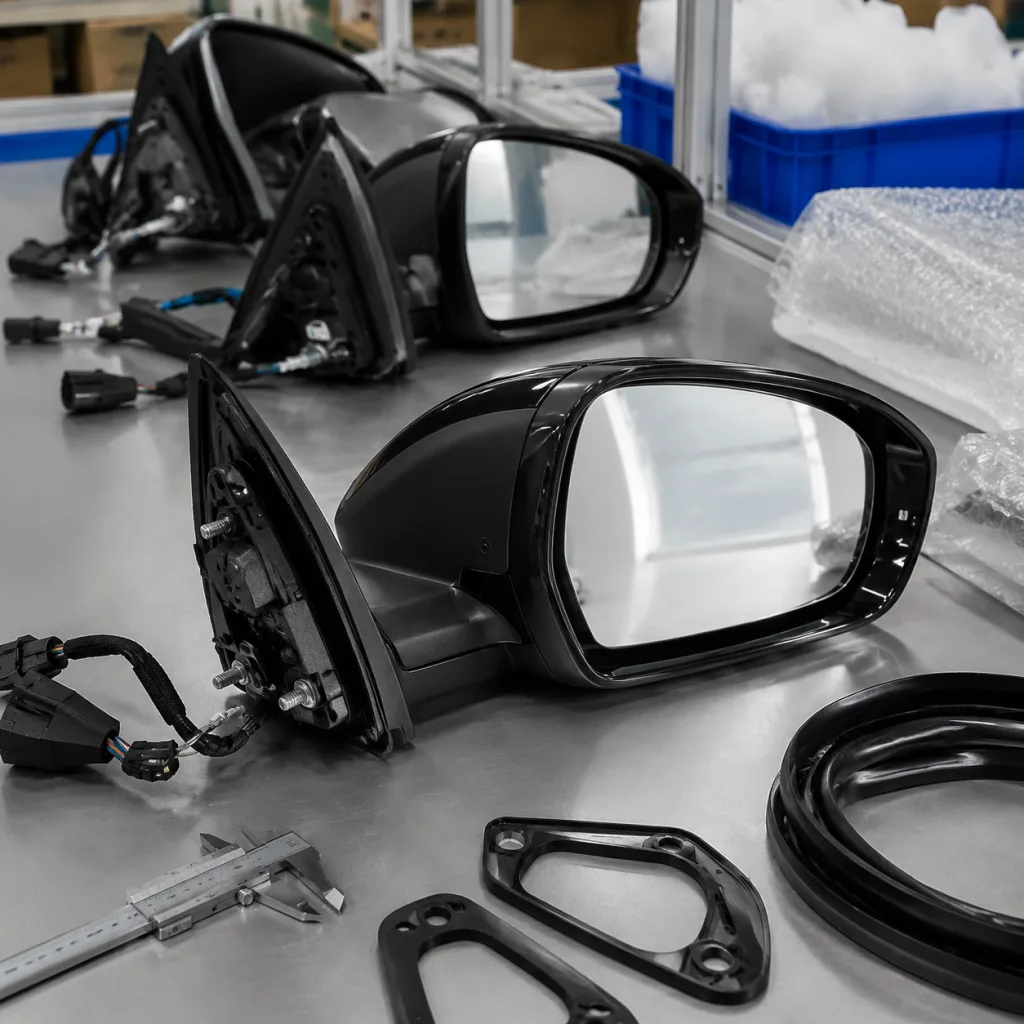
Passenger side view mirror replacement is a high-volume aftermarket category for distributors, repair networks, importers, and fleet maintenance buyers. Although the assembly appears straightforward, specification variation is substantial. Base geometry, glass curvature, heating pads, side indicators, power-fold motors, memory functions, blind-spot modules, camera provisions, puddle lamps, cap style, and connector pin counts can all change within the same vehicle generation. For procurement teams, the main risk is not mirror glass quality alone; it is a mismatch between the supplied assembly and the vehicle’s door mounting points, wiring harness, feature set, and regulated field of view. This guide explains how to source OE-equivalent passenger mirror assemblies for aftermarket programmes, with attention to dimensional matching, validation testing, packaging, documentation, and supplier qualification. Driventus is an independent aftermarket manufacturer; brand names are referenced for fitment identification only.
Fitment Scope and OE-Equivalent Definition
For a passenger-side mirror assembly, OE-equivalence means the replacement part installs without modification, provides the required rearward field of view, connects to the original harness, and delivers the same customer-facing functions as the part it replaces. It does not imply vehicle manufacturer approval, endorsement, or genuine-part status.
Procurement specifications should define the mirror by measurable characteristics rather than vehicle name alone. At minimum, buyers should confirm:
- Door mounting triangle dimensions, stud pattern, and base gasket profile
- Left-hand-drive or right-hand-drive application
- Passenger-side orientation by target market
- Manual or electric adjustment, heated glass, power fold, memory, puddle lamp, indicator, camera, or blind-spot function
- Connector housing shape, terminal count, keyway position, and wire colour logic where available
- Glass type: flat, convex, aspherical, blue-tinted, heated, or auto-dimming
- Housing finish: textured black, primed, painted, chrome cap, or cap-ready
- Target packaging format for wholesale, e-commerce, workshop, or fleet supply
End customers may use broad search terms, including passenger side view mirror replacement, but B2B catalogues need a stricter fitment matrix. Buyers can map mirror assemblies against application data in our catalog, then use sample approval to confirm mounting, connector, glass, and feature compatibility before volume release.
Key Specification Checks Before Purchase Order Release
A controlled passenger side view mirror replacement programme should separate visible cosmetic requirements from functional and dimensional requirements. Surface defects are usually caught during incoming inspection; wrong connector coding, incorrect glass curvature, or a small base-angle error may appear only after installation.
| Specification item | Typical procurement check | Acceptance focus |
|---|---|---|
| Mounting base flatness | Fixture or CMM check | No gap causing wind noise or water leak |
| Stud position tolerance | Gauge check to approved drawing | Direct fit to door inner panel |
| Base gasket compression | Installation or fixture check | Stable sealing without door-panel distortion |
| Connector compatibility | Pin count, keying, and housing comparison | Plug-in fit without harness modification |
| Motor adjustment range | Bench actuation test | Full travel without abnormal noise or stall |
| Heating pad function | Resistance and warm-up check | Stable heating with no local hot spots |
| Glass curvature | Radius check or approved master sample | Correct field of view for target market |
| Housing finish | Visual, colour, texture, and gloss check | Match agreed texture, primer, or cap quality |
| Fold mechanism | Cycle and torque check | Smooth movement with controlled detent force |
| Test area | Typical method | Procurement relevance |
|---|---|---|
| Vibration durability | Bench vibration by agreed profile | Confirms glass, motor, bracket, and housing retention |
| Thermal cycling | Low/high temperature exposure | Identifies cracking, warpage, seal shrinkage, and motor issues |
| Salt spray or corrosion check | Coated fasteners and metal brackets | Supports coastal and winter-road markets |
| Water ingress | Spray exposure around base, connector, and lamp area | Reduces electrical failures and warranty returns |
| Electrical endurance | Motor, heat, fold, lamp, and memory cycling where applicable | Confirms connector and actuator robustness |
| UV exposure | Housing, cap, and lens material ageing | Controls fade, chalking, yellowing, and gloss change |
| Fold impact or detent check | Manual fold and return-force verification | Reduces damage during parking, washing, and handling |
| Packaging drop test | Carton drop and compression | Protects glass, painted surfaces, and mounting studs in transit |